The Day Everything Changed
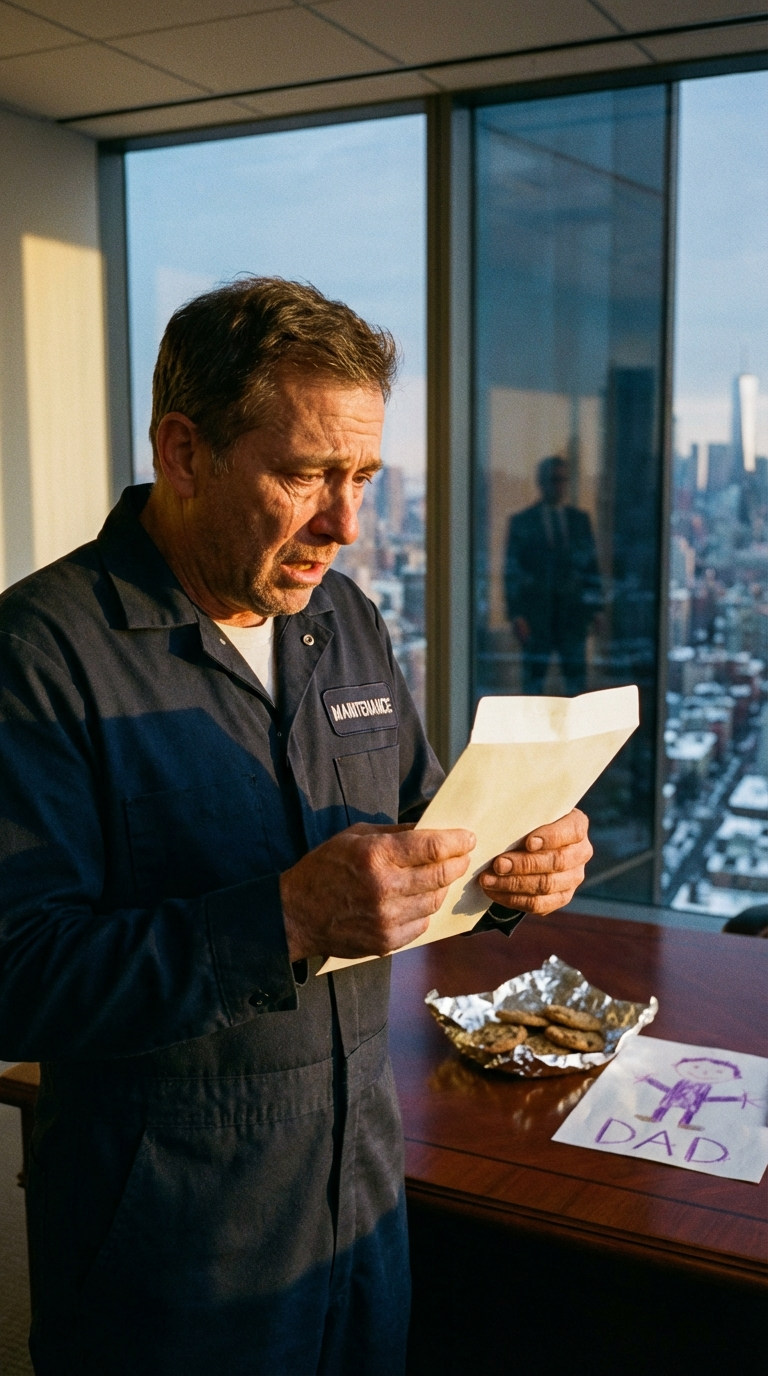
I stood there in the doorway of his mahogany office, my daughter’s hand-drawn Christmas card trembling in my grip, watching Marcus Thornwood—the man Forbes called “The Ice King of Manhattan”—fire seventy-three people on Christmas Eve via a single company-wide email.
The fluorescent lights of the 47th floor hummed their indifferent tune as my phone buzzed in my janitor’s uniform pocket. The message was brutal in its efficiency: “Effective immediately. Security will escort you out. No severance. Merry Christmas.”
I’d worked as a janitor at Thornwood Industries for eight years. Eight years of scrubbing floors while MBAs with fresh degrees stepped over me like I was furniture. Eight years of watching executives complain about their six-figure bonuses while I calculated whether I could afford both heat and groceries. Eight years of my nine-year-old daughter Emma asking why Daddy came home at midnight smelling like industrial bleach and broken dreams.
But Emma—God, my sweet, impossibly optimistic Emma—she didn’t see the world through the cynical lens that had become my default setting.
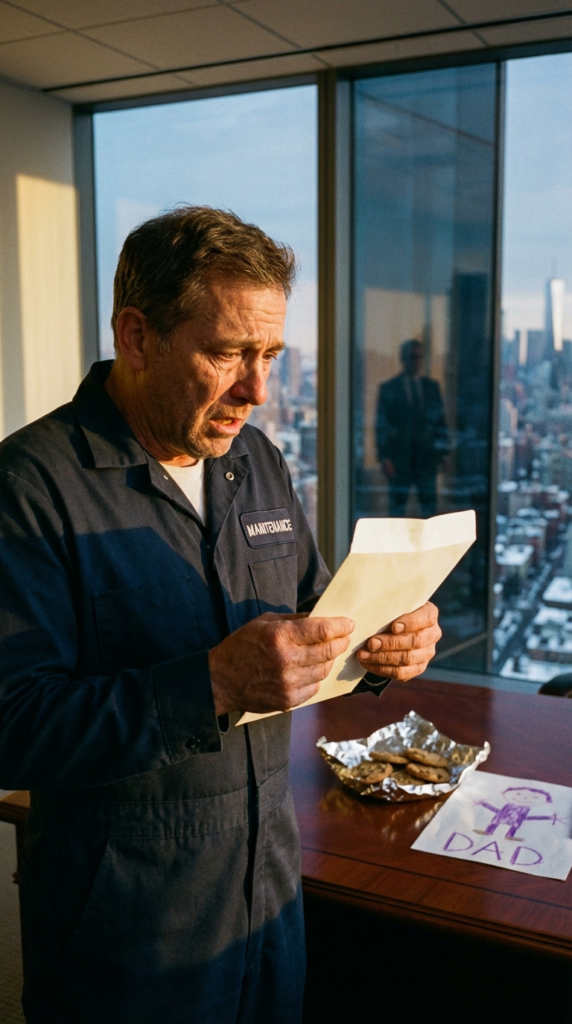
Every single morning for the past six months, she’d wake up at 5 AM in our cramped two-bedroom apartment in Queens to bake cookies with her grandmother. Chocolate chip, oatmeal raisin, snickerdoodles, peanut butter with fork marks pressed into the tops. She’d wrap them carefully in aluminum foil with notes written in purple crayon: “You’re doing great Mr. Thornwood!” or “Smile today!” or “Everyone deserves cookies!”
She’d make me take them to work, and before my 6 AM shift officially started, she’d accompany me on the subway, still in her pajamas under her winter coat, to leave them on Marcus Thornwood’s desk before anyone else arrived at the building.
I told her to stop a hundred times. “Sweetheart, men like him don’t care about cookies from little girls. He probably throws them away.” But she’d just smile with that gap-toothed grin and say, “Everyone needs a friend, Daddy. Even mean people.”
Now everyone was gone. The building echoed with a silence I’d never heard before—even during my late-night cleaning shifts, there was always someone working, always the hum of ambition and desperation. I walked past empty cubicles, family photos still sitting on desks next to cold cups of coffee, Christmas decorations that would never be taken home, half-finished projects that no longer mattered.
My own termination email glowed accusingly on my phone screen. After eight years of perfect attendance, of staying late without overtime pay, of fixing things that weren’t my job to fix, of being invisible until someone needed something cleaned—I was being discarded like the trash I emptied every night.
But then I saw something that made my heart stop.
His office door—always locked, always guarded by his assistant Patricia who treated me like a potential criminal—was cracked open. Just slightly. An invitation or a trap, I couldn’t tell which.
And on his desk, next to his sleek MacBook Pro and his third-generation iPhone, sat today’s cookies. Untouched, as always. But beside them was something new: an envelope with my name on it. Not “Janitorial Staff” or “Building Maintenance.” My actual name: “James Mitchell.”
My hands shook as I approached. The envelope was heavy. Official. The kind of expensive paper stock that rich people used for important documents. The kind of envelope that changes lives—usually for the worse, in my experience.
Through the floor-to-ceiling glass windows, I could see Marcus Thornwood sitting in his black leather chair, back turned to me, staring out at the snowy Manhattan skyline. The city glittered below him like he owned it. Maybe he did. At forty-two, he’d built a tech empire worth eleven billion dollars. Forbes called him a visionary. The Wall Street Journal called him ruthless. His employees called him a sociopath when they thought he couldn’t hear.
He knew I was there. The reflection in the glass showed his ice-blue eyes watching me. He was waiting.
I picked up the envelope.
Six Months Earlier: The First Cookie
To understand what happened that Christmas Eve, you need to understand how it started. How a nine-year-old girl with a purple crayon and an absurd amount of hope decided that the coldest billionaire in Manhattan needed a friend.
It was June 17th. I remember because it was Emma’s birthday, and I’d promised her we’d go to Coney Island, but I’d been called in for an emergency at work. Someone had shattered a glass conference table during what Patricia later described as “a minor disagreement about market projections.” I spent four hours on my hands and knees picking glass shards out of carpet while executives stepped around me to continue their meeting in the adjacent room.
I got home at 11 PM. Emma was asleep on the couch, still in her birthday dress, a homemade cake with nine candles sitting uneaten on our kitchen counter. My mother—who’d moved in with us after my wife died three years ago—sat at the table with tears in her eyes.
“She waited, James,” Mom said quietly. “She waited all day.”
I stood there in my uniform, smelling like commercial glass cleaner and shame, and I cried. I’d failed at being a husband—my wife Sarah had died in a car accident while I was working a double shift—and now I was failing at being a father.
Emma woke up around midnight. She didn’t cry. She didn’t yell. She just looked at me with those big brown eyes—Sarah’s eyes—and said, “It’s okay, Daddy. You were helping people.”
“I was cleaning up glass,” I said. “That’s not helping people.”
“But now they can walk safely,” she reasoned with the bulletproof logic of a child. “That’s helping.”
The next morning, I found her in the kitchen at 5 AM with my mother, flour in her hair, mixing cookie dough. “What are you doing, sweetheart?”
“Making cookies for your boss,” she said matter-of-factly. “Grandma says he’s the reason you had to work on my birthday. So maybe if he has a good day, you won’t have to miss the next one.”
My mother shrugged apologetically. “I might have explained corporate hierarchy poorly.”
That morning, Emma insisted on coming to work with me. Summer break had just started, and she was determined. She wore her favorite purple dress and carried a container of fresh-baked chocolate chip cookies. We took the 6 train from Queens, and she chattered the entire way about how everyone is nice deep down, even if they don’t show it.
At 5:45 AM, Thornwood Tower was empty except for security. I used my keycard to take us to the 47th floor. Emma held my hand as we walked through the executive suite—a world of glass and steel and expensive art that existed in a different universe than the service corridors where I usually worked.
Marcus Thornwood’s office was at the corner, overlooking Central Park. Emma walked right up to his desk—a massive thing made of reclaimed wood that probably cost more than my annual salary—and carefully placed the container of cookies in the center, along with a note written in purple crayon: “Happy Almost Birthday! (Everyone has one coming up!) – Emma”
“Won’t he be mad?” she whispered.
“Probably,” I admitted.
“Then why are we doing it?”
“Because you believe we should.”
We left before anyone arrived. That evening, I half-expected to be fired. Instead, nothing happened. The cookies were never mentioned. It was like they’d never existed.
But Emma was undeterred. “Maybe he was just too busy to say thank you today,” she reasoned. “Tomorrow he won’t be.”
Tomorrow became next week. Next week became a month. Every morning at 5:45 AM, we’d take the train together, and Emma would leave cookies with a new note. “You’re doing great!” or “Smile today!” or “This cookie is a high-five from me to you!”
The notes got more elaborate. She’d draw pictures of the office building with a smiling sun. She’d add facts she’d learned in school: “Did you know octopi have three hearts? You seem like you could use extra hearts too!”
I told her to stop. “Emma, he doesn’t care. He probably has someone throw them away.”
But she’d just shake her head. “Then that person gets to eat them! Everyone wins!”
Three months in, something changed. I was doing my regular cleaning rounds late one evening when I passed Thornwood’s office. The lights were on—he regularly worked until 2 or 3 AM. Through the glass, I saw him sitting at his desk, eating a cookie. Just one. Slowly. Deliberately. Staring at Emma’s note like it was a quarterly earnings report.
I ducked away before he could see me.
The next morning, Emma’s cookies were gone when I arrived for my shift. Not thrown away. Not left untouched. Gone. Eaten.
“See?” Emma said when I told her. “He just needed time to understand that we’re friends.”
“Sweetheart, you’ve never even met him.”
“Don’t you have to meet someone to be their friend?”
I didn’t have a good answer for that.
The Man Who Bought Everything Except Happiness
Marcus Thornwood was a ghost story told in the break rooms of Manhattan. Everyone had a theory about what made him so cold, so ruthlessly efficient, so utterly devoid of what normal people called compassion.
Patricia, his assistant, said he’d been betrayed by a business partner early in his career and never trusted anyone again. The CFO claimed Thornwood’s parents had been killed in a home invasion when he was twelve, and he’d inherited their struggling tech company, which he’d turned into an empire through sheer force of will and a complete absence of emotional attachment.
The IT department swore he was actually a highly sophisticated AI running on quantum processors in the basement.
I knew the real story because I was invisible, and invisible people hear things.
I’d been cleaning his office late one night about five years ago when I found a photograph tucked in the back of his desk drawer—I was returning a pen that had rolled under his desk. The photo showed a young Marcus, maybe twenty-five, with his arm around a beautiful woman. They were laughing. His smile was genuine, unguarded. Human.
On the back, in faded ink: “Marcus & Diane – The day we promised forever – June 12, 2009”
I’d heard whispers about Diane. She’d been his fiancée, a teacher who volunteered at homeless shelters. They were supposed to get married in 2010. Two weeks before the wedding, she died in a car accident caused by a drunk driver—a driver who happened to be the son of a prominent senator. The senator used his connections to ensure his son got probation instead of jail time.
Marcus disappeared for six months. When he came back, the warmth was gone. He fired half his company, restructured everything, and became the ruthless businessman the world knew today. He never dated again. Never mentioned her name.
And every year on June 12th, he’d take the day off without explanation.
I’d put the photo back and never mentioned it to anyone. It wasn’t my story to tell.
But it explained something. Marcus Thornwood wasn’t born cold. He’d learned to be cold because it was safer than feeling anything at all.
The Envelope
I stood in his office on Christmas Eve, the envelope in my hands, and Marcus Thornwood finally turned around.
Up close, he looked different than he did in Forbes photos. Older. Tired. His expensive suit couldn’t hide the weight loss or the dark circles under his eyes. His legendary ice-blue stare seemed dimmer, like a bulb burning out.
“Open it,” he said. His voice was quiet, almost hoarse.
“Am I fired?” I asked, though I already knew the answer from the company-wide email.
“Everyone’s fired,” he said. “The company is shutting down. I’m selling it in pieces to competitors. Thornwood Industries will cease to exist by January 1st.”
My hands shook harder. “Why?”
“Because I’m dying.”
The words hung in the air between us. Outside, snow began to fall harder, covering Manhattan in white silence.
“I have pancreatic cancer,” he continued, his voice matter-of-fact, clinical. “Stage four. I’ve known for six months. The doctors give me three months, maybe four if I’m lucky—which I’m not.” He laughed bitterly. “Eleven billion dollars and I can’t buy another year.”
“I’m sorry,” I said, because what else do you say?
“Don’t be. I’m not.” He stood and walked to the window, his back to me again. “I’ve spent the last twenty years building this company and systematically destroying every personal relationship I had. I have no family. No friends. No one who’ll miss me when I’m gone. My obituary will be impressive and utterly empty.”
“Then why fire everyone?” I asked. “Why not leave the company intact?”
“Because I’m tired of pretending any of this matters,” he said. “Because I’ve wasted two decades being angry at the world instead of living in it. Because I’m going to die alone in a hospital room and I’ve earned every second of that loneliness.”
He turned back to face me. “But your daughter doesn’t know that. She doesn’t know I’m a bad man who made bad choices. She thinks I’m her friend.”
I looked down at the envelope.
“Open it,” he said again.
Inside was a single document. A check. Made out to me. For five million dollars.
I stopped breathing.
“That’s not all,” Thornwood said. He pulled out another envelope from his desk drawer. “This is the deed to a house in Westchester. Four bedrooms, good school district. It’s in your name. Paid in full.”
“I don’t understand,” I whispered.
“And this,” he continued, producing a third document, “is a trust fund for Emma’s education. Full ride to any university she wants, graduate school included. And a stipend for living expenses.”
The room spun. “Why?”
“For six months, your daughter has been the only person in my life who gave a damn whether I was alive without wanting something from me. She doesn’t know I’m a billionaire. She doesn’t care. She just thought I looked sad and needed cookies.”
His voice cracked. “She’s nine years old and she has more humanity in her little finger than I’ve managed in forty-two years.”
I couldn’t speak.
“I’m giving the rest of my money away,” Thornwood said. “Various charities, cancer research, scholarships for kids from broken homes. The employees who were fired today will all receive severance packages—six months salary plus benefits. It’s already arranged. But you and Emma… you get more. Because she reminded me of something I’d forgotten.”
“What’s that?”
“That kindness exists without transaction. That someone can care about you without wanting your money or your influence or your approval. That a cookie and a purple crayon can mean more than a billion-dollar deal.”
He sat back down, suddenly looking exhausted. “I have three months left. Maybe four. I’m going to spend them trying to remember how to be human. How to feel something again. And I’m starting by making sure that the little girl who tried to be my friend never has to worry about whether her father can afford to be at her birthday.”
Tears ran down my face. “I don’t know what to say.”
“Tell her thank you,” Marcus said quietly. “Tell her that her cookies saved a man’s life. Not literally—the cancer is going to finish that job. But she saved what was left of my soul.”
He pulled out his phone and showed me a photo. His office drawer, filled with every note Emma had ever written. Dozens of them, arranged carefully, preserved.
“I kept every single one,” he said. “On the days when I wanted to give up—on business, on treatment, on everything—I’d read them. ‘You’re doing great.’ ‘Smile today.’ ‘Everyone deserves cookies.’ She was the only person who believed I deserved anything.”
Three Months Later
Marcus Thornwood died on March 17th in a private hospice in Connecticut. He wasn’t alone. I was there. Emma was there. My mother was there. Patricia was there, crying quietly in the corner.
In his final weeks, he’d transformed. The ice melted. He smiled more. He talked about Diane for the first time in fifteen years. He showed Emma pictures of his childhood, told her about his parents, admitted he’d been scared and angry for so long he’d forgotten how to be anything else.
Emma brought him cookies every visit. He ate every single one.
“Do you think,” he asked her during one visit, “that when I get to heaven, Diane will forgive me for wasting so much time?”
“I think she’ll just be happy you’re there,” Emma said with the confidence of a nine-year-old who’d never doubted the existence of grace.
He squeezed her hand. “You’re a better person than I ever was.”
“That’s not true,” she said. “You’re my friend. Friends are always good people.”
On his final day, he was barely conscious. But when Emma whispered, “You did great, Mr. Thornwood,” I swear I saw him smile.
At his funeral—a small, private affair he’d specifically requested—his lawyer read a final letter Marcus had written:
“To Emma Mitchell: Thank you for teaching an old, broken man that it’s never too late to be kind. That walls built to keep pain out also keep love out. That sometimes the bravest thing you can do is let someone care about you. You gave me cookies and friendship and reminded me what it meant to be human. I spent most of my life accumulating wealth and power, and none of it meant anything until a little girl with purple crayons showed me what actually matters. Thank you for being my friend. I didn’t deserve it, but I’m grateful beyond words that you gave it anyway.”
Five Years Later
I’m writing this from the back porch of our house in Westchester. Emma is fourteen now, about to start high school. She’s brilliant, kind, still bakes cookies for her friends. She wants to be a teacher, like Diane was.
The money Marcus gave us changed everything. I went back to school, got my degree in social work. Now I run a nonprofit helping formerly incarcerated people find jobs and housing. We focus on giving people dignity, second chances, and yes—sometimes cookies.
Every year on March 17th, Emma and I visit Marcus’s grave. She leaves cookies and a new note written in purple crayon. “Still proud of you.” “You’re missed.” “Heaven’s lucky to have you.”
I think about him often. About how close he came to dying without ever really living. About how easy it is to build walls so high you forget there’s a world outside them. About how a small act of kindness from a child saved a billionaire’s soul.
People ask me sometimes if I feel guilty about taking his money. If it was charity or pity or manipulation.
I tell them no. It wasn’t charity. It was gratitude. It was a dying man trying to do something good with what little time he had left. It was a little girl’s unconditional kindness being rewarded by someone who finally understood its value.
Was Marcus Thornwood a good man? I don’t know. He made ruthless decisions. He destroyed careers. He built an empire on the suffering of others.
But he was also a broken man who’d lost everything that mattered and forgot how to heal. And when a nine-year-old girl offered him friendship with no expectations, no conditions, no ulterior motives—just cookies and crayons and hope—he took it. And in taking it, he found a way to be more than his worst moments.
The Letter
Last week, on what would have been Marcus’s forty-seventh birthday, his lawyer called. There was one final document Marcus had left with instructions that it only be given to Emma on her fourteenth birthday.
We opened it together. Inside was a letter in Marcus’s handwriting:
“Dear Emma,
If you’re reading this, I’ve been gone for a while now. I hope your father has told you stories about our strange friendship. I hope he’s told you that your cookies and your kindness saved my life in the ways that mattered most.
I want you to know something important: You didn’t fix me. I was too broken for that, and it wasn’t your job anyway. Children shouldn’t have to repair adults. That’s not what you did.
What you did was show me that I deserved to be fixed. That I was worth saving. That somewhere underneath all my anger and fear and calculated cruelty, there was still a person who could receive love without suspicion.
You gave me cookies because you thought I looked sad. You wrote me notes because you believed everyone deserves encouragement. You didn’t know I was rich or powerful or dying. You just knew I was human and that humans need friends.
That simple, beautiful belief—that everyone deserves kindness—is the most valuable thing I’ve ever encountered. More valuable than every dollar I ever made.
By the time you read this, you’ll be starting high school. You’ll face people who are cruel, people who are broken like I was, people who’ve built walls so high they can’t remember why they built them. You’ll be tempted to match their coldness with your own.
Don’t.
Keep baking cookies. Keep writing notes. Keep believing that people are worth saving even when they don’t believe it themselves.
The world will tell you that kindness is weakness. That compassion is naive. That people like me don’t change, so why bother trying?
Don’t listen.
I changed because a nine-year-old girl bothered. I died a better man than I lived as one because you refused to accept that I was beyond redemption.
Enclosed in this letter is something I want you to have: the purple crayon you used to write your first note to me. ‘Happy Almost Birthday! Everyone has one coming up!’ I kept it. On the darkest days of my treatment, when the pain was overwhelming and I wanted to give up, I’d hold that crayon and remember that somewhere in the world was a little girl who believed I deserved happiness.
Keep it. Let it remind you that your kindness matters. That small acts of love can save lives. That you changed the world by changing one person’s world.
Thank you for being my friend, Emma. Thank you for seeing something in me worth seeing. Thank you for cookies and crayons and unconditional, inexplicable grace.
You made my last months bearable. You made my life meaningful. You made me human again.
Love,
Your friend,
Marcus”
Emma held the purple crayon—now old and worn—and cried. Not sad tears. Grateful ones.
“I’m glad he was my friend,” she said.
“He was grateful you were his,” I replied.
The Epilogue: What We Learned
This story isn’t really about a billionaire or a janitor or money or cancer. It’s about the walls we build to protect ourselves and the unexpected ways those walls come down.
Marcus Thornwood spent twenty years perfecting the art of emotional isolation. He believed that control and distance would keep him safe from the pain that had destroyed him. And they did—but they also kept him from everything that makes life worth living.
He’d convinced himself that the world was transactional. That people only cared about what you could give them. That love and friendship were commodities to be bought and sold, not given freely.
And then a nine-year-old girl who didn’t know or care about his wealth, his power, or his reputation decided he needed cookies.
She didn’t want anything from him. She didn’t know she was supposed to be intimidated by him. She just knew he looked sad, and sad people deserved kindness.
That simple act—repeated every morning for six months—cracked something in Marcus that twenty years of therapy, success, and accumulation couldn’t touch. It reminded him that beneath the armor he’d built, he was still human. Still capable of being cared for. Still worth saving.
The money was generous. The house, the trust fund, the security it provided—all of it changed our lives in tangible ways. But that’s not what the story is about.
It’s about how Emma taught me that cynicism is a choice. That I’d spent so many years being invisible and overlooked that I’d started to believe I was actually less than the people I served. That my worth was tied to my income, my job title, my economic value to society.
But Emma saw the world differently. She saw people. Just people. All equally deserving of cookies and kindness and friendship.
And she was right.
Marcus wasn’t evil. He was hurt. He’d built walls because the alternative—remaining vulnerable after devastating loss—felt like suicide. But walls that keep pain out also keep love out. And a life without love, no matter how successful, is a life half-lived.
The Foundation
With Marcus’s blessing before he died, we started something called The Purple Crayon Foundation. It’s named after Emma’s notes, and its mission is simple: we provide small, consistent acts of kindness to people who are isolated, forgotten, or invisible.
We send cookies to people in hospice care. We write notes to prisoners. We deliver meals to elderly people who haven’t had a visitor in months. We pay for stranger’s groceries when they’re clearly struggling at checkout. We leave anonymous gifts for single parents working night shifts.
It’s not about solving poverty or fixing systems—though those things matter. It’s about reminding people that they’re seen. That they matter. That someone, somewhere, thinks they deserve cookies.
The foundation is funded by the portion of Marcus’s estate he designated for “continuing Emma’s work.” Every year, we give away hundreds of thousands of dollars in small acts of kindness.
We’ve gotten letters from people who say a random cookie delivery kept them from suicide. From elderly people who say a handwritten note was the only mail they received all month. From prisoners who say our letters remind them they’re still human, still redeemable.
Marcus was right: Emma’s simple belief that everyone deserves kindness is the most valuable thing in the world.
What Happened to Everyone Else
Patricia, Marcus’s assistant, now runs our foundation full-time. She’d been with Marcus for fifteen years and was one of the few people who saw him break down in those final months. She says running the foundation is her way of honoring what he became, not what he was.
The seventy-three employees who were fired on Christmas Eve all received their severance packages as promised. Many have reached out over the years to say they were initially devastated but that the severance gave them the cushion they needed to pursue dreams they’d been too scared to chase. One started a tech nonprofit. Another went to medical school. Three became teachers.
The building that housed Thornwood Industries was sold and converted into affordable housing for artists and low-income families. Marcus had arranged it before he died. “If I’m going to be remembered for something,” he told me, “let it be that I created space for people to build lives, not just careers.”
His estate funded cancer research, scholarships for children of incarcerated parents, and programs for people re-entering society after prison. His obituary in the Times was exactly as he’d feared: impressive and utterly empty. But the lives he touched in those final months remember something different.
Emma’s Birthday, Five Years Later
Emma turned fourteen last June. We had a party at our house—the house Marcus bought us—and invited twenty of her friends. The house was filled with laughter, music, terrible teenage humor, and an enormous amount of cookies that Emma had spent all week baking.
As the party wound down and kids started getting picked up by their parents, Emma came and sat next to me on the back porch.
“Do you think Marcus would be proud?” she asked.
“Of what?”
“Of me. Of what we’re doing with the foundation. Of how things turned out.”
I put my arm around her. “I think he’d be amazed. I think he’d wonder how a little girl with purple crayons changed the world.”
“I didn’t change the world, Dad. I just gave cookies to one sad man.”
“And he gave those cookies to the world,” I said. “He took what you taught him and multiplied it. That’s how change works, Em. One person at a time. One cookie at a time. One purple crayon note at a time.”
She leaned against me. “I miss him.”
“Me too.”
“Do you think,” she said carefully, “that he would’ve still changed if he hadn’t been dying? Like, if he’d been healthy, would my cookies have mattered?”
It was a profound question from a fourteen-year-old.
“I don’t know,” I admitted. “Maybe the cancer forced him to confront things he’d been avoiding. Maybe knowing he was dying gave him permission to feel again. Or maybe you would’ve gotten through eventually anyway, because kindness is persistent.”
“I like to think,” Emma said, “that everyone can change. That no one is beyond reach. That’s what I want to believe.”
“Then believe it,” I said. “Marcus did. You taught him that.”
The Real Gift
The money Marcus gave us was extraordinary. Life-changing. We went from barely surviving to thriving. I finished school. Emma will never worry about college costs. We have security, stability, options.
But that’s not the real gift.
The real gift was learning that our humanity isn’t measured by our productivity or our economic value. That a janitor and a billionaire can be equals in the ways that actually matter. That my daughter’s kindness was worth more than a quarterly earnings report.
The real gift was watching a broken man become whole again, even as his body failed. Seeing him laugh. Seeing him cry. Seeing him allow himself to be loved by a nine-year-old who didn’t know she was supposed to be intimidated by his wealth and power.
The real gift was understanding that it’s never too late. That people can change. That walls can come down. That hearts can thaw.
Marcus spent twenty years as the Ice King of Manhattan. He died warm, surrounded by people who loved him, holding my daughter’s hand while she read him purple crayon notes from years past.
That transformation—from isolation to connection, from cold to warm, from broken to healing—that’s the gift. Everything else is just details.
The Question I Get Asked Most
People who hear this story always ask the same question: “But what if Emma had tried to be friends with someone who didn’t have billions of dollars to give away? What if she’d shown kindness to someone who couldn’t reward her with a house and a trust fund? Would it still have mattered?”
The question makes me sad because it reveals how deeply we’ve internalized the idea that acts of kindness only matter if they result in tangible, preferably financial, returns.
So here’s my answer: Emma didn’t know Marcus was rich. She just knew he looked sad. She would’ve—and has—done the same thing for homeless people, for kids at school who were being bullied, for elderly neighbors who lived alone.
The cookies and notes weren’t an investment. They were just kindness. Pure, uncomplicated, unconditional kindness.
The fact that Marcus had the resources to respond with extraordinary generosity doesn’t diminish the value of what Emma did. It amplifies it. It shows what happens when kindness meets gratitude, when someone who has everything they need materially realizes they’ve been starving for something money can’t buy.
But Emma has brightened countless lives that will never result in trust funds or houses. She’s made friends with homeless people who have nothing to give but stories. She’s written letters to soldiers overseas who will never meet her. She’s baked cookies for neighbors who responded with nothing more than a smile and a thank you.
And those acts matter just as much.
Marcus’s story is remarkable because of the scale of his transformation and his response. But the principle applies universally: small acts of consistent kindness change lives. Not always in dramatic, financially lucrative ways. Usually in quiet, modest ways that don’t make for viral stories.
But they matter. They always matter.
The Final Note
Last week, Emma asked if she could add something to Marcus’s grave. I drove her to the cemetery on a cold January morning—exactly five years after he died.
She’d brought cookies, as always. But this time, she’d also brought something new: a small plaque that we’d had made.
It read:
“Marcus Thornwood
1984-2021
Billionaire, CEO, Friend
He learned that kindness is never wasted
Even when it’s given to those who don’t deserve it
Especially when it’s given to those who don’t deserve it.”
We placed it next to his headstone. Emma stood there for a long time, her hand on the cold marble.
“I hope,” she said quietly, “that wherever he is, he’s not sad anymore.”
“I don’t think he is,” I said. “I think he’s with Diane. I think he’s telling her about the little girl with purple crayons who saved him.”
“Do you think he’s eating cookies in heaven?”
“I think heaven is made of cookies and purple crayons,” I said. “I think it’s full of second chances and people who figured out how to love before it was too late.”
She smiled. “That sounds like a good heaven.”
“It is,” I said. “Because people like you exist, and you make earth a little more like heaven every day.”
We stood there together in the cold, my daughter and I, at the grave of a billionaire who died richer than most people could imagine—not because of his bank account, but because a nine-year-old girl decided he deserved cookies.
That’s the story. That’s what happened when the cold billionaire fired everyone on Christmas except the janitor whose daughter left cookies on his desk every day.
He didn’t fire me because, for six months, my daughter had been reminding him that he was human. That he was worth saving. That beneath the armor and the anger and the accumulated pain, he was still someone who deserved kindness.
And in his final act, he paid that kindness forward. Not with money—money was just the tool. He paid it forward with transformation. With vulnerability. With the admission that he’d been wrong about everything that mattered.
He paid it forward by becoming the person Emma believed he could be.
And in doing so, he taught me the most important lesson of my life: It’s never too late to become human again. It’s never too late to let someone care about you. It’s never too late to accept that you’re worth saving.
Even if you’re dying.
Even if you’ve built walls so high you forgot what the world looks like.
Even if you’ve convinced yourself that you’re beyond redemption.
It’s never too late for cookies and purple crayons.
It’s never too late for grace.