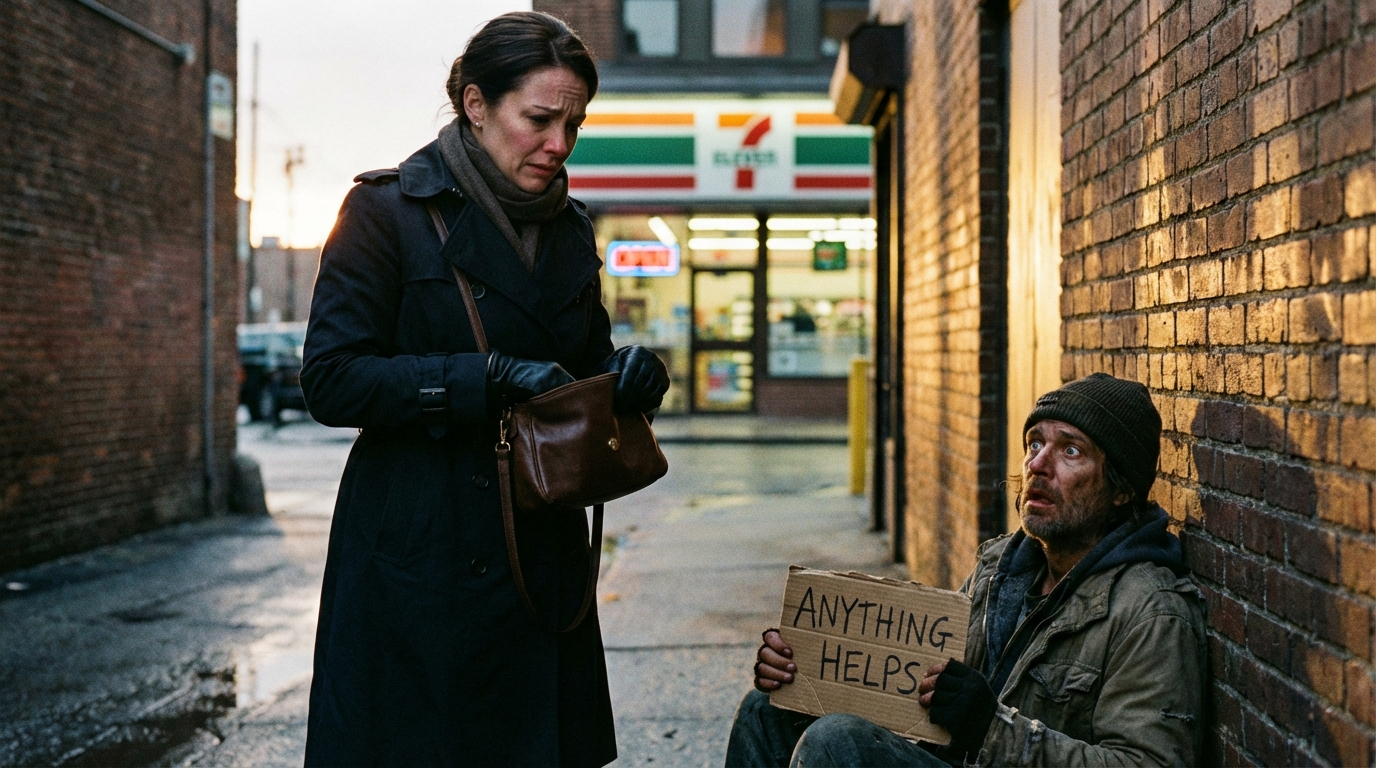
I recognized him immediately, even though he looked nothing like the man who’d destroyed me five years ago.
Marcus Chen. The investment banker who’d stolen $340,000 from my family’s restaurant and vanished before the trial. The reason my father had a heart attack at 58. The reason we lost everything.
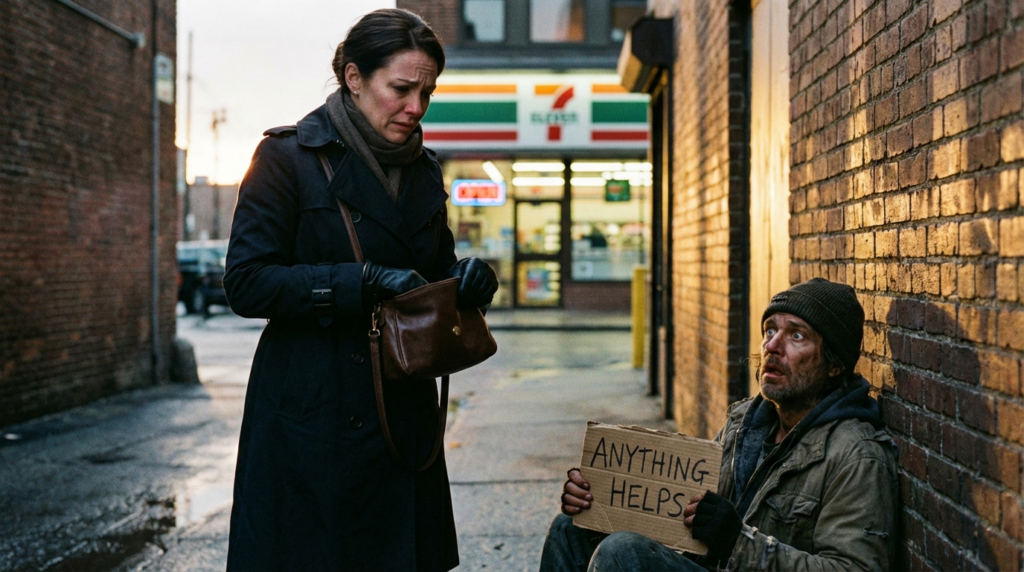
But now he was sitting against a brick wall outside the 7-Eleven on Madison Street, holding a cardboard sign that read “Hungry. Anything helps. God bless.”
His designer suits were gone. His smug smile was gone. His perfectly styled hair was now matted and gray. He looked twenty years older than his actual age of 42.
My hands gripped the steering wheel so hard my knuckles went white. I’d fantasized about this moment for five years. What I’d say if I ever saw him again. What I’d do. In my mind, I’d rehearsed a hundred confrontations. Called the police. Screamed at him in public. Made him feel the same humiliation he’d caused us.
I pulled over and got out of my car. My heart was hammering against my ribs like it wanted to escape.
He didn’t recognize me at first. His eyes were hollow, defeated. The kind of eyes that have seen too much and expect nothing good.
“Marcus,” I said.
His head snapped up. The color drained from his face, and for a moment I thought he might run.
“Emma?” His voice was hoarse, broken. “Oh God. Emma, I—”
“You destroyed my family.” The words came out cold, steady. “My father died because of you. We lost our restaurant. Our home. Everything.”
He started crying. Actual tears running down his dirt-stained face. “I know. I know. I’m so sorry. I’m so—”
“How did you end up here?” I demanded.
His hands were shaking. “The money’s gone. I gambled it all away in six months. Lost my license, my job, my wife. I’ve been on the streets for three years.” He looked up at me with desperate eyes. “I tried to kill myself twice. I deserve this. I deserve worse.”
I stood there looking down at the man who’d haunted my nightmares. Who I’d blamed for every bad thing that happened after. Who I’d wanted to watch suffer.
And now here he was. Suffering. Broken. Destroyed.
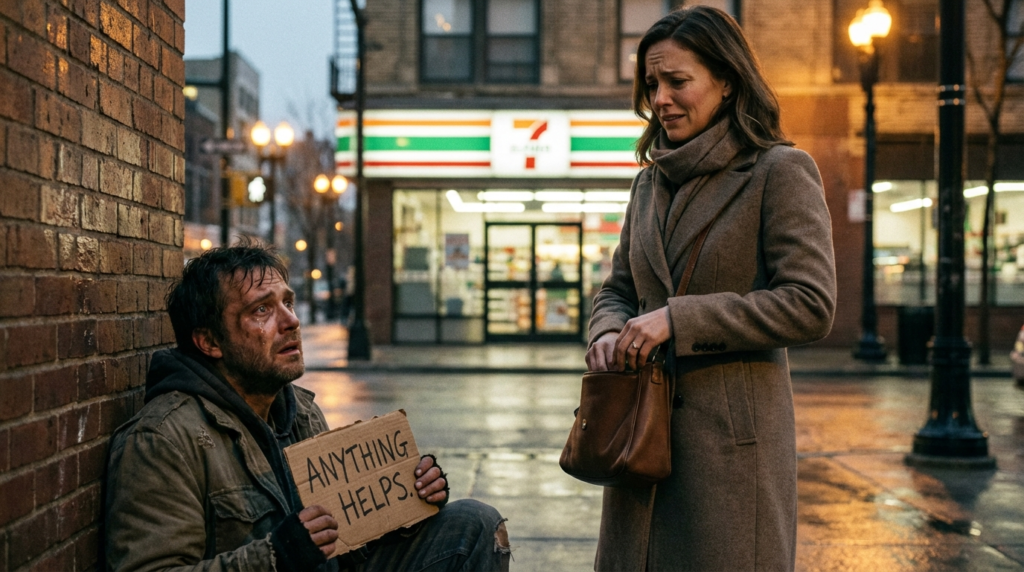
I reached into my purse, my hands shaking. Everything in me was screaming different things. Rage. Satisfaction. Confusion. And something else I didn’t want to acknowledge.
Marcus Chen had seemed like a godsend when he first walked into Golden Dragon Restaurant.
My parents had owned it for thirty years, a small family place in Chicago’s Chinatown. Good food, loyal customers, but Dad was terrible with money. When Marcus came in wearing his expensive suit, talking about investment opportunities and tax shelters, my father saw salvation.
“Emma, this young man can help us expand,” Dad said excitedly. “Open a second location. Retire properly.”
I was 28, helping manage the books while working on my teaching degree. Something about Marcus made my skin crawl, but Dad was so hopeful I didn’t push back hard enough.
Marcus convinced my parents to let him “invest” their savings and the money they’d set aside for my brother’s college fund. He had paperwork, credentials, references. Everything looked legitimate.
It took three months for us to realize the money was gone. The account was empty. Marcus had vanished. The references were fake. The credentials were forged.
Dad had his heart attack a week after we filed the police report. I found him collapsed in the restaurant kitchen, clutching his chest. He survived, but something in him broke that day.
We had to sell the restaurant to pay medical bills. Lost our house. Moved into a tiny apartment. My brother Tommy dropped out of college because we couldn’t afford tuition. Mom aged ten years in six months.
Dad died eighteen months later—officially from heart failure, but I knew the truth. Marcus Chen had killed him as surely as if he’d held a gun to his head.
The police never found Marcus. The case went cold. The prosecutor said he’d probably fled the country.
And I was left with rage that had nowhere to go.
“Please,” Marcus whispered from his spot against the wall. “Please don’t call the cops. I know you have every right. I know I destroyed you. But please, I can’t go to jail. I can’t—”
“You think jail is what I want for you?” I laughed bitterly. “Marcus, look at you. You’re already in hell.”
He flinched like I’d hit him.
People were staring at us now. A woman with two kids hurried past, pulling them closer. A teenager filmed us on his phone. I didn’t care.
“My father died hating himself,” I said. “He thought he was stupid for trusting you. He died believing he’d failed his family. You took his money, but you also took his dignity. His hope. Everything that made him who he was.”
“I know.” Marcus’s voice was barely audible. “I think about it every day. Every single day. I wake up and I remember what I did and I wish I hadn’t woken up at all.”
Something my therapist said six months ago echoed in my mind: “Forgiveness isn’t about them, Emma. It’s about you. Are you going to let what he did define the rest of your life?”
I’d gotten angry at her then. Walked out of her office. How dare she suggest I forgive him?
But standing here now, looking at this broken shell of a man, I understood something I hadn’t before.
Marcus had already been punished. The universe, karma, God—whatever you wanted to call it—had already delivered justice. He’d lost everything, just like we had. He was living in his own personal hell.
And me? I’d spent five years letting my hatred for him poison everything good in my life. I’d pushed away relationships because I couldn’t trust anyone. I’d abandoned my teaching career because I was too angry to be around kids. I’d become bitter, cynical, hard.
Marcus hadn’t just stolen our money. I’d let him steal my future too.
I pulled out my wallet.
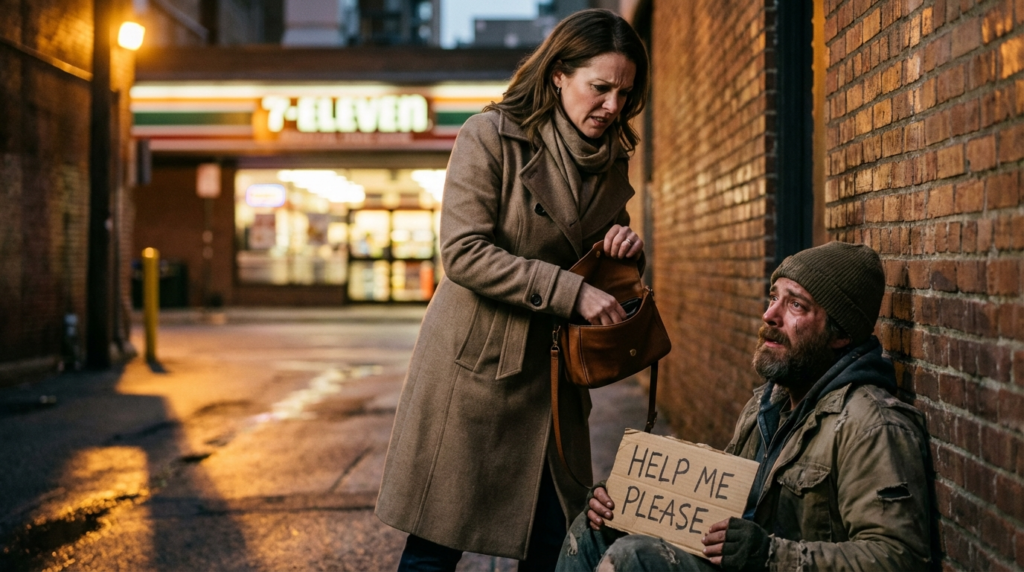
“Stand up,” I told him.
Marcus struggled to his feet, confused and scared. He was shorter than I remembered. Smaller. Just a man who’d made terrible choices and destroyed lives—including his own.
I handed him a hundred-dollar bill.
His eyes widened. “What? No. Emma, I can’t—”
“Take it,” I said firmly. “There’s a shelter three blocks from here. Saint Michael’s. They serve dinner at 6 PM. They have beds. Get cleaned up. Get a meal.”
“Why are you doing this?” Tears were streaming down his face now. “After everything I did to you?”
I looked at him—really looked at him. And I realized something profound: I didn’t want to be the kind of person who could walk away from human suffering, even when that human had caused me so much pain.
“Because my father was a good man,” I said quietly. “And he raised me to be better than my worst impulses. I’m not doing this for you, Marcus. I’m doing this because I refuse to let what you did turn me into someone I don’t recognize.”
I started to walk away, then turned back.
“Get help. Real help. There are programs at the shelter—addiction counseling, job placement, mental health services. Use them. And Marcus?” I held his gaze. “If you ever get back on your feet, donate to a food bank. Volunteer at a shelter. Help someone else who’s hungry and desperate. Don’t waste this second chance.”
He nodded, clutching the money like it was sacred. “Emma, I… I’m so sorry. I know those words mean nothing, but—”
“You’re right. They don’t mean much. But actions might. Make your life count for something.”
I walked back to my car and drove away without looking back.
I didn’t think about Marcus Chen every day anymore. Some days I didn’t think about him at all.
I’d gone back to therapy. Really committed to it this time. Started teaching again—kindergarten, which I loved. Started dating a kind man named David who made me laugh and didn’t flinch when I told him my story.
Then one afternoon, I got a letter forwarded from my old address.
Inside was a money order for $500 and a handwritten note:
Emma,
I’m working at a warehouse now. Living in a halfway house. Going to AA meetings. It’s not much, but it’s a start.
This is the first payment. I owe you $340,000 plus interest. At this rate, it’ll take me the rest of my life to repay you. But I’m going to try.
More importantly, I volunteer at Saint Michael’s now. I serve the meals you sent me there to eat. I help other homeless people fill out job applications. I tell them my story as a warning.
You saved my life that day. Not just because you gave me money, but because you showed me that people can choose kindness even when they have every reason to choose hate.
Your father raised an incredible person. I’m sorry I never got to tell him that.
I’ll keep sending what I can. Not because it’ll ever be enough, but because you deserve to see that your kindness wasn’t wasted.
Marcus
I cried reading it. Not sad tears—something else. Something that felt like a weight lifting.
I called my mom that night and read her the letter. She was quiet for a long time.
“Your father would be proud of you,” she finally said. “Not because of the money. Because you chose to be kind when you could have chosen revenge. That takes real strength, Emma. That’s real power.”
I started getting money orders every month. $500. Then $600 when Marcus got promoted. I put it all in a college fund for my brother Tommy, who’d eventually gone back to school and was now a nurse.
But the real gift wasn’t the money. It was the freedom I felt. The rage that had consumed me for five years was gone. I’d chosen to let it go, and in doing so, I’d gotten my life back.
I saw Marcus at a volunteer event for the homeless. He was serving soup, laughing with a older man about something. He looked healthy. Clean. Human again.
He saw me and froze, uncertain.
I walked over and extended my hand. “Hi, Marcus.”
He shook it, tears in his eyes. “Hi, Emma.”
We talked for a few minutes. He told me about his job, his sponsor in AA, his tiny apartment. He asked about my mom and Tommy. I told him I was engaged.
“I’m proud of you,” I said, and I meant it.
“I don’t deserve your kindness,” he replied.
“None of us deserve kindness,” I told him. “That’s what makes it kindness. But we can deserve our second chances by what we do with them. You’re doing good work here, Marcus. Keep doing it.”
As I walked away, I thought about my father. About the man who’d taught me to cook dumplings and balance the restaurant books. Who’d worked sixteen-hour days so we could have a better life. Who’d died thinking he’d failed.
Dad hadn’t failed. He’d raised me to understand that hatred destroys the hater. That revenge is a poison you drink yourself. That true strength isn’t about making others suffer—it’s about choosing kindness even when every instinct screams for vengeance.
Marcus Chen had stolen a lot from my family. But I refused to let him steal my humanity too.
And that decision—made in a 7-Eleven parking lot five years ago—had saved me as surely as it had saved him.