THE GOLDEN CAGE
“Daddy, STOP! You’re hurting her!”
The scream from the backseat was so piercing I dropped my phone. The Henderson deal—a merger worth forty million dollars—was open on the screen, waiting for my digital signature. But suddenly, the silence in the car was deafening.
“Chloe, sit down,” I snapped, turning around. “Daddy is working. No one is hurting anyone.”
It was Christmas Eve. We were in the back of my armored Escalade, stuck in gridlock Manhattan traffic. Inside, the heated leather seats were set to seventy-two degrees. The air smelled of expensive cedar detailing. Outside, a blizzard was burying the city, turning New York into a grey, hostile landscape.
“Open the door!” my eldest, Lily, yelled, tears streaming down her face. She was clawing at the window, smearing the glass. “Look at her, Daddy! Look!”
I sighed, rubbing my temples. Since my wife died three years ago, I had buried myself in work. I bought the girls everything they wanted—ponies, iPads, designer clothes—but I had forgotten how to listen to them.
“Driver, just… lock the doors,” I muttered, picking up my phone.
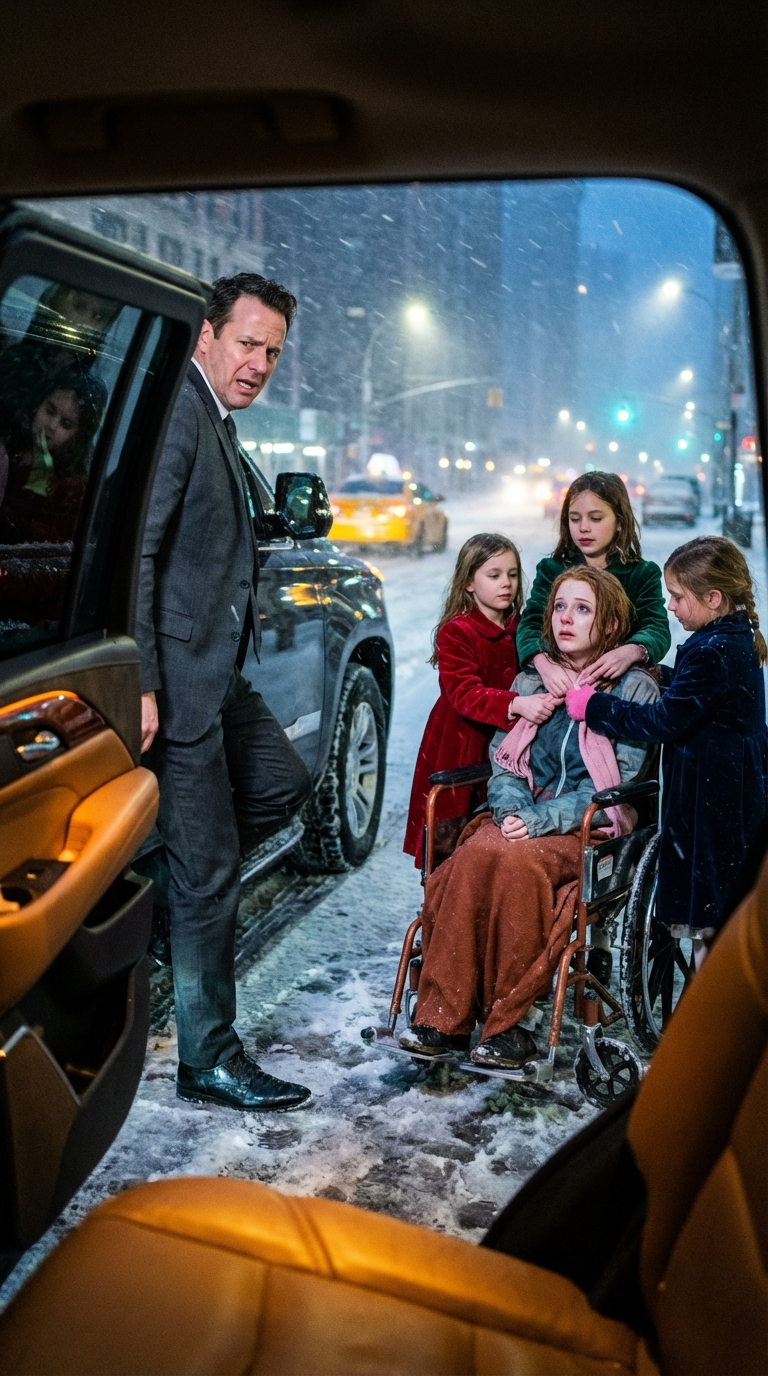
“NO!” Lily screamed. She manually popped the lock. Before I could stop her, my three daughters—dressed in their pristine holiday velvet—pushed the heavy door open. The wind howled into our warm sanctuary. They jumped out of the car and into the freezing mud.
“Girls!” I shouted, scrambling after them, my Italian leather shoes sinking instantly into the slush.
THE INVISIBLE WOMAN
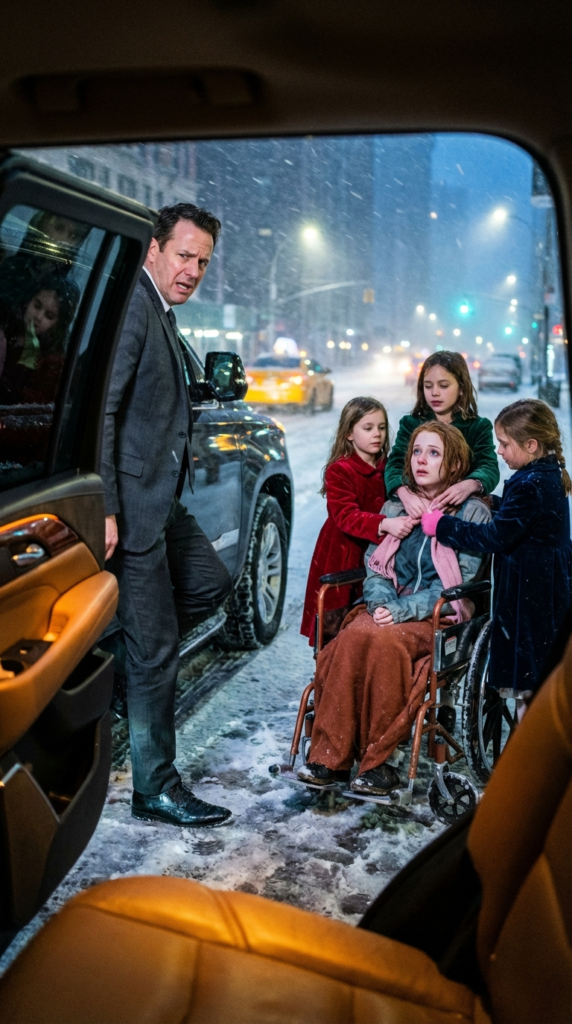
When I stepped out, the wind hit me like a physical blow. I ran to them, ready to scold them, ready to drag them back to safety. But what I saw stopped me cold.
My daughters were huddled around a figure near the crosswalk.
A woman. She couldn’t have been older than twenty-five. She was sitting in a rusted, manual wheelchair. The front casters were buried deep in a snowbank created by a passing plow. She was stuck. Trapped.
She was wearing a thin windbreaker. No hat. No gloves. Her red hair was plastered to her face with sleet.
She was shaking so violently that the metal frame of her wheelchair was rattling against the ice. People were walking right past her—dozens of them—stepping over her legs to get to their holiday parties, averting their eyes. To the city, she was invisible debris.
“Here!” Chloe, my youngest, was crying. She ripped off her pink cashmere scarf and wrapped it clumsily around the woman’s neck.
Maya took off her mittens and forced them onto the woman’s frozen, red hands.
Lily was trying to push the chair, slipping on the ice. “Help us, Daddy! Don’t just stand there!”
The woman looked up at me. Her lips were blue. Her eyes were wide with shock and humiliation. She tried to speak, but her teeth were chattering too hard.
I looked at my phone in my hand. The deal. The bonus. The life I thought mattered.
Then I looked at my daughters, shivering in their party dresses, doing the work that grown men were too selfish to do.
Shame, hot and sharp, pierced through my chest.
THE RESCUE
I pocketed the phone. “Move,” I said, my voice gruff with emotion.
I stepped into the snowbank. I grabbed the handles of the wheelchair. It was heavy, rusted solid. I heaved, my suit jacket pulling tight across my shoulders. With a grunt, I dislodged the chair from the ice.
“Get her in the car,” I ordered the driver, who was staring open-mouthed.
“Sir? The upholstery…”
“I said get her in the car!” I roared.
I lifted her myself. She was light. Terrifyingly light. Like a bird made of hollow bones. I placed her on the heated seat next to me. My daughters piled in around her, covering her with the emergency wool blankets we kept in the trunk.
“Thank you,” she whispered, her voice barely audible. “I… I was just trying to get to the shelter before curfew.”
“What’s your name?” I asked, pouring her a cup of hot water from the car’s thermos.
“Elena,” she said.
As she warmed up, and the color began to return to her cheeks, I noticed something. A pin on the lapel of her tattered jacket. It was a small, golden clef note.
“You’re a musician?” I asked.
She looked down, ashamed. “I was. A violinist. First chair… before the accident.”
THE CONNECTION
We didn’t go to the company party. I told the driver to take us to Le Bernardin.
When we walked in—a billionaire, three disheveled children, and a woman in a wheelchair wearing a dirty windbreaker—the maître d’ looked like he was going to faint.
“Mr. Sterling,” he stammered. “We have a dress code…”
“I’m buying the restaurant for the night,” I said, handing him my black card. “Clear the best table. And get a wheelchair ramp for the stairs. Now.”
Over dinner, Elena told us her story. It wasn’t just an accident that put her in the chair. It was a drunk driver. A driver who had run a red light two years ago.
“The settlement?” I asked. “Surely there was insurance.”
Elena laughed, a bitter, broken sound. “The driver was a diplomat’s son. He had immunity. I got nothing. I couldn’t play violin anymore. I lost my scholarship. Then my apartment. The landlord kicked me out three days ago because I was short fifty dollars on rent.”
My blood ran cold. “Who was the landlord?”
“Vanguard Properties,” she said. “A man named Marcus Thorne.”
I dropped my fork.
Marcus Thorne. The man I was currently merging with. The “Henderson Deal” was actually a subsidiary acquisition of Thorne’s real estate empire. I was about to sign a check that would put forty million dollars into the pocket of the man who threw this girl into the snow for fifty bucks.
THE CLARITY
I looked at Elena. I looked at my daughters, who were listening with rapt attention, feeding Elena bread rolls.
I realized then that my money had been useless. I had been hoarding it, counting it, using it to keep score. But my daughters… they understood currency. The currency of action.
I took out my phone. I opened the contract.
“What are you doing, Daddy?” Lily asked.
“I’m using my money for good, sweetie,” I said.
I called my lawyer. “Kill the deal.”
“Arthur, are you insane? It’s midnight. Thorne is waiting.”
“I said kill it. And initiate a hostile takeover of Vanguard Properties. I want to buy the debt. All of it.”
“That will cost you half your liquidity.”
“Do it.”
THE REVENGE
The next morning was Christmas. We didn’t open presents under the tree. Instead, we went to the Vanguard Properties office.
I had arranged an emergency meeting. Marcus Thorne was there, looking smug, expecting a merger signature.
“Arthur,” he smiled, extending a hand. “Glad you came to your senses.”
I didn’t shake his hand. I stepped aside. Elena rolled into the room in a brand-new, motorized wheelchair we had bought that morning.
Thorne’s smile faltered. “Who is this?”
“This,” I said, “is your new landlord.”
I threw the file on the table. “I bought the building, Marcus. And I bought your debt. You’re leveraged to the hilt. Which means I own you. And I’m transferring the deed of the apartment complex to a trust.”
I turned to Elena. “It’s yours. You run it. No one gets evicted for fifty dollars ever again.”
Thorne turned purple. “You can’t do this! That’s business suicide!”
“No,” I said, putting my arm around Lily. “It’s the best investment I’ve ever made.”
THE AFTERMATH
We spent the rest of that Christmas moving Elena back into her apartment—the penthouse unit, this time.
My daughters didn’t play with toys that year. They spent the day cleaning, painting, and setting up furniture. They laughed more that day than they had in the three years since their mother died.
I lost a fortune that day. The hostile takeover cost me millions. But as I watched Elena pick up a violin for the first time in two years—a gift from the girls—and play a shaky, beautiful version of “Silent Night,” I realized something.
I had been poor my whole life. I was just a man with money.
Now, watching the snow fall outside the warm window, surrounded by people who cared, I was finally, truly rich.
THE LESSON
Elena eventually started a music school for underprivileged kids in the building. My daughters volunteer there every weekend.
I still work, but I don’t chase the graph anymore. I look for the people in the snowbanks. I look for the invisible ones.
Because sometimes, you have to stop the limousine. You have to open the door. You have to let the cold in, so you can remember what it feels like to be warm.
And if you’re lucky, really lucky, three little girls will teach you that the only thing worth counting isn’t in your bank account—it’s in your heart.