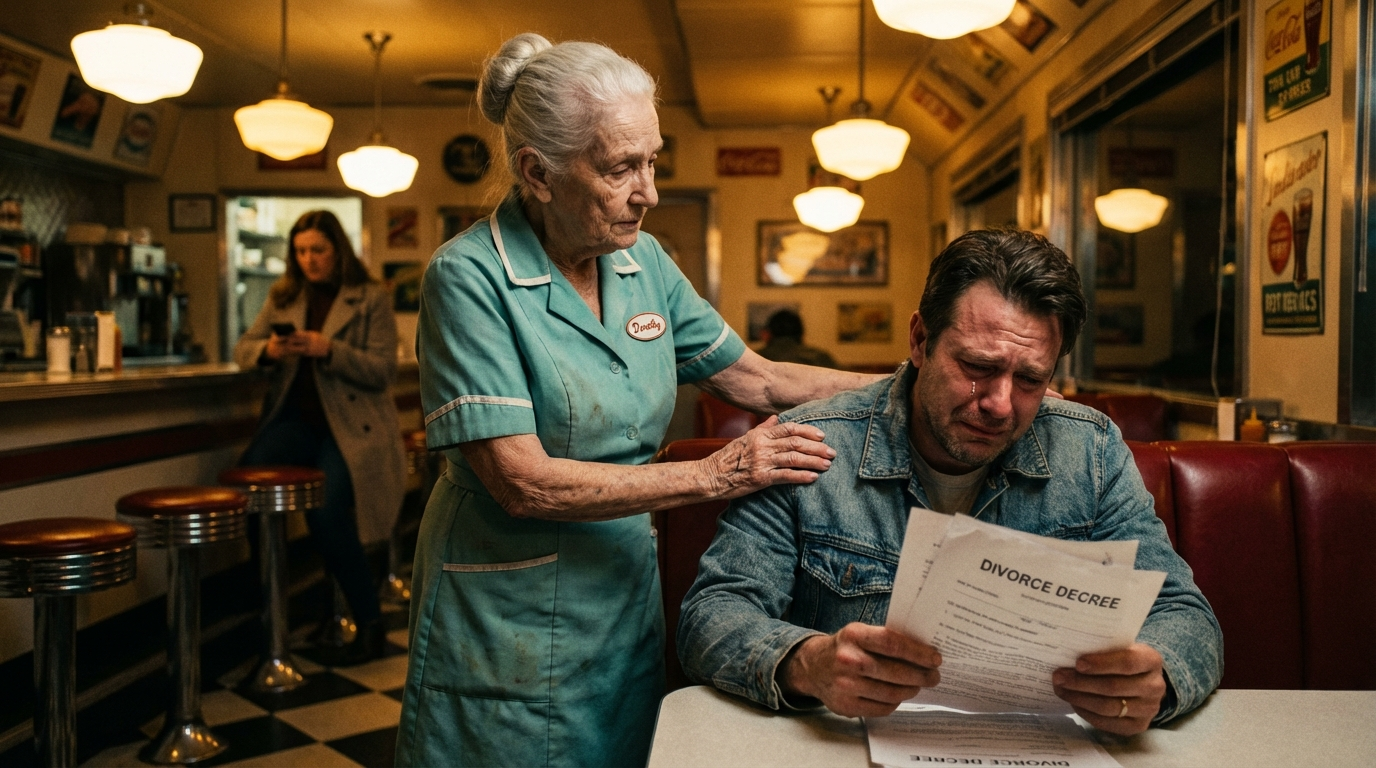
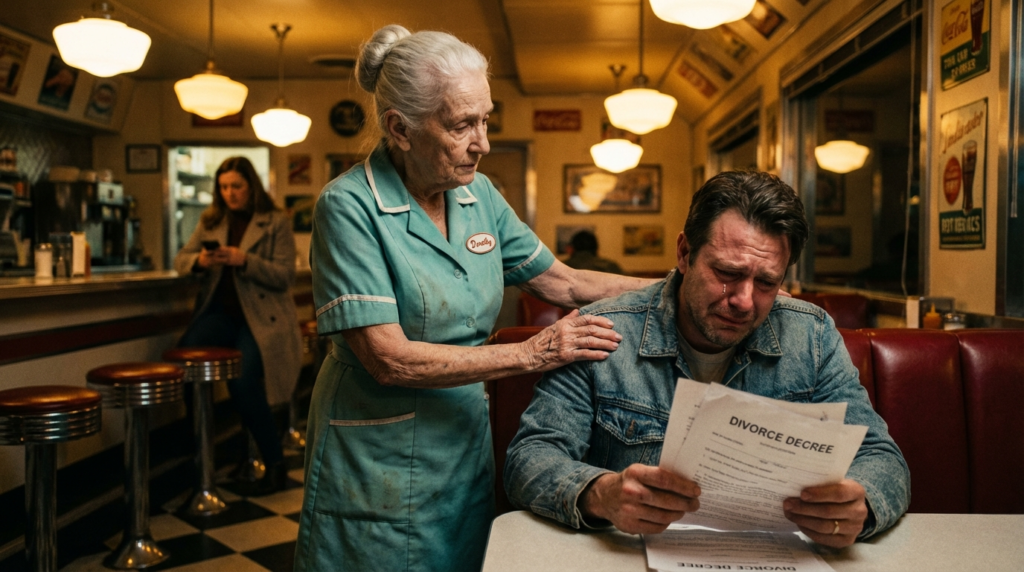
The divorce papers were sitting on the table between us when I finally lost it.
“You slept with my brother,” I said, my voice shaking. “In our bed. While I was at my mother’s funeral.”
Jessica didn’t even have the decency to deny it anymore. She just sat there in that booth at Rosie’s Diner, picking at her salad like we were discussing the weather. Her face was cold, blank. Like she was bored with my pain.
“Are you done?” she asked flatly.
That’s when I snapped. Five years of gaslighting, manipulation, and lies just erupted out of me. I didn’t yell—something worse happened. My voice went ice cold and deadly calm.
“You made me think I was crazy for two years,” I said, leaning forward. “You told me I was paranoid. Controlling. That I needed therapy because I didn’t trust you. And the whole time, you were sleeping with Jake.”
A few diners were staring now. An older couple two booths over had stopped eating. A businessman at the counter was pretending to read his newspaper but I could see him watching. I didn’t care anymore.
“You know what the worst part is?” I continued. “My brother told me last night. He came to my apartment at midnight crying, saying he couldn’t live with the guilt anymore. He begged for my forgiveness. But you? You still can’t even say you’re sorry.”
Jessica rolled her eyes. Actually rolled her eyes like a teenager being lectured. “This is exactly why I cheated, David. You’re so dramatic about everything. I wanted to feel alive again, not like I was suffocating under your neediness.”
I felt something break inside me. Not my heart—that had broken months ago when I’d first suspected. Something deeper. The last thread of kindness and hope I had left for humanity.
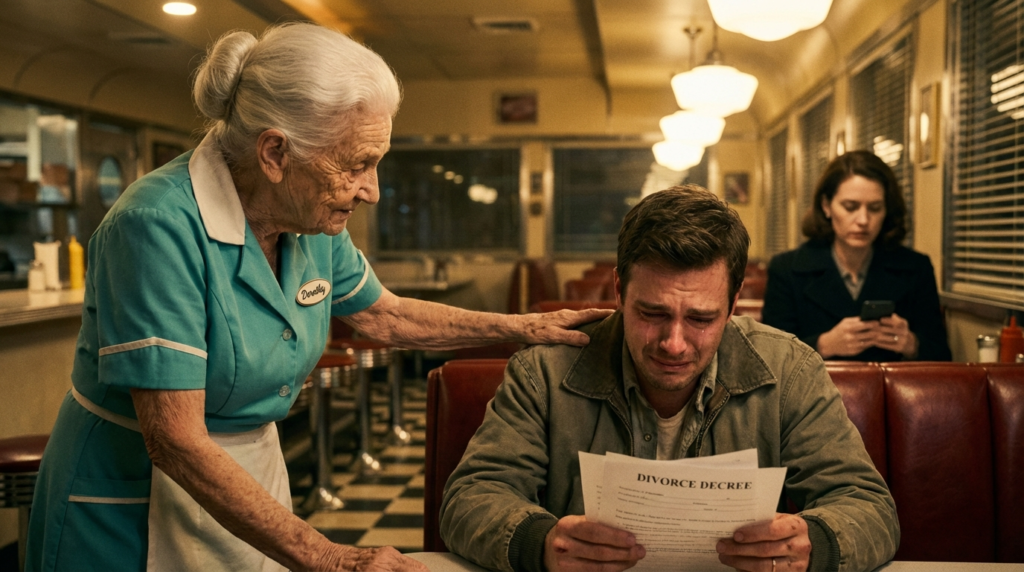
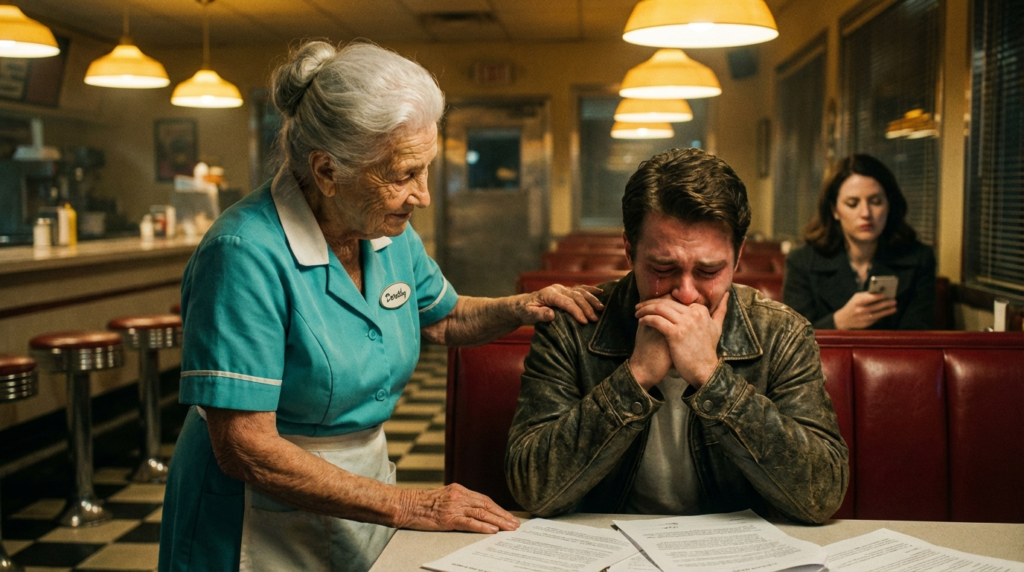
I stood up, grabbed the divorce papers, and was about to walk out of her life forever when I felt a gentle hand on my shoulder.
It was our waitress. She had to be in her seventies, with white hair pulled back in a simple bun and kind eyes that had seen everything life could throw at a person. Her name tag read “Dorothy.” She’d been serving us coffee and sympathy for the past hour, quietly refilling my cup while Jessica complained about how I was “making this harder than it needed to be.”
“Honey,” Dorothy said quietly, pressing something into my hand. “Before you leave, I need you to read this.”
I looked down. It was a folded napkin with handwriting on it.
Jessica was watching us, annoyed. “Can we finish this? I have somewhere to be.” Probably my brother, I thought bitterly.
Dorothy ignored her completely, keeping her weathered hand on my shoulder and her eyes locked on mine. “Read it now. Please. It’s important.”
Something about her urgency made me unfold the napkin.
The handwriting was shaky but clear:
“I heard everything. I’m 74 years old. I’ve been married three times. The first two ended like yours is ending. The third saved my life. Don’t let her take your kindness. That’s what they want. Meet me at the register when you’re done. I have something to tell you. -Dorothy”
I paid the bill ten minutes later. Jessica had stormed out without signing the papers, claiming I was “being impossible” by insisting on a fair split of assets. She wanted the house, the car, and half my 401k despite having an affair with my own brother.
Dorothy was waiting for me at the register, counting out tips from her apron.
“Thank you for staying,” she said softly. “I wasn’t sure you would.”
“What did you want to tell me?” I asked. I was exhausted. Hollowed out. Every word felt like it took effort.
She looked up at me with those kind eyes. “Forty-three years ago, my second husband left me for my sister. I found out at my daughter’s birthday party. They’d been carrying on for two years.”
I stared at her. “I’m so sorry.”
“Don’t be. I’m not telling you this for sympathy.” She finished counting and tucked the money in her pocket. “I’m telling you because I know what you’re feeling right now. You feel like you’ll never trust anyone again. Like something inside you died. Like maybe you deserved this somehow.”
It was like she’d read my mind. I nodded, not trusting myself to speak.
“I felt all of that too,” Dorothy continued. “And I let it poison me for fifteen years. I became bitter, suspicious, mean. I pushed away good people because I was convinced everyone would betray me eventually. I almost became just like the people who hurt me.”
“What changed?” I asked.
She smiled. “I met Walter. My third husband. He was patient and kind and he didn’t give up on me even when I was awful to him. But more importantly, he taught me something I want to teach you.”
“What’s that?”
“When someone betrays you, you have two choices. You can let it turn you into them—cold, selfish, incapable of love. Or you can let it show you exactly who you don’t want to be.”
The simple truth of it hit me like a physical force.
“Your wife,” Dorothy said gently, “she’s trying to convince you that you’re the problem. That your love was suffocating. That you’re too needy, too dramatic. Don’t believe her. People who cheat always rewrite history to justify what they did.”
“But what if she’s right?” I heard myself ask. “What if I was a bad husband?”
“Were you faithful?”
“Yes.”
“Did you love her?”
“With everything I had.”
“Did you try to make the marriage work even when you suspected?”
“I went to couples therapy. She refused to go.”
Dorothy nodded. “Then you weren’t the problem, honey. She was. And more importantly, she still is. But that’s not your burden to carry anymore.”
I should explain how I got here. How a man who used to believe in forever ended up signing divorce papers in a diner booth.
I met Jessica six years ago at a marketing conference in Seattle. She was beautiful, charming, ambitious. She laughed at my jokes and seemed genuinely interested in my work as a software engineer. We got married after a year of dating—too fast, my mom had warned, but I was sure.
The first two years were good. Great, even. We bought a house in the suburbs. Talked about having kids. Made plans for the future.
Then things started to shift. Subtly at first. She was always “working late.” Always on her phone. When I asked about her day, she’d snap at me for being “controlling.” When I suggested we spend more time together, she’d accuse me of being “clingy.”
I started to doubt myself. Maybe I was too needy. Maybe I needed to give her space. I threw myself into work, trying to be the husband she wanted.
My mom got sick two years ago. Pancreatic cancer. It happened fast—diagnosis to death in four months. I was devastated. Jessica seemed… impatient with my grief. She’d sigh when I cried. Tell me I needed to “move on” after two weeks.
Mom died on a Tuesday. The funeral was that Friday. Saturday morning, I came home early from helping my dad sort through her things. I’d forgotten my phone charger.
I found Jessica and Jake in our bedroom. Together.
They didn’t even hear me at first. I stood in the doorway for maybe ten seconds before Jake saw me. The look on his face—shame, guilt, fear—told me this wasn’t the first time.
I left without saying a word. Drove to a hotel. Called a lawyer the next morning.
When I confronted Jessica two days later, she denied everything. Said I’d “misunderstood what I saw.” Gaslit me so thoroughly that I started to question my own memory. Maybe they were just talking? Maybe I’d been so grief-stricken I’d imagined it?
It took Jake’s confession last night to confirm what I already knew in my heart.
“I have something for you,” Dorothy said now, pulling an envelope from her apron. “It’s a letter I wrote to myself twenty-five years ago, after Walter helped me heal. I’ve kept it for years, waiting for the right person to give it to.”
She handed me the envelope. “Read it when you get home. It’s my story, but I think it might help with yours.”
I took it, confused but grateful. “Why are you being so kind to me? You don’t even know me.”
“Because someone was kind to me once when I needed it most,” she said simply. “And because I see myself in you. You’re a good person going through hell, and you’re terrified that hell is going to change you. Don’t let it.”
She patted my hand. “One more thing. Your wife said you’re dramatic and needy. You’re not. You’re hurt and you’re grieving. Those are normal human emotions. Don’t let anyone make you ashamed of feeling deeply.”
I felt tears burning my eyes for the first time since the funeral.
“Thank you,” I managed.
“Go home,” Dorothy said. “Read the letter. Cry if you need to. Scream if you want. Then start building the life you deserve. Without her.”
I read Dorothy’s letter in my apartment that night. It was six pages of handwritten wisdom about betrayal, healing, and choosing kindness when everything in you wants to choose bitterness.
But the part that changed everything was near the end:
“The people who betray us want us to become like them. They want to drag us down into their emptiness so they can feel less alone in it. The most powerful thing you can do is refuse. Stay kind. Stay open. Stay capable of love. Not because they deserve your forgiveness, but because you deserve to keep your humanity.”
I cried reading it. Real, ugly, healing tears.
Then I did something I hadn’t done in months. I called my dad.
“David?” He sounded worried. It was late.
“Dad, I need to tell you something. About Jessica. And Jake.”
I told him everything. The affair. The gaslighting. The divorce. And he listened without interrupting.
When I finished, he was quiet for a long moment.
“Your mother saw it,” he finally said. “The way Jessica treated you. She told me before she died that she was worried. Said Jessica was slowly convincing you that you were the problem when she was the one pulling away.”
“Why didn’t she tell me?”
“She tried. You remember that conversation you had in the hospital? When she said you deserved someone who loved you as much as you loved them?”
I did remember. I’d thought she was just being sentimental because of the cancer.
“She saw what was happening,” Dad continued. “And I think she’d be proud of you for getting out. For not letting it destroy you.”
We talked for two more hours. Really talked, in a way we hadn’t since before Mom died.
And something started to shift in me. The anger was still there. The betrayal still hurt. But Dorothy’s words kept echoing: Don’t let her take your kindness.
The divorce was finalized. Jessica got the car. I kept the house and my retirement fund. Jake sent me letters I never opened. Jessica remarried—not to Jake, but to someone she met at the gym. I heard through mutual friends that she told people I’d been “emotionally abusive” during our marriage.
It hurt. But I didn’t let it change who I was.
I started going back to Rosie’s Diner every Sunday morning. Dorothy and I became friends. She told me more stories about Walter, who’d died five years earlier. About their thirty-two years of marriage. About how he’d taught her that love wasn’t about grand gestures—it was about small, consistent acts of kindness.
“He’d bring me coffee every morning,” she said one Sunday. “Exactly how I liked it. For thirty-two years, he never forgot. That’s love.”
Through Dorothy, I met other regulars. I joined their book club. Started volunteering at the community center where Dorothy taught quilting. Slowly, I rebuilt my life around people who chose kindness.
And then I met Sarah.
She was volunteering at the same community center, teaching art to kids. She had warm eyes and an easy laugh and she didn’t run when I told her about my divorce. Instead, she shared her own story—a broken engagement, a betrayal, the long road back to trusting again.
We took it slow. So slow that Dorothy teased us about it. But Sarah understood. She’d been where I was.
On our six-month anniversary, I took Sarah to Rosie’s Diner. Dorothy served us with a knowing smile.
“She’s a good one,” Dorothy whispered when Sarah went to the restroom. “Don’t let the past scare you away from the future.”
“I won’t,” I promised.
And I meant it.
Dorothy passed away peacefully in her sleep at 75. Heart failure, the doctors said. Walter’s name was the last word she spoke.
At her funeral, I learned I wasn’t the only person she’d saved. There were dozens of us—people she’d shown kindness to at exactly the right moment. A single mom she’d given her tips to when the woman couldn’t afford groceries. A veteran she’d sat with every morning for coffee when he was battling PTSD. A teenager she’d talked out of suicide in the diner bathroom.
Dorothy had spent her life proving that small acts of kindness could change everything.
Her daughter Emily approached me after the service.
“You’re David,” she said. “Mom talked about you. She said you reminded her of Dad before he met her—good but broken, needing someone to believe in him.”
“She saved my life,” I told her honestly.
“She saved a lot of lives.” Emily handed me a small box. “She wanted you to have this.”
Inside was Walter’s wedding ring and a note: “For when you’re ready. Love like Walter loved me—patiently, kindly, without keeping score. You’re going to make someone very happy someday. -Dorothy”
I’m wearing that ring now. Sarah and I got married three months ago in a small ceremony. Dorothy’s daughter was there. So was my dad. Even some of the regulars from the book club.
Jake wasn’t invited. Jessica sent a gift I donated to charity.
But I’m not bitter about them anymore. Dorothy taught me that holding onto anger is like drinking poison and expecting the other person to die. They moved on with their lives. I moved on with mine.
The difference is, I chose to move forward with kindness. And that made all the difference.
Every Sunday, Sarah and I go to Rosie’s Diner. A new waitress works there now, but we always sit in Dorothy’s old section. And sometimes, when I’m drinking my coffee and holding Sarah’s hand, I swear I can feel Dorothy smiling.
She taught me the most important lesson of my life: When people try to take your kindness, hold onto it tighter. It’s the most valuable thing you have.
And she was right.