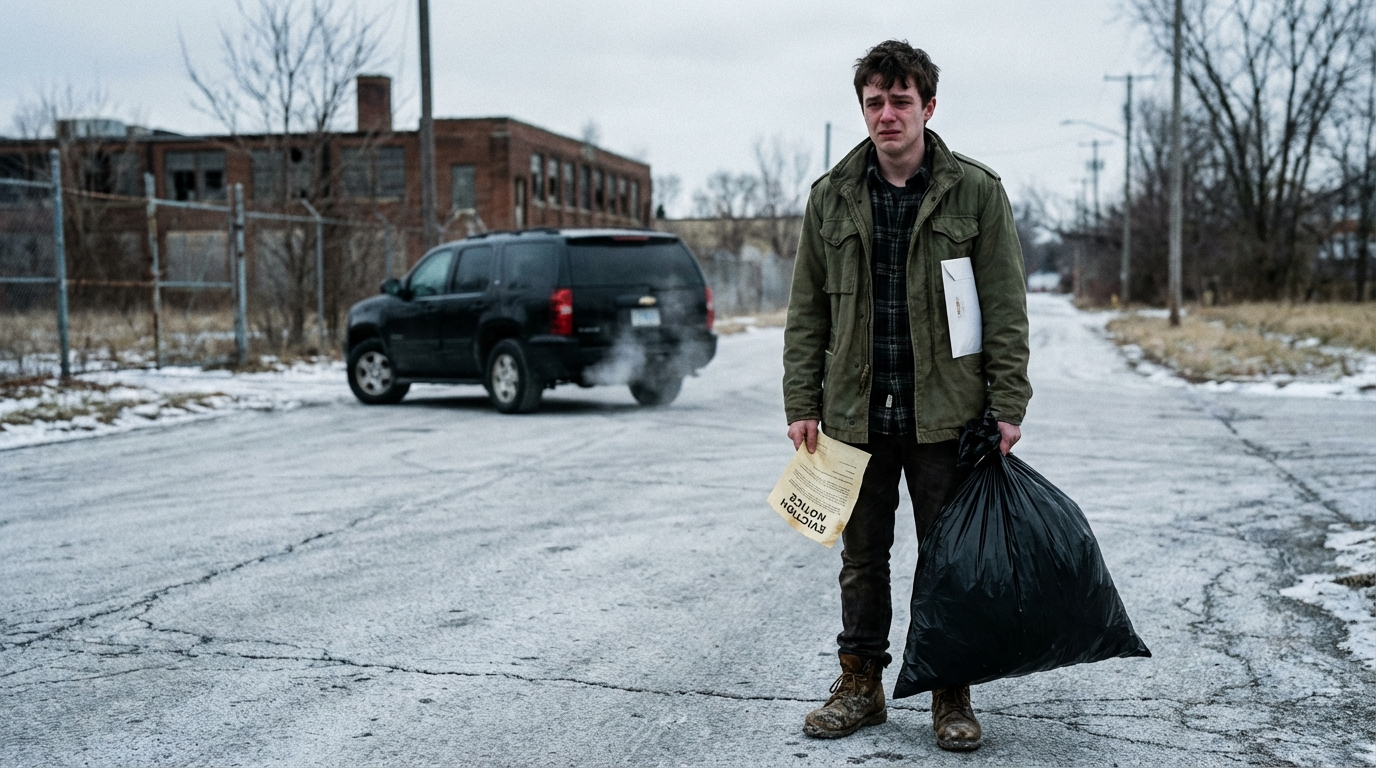
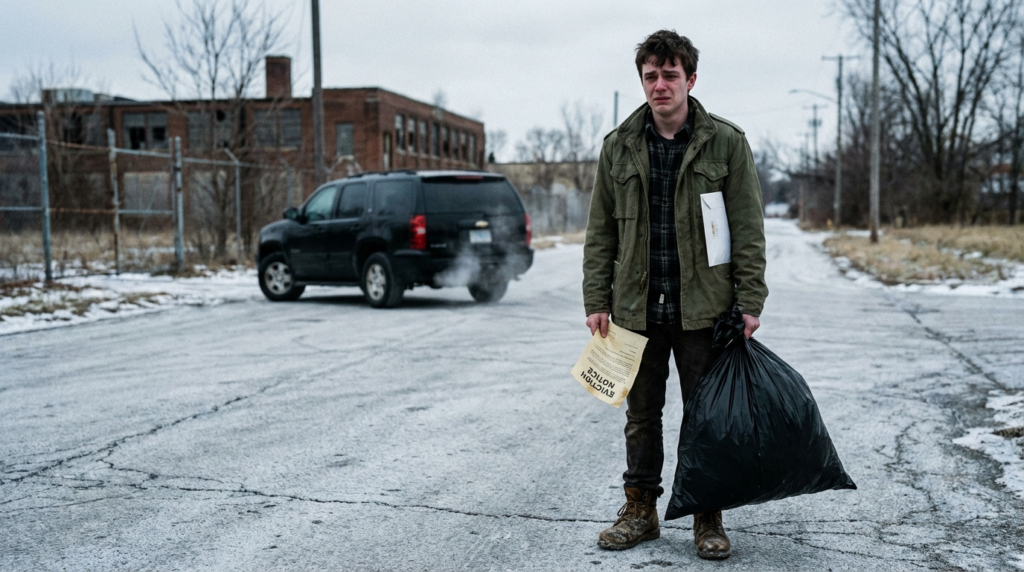
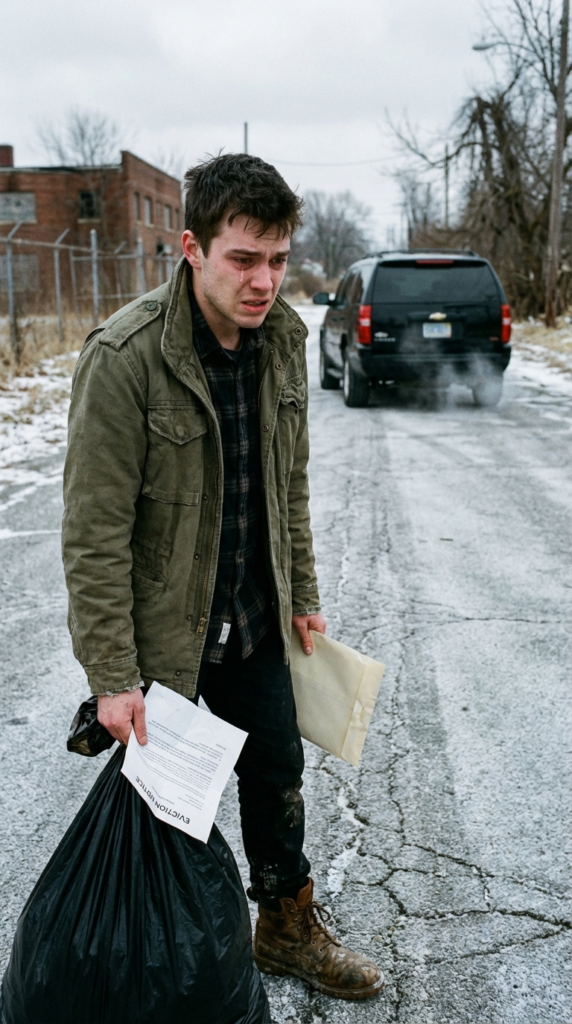
I stood on the cracked asphalt, my entire life stuffed into a black garbage bag at my feet. The January air bit through my thin jacket as I watched the black SUV’s taillights disappear down the road. My hands were shaking—not from the cold, but from pure rage and disbelief.
Twenty-four hours ago, I’d had a home. A family. A future.
Now I had nothing.
My stepfather’s voice still echoed in my head: “You’re eighteen now. We did our duty. Figure it out.” My mother had stood behind him, silent, not even looking at me as he shoved a trash bag into my arms and told me to pack. No cardboard boxes. No suitcases. A literal garbage bag, like I was trash being taken to the curb.
The drive had been silent except for the hum of the engine. Richard, my stepfather’s boss’s chauffeur, had picked me up because my stepfather “had better things to do.” I’d sat in the back of that luxury SUV feeling like a prisoner being transported. Richard hadn’t said a word, just glanced at me occasionally in the rearview mirror with those weathered, knowing eyes.
When we stopped, I’d expected a homeless shelter or a youth center. Instead, we were in front of an abandoned facility—some kind of old institution with broken windows and a chain-link fence. The sign above the gate was half-missing: “ST. JUDE’S HOME FOR—” the rest was gone.
“Here?” I’d asked, my voice breaking.
Richard had simply nodded, helped me out with my trash bag, and then—before I could process what was happening—he’d driven away.
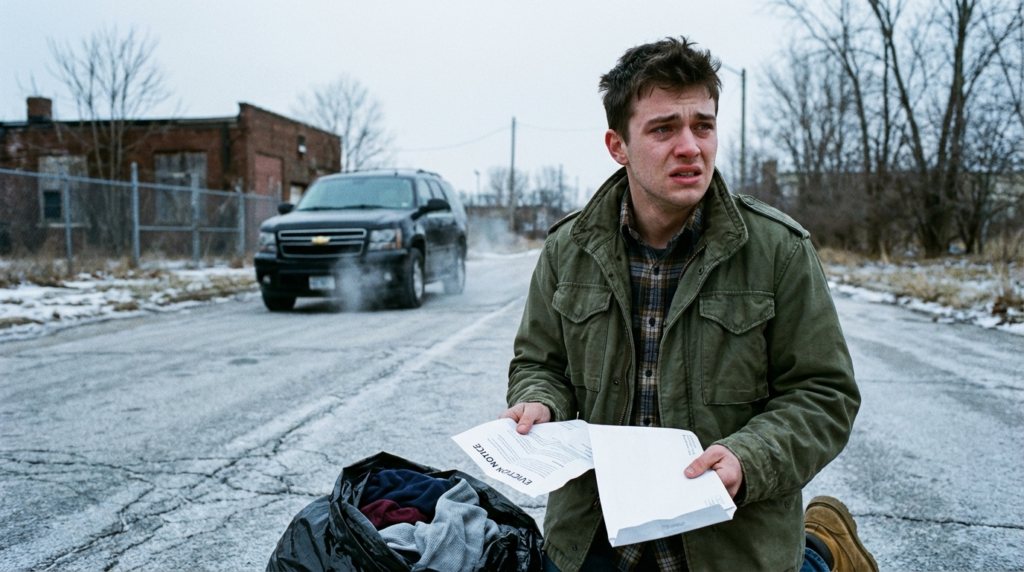
Now I stood there, alone, staring at the crumpled eviction notice in my right hand. It was dated yesterday. They’d planned this. My eighteenth birthday had been three weeks ago. They’d waited just long enough to make it “legal.”
But then I felt something in my jacket pocket that hadn’t been there before. My heart hammered as I pulled out a thick white envelope. Expensive paper. No name on it.
I looked back down the empty road where the SUV had disappeared. Richard had been silent the entire drive, but I’d noticed him watching me. Not with judgment—with something else. Something I hadn’t seen in years.
Compassion.
I tore open the envelope with shaking fingers. Inside was a handwritten letter on cream-colored stationery, and behind it—my breath caught—a cashier’s check. But it was the letter that made my knees weak.
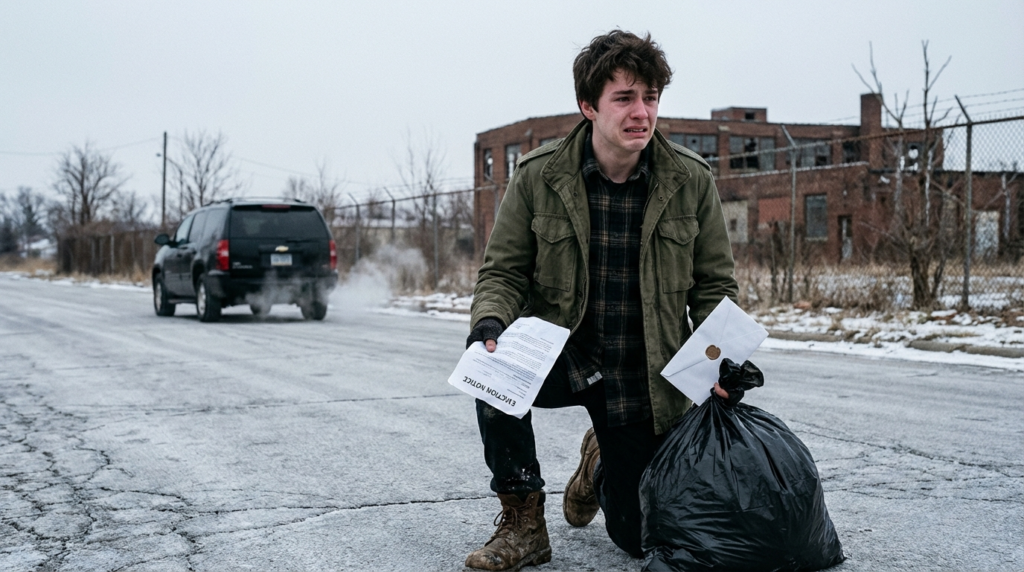
“Son,
I know what it’s like to stand where you’re standing right now. Thirty-five years ago, I was eighteen, homeless, and convinced the world had given up on me. Someone gave me a chance when I deserved nothing. I’ve been waiting my entire career to pay that forward.
What you’re holding isn’t charity. It’s an investment.
The check is for $50,000. Before you think this is some mistake, let me be clear: Mr. Harrison—my employer, the man your stepfather works for—doesn’t know about this. This is from me. From my savings. From my pension. From thirty-five years of driving rich people around and learning one thing: money doesn’t make you rich. Character does.
I’ve watched you for two years while driving your stepfather to and from that house. I’ve seen you mowing the neighbor’s lawn at 6 AM before school. I’ve seen you walking three miles to your job at the grocery store because they wouldn’t let you use the car. I’ve seen you eating lunch alone in the school parking lot because you gave your lunch money to that kid whose parents forgot to load his account.
You think nobody noticed. I noticed.
Your stepfather is a middle-manager who peaked in high school. Your mother chose security over her son. They’re small people living small lives, and they were terrified you’d outgrow them—so they had to cut you down first.
But here’s what they don’t understand: You can’t kill what’s already meant to rise.
The money has three conditions:
1. You finish your education. Community college, trade school, university—I don’t care. But you learn something real.
2. You help one person the way I’m helping you. Not today. Not tomorrow. But someday, when you’re on your feet, you find someone standing where you are now, and you give them a chance.
3. You never, ever let anyone make you feel worthless again.
There’s more in the envelope. An address. A phone number. The address is for a small apartment I own across town. It’s yours for two years, rent-free. After that, you’re on your own. The phone number is mine. You can call me once—anytime you need advice, help, or just someone to remind you that you matter.
But only once. After that, you’re flying solo.
Why am I doing this? Because Mr. Harrison isn’t the billionaire you think he is. I am. I’ve been investing my earnings for thirty-five years while everyone assumed I was just ‘the driver.’ I’m worth eight million dollars. And before you ask why I’m still driving—it’s because that’s what keeps me human.
I’ve watched entitled rich kids destroy themselves with too much money and no purpose. I’ve watched good people give up because they had no money and no chance. You’re different. You’ve got something most people never find: You know how to suffer without becoming cruel.
That’s rare. That’s valuable.
So here’s your shot, kid. Don’t waste it.
Also—one more thing. Behind the old bus down the road, there’s a lockbox chained to the fence. The combination is your birthday: 01-09-2008. Inside are the keys to the apartment, a bus pass good for six months, and a prepaid phone with my number saved.
Welcome to the rest of your life.
—Richard“*
I read the letter three times before my brain could process it. Fifty thousand dollars. An apartment. A phone. A billionaire disguised as a chauffeur.
It felt like a movie. Or a scam. Or a dream.
But the check was real. I could see the bank’s watermark. And the handwriting—it matched the careful, precise way Richard had written my stepfather’s name on documents I’d seen him deliver to the house.
I looked down the road at the abandoned yellow school bus Richard had mentioned. It sat there like a rusted monument to broken things. My legs felt like jelly as I walked toward it, the trash bag dragging behind me.
The lockbox was exactly where he said it would be—chained to the fence behind the bus, hidden in the dead grass. My hands shook as I dialed the combination: 01-09-2008. My birthday. The day I’d turned eighteen three weeks ago. The day my countdown to homelessness had officially begun.
The box clicked open.
Inside: Two keys on a simple ring. A six-month bus pass with my name on it. A flip phone with a single number saved: “R.”
And a Post-it note: “You’ve got this.”
I sat down in the frozen grass and cried. Not sad tears—something else. Relief. Rage. Gratitude. All of it mixed into something I couldn’t name.
For two years, I’d lived in that house feeling invisible. My stepfather treated me like an inconvenient expense. My mother treated me like a reminder of her “mistake”—her first marriage, my real father, who’d died when I was six. I’d worked two jobs to pay for my own food, my own clothes, my own school supplies. I’d stayed quiet, stayed small, stayed out of the way.
I’d thought that if I could just survive until graduation, I’d escape. I’d find a way.
I just didn’t expect the escape to come in a white envelope from a stranger who’d been watching out for me all along.
The address on Richard’s letter led me to a small complex on the east side of town. Not fancy—just a quiet, safe neighborhood with actual streetlights and mailboxes that weren’t covered in graffiti.
The apartment was on the second floor. Unit 2B.
I stood outside the door for five minutes, key in hand, convinced this couldn’t be real. But when I turned the key, the door opened.
Inside was a furnished studio. Nothing extravagant—a bed, a small couch, a kitchenette, a bathroom. But it was clean. It was warm. And on the kitchen counter was a grocery bag with a note:
“Basics to get you started. There’s a library two blocks east. A community college three miles north. A diner hiring dishwashers one block south. You’ve got options. Make good ones. —R”
The grocery bag had bread, peanut butter, eggs, milk, pasta, and a $50 gift card to the grocery store where I’d worked part-time.
I sat on the couch—my couch—and just breathed.
For the first time in two years, I felt safe.
I didn’t call Richard right away. Part of me wanted to. Part of me wanted to drive to wherever he lived and hug him until my ribs hurt. But his letter had been clear: You can call me once. That meant I had to save it. Save it for when I really, truly needed it.
So I got to work.
Day 1: I walked to the diner and applied for the dishwasher job. Started the next morning.
Day 7: I enrolled at the community college three miles north. Business administration. Part-time. Financial aid covered most of it. Richard’s check covered the rest.
Day 30: I opened a savings account and deposited $45,000. Kept $5,000 in checking for rent, food, and emergencies.
Day 60: I got promoted to line cook at the diner. Started taking night shifts for extra pay.
Day 90: I met Professor Chen, my accounting instructor. She saw something in me I didn’t see in myself. She became my mentor.
During those first three months, I thought about my mother and stepfather every single day. I imagined them assuming I was dead in a ditch somewhere. Or strung out. Or begging on the streets.
I wondered if they ever felt guilty.
I wondered if they ever felt anything at all.
But slowly—so slowly I didn’t notice at first—I stopped thinking about them. Because I was too busy building something they couldn’t touch. Something they couldn’t take away.
It happened fourteen months later.
I was in my second semester, working full-time at the diner, pulling straight A’s. I’d saved enough to cover the rent on the apartment after Richard’s two-year deadline. I was doing it.
But then Professor Chen pulled me aside after class.
“There’s a scholarship,” she said. “Full ride to State University. Business program. But the application requires three letters of recommendation, a personal essay, and an interview with the donor.”
“Who’s the donor?” I asked.
“A private philanthropist. Anonymous. They only fund students who’ve overcome significant hardship.”
I knew immediately I had to apply. This was my shot at something bigger than community college. Bigger than a diner job. But the essay question stopped me cold:
“Describe a moment when someone’s kindness changed the trajectory of your life.”
I sat at my kitchen counter that night, staring at the blank screen. And then I picked up the flip phone Richard had given me fourteen months ago.
I dialed “R.”
He answered on the second ring.
“Hello, son.”
His voice was exactly like I remembered—calm, steady, kind.
“Richard,” I said, my voice shaking. “I don’t know how to say this without crying, but—”
“Then cry,” he said gently. “We’ve all earned our tears.”
So I told him everything. The apartment. The job. The school. The scholarship. The essay question. And then I asked the only question that mattered:
“Why did you save me?”
There was a long pause.
“Because thirty-five years ago,” Richard said quietly, “a man named Samuel gave me $10,000 and an address to a room above his garage. He told me the same thing I told you: Finish your education. Help someone someday. Never let anyone make you feel worthless.”
My breath caught.
“Samuel was a janitor,” Richard continued. “Worked at the high school I dropped out of. He’d been saving for a decade. He saw me sleeping in the parking lot one night and decided I was worth the investment. I never saw him again after that first month. He passed away before I could thank him.”
“So you became him,” I whispered.
“No,” Richard said firmly. “I became me. But I carried his kindness forward. Just like you will.”
“The scholarship,” I said. “If I get it—when I get it—I’ll make you proud.”
“You already have,” he said. “Now go write that essay. And remember: You’re not writing about me. You’re writing about who you became because someone believed in you.”
We talked for an hour. He told me about his life, his investments, his philosophy. He told me he’d been watching my stepfather’s career implode—apparently Mr. Harrison had fired him for embezzlement six months ago. My mother had filed for divorce. They’d lost the house.
I felt nothing. Not satisfaction. Not pity. Nothing.
“They’re not your story anymore,” Richard said, as if reading my mind. “Let them go.”
When we hung up, I sat in the quiet of my apartment and wrote the essay. It poured out of me in one sitting—3,000 words about garbage bags, white envelopes, and the man who taught me that kindness isn’t soft. It’s the hardest, bravest thing a person can do.
Six weeks later, I walked into a conference room at State University for the scholarship interview. Three people sat across from me: two professors and a woman in her fifties wearing a simple black dress.
They asked about my grades, my goals, my challenges. I answered honestly. And then the woman in black leaned forward and asked the question that changed everything.
“Who gave you the envelope?”
My heart stopped. “I’m sorry?”
She smiled. “Your essay. You wrote about a billionaire’s chauffeur who gave you $50,000 and an apartment. We verified your financial records. The transaction is real. So I’ll ask again: Who was he?”
I swallowed hard. “His name is Richard. He’s—he was—my stepfather’s employer’s driver. I don’t know his last name. He made me promise not to find him unless I absolutely needed him.”
The woman nodded slowly. Then she stood up and extended her hand.
“My name is Margaret Harrison,” she said. “Richard has been my husband’s driver for thirty-five years. And I’ve been funding this scholarship anonymously for the past decade, looking for students like you.”
I couldn’t breathe. “You—you knew?”
“Richard and I have an understanding,” she said quietly. “He invests his earnings however he sees fit. I fund students he believes in. We don’t discuss it. But when I read your essay and saw his name, I knew exactly who you were.”
Tears streamed down my face. “Why?”
“Because thirty-five years ago,” Margaret said, “my father—a janitor named Samuel—gave Richard $10,000 and a room above our garage. Richard married me ten years later. And every year since, we’ve been paying it forward.”
The room spun.
“You’re saying—”
“I’m saying kindness isn’t a transaction,” Margaret said gently. “It’s a legacy. And you’re part of ours now.”
I’m twenty-three now. I graduated from State University with honors. I work as a financial advisor, helping first-generation college students manage money and plan for their futures.
Last month, I gave a young woman named Aisha $25,000 and the keys to a small apartment across town. She’d been sleeping in her car, working three jobs, and still managing to attend community college.
I handed her an envelope and told her the same thing Richard told me: This isn’t charity. It’s an investment.
She cried. I cried. And then I gave her my number and told her she could call me once—anytime she needed advice, help, or someone to remind her that she mattered.
But only once.
Because after that, she’d be flying solo.
I haven’t spoken to my mother or stepfather in five years. I heard through mutual acquaintances that they’re struggling. That my stepfather works at a warehouse now. That my mother regrets how things ended.
Part of me wonders if I should reach out. Forgive them. Offer help.
But then I remember standing on that cracked asphalt with a trash bag at my feet, watching their taillights disappear, and I realize: Some people deserve your forgiveness. Others just deserve your distance.
I chose distance.
Richard and I have dinner once a month now. He’s seventy-three, still driving for Mr. Harrison, still investing, still living quietly. Margaret joins us sometimes. They treat me like family.
Because that’s what kindness does. It doesn’t just save you.
It builds something bigger than rescue. It builds legacy. Connection. Proof that one person’s goodness can ripple forward through generations.
The day I became homeless, a billionaire’s chauffeur gave me something no one else would.
Not money. Not shelter. Not even hope.
He gave me a mirror.
He showed me that my worth wasn’t determined by the people who threw me away. It was determined by what I chose to build afterward.
And he taught me the most important lesson I’ve ever learned:
When someone is standing where you once stood—cold, scared, holding everything they own in a trash bag—you don’t walk past them.
You stop.
You reach out.
And you give them the one thing that changes everything:
A chance.