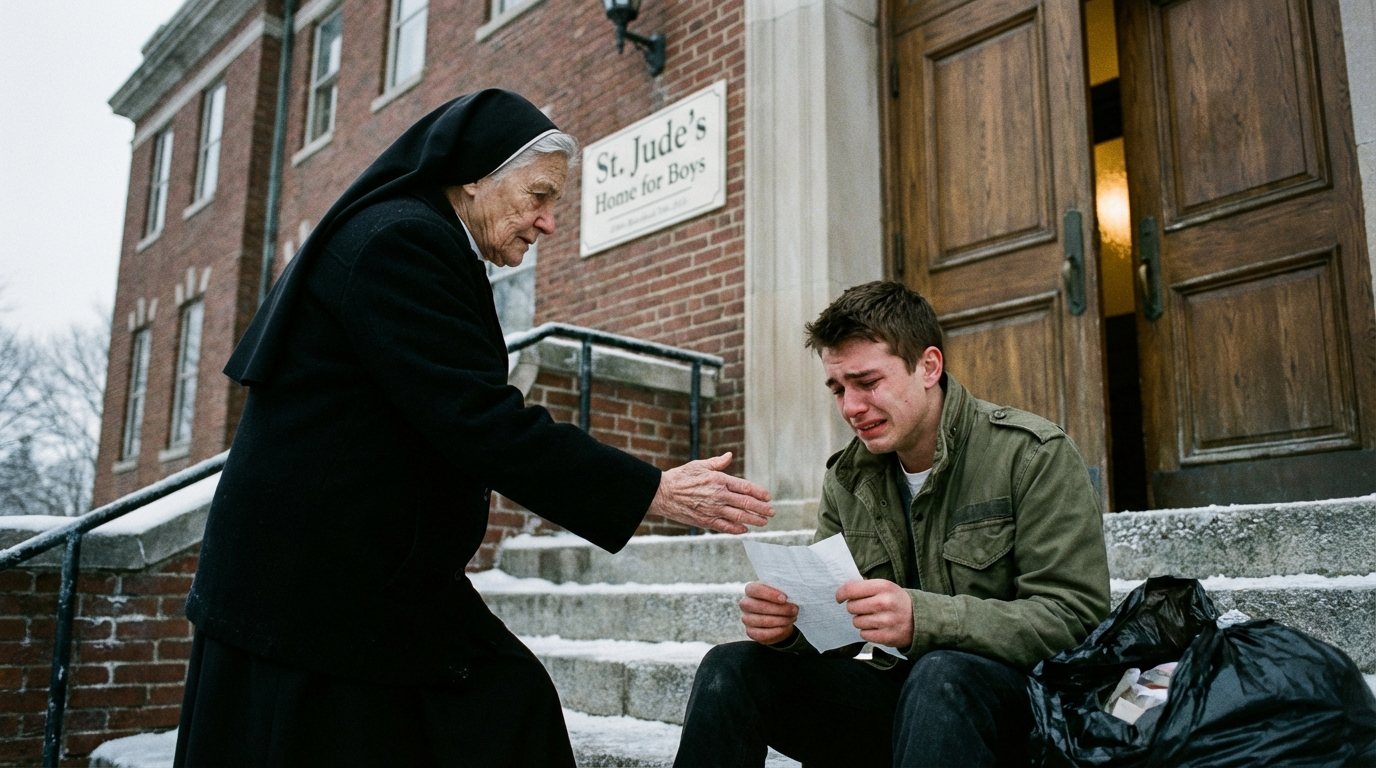
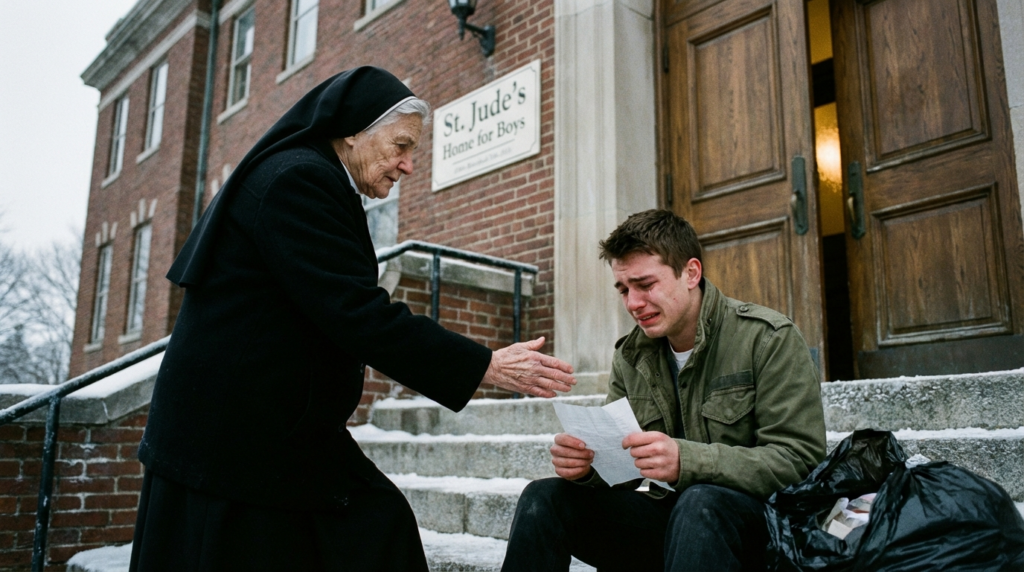
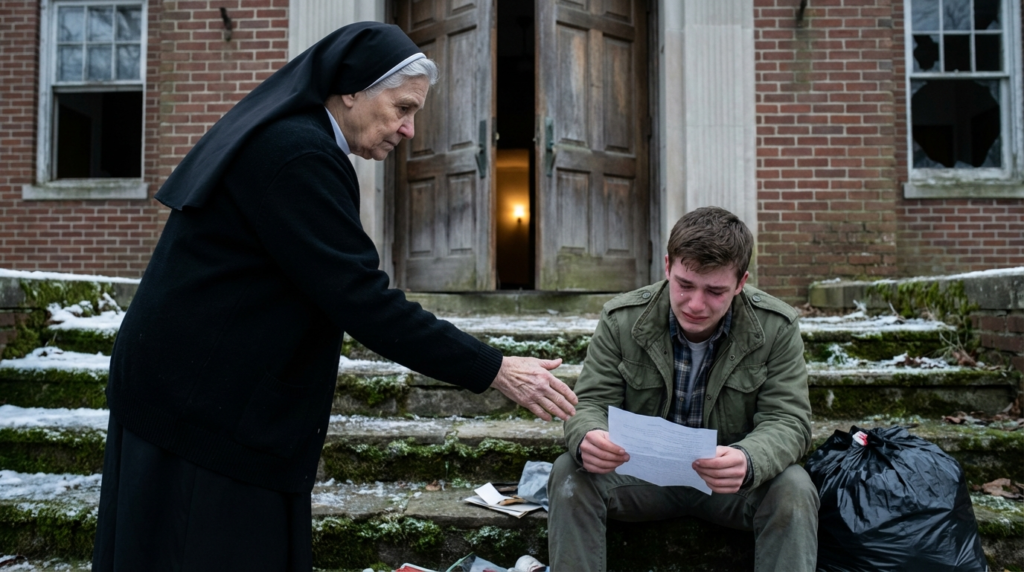
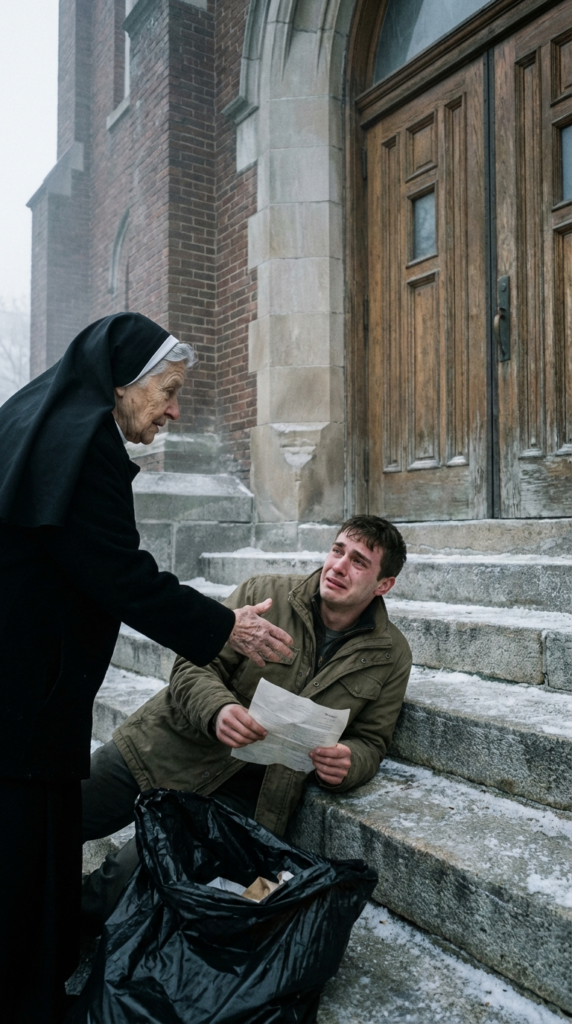
I stood outside St. Jude’s Home for Boys, my entire life stuffed into a trash bag, when the massive wooden doors creaked open. I expected a stern administrator or a social worker with a clipboard. Instead, an 80-year-old nun—barely five feet tall, with silver hair and eyes like weathered steel—stepped onto the stone steps.
She looked at me. Then at the garbage bag. Then at the eviction notice crumpled in my fist.
“They didn’t even give you a suitcase,” she said. Not a question. A statement.
I couldn’t speak. My throat had closed up three hours ago when my stepfather shoved me out of the SUV and drove away without looking back. I was eighteen, homeless, and convinced I was completely alone in the world.
The nun—Sister Catherine, I’d learn later—walked down the steps slowly, her rosary beads clicking with each movement. She stopped two feet from me, studying my face with an intensity that made me want to disappear.
“What’s your name?” she asked.
“Marcus,” I whispered.
“Marcus,” she repeated, like she was tasting the word. “Do you know why they brought you here?”
I shook my head. St. Jude’s had been closed for eight years. The building was half-abandoned, windows broken, paint peeling. This wasn’t a functioning boys’ home anymore. It was a dumping ground. A message. You’re worthless.
Sister Catherine nodded slowly, as if I’d spoken that thought aloud.
“Your stepfather called me yesterday,” she said. “Told me you were a ‘problem child.’ A ‘burden.’ He said you’d probably end up in jail or dead within a year.” She paused, and something flickered across her weathered face—something between fury and sorrow. “He wanted me to refuse you. To let you freeze out here. To teach you a ‘lesson about consequences.'”
My vision blurred. Of course he did. That sounded exactly like Daniel. Every punishment had to be a “lesson.” Every mistake had to be “corrected.” For twelve years, I’d lived under his roof feeling like a defect that needed fixing.
“But then he made a mistake,” Sister Catherine continued, her voice dropping to something sharp and dangerous. “He told me why he really wanted you gone.”
She reached into the folds of her habit and pulled out a folded piece of paper. My hands were shaking too hard to take it.
“This,” she said, holding it up, “is your birth certificate. The real one. Not the one they showed you.”
My heart stopped.
“The one that proves you’re not his stepson at all.”
The January wind cut through my thin jacket, but I couldn’t feel it anymore. I couldn’t feel anything except the roaring in my ears.
“You’re his biological son, Marcus. From an affair he had before he married your mother. She agreed to raise you as her ‘mistake’—her cover story—because she wanted his money. And he agreed because he was terrified his family would find out he’d fathered a child with a woman from the ‘wrong side of town.'”
Sister Catherine’s eyes never left mine. “You were never unwanted because you were broken. You were unwanted because you were evidence.”
I collapsed onto the frozen steps, the trash bag falling from my grip. Eighteen years. Eighteen years of being called “the mistake.” Eighteen years of sleeping in the unheated basement. Eighteen years of hand-me-down clothes and cold leftovers and silent treatments.
All of it—all of it—had been a lie to protect his reputation.
“How—” My voice cracked. “How do you know this?”
Sister Catherine folded the birth certificate carefully and placed it in my shaking hands. “Because twenty years ago, your biological mother came to St. Jude’s, pregnant and terrified. Daniel had given her $5,000 to ‘make the problem go away.’ She refused. She wanted to keep you.”
Tears streamed down my face. “Then why—”
“She died in childbirth, Marcus. Complications. No family, no insurance, no one to claim you. Daniel’s name was on the birth certificate, so Child Services contacted him. He panicked. Made a deal with your current ‘mother’ to cover it up. They forged a new birth certificate listing your mother as the birth parent. Erased your real mother from history.”
The world tilted.
“Why are you telling me this?” I whispered.
Sister Catherine sat down beside me on the cold stone steps, her aged joints creaking. “Because your stepfather made a second mistake. He assumed that when he called me yesterday, bragging about ‘finally getting rid of the evidence,’ I would congratulate him on his clever plan.”
She smiled—a small, dangerous smile.
“He forgot that I’ve been running this place for fifty years. And for fifty years, I’ve kept records of every child, every mother, every secret that walked through these doors. Including his.”
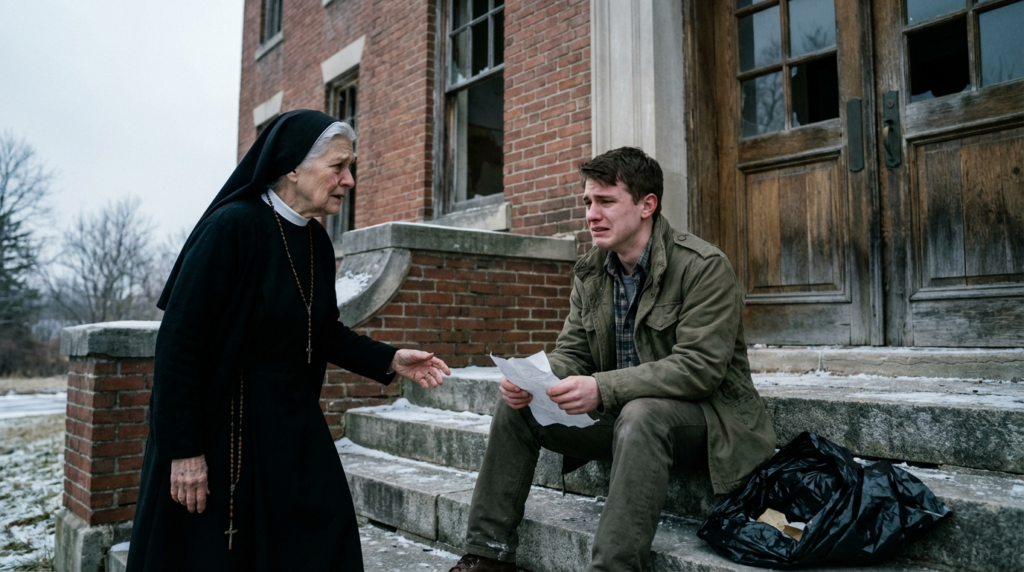
Sister Catherine stood slowly, offering me her hand. I took it, and she pulled me up with surprising strength for someone her age.
“Come inside,” she said. “You’re not sleeping on the street tonight.”
“But—” I looked at the broken windows, the peeling paint. “St. Jude’s is closed.”
“The front is closed,” she corrected. “The residence wing is still operational. Three other sisters live here with me. We’ve been running a quiet shelter for boys aged sixteen to twenty-one who have nowhere else to go. Boys whose families—” she paused meaningfully, “—no longer want them.”
She led me through the massive wooden doors into a foyer that looked frozen in time. Faded portraits of saints lined the walls. The floor was cracked marble. But beneath the decay, I could sense something else—warmth. The smell of soup. The distant sound of voices.
Sister Catherine guided me through a maze of hallways to a small room at the back of the building. It was simple—a bed, a desk, a lamp, a crucifix on the wall. But it was clean. And it was warm.
“This was your mother’s room,” she said quietly. “When she stayed here during her pregnancy. I’ve kept it exactly as she left it.”
My breath caught. “You knew her?”
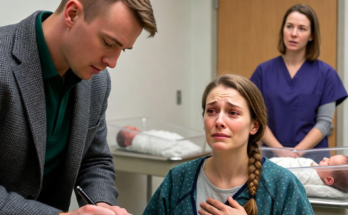
“I delivered you, Marcus. In this room. At 3:47 AM on January 9th, 2008. Your mother held you for seventeen minutes before she started hemorrhaging. Her last words were: ‘Tell him his name is Marcus. Tell him it means warrior. Tell him to fight.'”
I sat down on the bed—my mother’s bed—and buried my face in my hands. Sister Catherine sat beside me, silent, her presence solid as stone.
After a long time, I asked the only question that mattered: “Why didn’t you find me? Why did you let me grow up with them?”
“Because legally, I had no right,” she said, and I heard real pain in her voice. “Daniel had forged documents. He was listed as the father. Your ‘mother’ was listed as the birth parent. Child Services rubber-stamped it. By the time I learned what had happened, you were six months old and in their custody. I tried—God knows I tried—to report it. But without proof beyond my word against legal documents, I had nothing.”
She reached into her habit again and pulled out a worn leather journal.
“So I’ve been keeping records. Waiting. Building a case. Every year on your birthday, I would drive past their house and watch you from a distance. Making sure you were alive. Hoping you’d survive long enough for me to act.”
She opened the journal. Inside were photographs—dozens of them. Me at age six, walking to school alone. Me at age ten, shoveling their driveway in the snow. Me at age fourteen, sitting on a curb outside the grocery store where I worked.
“You’ve been watching me for twelve years?” I whispered.
“I’ve been protecting you for twelve years,” she corrected. “From a distance. Waiting for the day you turned eighteen and became legally independent. Waiting for the day I could give you this—”
She handed me a thick manila envelope.
“—your mother’s things. Her journal. Letters she wrote to you before she died. Photos of her family—your grandparents, your aunts, your cousins. She had people who loved her, Marcus. People who would have loved you. But Daniel made sure they never knew you existed.”
My hands trembled as I opened the envelope. Inside was a photograph of a young woman—mid-twenties, with my eyes, my nose, my smile. She was standing in front of St. Jude’s, pregnant, one hand on her belly, looking at the camera with hope and terror and love.
On the back, in careful handwriting: “Marcus’s mother. Elena Rodriguez. Age 24. December 2007.”
Elena.
My mother’s name was Elena.
I stayed up all night reading my mother’s journal and letters. Sister Catherine had left me alone with strict instructions: “Read everything. Cry as much as you need. Then sleep. Tomorrow, we talk about what comes next.”
The journal was small, spiral-bound, filled with my mother’s handwriting. She’d started it the day she found out she was pregnant:
“November 3, 2007. I took three tests. All positive. I’m terrified. I’m alone. Daniel says he’ll ‘take care of it’ but I know what that means. He wants me to get rid of the baby. But I can’t. I won’t. This baby is mine. I don’t care if Daniel never acknowledges him. I don’t care if I have to do this alone. I’m keeping him.”
Later entries showed her determination:
“November 20, 2007. I found a place. St. Jude’s Home for Boys. It’s run by nuns. They take in pregnant women with nowhere to go. Sister Catherine says I can stay until the baby comes. She’s kind. She doesn’t judge me. She just keeps saying, ‘Every child deserves a chance.'”
And then, weeks before I was born:
“December 28, 2007. I’ve decided on a name. Marcus. It means warrior. Because that’s what he’ll need to be. The world is hard for kids like us—kids without money, without status, without protection. But warriors survive. And my son will survive.”
The letters were harder to read. She’d written them knowing she might not live through childbirth. Twenty-three letters, one for each year of my life until I turned twenty-three:
“To Marcus, Age 1: You won’t remember me. That’s okay. But I hope someone tells you that you were wanted. That you were loved. That I chose you over everything.”
“To Marcus, Age 10: I hope you’ve found people who see your worth. I hope you know how to laugh. I hope you’re not alone.”
“To Marcus, Age 18: If you’re reading this, you’ve survived. That makes you stronger than most. Don’t let anyone tell you you’re broken. You’re a warrior. Now go fight for the life you deserve.”
By dawn, I understood something I’d never known before: I wasn’t a mistake. I wasn’t evidence. I wasn’t a burden.
I was a warrior.
And my mother had fought for me with her last breath.
The next morning, Sister Catherine found me in the small chapel attached to St. Jude’s. I’d been sitting there for an hour, staring at the crucifix, trying to make sense of everything.
She sat down beside me, silent, waiting.
“They lied to me my entire life,” I finally said. “About who I was. About where I came from. About my mother.”
“Yes,” Sister Catherine said simply.
“They threw me away the moment I turned eighteen because they thought I was disposable.”
“Yes.”
“And you—” My voice broke. “You watched over me for twelve years, waiting for this moment.”
Sister Catherine turned to look at me, and for the first time, I saw tears in her eyes.
“Marcus,” she said quietly. “Do you know what your family never gave you?”
I shook my head.
“Worth,” she said. “Not love. Not kindness. Not even basic decency. The thing they never gave you was the simple, foundational truth that you have worth. That you matter. That your existence isn’t something to apologize for.”
She reached over and placed her weathered hand on mine.
“For eighteen years, you’ve been fighting to prove you deserve to exist. You’ve been working two jobs. Staying silent. Making yourself small. Trying to earn something you should have been given the moment you were born: the belief that you are valuable.”
Tears streamed down my face.
“That’s what I’m giving you now,” Sister Catherine said. “Not shelter. Not charity. Not pity. I’m giving you the one thing your family never did: I see your worth. And it is not negotiable.“
She stood, pulling me up with her.
“You are Marcus Rodriguez. Son of Elena. Grandson of Maria and Carlos Rodriguez. Nephew of Rosa and Miguel. You have family—real family—who never knew you existed. And tomorrow, we’re going to find them.”
Sister Catherine had been thorough. Over eighteen years, she’d tracked down my mother’s family—scattered across three states, but alive. My grandparents. Two aunts. Four cousins I’d never met.
They’d been searching for Elena since 2008, when she disappeared. Daniel had told them she’d “moved away” and cut contact. They’d spent eighteen years grieving a daughter they thought had abandoned them.
Sister Catherine called my grandmother first.
I sat beside her in the small office, listening to her explain—calmly, carefully—that Elena hadn’t abandoned anyone. That she’d died giving birth. That her son was alive. That he was here, at St. Jude’s, waiting.
The silence on the other end of the line lasted so long I thought my grandmother had hung up.
Then: “My grandson is alive?”
Her voice broke something inside me.
“Yes,” Sister Catherine said. “And he needs his family.”
They arrived three days later—all of them. My grandparents, Maria and Carlos, both in their seventies. My aunts, Rosa and Isabel. My cousins, ranging from fifteen to twenty-five.
They walked into St. Jude’s like a small army, and when they saw me standing in the foyer, they stopped.
My grandmother—a small woman with silver hair and my mother’s eyes—walked forward slowly. She reached up and touched my face with trembling hands.
“You look just like her,” she whispered.
And then she pulled me into a hug so fierce I couldn’t breathe. The rest of the family surrounded us, and for the first time in eighteen years, I understood what it felt like to be claimed.
Not tolerated.
Not endured.
Claimed.
Three months later, I walked into a lawyer’s office with Sister Catherine, my grandmother, and a folder full of documentation.
The lawyer—a woman named Patricia Chen—had been recommended by Sister Catherine. She specialized in cases of fraud, identity theft, and parental rights violations.
“You have grounds for multiple lawsuits,” Patricia said after reviewing everything. “Fraud. Emotional distress. Identity theft. Eighteen years of unpaid child support. The forged birth certificate alone is a felony.”
My grandmother leaned forward. “What do we need to do?”
Patricia smiled. “We file. We expose. And we make sure Daniel and his wife answer for what they did.”
The lawsuit took nine months. During that time, I lived with my grandparents in their small home across town. I enrolled in community college. My aunts helped me get a part-time job at my cousin’s auto shop. My grandmother taught me to cook the recipes my mother had loved.
I learned about Elena—really learned. She’d been a talented artist. She’d wanted to study graphic design. She’d loved old movies and spicy food and thunderstorms. She’d been smart, stubborn, and kind.
She’d been real.
And when the court finally ruled in our favor—Daniel was found guilty of fraud and identity theft—I felt something I’d never felt before.
Peace.
Not because Daniel went to jail for two years.
Not because we won a settlement that covered my college tuition and then some.
But because I finally had an answer to the question that had haunted me for eighteen years:
Why wasn’t I enough?
I was enough.
I’d always been enough.
They just couldn’t see it.
Five years later, I graduated from State University with a degree in Social Work. Sister Catherine, now eighty-five and using a cane, sat in the front row beside my grandparents, beaming.
After the ceremony, she pulled me aside.
“I have something for you,” she said.
She handed me a small envelope. Inside was a check for $50,000.
“Sister Catherine—” I started.
“Don’t,” she said firmly. “This is from St. Jude’s endowment. It’s meant to help boys who’ve survived what you survived. But there are conditions.”
I smiled. “Always are.”
“You use this to start your own program. Something for kids aging out of foster care. Something that gives them what you never had: a soft place to land.”
“And?” I asked, knowing there was more.
“And you give them the one thing I gave you.” She tapped my chest with one gnarled finger. “Worth. You make sure every kid who walks through your door knows they matter. Not because of what they’ve done or who they came from. But because they exist.”
Ten years later, I run the Elena Rodriguez Center for Youth—a residential program for young adults aging out of foster care. We house twenty kids at a time. We help them finish school, find jobs, heal from trauma.
And every kid who comes through our doors hears the same thing on their first day:
You have worth. And it is not negotiable.
Last week, a fifteen-year-old girl named Jasmine arrived with her life in a trash bag. She’d been abandoned by her fourth foster family. She was angry, defensive, and convinced she was unlovable.
I sat down beside her on the steps—the same steps where Sister Catherine had found me twelve years ago—and I told her Elena’s story. My story.
“You’re not a mistake,” I said. “You’re a warrior. And warriors survive.”
She looked at me with eyes that had seen too much. “How do you know?”
“Because someone told me the same thing once. And it saved my soul.”
Sister Catherine passed away two years ago at age eighty-seven. She died peacefully in her sleep at St. Jude’s, surrounded by the boys she’d saved over fifty years.
At her funeral, forty men stood up and told stories of how she’d given them worth when no one else would.
I was the last to speak.
“Sister Catherine didn’t just save my life,” I said. “She taught me that kindness isn’t soft. It’s not weak. It’s the hardest, bravest thing a person can do. Because it requires you to see someone’s worth when the entire world has told them they’re worthless.”
I looked out at the crowd—my family, my staff, the kids from Elena Rodriguez Center, the men Sister Catherine had saved over the decades.
“She gave me something my family never did,” I continued. “Not food. Not shelter. Not even love. She gave me a mirror. She showed me that my worth wasn’t determined by the people who threw me away. It was determined by the person I chose to become afterward.”
I paused, my voice breaking.
“And she taught me that when you save someone—really save them—you’re not just changing one life. You’re starting a chain reaction that echoes forward through generations.”
Standing in that church, surrounded by proof of Sister Catherine’s legacy, I finally understood:
Kindness isn’t about grand gestures or perfect moments.
It’s about showing up on the steps when someone’s world is ending.
It’s about saying: You matter. And I’m not leaving.
It’s about being the mirror that reflects back someone’s worth when they can’t see it themselves.
And it’s about teaching them to become that mirror for someone else.
That’s what an 80-year-old nun at St. Jude’s gave me.
And that’s what saved my soul.