THE ZERO ON THE RECEIPT
The receipt fluttered in my shaking hand like a flag of surrender. Tip: $0.00. Total: $82.50.
I stared at the zeros until they blurred into black smudges. It was Saturday night at Le Monde, a downtown bistro where the lighting was low, the jazz was soft, and the clientele pretended that spending eighty dollars on dinner was a casual affair.
For me, eighty dollars was two weeks of electricity. It was a bus pass. It was survival.
I was twenty-four, drowning in student loans for a degree I wasn’t using, working double shifts to pay for a studio apartment with a radiator that hissed but never heated. My feet were blistered inside my mandatory black flats. My patience was thinner than the carpaccio.
The man at Table 4 had been the breaking point.
He stood out the moment the hostess sat him. He wore a faded grey overcoat that had seen better decades, and his hands were rough, the knuckles swollen and red. He looked like a smudge of charcoal in a room full of diamonds.
He didn’t make eye contact. He didn’t order a drink. He pointed a dirty finger at the menu. “The Ribeye Special,” he rasped. “And the truffle mac and cheese.”
I judged him. God, I judged him. I thought he was blowing a paycheck he didn’t have to play pretend for an hour. I gave him the bare minimum service. I slammed his water down.
When the food arrived—steaming, fragrant, perfect—he didn’t lift his fork. He stared at the meat for five seconds, then waved me over.
“Box,” he grunted. “To go. Now.”
I was annoyed. “Is something wrong with the steak, sir?”
“Just box it,” he snapped.
I did. I slapped the bill on the table. He counted out the cash—wrinkled fives and ones, mostly—and left. No tip. Not a dime.
I was furious. It wasn’t just the money; it was the indignity. I felt used. I grabbed the checkbook, blind with rage, and stormed through the kitchen.
“Maya, where are you going?” the manager yelled.
“Trash run,” I lied.
I burst out the back door into the alleyway. It was a miserable Seattle night, the rain coming down in sheets of ice. I knew the shortcut to the street. I was going to catch him. I was going to shame him. I wanted to yell, “If you can afford the steak, you can afford to tip the person who served it!”
I turned the corner past the dumpsters and saw a silhouette.
He was kneeling in the mud, oblivious to the freezing rain.
“Hey!” I shouted, the adrenaline spiking my voice. “You forgot something!”
He flinched violently, hunching his shoulders as if expecting a blow. He looked up. His eyes weren’t arrogant. They were terrified.
I looked down.
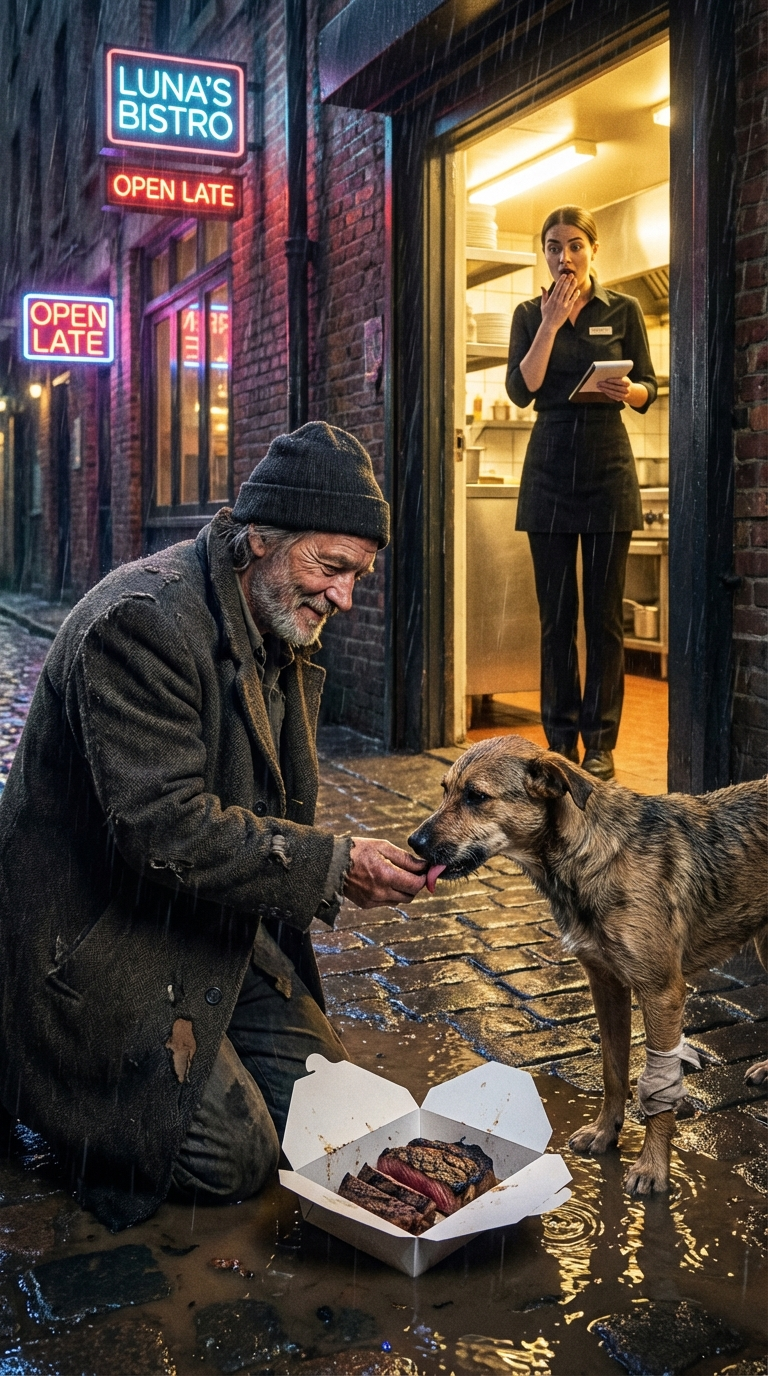
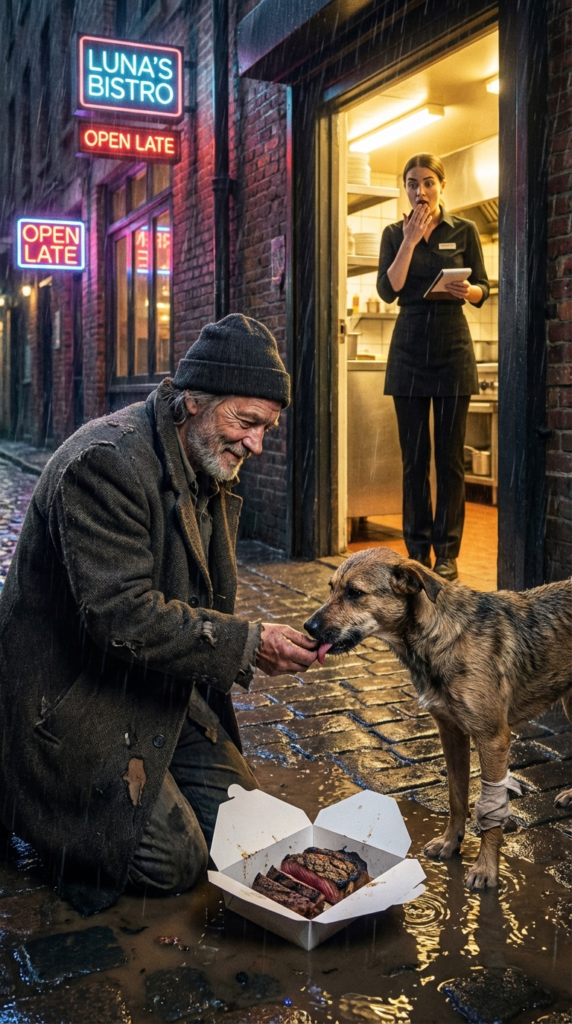
The expensive biodegradable to-go box was open on the wet asphalt. The $65 ribeye, cooked medium-rare, was cut into small, careful chunks.
A dog—a mangy, skeletal thing with a matted coat and a leg that hung at a sickening angle—was devouring the meat. It whimpered as it ate, shaking from pain and cold.
The man wasn’t eating the steak. He watched the dog with an expression of pure, heartbreaking love. As the dog finished the meat and moved on to the truffle mac and cheese, the man reached into the corner of the box. He picked up a piece of steamed broccoli—the garnish—and popped it into his own mouth. He chewed slowly.
I realized with a jolt that nearly knocked the wind out of me: That broccoli was his dinner. He had spent $82.50—likely every penny he owned—not for himself, but to give a dying animal one last, decent meal.
THE INVISIBLE WAR
To understand why my anger turned to ash in my mouth, you have to understand the callousness I had built up over the last three years.
I wasn’t always this cynical. I moved to the city to be an artist. I had dreams. But the city is a grinder. It chews up dreams and spits out bills.
My “backstory” isn’t unique, which is what makes it tragic. A sick mother back in Ohio. A mountain of medical debt. A degree in Art History that qualified me to pour water for tech millionaires.
I had developed a shell. I categorized people by their shoes. Italian leather? Good tipper. Scuffed sneakers? Waste of time.
I had categorized the man in the grey coat as “Trash.”
Standing in that alley, watching the rain plaster his grey hair to his skull, I saw the reflection of my own cruelty.
I took a step forward. The man scrambled back, trying to shield the dog.
“I paid,” he stammered, his voice cracking. “I paid the bill. You can’t take it back.”
“I’m not here to take it back,” I whispered. My anger was gone, replaced by a shame so heavy I could barely stand.
I looked at the dog. It was in bad shape. “He’s hurt.”
“Hit by a car,” the man said, stroking the dog’s wet head. “Three days ago. I’ve been trying to… I wanted him to have something good. Before…” He didn’t finish the sentence.
“What’s his name?”
“Doesn’t have one,” the man said. “I found him behind the library. He’s just… Buddy. He’s my buddy.”
“And what’s yours?”
He hesitated. “Elias.”
“Elias,” I said, ignoring the rain soaking my uniform. “You’re hungry.”
He looked at the empty to-go box. “I’m fine.”
His stomach growled, a loud, undeniable protest.
I looked at my watch. The kitchen closed in ten minutes. The chef, Marco, threw away gallons of soup and bread every night.
“Don’t move,” I commanded. “Do not move.”
PART III: THE REVERSAL
I ran back inside. I didn’t care about the mud on my shoes. I grabbed a fresh tablecloth from the laundry bin. I went to the kitchen.
“Marco,” I said to the head chef. “I need the soup. The leftover bisque. And the bread. All of it.”
Marco, a tyrant with a heart of gold buried under layers of stress, looked at me. “Maya, we’re closing. Why?”
“Just give it to me. And a steak. Put a ribeye on.”
“Who’s paying for a ribeye, Maya?”
“I am,” I said. It was a lie. I couldn’t afford a ribeye. I couldn’t afford the parsley on the ribeye. “Put it on my tab.”
Marco looked at my face. He saw the mascara running down my cheeks. He saw the mud. He didn’t ask again. He threw a slab of meat on the grill.
Ten minutes later, I walked back out. I carried a tray covered in foil.
Elias was still there. He had moved the dog under the overhang of the building to get out of the rain. He was curled around the animal, sharing his body heat.
I set the tray down on a dry crate.
“Eat,” I said.
I uncovered the soup—lobster bisque, rich and creamy. A basket of warm sourdough. And a fresh steak, for him.
Elias looked at the food, then at me. He started to cry. Silent, shaking sobs. He didn’t touch the food. He reached out and took my hand. His skin was rough, like sandpaper, but warm.
“Why?” he choked out. “I didn’t tip you.”
“You tipped me,” I said, my voice trembling. “You gave me a reality check. That’s worth more than twenty percent.”
I sat with him in the alley. I took off my apron and wrapped it around the dog’s broken leg to stabilize it. I learned that Elias used to be a history teacher. He lost his job when his district cut funding, then lost his wife to cancer, then lost his house to grief. He had been on the streets for two years. The dog was the first living thing he had touched in months.
THE MIDNIGHT AMBULANCE
We couldn’t leave the dog there. The leg was infected.
“I have a friend,” I said. It was a half-truth. I knew a girl, Jenna, who dated a vet tech. I called her at midnight.
“Jenna, don’t ask questions. I need a favor. A big one.”
An hour later, Jenna’s boyfriend, a guy named Dave with tattoos and a soft heart, pulled up in his hatchback. We loaded the dog—Buddy—into the back. Elias got in with him, refusing to let go of the dog’s paw.
I clocked out. I got in the front seat.
We drove to the emergency vet clinic. Dave called in a favor. They operated on Buddy that night. It wasn’t cheap, but Marco—the chef—had followed me out after closing. He saw the scene in the alley. He handed me a wad of cash from the tip pool. “The kitchen’s contribution,” he had grunted.
But the real twist happened the next morning.
I was sitting in the vet waiting room with Elias. He was clean now—we’d gotten him a shower at the clinic—but he looked exhausted.
A man in a suit walked in. He looked at Elias, then did a double-take.
“Mr. Vance?” the suit asked.
Elias looked up. “Yes?”
The man in the suit dropped his briefcase. “Mr. Vance! Elias Vance! You taught AP History at West high, right? Class of 2012?”
Elias nodded slowly. “I did.”
“You… you changed my life,” the man stammered. “I was the kid who couldn’t read. You stayed after school every day for a year. You got me into college.”
The man was now a partner at a local law firm. He looked at Elias, seeing the worn clothes, the exhaustion. He pieced it together instantly.
“What are you doing here, sir?”
“My dog,” Elias said. “And… my friend Maya.”
THE TIP THAT KEEPS GIVING
The lawyer—his name was David—didn’t just pay the vet bill. He took Elias to breakfast. Then he took him shopping. Then he took him to a hotel.
Two weeks later, Elias walked into Le Monde.
He was wearing a suit. It wasn’t expensive, but it fit. He was shaved. He looked ten years younger. Buddy was with him, limping slightly on a bright blue cast, waiting outside the glass door with a dog walker.
I was setting Table 4.
Elias sat down. He ordered a coffee.
“I believe I owe you a tip,” he said.
He slid an envelope across the table.
Inside wasn’t cash. It was a check. For $5,000.
“David—my former student—helped me get my pension sorted,” Elias smiled. “Apparently, the state owed me years of back pay they ‘couldn’t locate’ me to deliver. And he’s letting me stay in his guest house until I find a place. But this…” he pointed to the check. “This is from me.”
“I can’t take this,” I whispered.
“You have to,” he said. “Because you saw me. You didn’t just see a bum. You saw a man. And you saved the only thing I love.”
I took the check. I paid off my student loans. But I didn’t quit my job.
Now, every Saturday night, I keep a to-go box ready. And when I see someone outside who looks like they’ve forgotten what a warm meal tastes like, I don’t judge. I don’t check their shoes.
I just feed them.
Because the best tip I ever got wasn’t money. It was watching a starving man feed a dog a $65 steak, and realizing that kindness is the only currency that really matters.