THE SILENT WAR
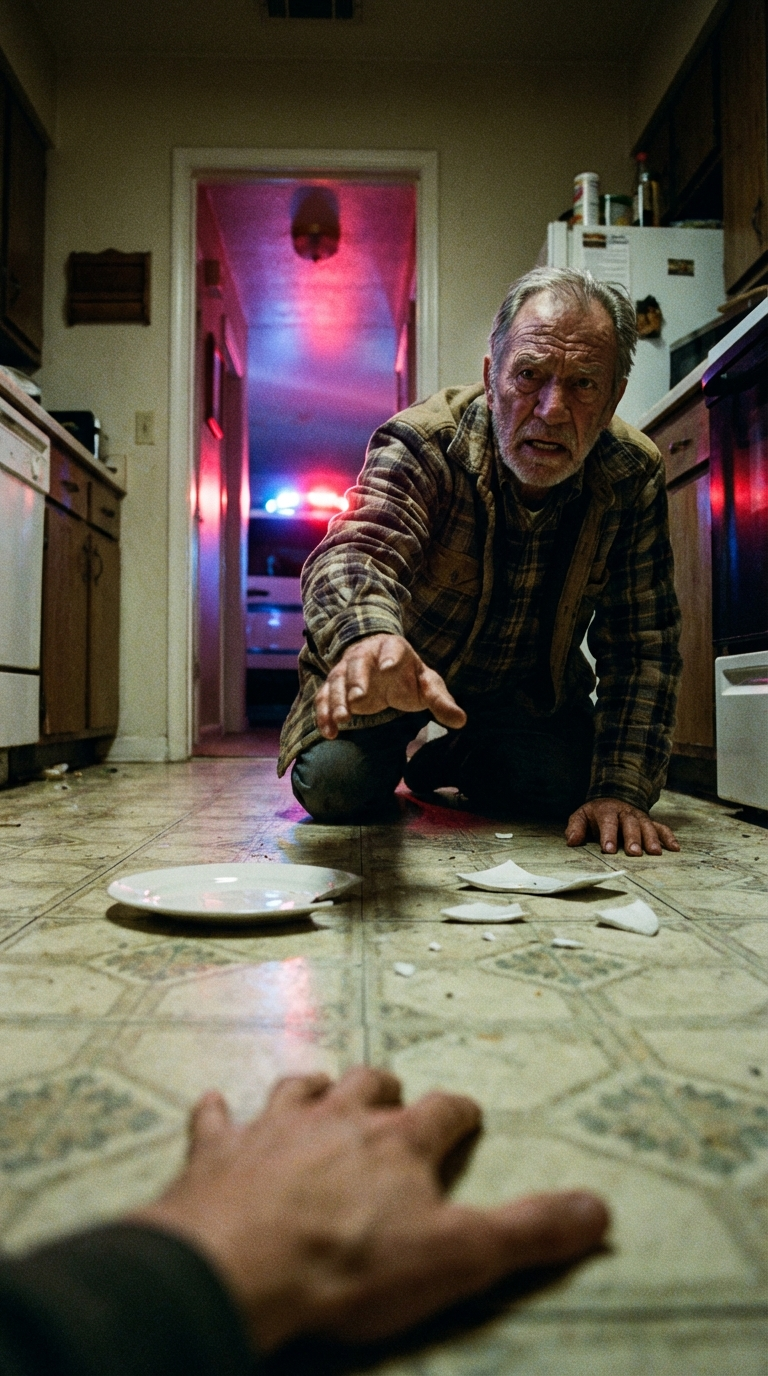
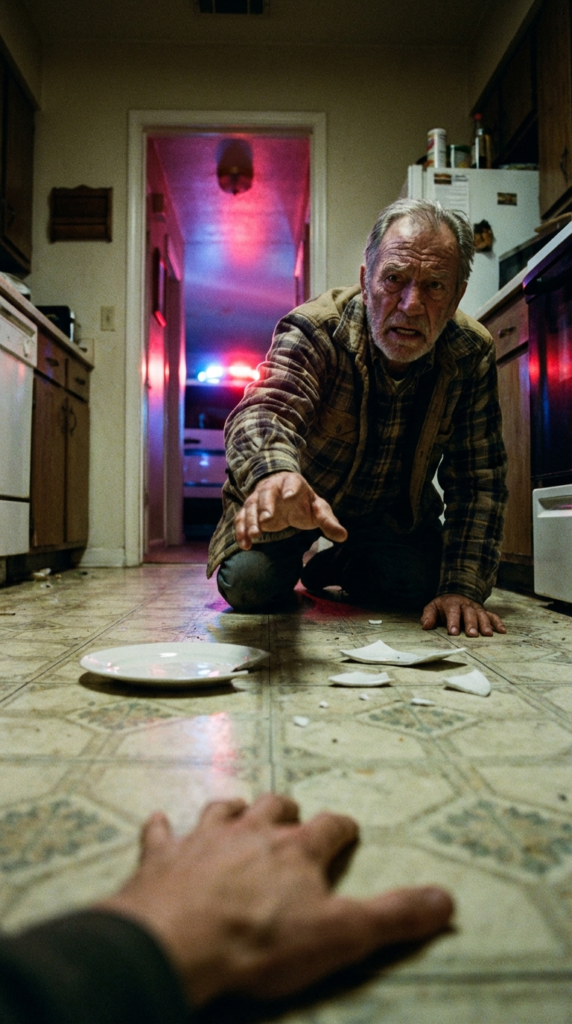
The floor was freezing. That was the only thing I could focus on. That, and the terrifying realization that my heart—the organ responsible for keeping me alive—had decided to go on strike.
“Sarah? Squeeze my hand if you can hear me.”
The voice belonged to Frank Henderson. To anyone else in our building, he was just the old guy in 4B. To me, he was the enemy. For three years, we had engaged in a silent, petty war of attrition. He banged on the walls when I blended a smoothie. I left my trash out an hour early just to annoy him. He glared at my boyfriend, Mark; I rolled my eyes at his cane.
But lying there, amidst the shattered remains of a dinner plate and my own mortality, the war evaporated.
Frank was holding my hand.
He wasn’t just holding it; he was anchoring me. The paramedics were working frantically—sticking me with IVs, attaching leads to my chest, shouting vitals. It was a chaotic storm of medical jargon and beeping machines. But Frank was the eye of the storm.
“She’s in V-tach! We need to move, now!”
“Is he family?” a paramedic shouted, looking at Frank.
I tried to speak. I tried to say No, he’s the guy who left a note on my car saying I park like a blind wombat. But no words came out.
Frank looked down at me. His face, usually set in a permanent scowl of disapproval, was etched with a terrifying tenderness. He looked at the paramedic.
“I’m her grandfather,” he lied. Smoothly. Instantly. “And I’m riding with her.”
The lie hung in the air. The paramedic didn’t have time to check IDs. “Get in the back. Keep her awake.”
They lifted the stretcher. The world tilted. I was carried out of my apartment, past the photos of my friends who weren’t there, past the door where Mark had walked out on me two weeks ago, and into the flashing red lights of the ambulance.
And through it all, the Ogre didn’t let go.
THE WALLS BETWEEN US
To understand the weight of that hand-hold, you have to understand the hatred.
I moved into the building three years ago. I was twenty-six, optimistic, and loud. Frank was seventy-something, solitary, and made of granite.
Our first interaction set the tone. I was moving a couch in. I accidentally scraped his doorframe. He opened the door, looked at the scratch, looked at me, and said, “Careless. That’s the problem with your generation. You break things and expect the world to sweep up the pieces.”
I hated him instantly.
I nicknamed him “The Ogre.” When my friends came over for wine nights, we’d mock him. “Shh, or the Ogre will eat us,” we’d giggle.
When Mark and I started fighting—loud, screaming fights that shook the thin walls—Frank would bang on the wall. Thump. Thump. Thump.
“Mind your own business, old man!” I’d scream back.
When Mark finally left me, packing his bags and calling me “too much work,” I sat on my floor and cried for hours. I heard a knock at the door. I assumed it was Frank coming to complain about the sobbing. I didn’t answer.
I spent weeks thinking he hated me. I spent weeks thinking he was just a miserable, lonely old man who wanted everyone else to be miserable too.
I didn’t know then that the banging on the wall wasn’t a complaint. It was a check-in.
THE LONG NIGHT
The hospital room was sterile and white. The heart attack turned out to be stress-induced cardiomyopathy—”Broken Heart Syndrome,” literally. My body had physically reacted to the stress of the breakup, the job pressure, the loneliness.
I woke up at 3:00 AM. The machines were humming rhythmically.
I expected an empty room. My parents lived in Ohio. My friends were all “busy” with their own lives; I hadn’t even texted them yet. Mark was gone.
But the chair in the corner wasn’t empty.
Frank was asleep. He was twisted into an uncomfortable position, his chin resting on his chest. He was still wearing his dirty gardening jeans. His cane was hooked over the armrest.
I watched him sleep. Without the scowl, he looked older. Frailer. I saw the lines of grief etched into his face that I had mistaken for anger.
He shifted, snorted, and woke up. His eyes snapped to mine.
“You’re not dead,” he grunted, sitting up and rubbing his bad knee.
“Disappointed?” I rasped. My throat was dry.
He poured a cup of water from the plastic pitcher and held the straw to my lips. “Hardly. The paperwork for a dead tenant is a nightmare for the building board.”
I drank. I looked at him. “You lied to the EMTs. You said you were my grandfather.”
Frank looked away, staring at the linoleum floor. He stayed silent for a long time. Finally, he reached into his pocket and pulled out a wallet. It was worn leather, shaped to his hip.
He opened it and turned it towards me.
Inside was a black-and-white photo of a young woman. She looked eerily like me. Same dark curls. Same stubborn chin.
“My granddaughter,” Frank whispered. “Emily.”
“She’s beautiful,” I said. “Does she live far away?”
Frank closed the wallet. “She died four years ago. Aneurysm. She was twenty-seven. She lived alone.”
The air left the room.
“She collapsed in her kitchen,” Frank continued, his voice steady but hollow. “Nobody knew until two days later. I wasn’t there.”
He looked at me, his blue eyes piercing through the facade of the grumpy neighbor.
“When I heard you fall… when I heard that plate break… I didn’t think. I just ran. I couldn’t let it happen again. I couldn’t let a girl die alone on a kitchen floor.”
I started to cry. Not the hysterical crying of the breakup, but a slow, aching release of shame.
“I’ve been so horrible to you,” I whispered. “I called you the Ogre.”
“I know,” he half-smiled. “I have thin walls, remember? And I am an Ogre. I’m grumpy. I don’t like loud music. And you park like a blind wombat.”
I laughed, and it hurt my chest, but it felt good.
“Why did you stay?” I asked. “You got me here. You could have left.”
Frank shrugged, adjusting his cane. “Your ex-boyfriend—the loud one? Mark?”
“Yeah.”
“He didn’t show up. Your friends didn’t show up. Someone had to make sure the doctors didn’t screw up. Besides…” He looked at the ceiling. “I didn’t have anywhere else to be.”
THE PEACE TREATY
I was discharged two days later. Frank drove me home in his pristine, 1990s Buick that smelled like mints and old tobacco.
When we got to our floor, he walked me to my door.
“Go to bed,” he ordered. “Don’t lift anything heavy. If you need something, stomp on the floor three times. I’ll hear it.”
“Frank?”
He turned back.
“Thank you. For saving my life. And for holding my hand.”
He grunted, waving a dismissive hand. “Just keep the music down after ten, Sarah.”
But he was smiling.
The war was over. The dynamic of the building changed that day.
I didn’t stop being loud, and he didn’t stop being grumpy. But the context changed.
When I made lasagna, I made two pans. I’d knock on 4B, and we’d eat together while watching Jeopardy. I learned that his wife had died ten years ago, and Emily was his only family. I learned he had been a structural engineer who helped build half the skyline I looked at every day.
I learned that loneliness is a mask that looks a lot like anger.
Six months later, Mark—my ex—showed up at my door. He’d heard about the “health scare” and wanted to “see how I was doing.” Mostly, he wanted to see if I was desperate enough to take him back.
He was standing in the hallway, giving me his best charming smile, when 4B’s door flew open.
Frank stepped out. He looked at Mark. He looked at me. He saw the discomfort in my eyes.
“Is this pest bothering you, Sarah?” Frank barked, brandishing his cane like a broadsword.
Mark looked at the crazy old man. “Who is this guy?”
I stepped out into the hall and put my arm around Frank’s shoulder.
“This is my grandfather,” I said, looking Mark dead in the eye. “And you’re leaving.”
Mark left.
Frank looked at me, his face turning a shade of pink. “Grandfather, huh? I’m not that old.”
“You’re old as dirt, Frank,” I said, squeezing his shoulder. “Come on. Wheel of Fortune is on.”
I hated my grumpy neighbor for years. I thought he was the villain of my story. But when the world went dark, he was the only hero who showed up. He taught me that family isn’t always blood. Sometimes, it’s just the person who refuses to let go of your hand when you’re too weak to hold on.