THE $400 MISTAKE
The silence in the hallway was louder than my screaming. My ten-year-old son, Leo, stood with his back to the wall, his small frame rigid with the terror only an enraged parent can inspire.
“Where is it, Leo?” I repeated, my voice vibrating with an exhaustion that went deeper than my bones.
The spot by the door where his brand new, metallic blue Trek bike usually stood was empty. It was a glaring absence.
To anyone else, it was just a bike. To me, that bike was a trophy of survival. It represented three months of working double shifts at Patty’s Diner, my ankles swollen to the size of grapefruits, smelling permanently of fryer grease and cheap coffee. It was $400 I didn’t have, spent so my son wouldn’t have to be the kid walking behind his friends on wheels this summer. It was my desperate attempt to prove that despite his father abandoning us, despite the eviction notices hid in my underwear drawer, we were okay.
And now, in its place, sat a filthy, water-damaged cardboard box that smelled faintly of mildew and ancient dust.
“I traded it,” Leo whispered, finally looking up. His eyes were swimming in tears. “With Mr. Henderson down the street. He was moving out. He said… he said these books were magic. He said you needed them more than I needed wheels.”
My stomach dropped through the floor. Mr. Henderson? The neighborhood recluse whose overgrown yard was a monument to neglect? He was a known hoarder, a man people crossed the street to avoid.
I wasn’t just mad; I was drowning. I felt the crushing weight of my reality pressing in on my chest. My bank account balance was currently $12.40. Rent was $1,200, due Friday. My landlord, Mr. Vane, had already given me the “this is your last chance” look when I paid late last month.
“You traded a four-hundred-dollar bike for trash, Leo!” I exploded. The fear took over, turning into acid in my throat. “How could you be so stupid? Do you know how hard I worked for that?”
Leo flinched as if I’d hit him. “He seemed sad, Mom. He said he couldn’t take them where he was going.”
“I don’t care!” I grabbed the heavy box, my knuckles white. “We are going down there right now, and you are getting that bike back if I have to tear his house apart.”
“Mom, please, just look,” Leo begged, his voice cracking. He latched onto my arm, a desperate little anchor.
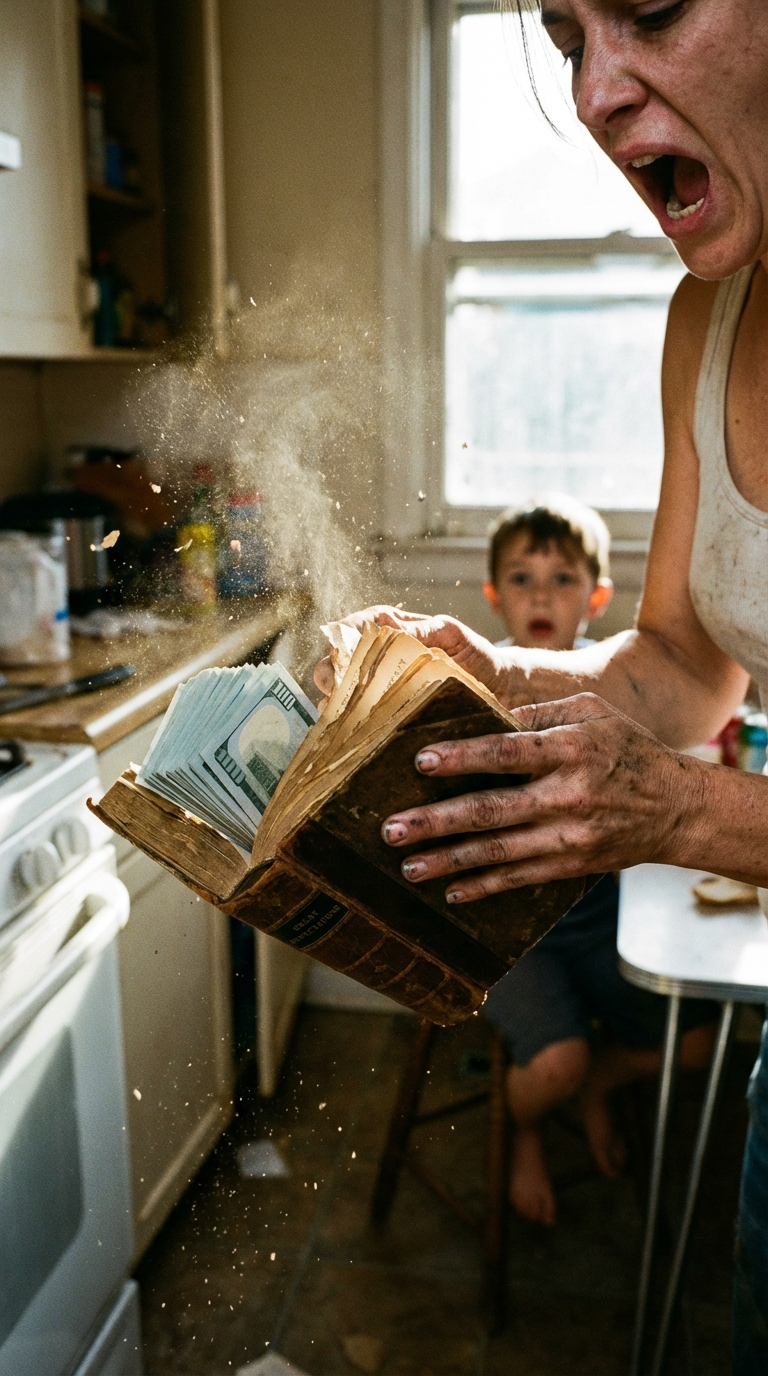
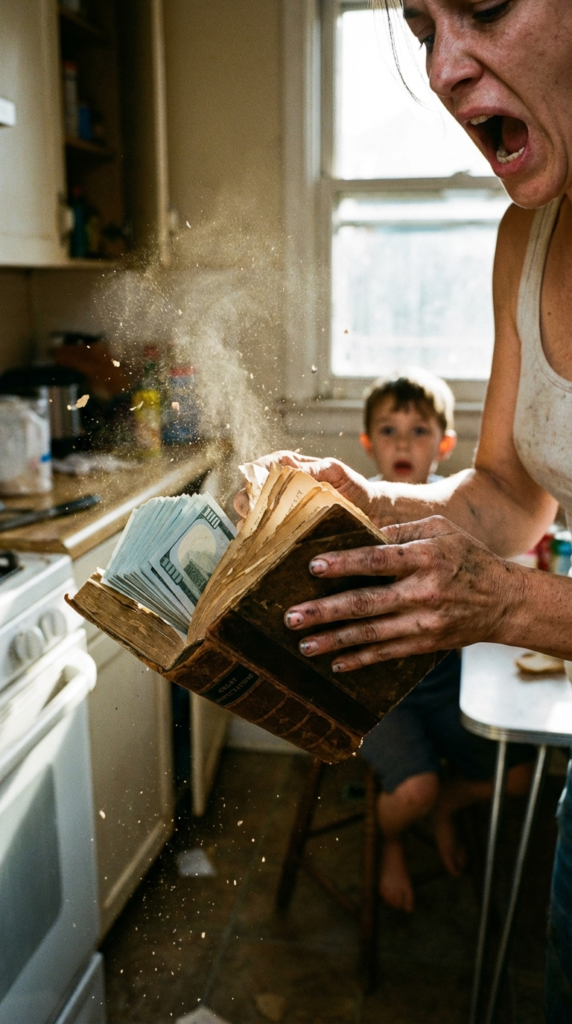
I tried to shake him off, but the desperation in his touch stopped me. I slammed the box onto our cheap laminate kitchen table in a blind rage. A thick cloud of dust puffed up into a shaft of afternoon sunlight, dancing mockingly.
I furiously ripped open the flaps. The box was filled with ancient, leather-bound books. Their spines were cracked, covers peeling like sunburned skin. Jane Eyre, Moby Dick, Great Expectations. Useless, heavy garbage.
I grabbed the top one—the rotting copy of Great Expectations—ready to hurl it across the room in a fit of impotence.
The heavy cover fell open in my hands.
I stopped breathing.
Stuck flat between pages 44 and 45 wasn’t a bookmark. It wasn’t a pressed flower. It was green paper. Benjamin Franklin’s judging eyes stared right at me. A crisp, one-hundred-dollar bill.
THE GHOST OF DEBT PAST
To understand why I almost collapsed at the sight of a hundred-dollar bill, you have to understand the last two years of my life.
I wasn’t always the yelling mom. I wasn’t always the tired waitress. Two years ago, I was Sarah Jenkins, a part-time graphic designer with a husband named Mark who worked in sales. We had a savings account. We had Sunday dinners. We were normal.
Then Mark discovered online gambling.
It didn’t happen all at once. It was a slow bleed. Fifty dollars here, two hundred there. He hid it well, until he couldn’t hide the second mortgage he took out on the house without telling me. The “toxic” part of our marriage wasn’t shouting; it was the gaslighting. When I’d ask where money went, he’d tell me I was crazy, that I’d spent it, that I was bad with numbers.
Six months ago, I came home to find his closet empty and a note on the fridge that said, “I can’t do this anymore. Sorry.”
He left me with $45,000 in debt, a foreclosure notice, and a shattered ten-year-old boy who thought his dad left because he didn’t clean his room enough.
We lost the house. We moved into this cramped two-bedroom apartment where the neighbors argue loudly at 3 AM and the heat only works when it feels like it.
I took the job at the diner because it was cash tips every night, money I could hide from the bank so it wouldn’t get swallowed by overdraft fees. Every day was a tightrope walk over a pit of financial ruin.
The bike wasn’t just a bike. It was my apology to Leo for wrecking his life. It was a shiny, blue promise that things would get better.
And when he traded it, I didn’t just see a lost bike. I saw my failure as a mother. I saw us on the street. I saw the terrifying reality that my son was too innocent for the brutal world I was raising him in.
THE PAPER RIVER
Back in the kitchen, the silence was different now. It was thick, heavy with disbelief.
Leo was watching me, his breathing shallow. “Mom? Are you okay? You’re shaking.”
I couldn’t speak. My hands, trembling violently, reached for the next page of Great Expectations.
Another hundred.
I flipped again. Two fifties.
I dropped the book and grabbed Moby Dick. I shook it upside down. A shower of green rained onto the kitchen table. It was like a magic trick. It was impossible.
I dumped the entire box out. There were twenty books in total.
For the next hour, Leo and I didn’t speak. The only sound in the apartment was the rustle of old paper and the sharp intake of breath. We went through every single page of every single book.
Mr. Henderson hadn’t just used them as a piggy bank; they were his life savings. Some bills were old and soft, dating back to the 80s. Others were brand new, crisp blue hundreds. They were tucked behind illustrations, flattened between chapters, lining the spines.
When the last book was empty, the kitchen table was covered in a chaotic mountain of cash.
I sat back in my rickety chair, my head spinning. I started counting. My hands were covered in dust and the peculiar ink smell of money.
One thousand. Two thousand. Five. Ten.
“Is it real?” Leo asked, his voice small. He picked up a stack of fifties, looking at them as if they might bite him.
“I think so, baby,” I whispered.
Thirty-two thousand, four hundred and fifty dollars.
I stared at the pile. It was more money than I made in a year. It was enough to pay off the immediate debts. It was enough for rent for two years. It was safety.
A sharp knock at the door shattered the moment.
We both jumped. I instinctively threw a dishtowel over the biggest pile of cash.
“Sarah? I know you’re in there. It’s the 1st of the month somewhere.”
It was Mr. Vane, the landlord.
My heart hammered against my ribs, but for the first time in six months, it wasn’t out of fear. It was adrenaline.
I looked at Leo. He looked from the door to the money, realization dawning on his face.
“Stay here,” I said, my voice steadier than it had been in years.
I walked to the door and opened it just a crack. Mr. Vane was standing there, smelling of cheap cologne and impatience.
“Rent’s due Friday, Sarah. I’m just here for a friendly reminder that I don’t do grace periods anymore. You got it, or do I need to start typing up the paperwork?”
I looked at this man, this petty tyrant who held the power to make my son homeless. I thought about the blisters on my feet. I thought about Mark running away like a coward.
“Wait one second, Mr. Vane,” I said coldly.
I closed the door in his face. I walked back to the kitchen table. I grabbed a stack of hundreds—twelve of them. I walked back to the door and whipped it open.
I slapped the money into his hand.
“Here’s this month,” I said, watching his jaw drop as he fingered the crisp bills.
Then, I reached into my pocket, where I’d shoved another stack. I peeled off another twelve hundred.
“And here’s next month. Now get off my doorstep and don’t come back until July.”
He spluttered, staring at the cash, then at me. He tried to sneer, to find some way to regain control, but the money silenced him. He turned and walked away without a word.
I closed the door and locked the deadbolt. The sound echoed like a gunshot starting a race.
THE REAL MAGIC
I slid down the door until I was sitting on the floor, and I started to cry. Not sad tears. Great, racking sobs of pure relief that shook my whole body.
Leo sat down next to me and put his head on my shoulder.
“Mr. Henderson was right,” he said softly. “They were magic.”
We sat there for a long time.
Later that night, after we had hidden the rest of the money in twenty different places around the apartment, I made Leo hot chocolate. We sat at the table where the dust from the books still lingered.
“Leo,” I said, taking his hands. “I am so sorry I yelled at you. I was scared. I was so scared.”
“It’s okay, Mom,” he said.
“No, it’s not. You did a kind thing. You saw someone sad and you tried to help, even though it cost you something you loved. That’s… that’s better than being smart with money. That’s being a good man.”
He smiled, a real smile this time.
The next day, we walked down to Mr. Henderson’s house. It was empty. A “Sold As Is” sign was planted in the overgrown lawn. Neighbors said an ambulance had come for him two days ago; he’d gone into hospice care. He had no family.
He knew. He must have known he was dying, and he saw a struggling mom and a kind-hearted boy, and he decided to leave his legacy to the only people who had talked to him in years.
We never got the bike back. Honestly, I didn’t want it.
Two weeks later, I bought Leo a new one. It wasn’t a $400 Trek. It was a solid, second-hand mongoose from a garage sale. He loved it just as much.
We used the money to pay off the debts that were drowning us. We moved into a slightly better apartment in a safer neighborhood. I cut my hours at the diner back to single shifts so I could be home for dinner.
We weren’t rich. $32,000 doesn’t last forever. But we were able to breathe.
I kept one bill—that very first hundred I found in Great Expectations. I framed it and hung it by our front door. It’s a reminder that sometimes, the things that look like trash are actually treasures, and the biggest mistakes can turn into the greatest miracles. And most importantly, it reminds me to listen to my son before I start yelling.