THE LAST TWELVE DOLLARS
The rain in Seattle doesn’t wash things clean; it just makes the grime stick to you. It was a relentless, gray drizzle that seeped into your bones. I was standing outside a Starbucks on 4th Avenue, my cheap interview suit—polyester, bought at a thrift store—soaked through to my skin. In my hand, I crumpled a rejection letter that felt less like a piece of paper and more like a physical blow to the chest.
That was the third “No” this week. And not just a “No,” but a “We’re going in a different direction, Clara.”
The direction of my life was currently a downward spiral. My ex-husband, Greg, had systematically drained our joint accounts before leaving me for his 24-year-old assistant, leaving me with nothing but debt and a bruised ego. My landlord, a man with as much empathy as a parking meter, had given me until Friday to pay rent or face eviction.
I pulled out my phone. Battery: 14%. Bank Account: $12.40.
I wasn’t just broke; I was broken. I was thirty-four years old, holding a Master’s degree in Supply Chain Management, and I was about to be homeless.
Then I saw him.
He was huddled on a soggy piece of cardboard near the building’s heating vent, shaking so hard his teeth were audibly chattering. He looked like a heap of discarded laundry. People in expensive North Face raincoats and Italian leather shoes stepped over him like he was a puddle of dirty water. They didn’t even break stride. He didn’t have a sign. He wasn’t asking for money. He was just trying not to freeze.
I looked at my banking app again. $12.40. A coffee and a warm sandwich would cost me roughly $11. It meant I wouldn’t eat dinner. It meant I couldn’t take the bus back to my apartment. I’d have to walk five miles in the rain.
I wrestled with the selfishness of survival. I need this money, I thought. I am drowning too.
But looking at him, shivering in a way that suggested hypothermia was knocking at the door, I realized I was drowning, but he was already underwater. I knew what it felt like to be invisible. To scream for help and have the world put on noise-canceling headphones.
I walked inside. The warmth of the coffee shop hit me, smelling of roasted beans and privilege. I bought a venti dark roast—black, maximum heat—and a warm turkey pesto panini.
I walked back out into the cold. I crouched down next to the vent.
“Hey,” I said softly, trying not to startle him. “It’s not much, but it’s hot.”
The man looked up. His face was hidden behind a matted gray beard, his eyes piercingly blue but exhausted, red-rimmed and wary. He stared at the steaming cup, then at the sandwich, and finally at me. He didn’t grab it. He studied me with an intensity that made me uncomfortable.
“Why?” he asked. One word.
“Because you’re cold,” I said simply. “And I’ve had a really bad day. Maybe making yours better will fix mine.”
He took the food. His hands were caked in dirt, fingernails long and jagged. But he didn’t eat immediately. He reached into the deep pocket of his filthy, oversized army jacket.
I flinched. Instinct took over; I thought he was reaching for a weapon. My heart hammered against my ribs.
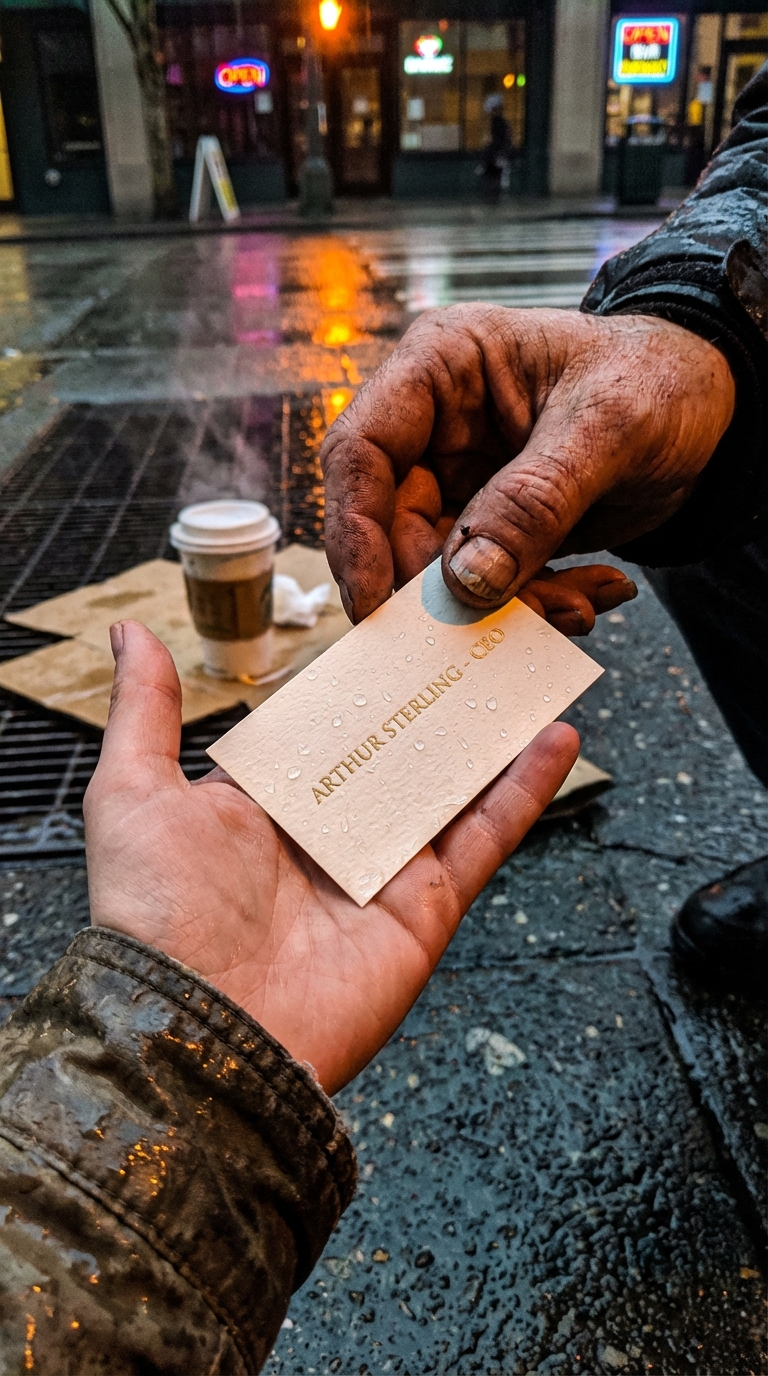
Instead, he pulled out a small, wet, rectangular piece of paper. It wasn’t a gum wrapper. It was thick. Heavy cardstock.
“Take it,” he rasped, his voice sounding like gravel churned in a mixer. “Come to this address at 9:00 AM tomorrow. Don’t be late. Ask for the Board Room.”
I took the card. I wiped a raindrop off the surface. The gold embossing caught the streetlamp light, shimmering against the gray backdrop of the city.
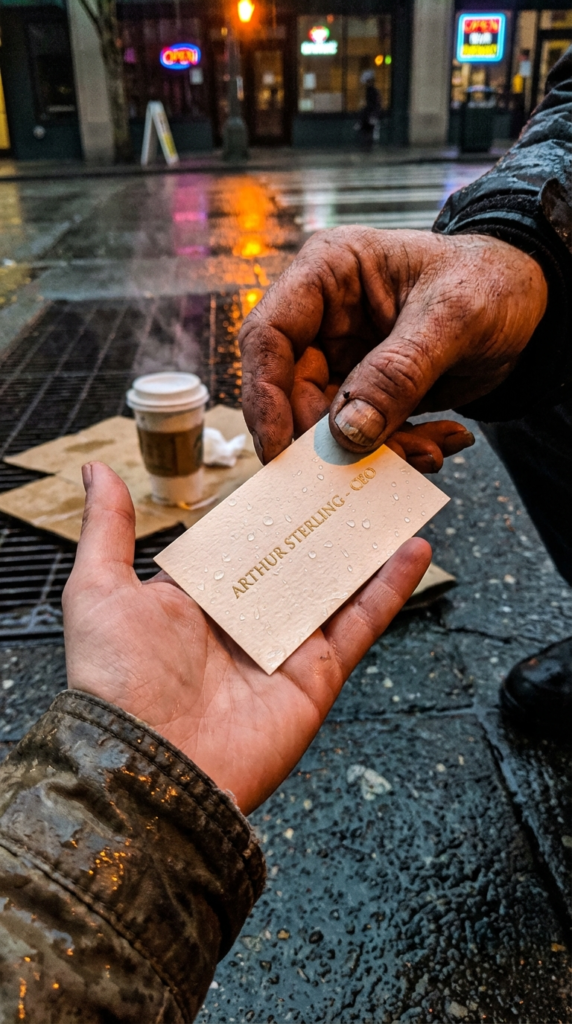
Arthur Sterling. CEO, Sterling Dynamics.
I froze. My breath hitched. Sterling Dynamics was the company I had just walked out of. The company that had just rejected me. The tech giant that practically owned the Pacific Northwest.
“Arthur Sterling hasn’t been seen in public for three years,” I whispered, repeating the rumors I’d read in the business journals. “Everyone says he’s a recluse. Sick. Dying.”
The man took a bite of the panini, closing his eyes as the warmth hit him. “People say a lot of things,” he mumbled. “9:00 AM. Don’t make me regret the coffee.”
THE SNAKE IN THE SUIT
To understand why that card felt like a live grenade in my hand, you have to understand the man who had just fired me before I was even hired.
Marcus Vane.
Marcus was the VP of Operations at Sterling Dynamics. He was also the man who had been my boss at my previous company, LogiTech. Two years ago, Marcus had orchestrated a massive accounting error to cover his own embezzlement. When the auditors came sniffing, he had expertly framed me.
I didn’t go to jail—there wasn’t enough hard proof—but I was blacklisted. My reputation was torched. Marcus, meanwhile, failed upward, landing a cushy executive role at Sterling Dynamics.
When I applied to Sterling, I used my maiden name. I got through the initial screenings. I got the interview. But when I walked into that glass-walled office an hour ago, Marcus was sitting there.
He didn’t interview me. He gloated.
“Clara, Clara, Clara,” he had sneered, spinning a Montblanc pen in his fingers. “Did you really think you could sneak past me? I run this city’s logistics networks. You’ll never work in this town again. I’ll make sure of it.”
He had security escort me out. He humiliated me. He wanted me to know that he still held the leash.
So, standing there in the rain with the homeless man’s card, I felt a surge of terrifying hope mixed with skepticism. Was this a prank? Was this man just a delusional wanderer who found an old business card in a dumpster?
Arthur Sterling was a legend. A billionaire engineer who built an empire and then vanished into his estate after his wife died. The idea that he was sitting on a grate on 4th Avenue was insane.
But I had nothing left to lose.
THE ELEVATOR RIDE
The next morning, I put on my suit again. I ironed it dry. It smelled faintly of damp wool, but it was all I had.
I walked into the Sterling Dynamics tower at 8:50 AM. The lobby was a cathedral of glass and steel.
“I have a meeting with Mr. Sterling,” I told the receptionist.
She looked at me like I was a bug on the counter. “Mr. Sterling is not on the premises. He hasn’t been here in years. If you don’t have an appointment, I’m calling security.”
“I have this,” I said, sliding the dirty, water-warped card across the marble.
She picked it up with two fingers, grimacing. She was about to toss it in the bin when she paused. She turned it over. There was a handwritten code on the back in blue ink. Omega-7-Blue.
Her face drained of color. She looked at me with new eyes. Fear.
“Wait here,” she whispered. She picked up the phone, her hand trembling. “Security? Code Omega. Yes. Escort to the Penthouse Boardroom.”
Two minutes later, I was in a private elevator rising 60 floors. My stomach was doing somersaults.
When the doors opened, I wasn’t in a hallway. I was directly in the boardroom.
It was full.
Twelve people sat around a mahogany table that cost more than my parents’ house. And at the head of the table sat Marcus Vane.
He stopped mid-sentence. His eyes bulged when he saw me.
“What is this?” Marcus stood up, his face flushing red. “Security! I told you to throw this trash out yesterday! How did she get up here?”
I stood my ground, though my knees were shaking. “I was invited.”
“Invited?” Marcus laughed, a cruel, barking sound. “By who? The janitor?”
“By me,” a voice boomed from the double doors behind Marcus.
The room went dead silent.
The doors swung open. A man walked in. He was clean-shaven now. He wore a charcoal three-piece suit that fit him like armor. His hair was trimmed silver. But the eyes—those piercing, intense blue eyes—were unmistakable.
It was the man from the vent.
Gasps rippled around the table. “Mr. Sterling,” someone whispered.
Marcus looked like he had seen a ghost. “Arthur? Sir? We… we didn’t know you were coming back. You look… well.”
Arthur Sterling ignored him. He walked straight to me. He extended a hand. “Clara. You’re on time.”
“I walked,” I said, my voice steadying.
“I know,” Arthur said. He turned to the table. “For the last month, I have been living on the streets of this city. I wanted to see what my company looks like from the ground up. I wanted to see how we treat the people we serve. And I wanted to see who, in this city of three million people, still had a soul.”
He paused, his gaze drilling into Marcus.
“I sat outside this building for three days,” Arthur continued. “Hundreds of my own employees walked past me. Some spat. Some looked away. Only one person stopped. Only one person spent her last dollar to feed me.”
He gestured to me.
Marcus was sweating profusely now. “Sir, that’s… that’s very touching, but this woman is a liability. She was fired from LogiTech for embezzlement. She’s a thief.”
Arthur smiled. It wasn’t a nice smile. It was a shark’s smile.
“I know,” Arthur said. “I had my private investigators look into Clara’s file last night. It’s amazing what you find when you dig deep, Marcus. We found the digital footprints. We found the offshore accounts. Yours. Not hers.”
Marcus knocked his chair over backing away. “This is preposterous! You can’t prove—”
“I already have,” Arthur interrupted. He tossed a file onto the table. It slid across the mahogany and stopped right in front of Marcus. “The police are waiting in the lobby. You’re fired, Marcus. And you’re going to prison.”
Two security guards stepped forward. Marcus looked at them, then at me. The arrogance was gone, replaced by the terrified look of a trapped rat. As they dragged him out, he didn’t scream. He just stared at the floor.
THE NEW ARCHITECT
The room was silent again. The remaining board members looked terrified.
Arthur turned to me. “I need a new VP of Operations. Someone who understands logistics, yes. But someone who understands that numbers on a spreadsheet are actually people.”
He pulled a contract from his jacket pocket.
“The salary is triple what Marcus was making,” Arthur said. “Plus a signing bonus that should clear up your landlord issue by this afternoon.”
I looked at the contract. I looked at the man who had been shivering in a box twelve hours ago.
“Why?” I asked again.
“Because you tied a knot,” he said cryptically, winking. “Or rather, you bought a coffee. You saw me, Clara. Now, I want you to help me make sure this company sees everyone else.”
I picked up the pen.
EPILOGUE
I paid my landlord in cash. I moved into a new place a month later. But the first thing I did as VP of Operations was launch the “Sterling Shelter Initiative.” We converted three of our unused warehouses into state-of-the-art transitional housing and job training centers.
Every morning, when I walk into the building, I look at the heating vent. It’s empty now. But I never forget the feeling of the rain, the fear of the last dollar, and the power of a single cup of coffee.
I saved Arthur Sterling’s life that night—he told me later he was close to giving up on humanity, close to selling the company and disappearing for good.
But he saved mine, too.