THE VULTURE IN THE MERCEDES
I sat on the crumbling curb, hugging my knees to my chest, the damp cold of the pavement seeping into my bones. I was staring at the blackened, dripping skeleton of what used to be my life. The smell was specific—a suffocating mix of wet ash, melted plastic, and the ozone tang of total destruction.
“I told you,” a voice sneered from the open window of a sleek black Mercedes parked across the street.
It was Mark. My ex-husband. He hadn’t come to help. He had come to collect.
“You can’t take care of them, Sarah,” he said, stepping out of the car, adjusting his expensive cufflinks as if he were walking into a board meeting rather than a disaster zone. “Look at this mess. You have no renter’s insurance because you missed the payment. You have no savings. You’re done.”
He walked over, his Italian leather shoes crunching on the glass of my blown-out living room window.
“Sign the custody papers,” he said, his voice dropping to that faux-sympathetic tone that used to trick me. “Let me take the kids. I’ll get you a motel room for a week. It’s more than you deserve after putting them in danger like this.”
He was right about the danger. I was done. I had escaped him two years ago with nothing but two suitcases and my dignity. I had fled a marriage that was a golden cage, where every dollar I spent was tracked, where I wasn’t allowed to have friends, where I was told daily that I was incompetent.
I had clawed my way back. I worked two jobs—stocking shelves at the library by day, baking cakes by night. I had built that little rental house into a sanctuary. Every piece of furniture was a thrift store find I had sanded and painted myself. Every book was a treasure.
And a faulty wire in the wall—something the landlord swore he’d fix next week—had taken it all in twenty minutes.
I looked at my twins, Leo and Mia, huddled under a gray Red Cross blanket, their faces streaked with soot and tears. They looked at me with wide, terrified eyes. I was about to stand up. I was about to give in. I was about to sign my freedom away because I couldn’t let them sleep on the street.
Then, I felt a vibration in the ground. A low rumble.
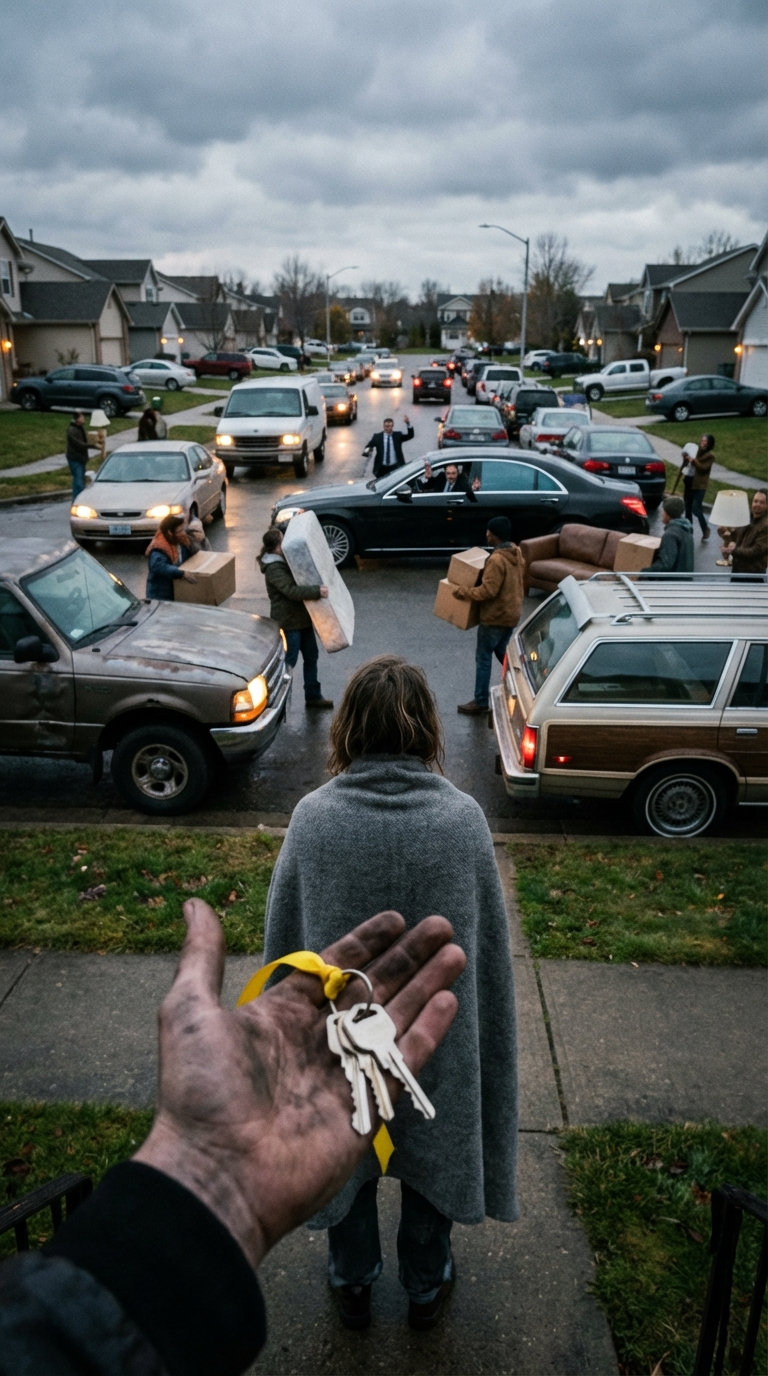
I looked down the street. It wasn’t a fire truck. It was a caravan.
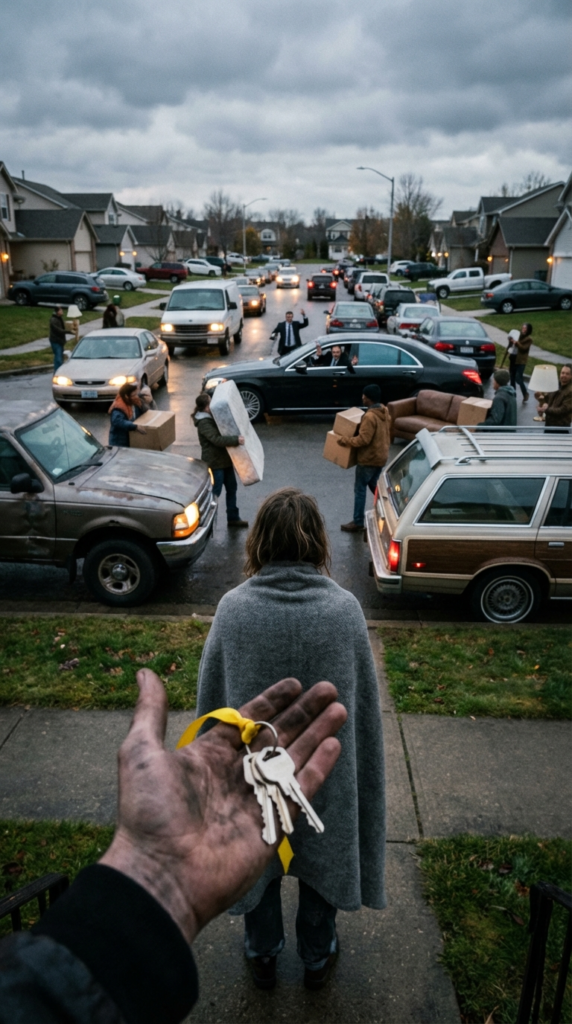
A line of cars, trucks, and minivans was turning the corner. Five. Ten. Twenty. They just kept coming. They parked on the grass, on the sidewalk, double-parking, effectively boxing Mark’s Mercedes in.
People started pouring out. It looked like an invasion. I didn’t recognize them. Women carrying boxes, men hauling mattresses strapped to roofs, teenagers holding bags of groceries.
A woman in a heavy wool coat walked straight up to me. She walked right past Mark like he was invisible. She stopped in front of me and held out her hand.
In her palm was a silver key on a bright yellow ribbon.
“We heard what happened,” she said. “We didn’t know if you liked the second floor or the first, so we got you the whole duplex.”
THE INVISIBLE WOMAN
To understand why fifty strangers were standing on my lawn, you have to understand who I was before the fire.
I was the Invisible Woman. That’s what Mark had trained me to be. “Don’t make a scene, Sarah.” “Nobody cares what you think, Sarah.”
When I left him, I was terrified of the world. But I needed to survive. I got a job at the public library. It wasn’t glamorous. I checked books in and out. But I started noticing people.
I noticed the elderly man, Mr. Henderson, who came in every Tuesday just to have someone to talk to. I started baking him muffins. I noticed the stressed young mom, Jenna, who couldn’t afford late fees. I paid them for her out of my tip jar from the bakery gig. I noticed the teenager, Chris, who hid in the back corner because he was being bullied. I let him charge his phone behind my desk and gave him the Wi-Fi password.
I did these things because I knew what it felt like to be alone. I didn’t think anyone noticed. I didn’t think it mattered. I was just the quiet lady at the library desk.
I didn’t know that Jenna ran the biggest “Mom’s Group” in the county. I didn’t know Mr. Henderson was a retired union leader with connections to every contractor in the city. I didn’t know Chris ran a local discord server with 5,000 members.
When the fire news hit the police scanner and the local Facebook page last night, Jenna recognized the address. She posted it. Chris boosted it. Mr. Henderson made calls.
While I was watching my house burn, they were building me a new one.
THE STANDOFF
Back on the curb, Mark looked around, confused. His narrative was collapsing.
“Who are you people?” he barked, stepping toward the woman with the keys. “I’m her husband. I’m handling this.”
“Ex-husband,” the woman said coolly. Her name was Brenda. I remembered her; she came to the library for gardening books. “And you’re not handling anything. You’re blocking the loading zone. Move your car.”
“I’m not moving anything,” Mark spat. “Sarah is destitute. She has nowhere to go. The courts will give me the kids by noon.”
Brenda turned to the crowd. “Boys?”
Three large men stepped forward. One was Mr. Henderson’s son. Another was the guy who fixed the library roof last winter. They crossed their arms.
“She’s not destitute,” Brenda said, turning back to Mark. “She has furniture. She has clothes. She has food for a month. And she has a lease signed and paid for six months on the duplex down the street. We crowdfunded it in three hours.”
She turned to me, her eyes softening. “Sarah, you aren’t alone. You never were. You just didn’t look up from your desk long enough to see us.”
I stood up. My legs were shaking, but not from fear anymore.
I walked over to Mark. He looked small. For the first time in ten years, he looked small.
“You heard her,” I said, my voice raspy from smoke but steady as steel. “Move your car. We have moving to do.”
PART IV: THE NEW SANCTUARY
The “strangers” didn’t just drop off stuff. They moved me in.
They drove us to the duplex—a beautiful, sunny place three blocks away. It wasn’t empty.
They had set up beds. There were sheets on them. There were toys for Leo and Mia—the exact Lego sets they had lost in the fire (Chris had remembered Leo talking about them). The kitchen was stocked. There was a lasagna in the oven.
I sat on a couch that smelled like lemon polish—a donation from a family I’d helped find tax forms for—and I cried.
Mark tried to sue for emergency custody the next day. He walked into the courtroom with his expensive lawyer, claiming I was unstable and homeless.
I walked in with a lease, a bank statement showing the surplus donations ($15,000), and five character witnesses including the head librarian and a city council member who knew me because I always saved him the morning paper.
The judge threw Mark’s case out in ten minutes.
THE AFTERMATH
It’s been six months.
I didn’t keep all the money. I used what I needed to get back on my feet, and I used the rest to start a foundation called “The Library Fund.” We help people who fall through the cracks—one rent payment, one grocery run, one pair of shoes at a time.
Mark stopped calling. He realized he couldn’t bully a woman who had an army behind her.
I realized something too. I used to think independence meant doing everything by yourself. I used to think asking for help was weakness, because Mark told me it was.
But as I tuck Leo and Mia into their beds in our safe, warm duplex, I know the truth. Independence isn’t solitude. Independence is having a village so strong that no tyrant can ever tear your house down again.
The fire took my things. But the strangers? They gave me back my voice.