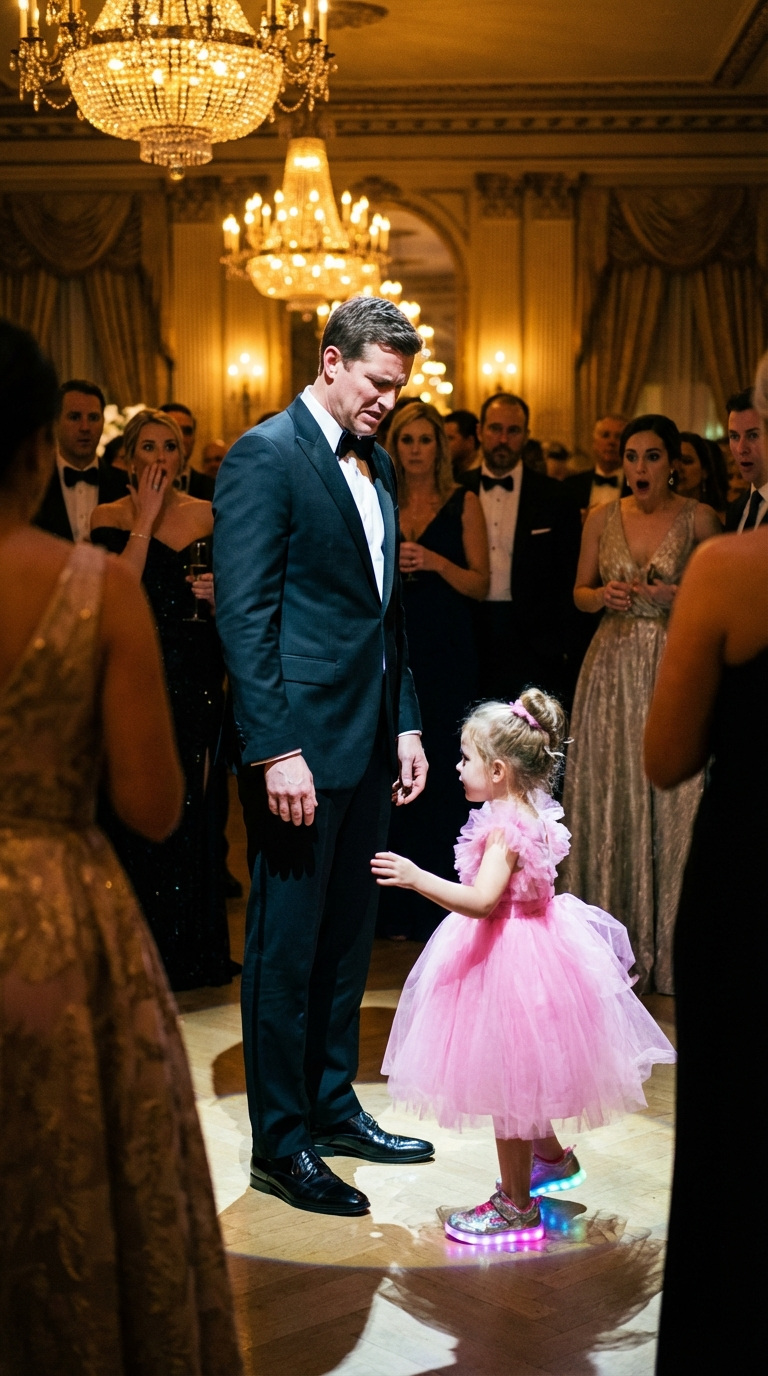
I held my breath, watching my five-year-old daughter, Lily, march across the pristine marble dance floor toward the most dangerous man in New York City.
Julian Blackwood. The Tech Titan. The “Ice King.” The man whose net worth was higher than the GDP of some small countries.
He was standing alone near the string orchestra, nursing an amber scotch, looking at the crowd with absolute disdain. In the last hour, he had already made two waiters cry. He had ignored the Mayor’s outstretched hand. He had walked away while a Senator was midway through a compliment.
I was only there because my catering shift manager, a tyrant named Greg, had threatened to fire me if I didn’t work the Winter Solstice Gala. My babysitter had canceled ten minutes before my shift. I had no choice. I had smuggled Lily in through the service entrance and hidden her in the coat check room with an iPad, a bag of goldfish crackers, and strict instructions to stay put.
But Lily doesn’t do “stay put.” She does “explore.”
I was halfway across the room, balancing a heavy tray of untouched champagne flutes, when I saw her. She was wearing her favorite outfit: a cheap, glittery pink tulle dress from Walmart that scratched her skin, her light-up sneakers, and a plastic tiara missing two gems.
She looked like a drop of bright strawberry syrup in a sea of black ink and diamonds.
“Lily! No!” I whispered frantically, trying to maneuver through the wall of tuxedoes without dropping the tray.
She didn’t hear me. She had a mission. She walked right up to Julian Blackwood. He was six-foot-three, broad-shouldered, and imposing. She was three-foot-nothing.
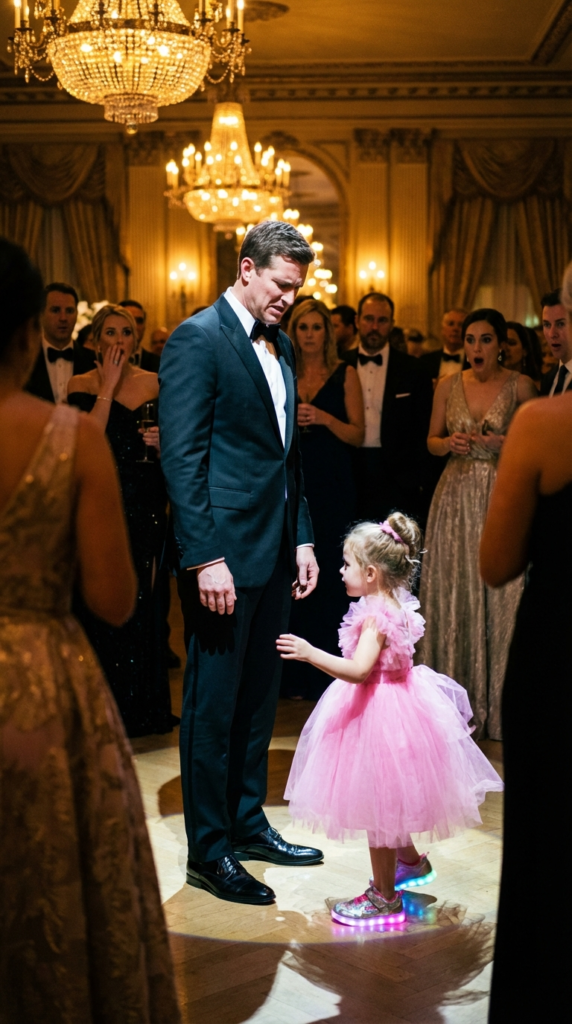
The chatter in the ballroom died. The music seemed to stop. The wealthy socialites nearby gasped and pulled back, clutching their pearls, waiting for the explosion. This was the man who fired people for making eye contact in the elevator. This was the man who hadn’t smiled in public in five years.
Julian looked down. His face was a mask of cold granite. He glared at this tiny intruder who had dared to enter his perimeter.
“Are you lost?” he rumbled, his voice deep, baritone, and terrifying.
I was ten feet away, paralyzed. My heart hammered against my ribs. I was about to lose my job. I was about to be humiliated in front of the city’s elite. I prepared myself to drop the tray and run to shield her.
Lily didn’t flinch. She tilted her head, looking up at his stormy grey eyes with the brutal honesty only a child possesses.
“No,” she said, her voice ringing out in the silent ballroom. “But you look like my daddy did before he went to heaven. You have the sad eyes.”
Julian froze. The air left the room. His grip on the crystal glass tightened until his knuckles turned white. He looked like he had been slapped.
Lily reached out her tiny, sticky hand. “My mommy says lonely people need hugs. Do you want to dance?”
THE INVISIBLE WAR
To understand why the room was holding its breath, you have to understand the myth of Julian Blackwood.
Five years ago, Julian wasn’t the Ice King. He was charismatic. He was open. He was a husband and a father. Then came the crash. A drunk driver on the I-95. He lost his wife, Elena, and his six-year-old daughter, Sarah, in a heartbeat.
He survived without a scratch. Physically, at least.
Since that day, he had dismantled his life. He sold his family home. He threw himself into his company with a ruthless, robotic efficiency. He stopped attending social events, and when he did, he stood in the corner like a gargoyle, radiating a misery so intense it felt like cold radiation.
And then there was me. Maya. A twenty-eight-year-old widow trying to keep the lights on. My husband, Mark, had died of cancer two years ago, leaving me with mountains of medical debt and a daughter who looked just like him.
I was the “help.” I was invisible to people like Julian Blackwood. I was a pair of hands holding a tray.
But Lily saw everyone. She hadn’t learned yet that there were social strata. She hadn’t learned that you don’t talk to the billionaires. She only knew grief, because she lived with it too. She saw a mirror in Julian’s eyes.
THE WALTZ
Julian stared at Lily’s hand. For a second, I thought he was going to snap at her. I thought he was going to signal security to have us thrown out.
I took a step forward. “I am so sorry, sir,” I blurted out, my voice shaking. “She’s mine. She slipped away. We’re leaving.”
Julian didn’t look at me. He didn’t blink. He slowly set his drink down on a passing waiter’s tray without breaking eye contact with Lily.
He dropped to one knee.
The movement was so fluid, so unexpected, that a collective gasp rippled through the room. The giant was kneeling. He was now eye-level with the girl in the Walmart dress.
“You think I have sad eyes?” Julian asked, his voice rough, like gravel grinding together.
“Yes,” Lily said, reaching out to touch his cheek. “Like you lost your best friend.”
Julian closed his eyes. I saw his throat work as he swallowed a lump the size of a fist. He took a shuddering breath.
“I did,” he whispered. “I lost two of them.”
“That’s okay,” Lily said matter-of-factly. “I can be your best friend for tonight. But we have to dance. dancing scares the sad away.”
Julian opened his eyes. The ice was cracking. There was water in them.
“I don’t know if I remember how,” he said.
“It’s easy,” Lily said. “You just wobble.”
Julian let out a sound. It was rusty and strange. A laugh. A genuine, broken laugh.
“Wobble,” he repeated.
He stood up. He offered his hand to her—the hand that signed billion-dollar mergers. Lily took it.
He gestured to the conductor, who was staring with his mouth open. “Play,” Julian commanded. “Something… wobbly.”
The orchestra launched into a gentle waltz.
And there, in the middle of the Plaza Hotel ballroom, under million-dollar chandeliers, Julian Blackwood danced. He didn’t dance like a socialite. He danced like a dad. He held Lily’s hand high, twirling her. She giggled, her light-up sneakers flashing red and blue with every step, clashing horribly and beautifully with the decor.
He spun her. He bowed to her. For three minutes, the rest of the room ceased to exist. The sharks, the gold-diggers, the politicians—they all vanished. It was just a grieving man and a little girl healing each other.
I stood there, tears streaming down my face, forgetting I was holding a tray.
THE AFTERMATH
When the music ended, Julian bowed low to Lily.
“Thank you, mademoiselle,” he said.
“You’re welcome, Sad Eyes,” she chirped.
Then he turned to me. The softness lingered in his face, but the authority returned. He walked over to where I was standing.
“Is she yours?” he asked.
“Yes, sir,” I stammered. “I’m so sorry, I—”
“Don’t apologize,” he cut me off. “What is your name?”
“Maya.”
“Maya. Take that apron off.”
“Sir, I need this job. Please.”
“You don’t need this job,” he said. He pulled a card from his tuxedo pocket. “My executive assistant just quit. She couldn’t handle the… atmosphere. I need someone who isn’t afraid of reality. And I need to be reminded that the world isn’t just numbers.”
He looked down at Lily, who was now examining the sequins on a nearby lady’s dress.
“She reminds me of Sarah,” he said quietly. “I forgot what it sounded like to hear a child laugh.”
THE NEW LEGACY
I didn’t believe him at first. I thought it was a rich man’s whim.
But I showed up at the address on the card the next day. It wasn’t a whim.
I’ve worked for Julian for three years now. I’m not his caterer; I’m his Director of Philanthropy.
Julian changed. He didn’t become a saint overnight—he’s still demanding, he’s still intense—but the ice melted. He started a foundation in his daughter’s name. We build art centers for grieving children.
Lily is eight now. She calls Julian “Uncle J.” He comes to her school recitals. He sits in the front row, usually the only man in a bespoke suit, cheering the loudest when she plays the recorder badly.
Last week, we were at another gala. This one was for our foundation.
Julian was on stage, giving a speech. He looked out at the crowd, smiling.
“People ask me how I turned the company around,” he said into the mic. “They ask about strategies and market caps.”
He pointed to table one, where Lily was sitting, drawing on a napkin.
“But the truth is, I just needed to learn how to wobble.”
The room erupted in applause. I looked at Julian, and then at my daughter. The man who had ignored everyone, who had shut out the world to protect his broken heart, had been saved by a five-dollar plastic tiara and a refusal to let him stay lonely.
It turns out, the most powerful transaction in the world isn’t a merger. It’s a hug.