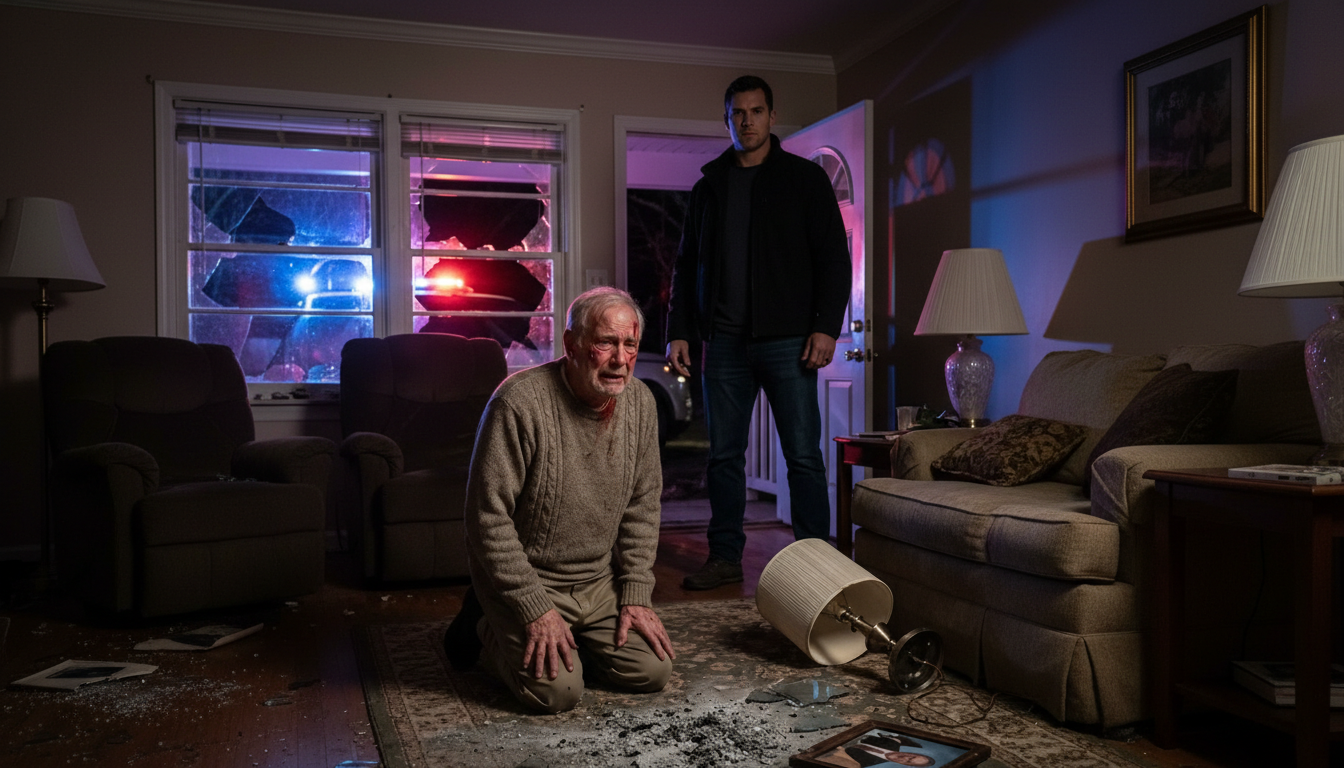
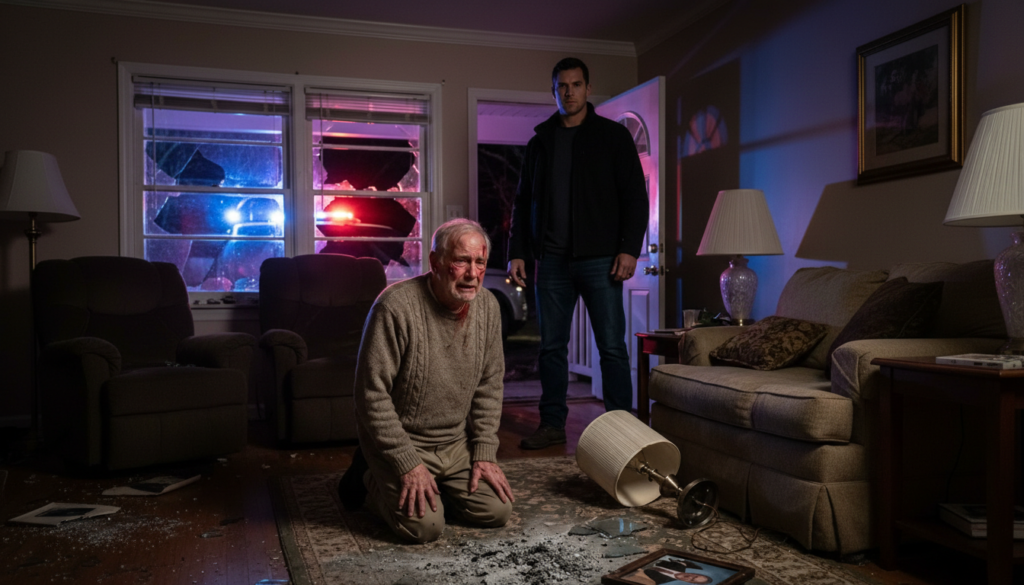
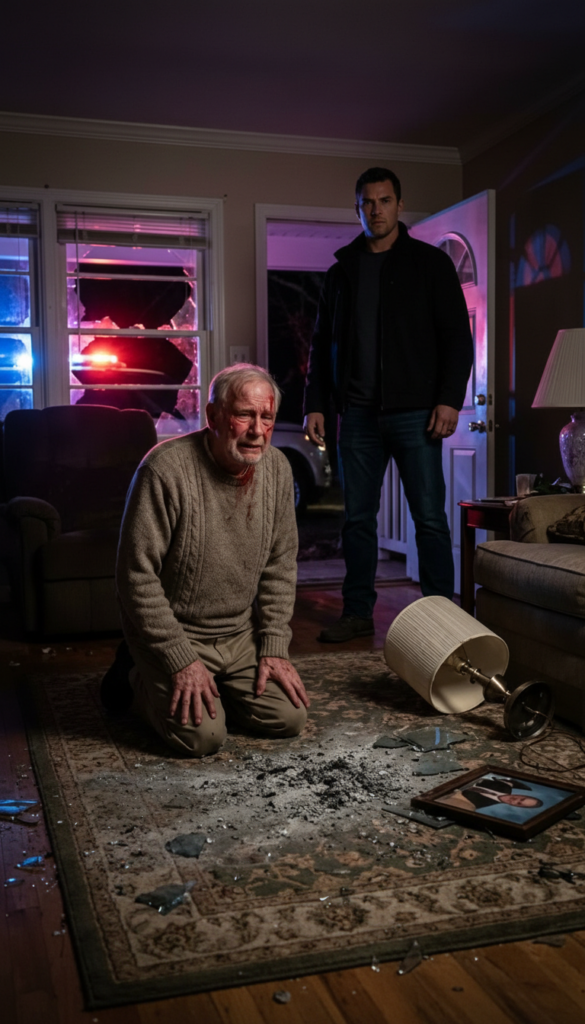
I was standing in the shattered glass of my father’s living room, my heart pounding so hard I thought it would explode. The window I’d smashed was still dripping with rain, streaks of water catching the red and blue lights from the cop cars outside like blood vessels on glass. The sirens had stopped, but I could hear boots crunching on gravel, voices shouting commands I couldn’t process.
And there he was.
My father. Robert Mitchell. Seventy-two years old. The man who taught me to ride a bike, who came to every one of my Little League games, who cried at my high school graduation. On his knees on that ugly beige rug he’d had since I was six. Blood trickling from his temple where he’d hit the corner of the coffee table when I shoved past him. His mouth open in this gasping, wounded-animal cry that I’ll hear in my nightmares for the rest of my life.
I didn’t mean for it to go this far. I swear to God, I didn’t mean for any of this.
Let me back up. Let me explain how a good son becomes the kind of man who breaks into his father’s house in the middle of the night.
Three days earlier, my phone rang at 2:47 AM. I know because I stared at the time for a full minute before answering, my wife Sarah grumbling beside me about “probably a wrong number.”
“Is this Daniel Mitchell?” a woman’s voice asked. Professional. Cold.
“Yeah. Who is this?”
“I’m calling from Providence Medical Center. Your father, Robert Mitchell, was admitted tonight with a suspected cardiac event. You’re listed as his emergency contact.”
The words hit me like a freight train. Five years. Five years of silence, of not speaking, of crossing the street if I saw his car at the grocery store. And he still had me listed as his emergency contact.
“Is he—is he okay?” I managed.
“He’s stable now, but you should come as soon as you can.”
I threw on clothes, left a note for Sarah, and drove ninety miles an hour to the hospital. The whole way, I kept thinking: This is it. This is your chance. You tell him you’re sorry, he tells you he’s sorry, and you get your father back before it’s too late.
Because here’s the thing nobody tells you about family feuds: they feel righteous for about six months, and then they just feel stupid. Exhausting. Lonely.
Our fight—God, it seems so petty now—was about Mom’s house. When she died of cancer three years ago, Dad wanted to sell it immediately. “Too many memories,” he said. “I can’t live there anymore.” I thought he should wait, that he was making decisions while grieving. We said things we couldn’t take back. He called me controlling. I called him a coward who was running from Mom’s memory.
He told me I was no son of his. I told him fine, maybe I wasn’t.
We hadn’t spoken since Mom’s burial.
But at 3:30 AM, driving through empty streets with my hands shaking on the wheel, none of that mattered. I just wanted my dad to be okay.
I burst through the ER doors, found the front desk. “Robert Mitchell. Heart attack. Where is he?”
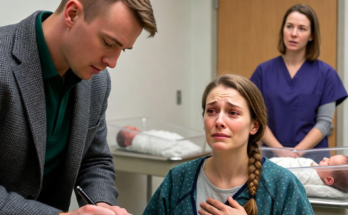
The nurse, this young woman with tired eyes, looked at her computer. Frowned. Looked at me. “Sir… your father was discharged two hours ago. At 1:15 AM.”
“What? No. I just got a call.”
“Let me check again.” She clicked through screens. “Yes. Robert Mitchell, 72. Came in with chest pains around 11 PM. EKG was normal. Anxiety attack. We observed him for an hour, he felt better, and he signed himself out.”
“But someone called me. They said—”
“I don’t know who called you, sir, but your father went home. He’s fine.”
I stood there feeling like an idiot. An anxiety attack. Not even a real heart attack. And he’d left without telling them to cancel the call to me.
Or maybe—maybe he’d wanted me to come. Maybe this was his way of reaching out.
I called his cell seventeen times on the drive to his house. Straight to voicemail. Every single time, that robotic voice: “You have reached Robert Mitchell. Please leave a message.”
By 4 AM, I was parked outside his house—the house where I grew up, where Mom used to make Sunday pancakes, where Dad taught me to throw a football in the backyard. His car was in the driveway. Lights were on in the living room.
I knocked. Rang the doorbell. Knocked harder. Pounded.
“Dad! It’s me! Open up! I know you’re in there!”
Nothing.
I circled the house, peering in windows. I could see the TV flickering. His reading glasses on the side table. But no Dad.
That’s when my brain started going to dark places. What if he’d had another attack? What if he was lying on the floor, unable to reach the door? What if I was standing out here yelling while my father died alone inside?
I tried the back door. Locked. Checked under the mat for a spare key—nothing. The garage side door—locked.
And then I just… snapped.
I picked up a decorative rock from Mom’s old garden—she’d painted it herself, with little flowers—and I hurled it through the living room window.
The crash was so loud. Glass everywhere, glittering under the streetlight like diamonds. And suddenly I could hear everything: a neighbor’s dog barking, my own ragged breathing, and—
Footsteps. Running footsteps inside the house.
I climbed through the window, my jacket catching on jagged glass, a shard slicing my palm. Didn’t even feel it.
“Dad! DAD!”
I burst into the living room just as he came around the corner from the hallway. We collided. He was bigger than I remembered—or maybe I was just smaller, after five years of feeling like a child who’d disappointed his parent. He stumbled backward, grabbed my jacket, and we both went down. He hit the coffee table. That sickening crack.
And then the lights.
Red and blue lights flooding the windows. Someone had called the cops.
Dad crawled away from me, got to his knees on that old rug. Blood on his face. That horrible, wounded cry.
I froze. Literally couldn’t move. Because in that moment, I saw what I’d become. What rage and stubbornness and five years of silence had turned me into.
A monster.
“Please,” Dad whispered, and his voice was so small. So old. When had he gotten old? “Please, son. Let me show you something before you do this.”
“Before I—Dad, I’m not going to—I didn’t mean to—”
But he was already reaching into his cardigan pocket with shaking hands, and I almost tackled him because what if he had a weapon, what if after everything, it ended like this—
He pulled out an envelope. Crumpled, worn at the edges like it had been folded and unfolded a thousand times. My name was on it in handwriting I’d know anywhere.
Mom’s handwriting.
“She gave this to me,” Dad said, “the night before she died. Made me promise not to give it to you until… until I thought you were ready.”
I took it. My hands were shaking so badly I could barely tear it open. Behind me, I could hear cops at the door: “POLICE! OPEN UP!”
“Dad, we have to—”
“Read it,” he said. “I’ve been trying to give this to you for three years.”
I unfolded the letter. Mom’s handwriting, getting weaker toward the end, the cancer eating away at everything including her ability to hold a pen steady.
My dearest Danny,
If you’re reading this, I’m gone, and I’m guessing you and your father aren’t speaking. I know my boys. I know how stubborn you both are—you got that from me, not him, no matter what he says.
I need you to know something about the house. Your father didn’t want to sell it because he was running from memories. He wanted to sell it because he couldn’t afford to keep it.
We took out a second mortgage four years ago to pay for my treatments. The ones insurance wouldn’t cover. The experimental ones that bought me two more years with you both. Your father worked three jobs—yes, THREE, those “consulting gigs” and “freelance projects” were him installing floors at night and driving for a medical transport service on weekends—to keep us afloat.
He sold his father’s watch. His vintage car. The signed baseball from Mickey Mantle that he’d had since he was ten. He sold everything, Danny. And he never told you because he didn’t want you to worry, didn’t want you to feel guilty about my treatment costs.
When I died, we were $340,000 in debt. The house—our house—was the only way to fix it. He wasn’t running from me. He was trying to honor my memory by not drowning in debt I caused.
Please forgive him. Please forgive each other. Life is too short for this silence.
I love you forever,
Mom
I couldn’t breathe. Couldn’t see through the tears. Three hundred and forty thousand dollars. Three jobs. Everything he loved, sold to buy Mom two more years.
And I’d called him a coward.
“POLICE! WE’RE COMING IN!”
The door burst open. Two officers, guns drawn, taking in the scene: broken window, blood on my father’s face, me holding a letter and crying like a child.
“I’m sorry,” I sobbed. “Dad, I’m so sorry—”
And my father—this man I’d shoved to the floor, this man I’d hurt—crawled over to me and wrapped his arms around me like I was six years old again and had skinned my knee on the driveway.
“I should have told you,” he whispered. “I should have told you everything.”
I’m writing this from Dad’s living room—the window has been replaced, the coffee table repaired. The charges were dropped after Dad explained everything to the police, insisted it was all a misunderstanding, that I was trying to help, that the fall was an accident.
The medical bills are paid off now. Sarah and I remortgaged our house to help. It wasn’t even a question.
Dad and I talk every day. Sometimes about big things, mostly about small ones: the weather, a movie he watched, whether the Patriots have any shot this season (they don’t). We’re rebuilding. Slowly. Carefully.
Some nights, when I can’t sleep, I still see him on his knees on that rug. I still hear that cry. And I think about how close I came to losing him forever over pride and silence and not asking the right questions.
Last week, on what would have been Mom’s sixty-eighth birthday, Dad and I drove to her grave. We brought flowers—her favorite, purple irises. And we sat there together, not talking, just being. Two stubborn men who finally learned that love isn’t about being right.
It’s about showing up.
It’s about asking why.
It’s about breaking through windows—not with rocks, but with words like “I’m sorry” and “I should have asked” and “I love you.”
I broke into my father’s house and found him on his knees. What he said next changed everything.
But what I did after—the listening, the forgiving, the rebuilding—that’s what saved us both.