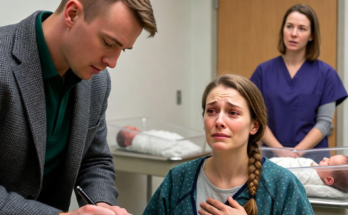
I didn’t even want to go to that barbecue.
Not because I don’t like food or sunshine or the smell of charcoal on a warm afternoon.
I didn’t want to go because I knew my family.
And when you have a child with special needs, you learn fast that some people aren’t “awkward.”
They’re cruel.
And cruelty always comes out eventually.
Sometimes it just waits until there are enough witnesses.
My daughter Emma was five.
She had Down syndrome.
And if you’ve never spent time with a kid like her, let me tell you something—Emma wasn’t “easy,” but she was… pure.
She felt everything.
She tried hard at everything.
She celebrated small wins like they were fireworks.
And she loved people even when they didn’t deserve it.
That Saturday, she sat next to me at my parents’ picnic table wearing her little pink dress with strawberries on it, the one she insisted was her “fancy dinner dress.”
She was holding her burger with both hands, concentrating so hard like she was defusing a bomb.
Emma had this habit where she liked to cut her food into the same-size pieces.
Perfect little squares.
It wasn’t a “problem.” It was just… her.
And honestly, watching her do it always made my chest ache in a good way.
Like… look at my kid. She’s trying so hard.
The backyard looked normal from the outside.
Dad at the grill.
Mom hovering over side dishes like the potato salad was going to be judged by Michelin.
My brother Tyler sitting with his girlfriend, Amber, pretending he didn’t hate being there.
And then there was my sister Vanessa.
Vanessa was the kind of person who could make a compliment feel like an insult.
The kind of person who could smile while twisting the knife.
She had twins—eleven-year-old boys who were basically feral raccoons in soccer cleats.
And she was always broke.
Always.
Even though she posted like she lived in a magazine.
Her nails done.
Her hair perfect.
Her “self-care” quotes.
But her reality was… me.
I’d been paying her bills for years.
Not once or twice.
Years.
Mortgage help.
Groceries.
Utilities.
Sports fees.
Car insurance.
Sometimes I’d send the money and she wouldn’t even say thank you.
Just a thumbs-up emoji.
Like I was a vending machine that dispensed survival.
But I kept doing it because I told myself: They’re family. The kids shouldn’t suffer.
That was my weakness.
I thought being the steady one made me good.
I didn’t realize it made me easy.
Anyway, the barbecue started fine.
Emma was calm.
She was even humming to herself.
And that’s when Vanessa—out of nowhere—looked at my daughter and said, loudly, for everyone to hear:
“So… Emma’s always going to need help, right?”
She said it like she was asking about the weather.
But her eyes were bright.
Mean.
Waiting.
I felt my stomach tighten.
I kept my voice polite.
“Emma’s doing great,” I said. “Her speech therapy has been amazing.”
Emma smiled at the word “amazing” like she understood it was good.
Vanessa laughed.
Not a cute laugh.
Not a “that’s funny” laugh.
A harsh, ugly sound that made the air go thin.
“If I had a kid like that,” she said, waving her hand like she was discussing a bad haircut, “I’d just abandon it.”
It.
She called my child it.
My brain went white.
Emma froze.
Her hands stopped moving.
Her mouth trembled.
And then she started crying quietly—like she was trying not to be too loud, like she already knew crying makes people angry.
And before I could even process that Vanessa had said something so evil—
Dad chimed in from the grill.
“Some kids are burdens,” he said.
Like it was a fact.
Like it was wisdom.
Tyler snorted and said, “Finally. Someone said it.”
I swear to God, I felt something in me break.
Not explode.
Break.
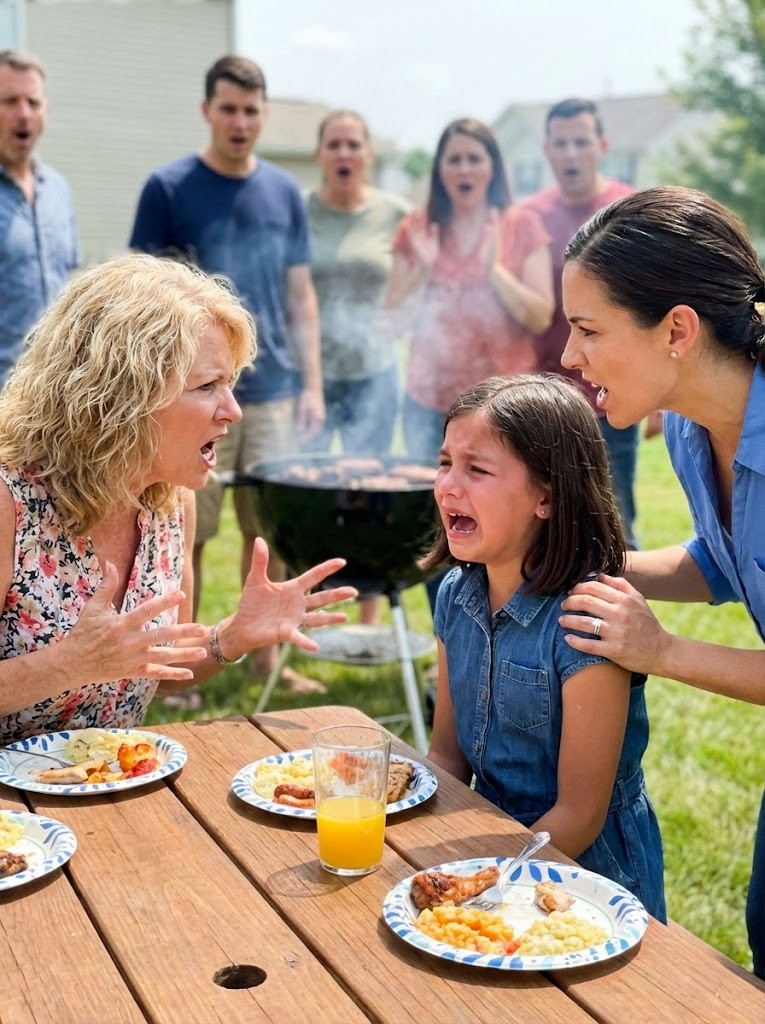
Like a piece of me that had been trying to keep the peace finally snapped in half.
Emma pushed her chair back, trying to get away.
And then Vanessa grabbed her arm.
Hard.
Not gently. Not guiding.
Grabbing.
She yanked Emma back into the chair and shoved her down like she was disciplining a dog.
“Sit,” Vanessa snapped. “You can’t act like that. Take it.”
Emma cried louder, startled by the force.
And my mother—my own mother—picked up her napkin and threw it at my daughter.
It hit Emma’s face and fell onto her food.
“Stop crying,” Mom said sharply. “You’re ruining dinner.”
I stood up so fast my chair scraped the ground.
My hands were shaking.
But my voice came out calm.
That scared me more than the shaking.
Because when your voice gets calm like that, it means you’re done.
I looked directly at Vanessa.
And I said, clear as day:
“Funny. You’re talking about burdens… like your kids don’t need my financial help every single day.”
Vanessa stopped mid-bite.
Her eyes widened.
Her face went red so fast it was like watching paint spread.
Mom’s head snapped toward me.
Her voice dropped into this desperate whisper.
“Please don’t say anything more.”
I stared at her.
Like… now you care about embarrassment?
You didn’t care when your daughter threw a napkin at a crying five-year-old.
But now you wanted me quiet.
I laughed once.
Soft.
Cold.
“Should I break down the numbers?” I asked Vanessa, still calm. “Or do you remember them?”
Amber—Tyler’s girlfriend—looked confused. Horrified.
“Wait,” she said. “What does she mean?”
Vanessa sputtered. “She’s lying.”
So I pulled out my phone.
Opened my bank app.
And I said, “Let’s check.”
I didn’t even need to show the screen at first. I just spoke the facts.
“Last month: $2,300 mortgage. $462 electric. $800 groceries. $600 sports fees.”
Vanessa’s fork dropped onto her plate.
Brad—her husband—looked like someone had punched him.
Dad finally turned from the grill, eyes narrowed.
“What the hell is this?”
I didn’t even look at him.
I picked Emma up—my baby girl shaking in my arms, face wet, breathing fast.
And I said, “This is me being done.”
I looked around the table.
At my father.
My mother.
My brother.
My sister.
All adults.
All participating.
All watching.
And not one of them had protected my child.
Not one.
“You all sat here and let this happen,” I said.
My voice cracked a little on that line.
But I didn’t stop.
“She’s five. She has Down syndrome. And you treated her like she was less than human.”
Vanessa started panicking.
“Okay, okay, I’m sorry—”
“No,” I said. “You’re sorry you got caught.”
Then I said the sentence that changed everything:
“You’re cut off.”
Vanessa blinked like she didn’t understand English.
“What?”
“I’m done paying your bills,” I said. “I’m done funding your fake lifestyle while you abuse my child. I’m done.”
Brad stepped forward, hands up like he could negotiate.
“Megan, please—”
“No,” I repeated.
Then I looked at Tyler.
“You too,” I said. “If you want to call my daughter a burden, you can carry your own weight.”
Tyler’s face twisted.
“You’re overreacting. It was a joke.”
I stared at him.
“Explain the joke,” I said. “Go ahead. Tell me what part is funny.”
Silence.
Even the twins stopped moving.
Because even kids know when the adults are being monsters.
I walked toward the gate with Emma in my arms.
Vanessa followed, voice rising.
“We’ll lose the house!”
I turned back.
And for the first time in my entire life, I didn’t feel guilt.
I felt… clarity.
“You should’ve thought about that before you grabbed my daughter,” I said.
Then I added, very calmly:
“And by the way—touching her like that? That’s assault.”
Vanessa’s face went blank.
Mom gasped.
Dad’s mouth opened like he wanted to roar.
But Marcus wasn’t there.
My husband wasn’t my shield.
I was my child’s shield.
I took Emma home.
She fell asleep in the backseat from crying.
And the second I got inside, I took photos of her arm.
Red marks. Finger-shaped.
I called my attorney Monday morning.
I got a medical report from urgent care that same day.
And when the social worker said, “I’m mandated to report this,” I didn’t flinch.
I said, “Good. Report it.”
Because if my own family could do that to my child once—
They’d do it again.
And I wasn’t going to wait for next time.
PART 2
That night after the barbecue, I didn’t really sleep.
I laid in bed listening to the house settle—little pops in the walls, the hum of the fridge—and every time I closed my eyes I saw Emma’s face when the napkin hit her. The way her burger squares stuck to the cloth like her whole little system—the one thing she’d been controlling in a chaotic moment—got ruined on purpose.
And the worst part?
She didn’t scream.
She didn’t throw anything.
She didn’t hit.
She just… folded in on herself like she’d learned that being small makes adults less angry.
That’s what kept replaying in my head.
Not Vanessa’s words, not Dad calling her a burden.
Emma’s quiet.
Like she already knew she didn’t have the right to take up space.
At 6:12 a.m., I was up making coffee with one hand and scrolling my phone with the other.
I’d blocked everyone… except I hadn’t thought about unknown numbers.
My screen lit up again and again:
MOM: You embarrassed us.
DAD: Call me now.
VANESSA: Please. You’re going to ruin my kids’ lives.
TYLER: You’re being dramatic.
BRAD: Megan… please, let’s talk.
I stared at the messages like they belonged to someone else.
Like I was reading a script.
And then I remembered something my therapist once told me after my divorce—back when I was learning boundaries for the first time:
When people finally meet your “no,” they don’t hear it as a boundary.
They hear it as an attack.
That was exactly what this was.
Not remorse.
Not accountability.
Just panic because the money pipeline got cut.
I turned the phone off and went into Emma’s room.
She was asleep with her stuffed elephant tucked under her chin, lips slightly open, cheeks still puffy from crying.
I sat on the edge of her bed and watched her breathe until my own chest stopped feeling tight.
Then I whispered, “I’m going to fix this.”
Not in a revenge way.
In a mother way.
The next step was not emotional. It was clinical.
Urgent care had documented the bruising. I had timestamped photos. I had the doctor’s note.
On Monday morning, my attorney—Richard Morrison—met me in his office and didn’t even let me finish my first sentence before his face changed.
“Did she leave marks?” he asked.
“Yes,” I said, sliding my folder over like it was evidence in court—because it was.
He flipped through everything, quietly.
Then he looked up at me.
“Okay,” he said. “We do three things, fast.”
He held up a finger.
“One: a temporary protective order for Emma. Against Vanessa. And if your parents try anything—against them too.”
Second finger.
“Two: a formal cease-and-desist. No contact. No showing up at daycare, school, home, work. Nothing.”
Third finger.
“And three: we get ahead of their story. Because I promise you, they’re already rewriting what happened.”
I swallowed.
“Like what?”
Richard didn’t even blink.
“They’ll say Emma was ‘out of control.’ They’ll say Vanessa ‘barely touched her.’ They’ll say you’re unstable, vindictive, trying to hurt the family. And then they’ll file something stupid like ‘grandparents’ rights’ or call CPS first so it looks like you’re the one being investigated.”
My stomach dropped.
Because… yeah.
That sounded exactly like my mother.
Weaponize “concern.” Make herself the victim. Turn the blame into a halo.
Richard leaned forward.
“You’re not going to let them set the narrative.”
He tapped my folder.
“You already did the smartest thing possible: documentation.”
Tuesday: CPS called me.
Not because my family told the truth.
Because urgent care had to report it.
The social worker’s name was Angela Torres, and the first thing she said was:
“I’m not here to punish you. I’m here to make sure Emma is safe.”
I let out a breath I didn’t know I was holding.
Angela came to the house, sat at my kitchen table, and spoke to Emma gently like she was a person—not a “problem.”
Emma was shy at first, hiding behind my legs.
Then Angela pulled out stickers.
Emma’s eyes brightened.
“Elephant?” Emma whispered.
Angela smiled. “Yes. Elephant.”
That tiny moment—someone meeting my daughter where she was—made my throat tighten.
Angela asked me questions. I answered everything honestly.
Then she asked:
“Do you want Emma to have contact with them?”
My jaw clenched.
“No,” I said. “Not now. Maybe never.”
Angela nodded like she understood.
“Then we build protections around that.”
Before she left, she looked at me and said quietly:
“I’ve seen a lot of families who say awful things about disabled kids. Not all of them escalate to physical harm. But when they do… it usually gets worse. You did the right thing leaving.”
I stared at the door after she left, feeling something I hadn’t felt since the barbecue.
Not rage.
Not fear.
Relief.
Wednesday: Vanessa’s house of cards started collapsing.
It wasn’t dramatic at first.
It was small things.
Vanessa’s mortgage company calling.
Her utilities hitting “final notice.”
Her husband Brad calling me from a number I didn’t recognize.
“Megan… please,” he said, voice cracking. “We’re not asking for a handout. Just… until we stabilize.”
I didn’t raise my voice.
I didn’t yell.
I just asked one question.
“Brad… when Vanessa grabbed Emma’s arm, where were you?”
Silence.
“I didn’t— I didn’t know what to do.”
“You could’ve said, ‘Don’t touch her.’” My voice was flat. “You could’ve taken your wife’s hand off my daughter.”
Another silence.
Then, small: “I’m sorry.”
And for one second, I almost felt something.
Then I remembered him standing there while my daughter cried.
So I said, “Talk to your lawyer. Not me.”
And hung up.
Friday: They tried to come to my house.
My doorbell camera showed them.
Mom, Dad, Tyler… all on my porch.
Mom clutching something like a gift bag.
Dad’s face already angry.
Tyler looking around like he was checking if neighbors were watching.
I didn’t open the door.
I watched from my phone as my mother knocked harder and harder.
Then she started crying.
Not the soft kind.
The loud kind.
The kind meant to pull attention.
My father leaned close to the camera and said:
“Megan. Open the door. This is ridiculous.”
I texted Richard a screenshot.
He replied immediately:
Do not engage. If they refuse to leave, call police. This is a violation of the C&D.
So I called.
And I didn’t feel guilty.
I felt… tired.
When the police arrived, my family suddenly remembered how to act polite.
They left without being arrested, but the officer looked at me through the cracked door and said quietly:
“If they come back, call again. Don’t wait.”
When I closed the door, Emma was standing in the hallway rubbing her eyes.
“Who?” she asked.
I crouched down.
“Not safe people,” I told her gently. “But you’re safe. Okay?”
Emma nodded, then held up her elephant.
“Elephant safe.”
“Yeah,” I whispered. “Elephant safe.”
The court date came fast.
Vanessa showed up looking like she’d been crying for days.
Her attorney tried the usual nonsense—misunderstanding, family conflict, she didn’t mean it, she was emotional.
But the judge didn’t care about excuses.
Because there were photos.
A medical report.
A CPS report.
And multiple witnesses.
Vanessa ended up taking a plea: probation, anger management, community service, and a no-contact order with Emma.
When we walked out of the courtroom, Vanessa hissed at me:
“You’re destroying everything.”
I didn’t even look at her.
“No,” I said. “You did.”
And that should’ve been the end.
But the thing about people who’ve lived off your kindness for years?
They don’t accept consequences quietly.
They come back.
Different masks. Different angles.
Same hunger.
So yeah.
It wasn’t over yet.
PART 3 (Final)
I wish I could tell you that after court, everyone backed off and suddenly grew a conscience.
But people like my family don’t “learn lessons.”
They just switch tactics.
And the next tactic was simple:
If they couldn’t control me with guilt… they’d try to scare me.
The first escalation came through Emma’s school.
It was a Tuesday afternoon. I was at work when my phone rang.
The caller ID said: Emma’s Elementary Office.
My stomach dropped so fast I swear I felt it in my throat.
“Ms. Carter?” the principal said, voice tight. “I need you to come here immediately. Someone attempted to pick Emma up.”
My hands went cold.
“Who?”
A pause.
“Your brother-in-law. Brad Thompson.”
I didn’t even remember driving.
One minute I was at my desk, the next I was in the school parking lot, heart hammering, palms slick.
Brad was outside by the front doors with two police officers.
And he was mad.
Not embarrassed.
Not apologetic.
Mad, like the school was the problem.
“I’m family,” he was saying. “Her aunt is her mother’s sister, for God’s sake. You can’t keep a child from her family.”
I walked up and the principal saw me and immediately stepped closer, like she was physically shielding me.
“Emma is safe,” she said quickly. “She never left the classroom. She doesn’t even know this happened.”
Brad’s eyes landed on me, and that fake pleading look popped on his face like a costume.
“Megan—please. Vanessa is falling apart. The boys are crying every night. We’re losing the house. We just need to talk.”
I stared at him.
“You tried to pick up my daughter from school.”
“I didn’t try to take her,” he snapped. “I tried to show you how serious this is. If you’d just see Vanessa—”
One of the officers cut in, calm but firm.
“Sir, you are not authorized on the child’s pickup list. You were told to leave. You refused. That’s trespassing.”
Brad’s face went red.
“I’m not trespassing. This is a FAMILY ISSUE.”
I laughed once, short and sharp.
“Funny,” I said. “Because you all made it very clear at that barbecue that Emma isn’t family. Remember? Burden? Brat? Abandon it?”
Brad flinched like the words tasted bad.
The officer turned to me.
“Ma’am, do you want to press charges for the trespass attempt?”
I didn’t hesitate.
“Yes.”
Brad’s face cracked.
“You can’t—”
“I can,” I said. “And I will.”
They cuffed him right there in front of the doors.
And the whole time he kept shouting like it was my fault.
Like I was the villain.
Like I was the one who chose violence first.
That night, I sat on my couch after Emma was asleep and I just… stared.
Because here was the truth I didn’t want to admit out loud:
They weren’t going to stop.
Not because they missed Emma.
Not because they loved her.
Because they were desperate.
And desperation makes selfish people dangerous.
Natalie came over again, no questions, just… showing up.
She set a bag of groceries on my counter like she lived here.
“You okay?” she asked softly.
I shook my head.
“I’m scared,” I admitted.
Natalie didn’t do that empty “it’ll be fine” thing.
She nodded like she understood exactly how serious that was.
“Okay,” she said. “Then we make a plan.”
Plan first. Fear later.
The next day, Richard filed an expanded protective order.
Not just Vanessa.
Brad. My parents. Tyler.
Anyone who was at that table and participated—or watched and did nothing.
The judge granted it fast.
Because now it wasn’t “family drama.”
Now it was a pattern:
- Assault on a minor
- Attempted unauthorized pickup
- Harassment at my workplace
- Repeated contact attempts despite legal notice
And because life loves to be dramatic, the day the expanded order was served…
I walked outside and found my tires slashed.
All four.
Clean cuts.
Not random.
A message.
I didn’t even cry.
I just felt this cold, steady anger settle in my bones.
I called the police.
Then I called Richard.
Then I called my boss, Jennifer.
And then I installed cameras on every angle of my home.
Front.
Back.
Driveway.
Doorbell.
And I changed the routine.
Different route to school.
Different time leaving the house.
No more “predictable.”
Because my family had proven something:
They didn’t deserve access to my life.
The final confrontation came from my father.
He showed up at my office.
Again.
Security stopped him at reception, but not before he made sure people heard him.
“She’s keeping my granddaughter from me!”
“She’s unstable!”
“She’s poisoning the family!”
Jennifer called my extension.
“Your dad is downstairs. Security is with him. Do you want him escorted out or do you want to speak to him?”
I stared at my monitor, seeing nothing.
Then I said, “I’ll come down.”
Natalie would’ve told me not to.
Richard would’ve told me not to.
But something in me needed to look him in the eye one last time.
I walked into the lobby and there he was.
My father, red-faced, shaking with rage, trying to intimidate the world into giving him what he wanted.
When he saw me, his expression shifted instantly.
He tried to soften.
Tried the “dad voice.”
“Megan,” he said. “We need to talk like adults.”
I didn’t raise my voice.
I didn’t cry.
I just said, “You called my daughter a burden.”
He blinked.
“We were upset—”
“You called her a burden.”
I repeated it, slower.
“You said some kids are burdens. You said it while she was sitting there. While she was eating.”
Dad’s jaw clenched.
“She doesn’t even understand—”
That was the moment I snapped.
Not loud.
Not explosive.
Just… final.
“She asked me why grandpa thinks she’s a burden,” I said.
The lobby went dead quiet.
Even security stopped shifting.
My father’s face changed—like for the first time he realized he couldn’t argue with the truth.
But he still tried.
“We didn’t mean it like that.”
I stared at him.
“Then explain how you meant it.”
He couldn’t.
So I took one step closer and said, calmly:
“You will never see her again.”
His eyes widened.
“You can’t do that.”
“Oh,” I said. “Watch me.”
Jennifer stepped beside me.
“Sir,” she said coolly. “You are trespassing. Leave now, or we will call the police.”
My father looked around, realizing he’d lost the room.
He’d expected shame to make me fold.
He’d expected fear.
But I wasn’t afraid of him anymore.
I was afraid of what he might do to Emma.
And that fear made me ruthless.
Security walked him out.
And when the doors closed behind him, I felt something I didn’t expect.
Relief.
Like my lungs finally remembered how to breathe.
What happened to them
Vanessa’s probation stuck.
Brad’s trespass charge stuck.
Their finances collapsed without my monthly support, because here’s the truth they never admitted:
They weren’t “struggling.”
They were living above their means and using my wallet as a safety net.
They moved out of their house.
The twins changed schools.
Vanessa went quiet online for a while, then came back with a brand-new narrative where she was the victim of a “cruel sister.”
But she never posted the full story.
Because she couldn’t.
Not without exposing herself.
My parents stopped calling after the restraining order got renewed.
Tyler disappeared into his usual pattern of avoiding responsibility.
And Emma?
Emma thrived.
Because she was finally breathing in air that wasn’t poisoned.
She started sleeping through the night again.
She stopped flinching when adults raised their voices on TV.
She started singing to herself at the table again.
Little songs about elephants and pancakes and butterflies.
One day, months later, she came home from school with a drawing.
Stick figures holding hands under a rainbow.
She labeled them carefully:
Me. Mama. Natalie. Mrs. Patterson.
I looked at it and my throat tightened.
“Who are these, baby?” I asked.
Emma smiled like it was obvious.
“My family.”
And that was it.
That was the ending.
Not the court.
Not the restraining orders.
Not their downfall.
The ending was my daughter, five years old, deciding what family meant… and getting it right.
I hung her drawing on the fridge.
And I never looked back.
the end