Walking Into a Nightmare
I knew something was wrong the second I walked into the house.
It was too quiet.
No TV humming, no dishwasher running, no clinking of bottles from my mother-in-law “helping” in the kitchen like she always insisted on doing. Just this heavy, suffocating silence that didn’t belong in a house with a six-week-old baby.
“Mom?” I called out, dropping my work bag by the door and kicking off my shoes. “Julia?”
Nothing.
My breasts ached under my blouse, that sharp, familiar pull that meant it was time to pump. I glanced at the clock: I’d come home early from my shift—two hours earlier than planned—because I’d had this awful, primal feeling all day that something was off. Call it mother’s intuition, anxiety, paranoia… whatever it was, it dragged me out of work and straight into my car.
The baby monitor screen sat on the console table, turned on, the little green light glowing. But the volume was down to zero.
That was the first red flag.
My fingers trembled as I picked it up. The camera showed my daughter’s crib. The angle was slightly skewed, like it had been bumped. I could see part of the mattress, the side rail… and movement. An arm. Pale skin. A flash of fabric.
Someone was in the crib area with her.
My heart started beating so loud I could hear it in my ears.
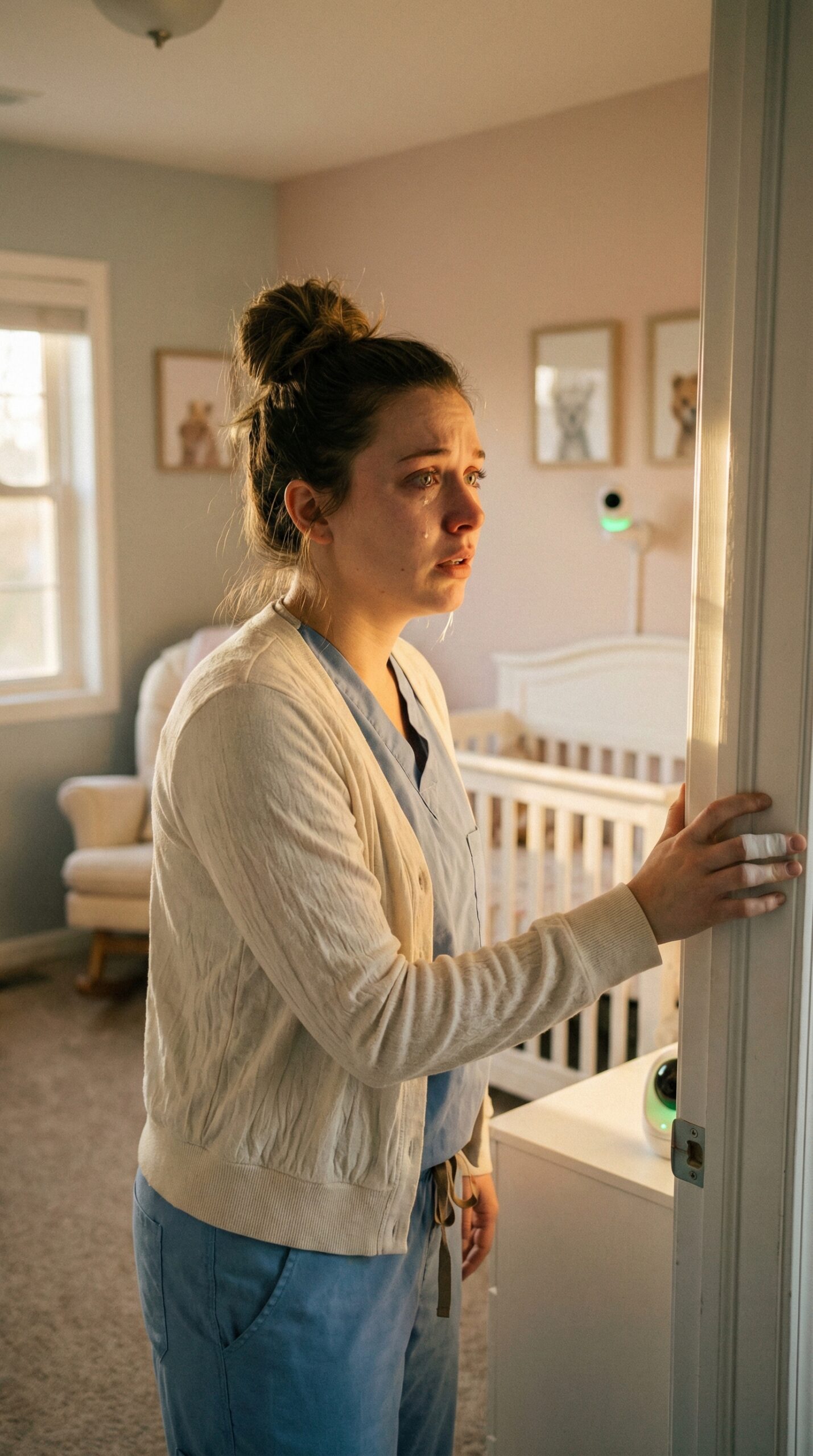
I walked down the hallway slowly, each step feeling like I was moving through wet cement. As I got closer to the nursery, sounds began to filter through the cracked door—soft shushing, the creak of the rocking chair, a woman’s low voice.
My baby gave a little whimper.
Not her usual hungry scream, not the cry that meant gas or a dirty diaper. This was a muffled, frustrated sound that made every cell in my body light up with alarm.
My hand closed around the doorknob.
I pushed the door open an inch.
And there she was.
My mother-in-law, Linda, sitting in my rocking chair, in my nursing corner by the window, her blouse unbuttoned halfway down. My six-week-old daughter was pressed against her bare chest, Linda’s hand cradling the back of her tiny head, guiding her to latch.
Like this was normal.
Like this was hers.
For a split second, the world went silent. My brain completely stalled, refusing to register what my eyes were seeing. It felt like I was looking at a glitch in reality, like someone had taken my life and spliced in the most disturbing scene imaginable.
“Mom,” I whispered, my voice breaking. “What are you doing?”
She jerked her head up, eyes wide. Her arms tightened around my baby instinctively, pulling her closer to a body that was not mine. Her face flushed, then hardened.
“Why are you home so early?” she demanded, instead of answering.
There it was. Not shock. Not apology. Annoyance. Guilt. Entitlement.
My hands started to shake so violently I had to grip the doorframe.
I stepped into the room, every nerve on fire, staring at my newborn in another woman’s arms—my husband’s mother, my baby’s grandmother—doing something that felt so fundamentally, violently wrong that I didn’t know whether to scream, cry, or collapse.
I was shaking. I didn’t know whether to scream or laugh. But what I did next shocked everyone.
Years of Control and “Help”
To understand how I got to that moment—standing in the doorway while my mother-in-law breastfed my child—you have to understand the years that led up to it.
I met my husband, Mark, when we were both 26. I was working as a nurse, he was a project manager in IT. On paper, we were equals: both college-educated, both working, both from middle-class families.
In reality, there was a third person in our relationship from day one: his mother, Linda.
Linda was the kind of woman people called “involved” and “devoted” with a mixture of admiration and fear. She lived fifteen minutes away from us, was widowed, and had dedicated her entire life to being a mother. To her, motherhood wasn’t a phase—it was an identity she refused to loosen her grip on.
When we were dating, it was “cute” in that suffocating way.
- She would call him every night at 9 p.m. “just to check in.”
- She would show up at his apartment with pre-cooked meals “because you look thin on FaceTime.”
- She would text him his horoscope and then analyze how it “explained his mood.”
The first time I met her, she hugged me so hard my ribs protested and said, “So you’re the girl taking my baby boy away from me.” She laughed after she said it, but the words landed like a warning.
Over the next three years, the pattern was always the same:
- If Mark and I made plans, she’d “accidentally” drop by.
- If we disagreed on something, she’d insert herself as the mediator.
- If I set a boundary—no unannounced visits, no calling him at work—she’d cry and say, “I guess I’m just not wanted anymore.”
When we got engaged, she told everyone before we had the chance to. She insisted on coming dress shopping with me, criticizing every gown I tried on until I picked the one she liked. She demanded we get married in the church where she had married Mark’s father, even though I’d left that denomination years ago.
Every time I pushed back, Mark would say, “That’s just how she is. She means well. She’s just excited.”
After the wedding, “excited” became “controlling.”
She would rearrange my kitchen cabinets because “this makes more sense.” She would rewash clothes I had already laundered because “your detergent is too harsh for Mark’s sensitive skin.” She would let herself into our house with the spare key whenever she felt like it, claiming she was “helping.”
When I got pregnant, it escalated.
Linda had always wanted more children, but after Mark, she’d had medical complications that made it impossible. She told me this over coffee one day, her eyes glossy and distant.
“You have no idea how lucky you are,” she said. “If I could have another baby, I’d never put them down. I’d savor every second.”
At first, that sounded sweet. Then it became something else.
She started sending me articles about the “right” way to give birth, the “right” way to feed, the “right” way to sleep train. She made snide comments when I told her I was considering an epidural. She scoffed when I mentioned I might need to go back to work earlier than planned because my maternity leave was only partially paid.
“A real mother sacrifices,” she said, wrinkling her nose. “I quit my job the second I knew I was pregnant with Mark. I couldn’t imagine leaving my baby with strangers.”
“I’m not leaving her with strangers,” I said carefully. “I’m leaving her with family. With you, actually. You offered to help watch her a few days a week.”
She smiled, satisfied. “Exactly. Because no one will care for her like I will.”
I didn’t hear the warning in that sentence until it was too late.
The Baby, the Boundaries, and the Breastfeeding Obsession
Our daughter, Lily, was born on a rainy Tuesday at 3:14 a.m. The labor was long, exhausting, and complicated. I ended up with an emergency C-section after twelve hours of trying to deliver naturally.
The moment they placed her on my chest, everything else—Linda’s comments, Mark’s excuses, my exhaustion—faded into background noise. She was perfect. Tiny, warm, and real. She was mine.
Breastfeeding did not come easily.
Despite being a nurse, despite all the books and videos and classes, my body didn’t just “get it.” Lily struggled to latch. My nipples cracked and bled. I cried almost every time she fed. The lactation consultant told me to keep trying, that “it gets better.” I wanted to believe her.
Linda, of course, had opinions.
“You just have to push through,” she said, watching me wince as Lily tried to latch. “I breastfed Mark straight away. No issues. It’s the most natural thing in the world, you know.”
When my milk finally came in, it came in fast and hard. I was engorged, in pain, leaking through my shirts. I started pumping to relieve the pressure and to build a freezer stash for when I went back to work.
Linda watched me like a hawk.
“You’re not going to use formula, are you?” she asked one day, her tone sharp.
“Only if we have to,” I replied. “Sometimes I might have to supplement if my supply dips or if I’m not home.”
She pursed her lips like I’d confessed to a crime. “Formula is poison. Breast is best. That’s how you bond with your baby.”
Bond. The word echoed.
She started making little comments when she held Lily.
“Oh, she settles so quickly with me,” she’d say, smirking. “She knows real maternal energy.”
If Lily fussed in my arms, Linda would reach for her. “Here, let Nana take her. She likes me.”
At first, I brushed it off as grandma enthusiasm. But it kept happening.
- She’d take Lily out of my arms even when I didn’t offer.
- She’d hold her for hours, refusing to put her down for naps in the bassinet.
- She’d “forget” to bring Lily back to me when it was time to feed, so Lily would be screaming by the time I got her.
“You’re spoiling her,” I said more than once. “She needs to learn to sleep on her own too.”
“Nonsense,” Linda replied. “You can’t spoil a baby with love. You’re too rigid. Loosen up. Enjoy her.”
You’ll notice that in all of this, Mark is mostly background noise. That’s because he always faded when his mother was in the room.
“Please talk to her,” I begged him one night, after Linda had criticized my swaddling technique for the fifth time that day. “She’s undermining me constantly. I feel like a babysitter in my own house.”
“She just wants to help,” he said, exhausted. “She’s lonely. Dad’s gone. This baby is her whole world right now.”
“She’s not her mother,” I snapped. “I am.”
He sighed. “Just pick your battles, okay? She won’t be around forever. Isn’t it better that Lily is with family instead of daycare?”
I picked my battles. I bit my tongue. I told myself that once I went back to work, things would settle into a routine.
I had no idea things were about to get much, much worse.
The Day It Happened
The plan was simple: I would go back to work part-time at the hospital, three shifts a week. Linda would watch Lily at our house on those days. Mark worked from home two of those days, so technically he’d be in the house too, though in his office.
We trialed it for a week before my official return.
During the trial week, things seemed… okay. I’d pump, label bottles, leave detailed instructions. Linda fussed and made comments, but she followed the schedule. I’d come home to empty bottles in the sink and a sleeping baby. I felt cautiously hopeful.
Then came my first “real” day back.
That morning, Lily was extra clingy. She screamed when I tried to leave her in the bassinet. My body screamed right along with her, every instinct telling me to stay. But rent doesn’t care about instincts.
I nursed her one last time, kissed her forehead, and handed her to Linda.
“Text me if anything feels off,” I said. “Anything.”
Linda rolled her eyes. “You act like I’ve never cared for a baby before. Go. You’re going to be late.”
The entire day at work, I couldn’t shake the unease. Even when I was busy, there was this constant low-level panic humming under the surface. I pumped on schedule, wiped away tears in the bathroom, and watched the clock crawl.
At around 2 p.m., I texted Linda to check in.
“How’s my girl?” I wrote.
No response.
I waited twenty minutes. Nothing.
I texted Mark. “Everything okay at home?”
He replied five minutes later: “On a Zoom. Mom’s got Lily. All good.”
Something in me snapped.
I went to my charge nurse and asked if I could leave early. I told her I wasn’t feeling well. She looked at me—at the dark circles under my eyes, the tension in my shoulders—and said, “Go. We’ve got it covered.”
On the drive home, my mind raced:
- Maybe Lily was sleeping and Linda didn’t want to wake her.
- Maybe Linda left her phone in another room.
- Maybe I was overreacting, like everyone always said.
I opened the front door. Silence.
I saw the muted baby monitor.
I saw the movement on the screen.
Then I saw my mother-in-law in my rocking chair with my baby at her chest.
The Explosion
I don’t remember crossing the room. One moment I was in the doorway, the next I was standing over Linda, close enough to see the fine lines around her mouth, the way her lips were pursed in concentration as she held my daughter like a human prop.
“Put. Her. Down.” My voice didn’t sound like mine. It was low, shaking, dangerous.
Linda flinched, then clutched Lily tighter.
“Don’t you dare talk to me like that,” she hissed. “You’re startling her.”
“She is latched onto you,” I said, the words coming out clipped and sharp. “You are not her mother. Put. Her. Down.”
Lily whimpered, her tiny head rubbing against Linda’s chest in confusion, searching for milk that wasn’t there.
“I’m just comforting her,” Linda said, like she was explaining something obvious to a child. “She was crying. She needed comfort. Skin-to-skin is bonding. That’s what all your little mommy blogs say, isn’t it?”
My vision went red.
“Did you put her to your breast?” I asked, my voice barely above a whisper.
Linda lifted her chin. “Of course I did. She was rooting. She wanted to nurse. You weren’t here. Someone had to do it. I can lactate again, you know. It’s possible at my age. I looked it up.”
The room swayed. “You… what?”
She looked almost proud. “I’ve been stimulating, using a pump when you’re gone. It’s called induced lactation. In some cultures, grandmothers breastfeed. It’s natural. We’re connected, she and I. She relaxes with me in a way she doesn’t with you.”
That last sentence was the match to the powder keg.
In one swift motion, I reached down and took my daughter from her arms. I didn’t yank, I didn’t hurt Lily—but I made sure Linda felt the force of my resolve.
Lily let out a full-bodied cry the second she was against my chest, her little hands grabbing at my blouse. I held her tight, breathing in the sweet, milky scent of her hair, my whole body shaking.
“You are never,” I said, each word like a stone, “to put my daughter to your breast again. Ever.”
Linda stood up, her blouse still open, indignation flooding her face. “You are overreacting. This is postpartum hormones talking. I am helping you. Do you have any idea how ungrateful you sound? Women would kill to have this level of support.”
I laughed—a sharp, humorless sound. “Support? You violated one of the most intimate things between a mother and her baby. You used my child to fulfill your twisted need to be a mom again. You didn’t ask. You didn’t tell me. You did it behind my back and then lied about it.”
She scoffed. “You’re selfish. You go off to work and leave her, and then you get mad when someone who truly loves her steps in to give her what she needs.”
I heard Mark’s footsteps before I saw him.
“What’s going on?” he asked, walking into the nursery, eyes darting between us. His gaze snagged on his mother’s open blouse. His face paled. “Mom… what…?”
“She’s crazy, Mark,” Linda said immediately, pointing at me. “She barged in here screaming at me for comforting her own child. She’s unstable. I’ve been telling you she needs help.”
“What were you doing?” I asked him, ignoring her. “Did you know about this?”
He looked like a deer in headlights. “About… what?”
“Your mother,” I said, my voice cracking. “Breastfeeding. Our. Child.”
The words hung in the air like a bad smell.
“That’s not what happened,” Linda snapped. “I was just—”
“Were you or were you not trying to induce lactation to nurse my baby?” I cut in.
Mark’s eyes darted to his mother. “Mom?”
She folded her arms. “I was bonding with my granddaughter. That’s all. This is being blown out of proportion.”
“Answer the question,” I said.
She glared at me, then at him. “Yes,” she said finally. “I was trying. Because someone has to be the real mother around here.”
Silence.
Something in Mark’s face shifted. A crack in the perfect “Mom can do no wrong” illusion.
“Mom, that’s… no,” he stammered. “That’s not okay. You can’t—”
“Oh, now you grow a spine?” I cut in, my anger turning icy. “Now that you’ve seen it with your own eyes?”
I turned to him fully, Lily squirming against my chest.
“You left her alone with our newborn,” I said. “You ignored my concerns for months. You brushed off every red flag. And now I walk in and find this.”
“I didn’t know she—” he started.
“You didn’t want to know,” I said. “Because it was easier to let your mom play house with our baby than to set boundaries.”
Linda gasped. “How dare you talk to my son like that! You don’t deserve either of them. If you can’t handle being a mother, I will gladly—”
I cut her off. “Get out.”
She blinked. “Excuse me?”
“Get. Out. Of my house,” I said. “You are no longer welcome here. You will not be alone with my child ever again. If you step foot in this house without my permission, I will call the police.”
Her face twisted. “You wouldn’t.”
“Try me,” I said, my voice deadly calm. “And while you’re at it, Google what social services think about adults forcing newborns to latch on without the mother’s consent. I’m a nurse. I know exactly who to call and what language to use.”
Mark opened his mouth. “Babe, maybe we should—”
I rounded on him. “No. There is no ‘maybe’ here. Our daughter is not a therapy animal for your mother’s empty nest syndrome. This is a non-negotiable line.”
He shut his mouth.
Linda grabbed her purse with shaking hands, buttoned her blouse, and muttered, “You’ll regret this,” as she stormed past me.
She was half-right. Someone would regret something. But it wouldn’t be me.
Consequences and Taking Back Control
The fallout was immediate and brutal.
- Linda called Mark twenty times that night, leaving voicemails sobbing and screaming, sometimes in the same breath.
- She sent me long texts alternating between apologies and accusations.
- She called my mother to “warn” her that I was “unstable” and “endangering” Lily by denying her “proper bonding.”
I documented everything.
Screenshots of messages. Voicemails saved. A written account, in detail, of what I’d walked in on. Dates, times, exact wording. The nurse in me knew: if this escalated, I needed a paper trail.
Mark and I fought. A lot.
“I agree what she did was wrong,” he kept saying. “But she’s still my mom. Cutting her off completely is extreme.”
“Extreme,” I repeated. “You want to talk about extreme? She tried to become a second mother to our baby. She went behind my back, put my daughter to her breast, and then gaslit me when I caught her. What would you call that?”
He didn’t have an answer.
I gave him a choice: couples therapy with someone who specialized in enmeshment and boundaries, or I would go stay with my parents with Lily until he figured out where his loyalties lay.
He chose therapy.
The therapist didn’t mince words. She used terms like “emotional incest,” “parentification,” and “enmeshment” to describe Linda’s relationship with him. She explained that his inability to set boundaries was a learned behavior from a mother who had never respected his autonomy.
Slowly, painfully, he began to see it.
Linda did not.
She refused to attend joint sessions, insisting she “wasn’t the problem.” She tried to rally extended family to her side, telling anyone who would listen that I was “keeping her grandchild away” and “brainwashing” her son.
What she didn’t realize was that her own words condemned her.
In one particularly unhinged text, she wrote:
“If you think you can stop me from being the mother figure in Lily’s life, you’re delusional. You may have given birth to her, but I know what she needs.”
I forwarded that text, along with my written account, to our pediatrician and asked to discuss it at Lily’s next appointment. I wanted a medical professional to weigh in on just how inappropriate and unsafe Linda’s behavior was.
The pediatrician’s face went pale when I told her everything.
“This is absolutely not okay,” she said. “From a medical standpoint, there are serious risks—disease transmission, supply confusion, allergies. From a psychological standpoint, it’s a massive boundary violation. You are right to enforce distance. If she continues to push, we can document this in Lily’s chart in case it’s ever relevant legally.”
That was the validation I needed.
I told Mark that if Linda ever saw Lily again, it would be:
- In our home.
- With both of us present.
- With crystal-clear rules: no unsupervised time, no overnights, and absolutely no physical caregiving that involved feeding, bathing, or sleeping arrangements.
He agreed.
Linda did not.
She refused to see her granddaughter “on a leash,” as she called it. She told Mark he was “choosing a woman over his family.” She told him he would “regret letting a manipulative girl ruin his relationship with his own mother.”
He showed me those messages. For the first time, instead of deleting them, he blocked her.
“I didn’t see it before,” he said, tears in his eyes. “I thought she was just… loving. I didn’t realize how much she needed to control everything. I’m so sorry I didn’t protect you and Lily sooner.”
“Then protect us now,” I said. “Every day from this point forward.”
We went low contact, then essentially no contact. Holidays were quiet but peaceful. My anxiety, for the first time in years, began to ease.
I poured my energy into bonding with Lily in ways that felt safe and genuine:
- Skin-to-skin on my terms.
- Nursing when it worked, pumping and supplementing without guilt when it didn’t.
- Watching her fall asleep on my chest, knowing that no one else was trying to replace me in that role.
I also started talking about what happened—carefully, anonymously at first—on mom forums and support groups.
The responses floored me.
So many women had their own horror stories:
- A MIL who snuck formula into bottles “because breast milk isn’t enough.”
- A grandmother who coslept with the baby against parents’ wishes.
- A relative who secretly had the baby baptized in her church without telling the parents.
It wasn’t just about breastfeeding. It was about control. About older generations refusing to see their adult children as adults, and their grandchildren as anything other than fresh chances to redo their own lives.
So I did something Linda never expected: I turned my trauma into something useful.
I started a blog—“Boundaries Before Bibs”—writing about:
- Enmeshed families.
- Overbearing in-laws.
- The importance of consent and autonomy in parenting.
I kept my identity private at first. Then, as the blog grew and moms reached out saying my words gave them the courage to set boundaries, I started to own my story publicly.
One day, my mother called me, half-laughing, half-shocked.
“You are not going to believe this,” she said. “Your blog got shared in a Facebook group… that Linda is in.”
Apparently, Linda had posted a rant about “ungrateful daughters-in-law” and someone had replied with a link to my article titled: “Your Grandchild Is Not Your Emotional Support Animal.”
She had no idea she was reading her daughter-in-law’s words.
The irony tasted sweet.
We haven’t seen Linda in over a year now. She occasionally sends birthday cards addressed only to Mark, never to me or Lily. He doesn’t open them.
Our marriage, ironically, is stronger now than it ever was when his mother was in the center of it. Therapy forced us to confront hard truths: his fear of disappointing her, my tendency to doubt my own instincts because everyone called me “dramatic.”
We are still healing. But we are healing together.
As for Lily, she is happy, healthy, and very attached—to the people who actually respect her parents and her boundaries.
One day, when she’s older, I will tell her this story. Not to scare her, but to teach her something Linda never learned:
Love without respect isn’t love. It’s possession.
When I walked into that nursery and saw my mother-in-law trying to make my baby hers, I thought I might shatter.
Instead, I found something I didn’t know I had left inside me.
A line.
A steel-solid boundary.
And the strength to say: This far, no further.
Linda thought she could rewrite the story of my motherhood.
But in the end, I wrote my own.