The Discovery
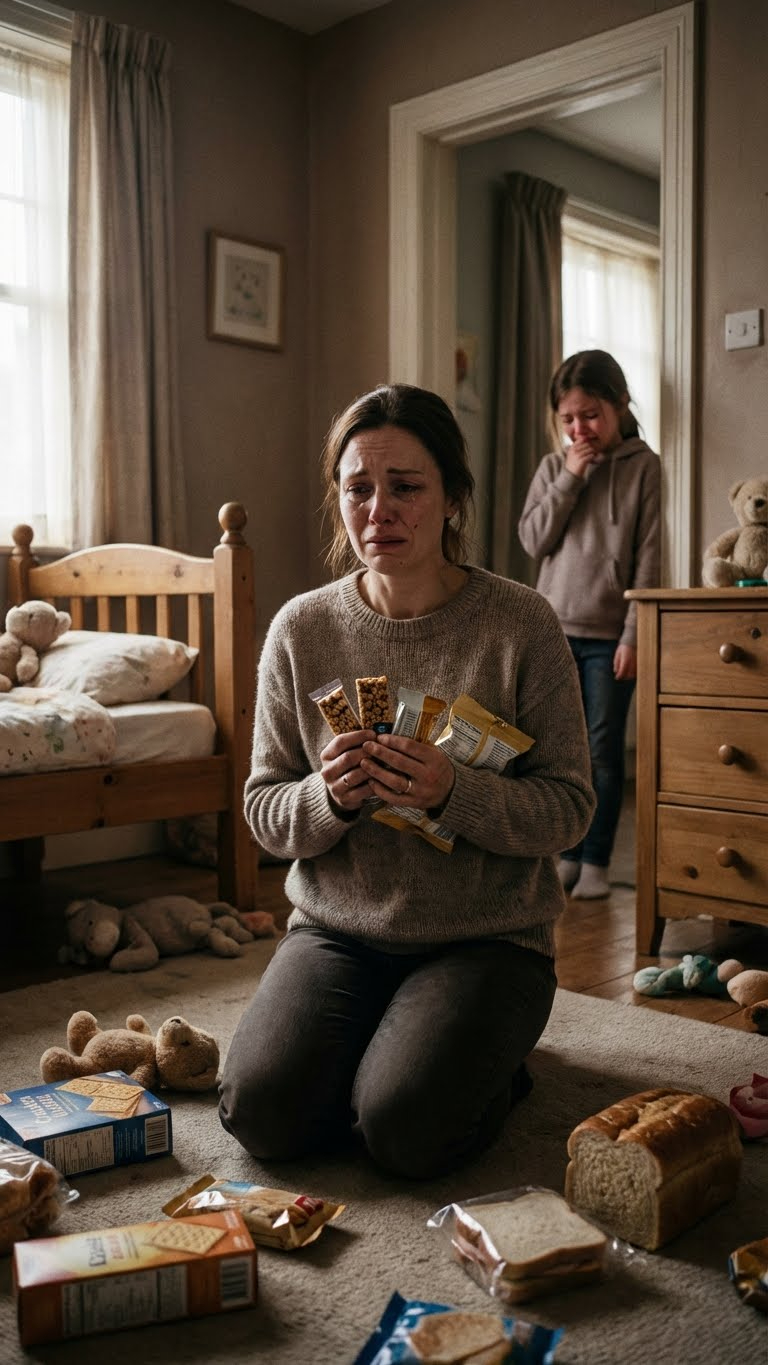
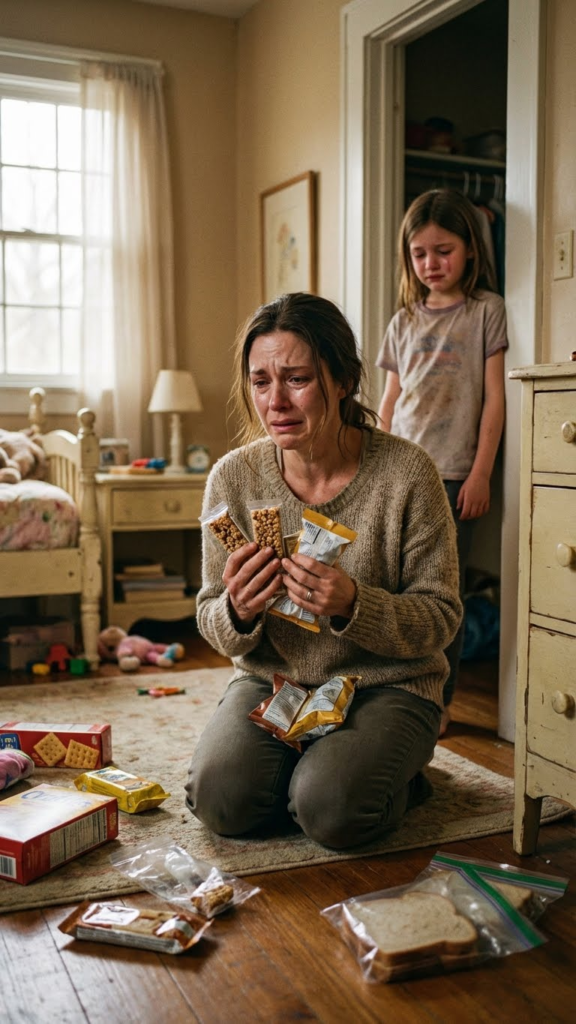
I found the granola bars first. Thirty-seven of them, hidden under my daughter’s bed in a shoebox marked “PRIVATE.”
Then the crackers. Sleeves of saltines stuffed behind her books. Packs of peanut butter squeezed into her winter boots. Apple slices wrapped in napkins, carefully placed in her dresser drawer, slowly turning brown.
My hands were shaking as I pulled out more—cheese sticks, hard as rocks. Bread rolls from the school cafeteria, green with mold. A half-eaten sandwich from god knows when.
I’d come into Mia’s room to put away her laundry. That’s it. Just a normal Wednesday afternoon task. But when I’d bent down to pick up a sock that had rolled under the bed, I’d seen the corner of the shoebox. And curiosity—or maybe mother’s intuition—made me pull it out.
“Mia?” I called out, my voice cracking. “Can you come here, please?”
She appeared in the doorway of her bedroom, ten years old with my eyes and her father’s dark hair, wearing the same jeans she’d worn for the past week because they were the only pair that still fit. The moment she saw what I was holding, her face crumpled.
“I’m sorry,” she whispered. “I’m so sorry, Mama.”
I thought I knew why. I thought she was hoarding because we’d been struggling. Because there were nights when dinner was rice and beans, again. Because I’d started skipping meals so she and her little brother could eat more. Because she’d heard me crying on the phone with the electric company, begging for an extension.
I thought she was hoarding out of fear that the food would run out. That we’d go hungry. That the poverty that had crept into our lives like a slow-moving shadow would eventually swallow us whole.
I was wrong.
“Baby, it’s okay,” I said, kneeling down to her level. My knees cracked—I was only thirty-two, but poverty ages you. “We’re okay. I know things have been tight, but we always have enough food. You don’t need to hide—”
“It’s not for me.” Her voice was so small I almost didn’t hear it.
I froze. “What?”
“It’s not for me, Mama. It’s for Tommy.”
The Truth
Tommy. The boy from her class. The one she’d mentioned a few times. The quiet kid who sat alone at lunch.
“Why does Tommy need—”
“Because he doesn’t get breakfast. Or lunch. His mom… she’s sick or something, and his dad left, and he told me he’s so hungry all the time that his stomach hurts.” Tears were streaming down her face now. “So I started bringing him food. But then he said his little sister was hungry too, and I didn’t know what to do, so I just… I started taking extra. From home. From school. Anywhere I could.”
My heart shattered.
This whole time, I’d been so focused on keeping us afloat that I hadn’t noticed my daughter was trying to save someone else from drowning.
“How long?” I managed to ask.
“Three months.”
Three months. My ten-year-old daughter had been running a secret food bank out of her bedroom for three months, and I’d been too wrapped up in our own survival to see it.
I pulled her into my arms and held her while she sobbed. And then, through my own tears, I asked her the question that would change everything.
“Where does Tommy live?”
Our Story
To understand what happened next, you need to understand how we got here.
Two years ago, I had a different life. I was married to Daniel, Mia’s father. We weren’t rich, but we were comfortable. I worked as an administrative assistant at a dental office. Daniel was a construction foreman. We had a small house with a yard. We took the kids to the movies sometimes. We weren’t drowning.
Then Daniel got injured on a job site. A fall that shattered his pelvis and crushed three vertebrae. The workers’ comp barely covered the medical bills. He couldn’t work. The painkillers the doctors prescribed turned into something darker—an addiction that consumed him faster than I could understand what was happening.
He left us eight months after the accident. Just… disappeared one night with whatever pills he could find and $300 from our emergency fund. I got divorce papers in the mail six weeks later, sent from a motel three states away.
I tried to hold it together. I really did. But the bills piled up. The house went into foreclosure. We moved into a two-bedroom apartment in a building where the heat only worked half the time and the landlord ignored every maintenance request.
I picked up a second job cleaning offices at night. Mia started watching her little brother, Jake, after school. She was eight years old, making mac and cheese for her four-year-old brother while I scrubbed toilets to keep the lights on.
I told myself we were surviving. That we’d be okay. That poverty was temporary, just a rough patch we’d get through.
But poverty isn’t temporary when you’re living it. It’s the shirt you wear three days in a row because laundry costs money. It’s the gnawing anxiety every time your car makes a weird noise because you can’t afford repairs. It’s watering down the milk to make it last longer and calling it a “recipe.”
It’s your ten-year-old daughter hoarding food because even in her own hunger, she sees someone who has it worse.
Tommy’s House
Mia gave me Tommy’s address. She made me promise not to tell anyone she’d told me. She was terrified he’d be embarrassed. That he’d hate her. That he’d stop being her friend.
I promised.
The next day, after I dropped both kids at school, I drove to the address. It was a apartment building worse than ours—crumbling brick, broken windows patched with cardboard, a front door that didn’t quite close.
I knocked on apartment 2C. No answer. I knocked again.
The door opened a crack. A woman—maybe forty, maybe twenty-five, impossible to tell—peered out. She was thin, painfully so, with hollow eyes and unwashed hair.
“Yeah?”
“Hi. I’m… my daughter goes to school with your son, Tommy. I wanted to—”
“We don’t need charity.” The door started to close.
“Wait. Please. I’m not here to—” I took a breath. “I’m poor too. I know what it’s like. I just want to help.”
She studied me for a long moment. Then the door opened wider.
The apartment was bare. A couch with the stuffing coming out. A TV that didn’t work. In the kitchen, the cabinets were open and empty. The fridge hummed, but I could see from where I stood that it held only condiment bottles and a half-gallon of milk.
“I’m Sarah,” the woman said. She didn’t offer her hand. “Tommy’s mom.”
“I’m Lisa. My daughter, Mia, she’s been… she’s been bringing Tommy food.”
Sarah’s face crumpled. “I know. He told me. I told him to stop taking it, that it wasn’t right, but he said…” She swallowed hard. “He said Mia’s mom wouldn’t mind.”
“I don’t mind,” I said quickly. “I don’t mind at all. I just… I wanted to meet you. To see if there’s more I can do.”
“Why?” Her voice was sharp. Defensive. “Why would you help us?”
“Because someone should have helped me two years ago, and they didn’t. Because my daughter has a bigger heart than I do, and she’s teaching me something I should have already known.”
Sarah started crying. Not gentle tears—big, choking sobs that shook her whole body. I didn’t know what to do, so I just hugged her. This stranger. This woman I’d never met who was living a life parallel to mine, just a few degrees worse.
“I have cancer,” she whispered into my shoulder. “Stage three. I can’t afford treatment. I can barely afford rent. Tommy’s dad left when I got diagnosed. Said he couldn’t handle it. And I’m trying, I swear I’m trying, but I can’t work and I can’t—”
“Stop,” I said. “Stop. It’s okay. We’re going to figure this out.”
I had no idea how. I was barely keeping my own family fed. But in that moment, I meant it.
The Plan
That night, I did something I’d never done before. I asked for help.
I posted in a local Facebook group. Not the whole story—Sarah deserved privacy—but enough. A family in need. Kids going hungry. Medical crisis. If anyone could spare anything.
The response was overwhelming.
Within two hours, seven people had offered food donations. Three offered cash. One woman, a nurse, said she’d help Sarah navigate getting enrolled in a charity care program for her cancer treatment.
By the end of the week, we’d collected enough groceries to stock both our apartments for a month. Someone donated a working refrigerator. Another person dropped off bags of clothes for Tommy and his little sister, Emma.
But the most important thing happened when I introduced Sarah to Maria, a social worker who volunteered at the community center. Maria helped Sarah apply for emergency assistance programs I didn’t even know existed. Food stamps. Medicaid. Emergency housing vouchers.
Within a month, Sarah was enrolled in a treatment program. Within two, she’d started chemotherapy. The prognosis wasn’t great, but it was better than dying without trying.
What Mia Taught Me
One night, about three months after I found the food in Mia’s room, I was tucking her into bed. She’d just come back from Tommy’s apartment, where we’d all had dinner together—me, Mia, Jake, Sarah, Tommy, and Emma. It was chaotic and loud and wonderful.
“Mama?” Mia said as I pulled her blanket up.
“Yeah, baby?”
“Are we still poor?”
I paused. Thought about it. “Yeah, sweetheart. We are.”
“But we’re okay, right?”
“We’re okay.”
“Then I don’t mind being poor,” she said. “Because if we weren’t poor, I wouldn’t have known how to help Tommy. I wouldn’t have understood.”
I kissed her forehead, unable to speak around the lump in my throat.
She was right. Being poor had taught her something invaluable—empathy. Compassion. The understanding that everyone is fighting battles you can’t see, and sometimes the smallest act of kindness can save someone’s life.
I’d spent two years being angry about our poverty. Ashamed of it. Treating it like a personal failure.
But Mia saw it differently. She saw it as a bridge—something that connected her to people who needed help, who needed to know they weren’t alone.
Six Months Later
Sarah’s in remission. The cancer’s not gone, but it’s manageable. She’s working part-time at a grocery store that gives her flexible hours for treatment.
Tommy and Mia are best friends. They do homework together at our apartment twice a week. Emma and Jake have playdates.
I’m still working two jobs. We’re still poor. But we’re not alone anymore.
That’s the thing about poverty nobody tells you—it’s isolating. It makes you feel like you’re the only one struggling, the only one failing, the only one who can’t keep their head above water.
But when you start being honest about it, when you stop hiding and start asking for help, you realize there’s a whole community of people just like you. People who understand. People who want to help because they’ve been there too.
The Real Victory
A few weeks ago, the school called me. They wanted to give Mia an award for “Outstanding Community Service.” Apparently, her teacher had found out what she’d been doing—feeding Tommy, organizing the donation drive for his family—and nominated her.
At the ceremony, I sat in the audience and watched my ten-year-old daughter walk across the stage to accept a certificate and a $50 gift card to a bookstore. She was wearing a dress from Goodwill that was a size too big, shoes that were starting to fall apart.
And she was beaming.
The principal asked her to say a few words. Mia took the microphone, looked right at me, and said: “My mom always tells me that we don’t have a lot of money, but we have a lot of love. And I think love is the thing that matters most. Tommy needed food, and I had food to give, so I gave it. That’s what you do when you love people. You share what you have, even when you don’t have much.”
I cried through the entire speech. Ugly, snotty crying that I didn’t even try to hide.
After the ceremony, a woman approached me. She introduced herself as the director of a local nonprofit that fought food insecurity in schools. She’d heard about Mia’s story.
“We want to start a program,” she said. “A student-led food pantry. Where kids can anonymously access food to take home. Would Mia be interested in helping us set it up?”
I looked at my daughter, who was already nodding enthusiastically.
“Yes,” I said. “She’d love that.”
What I Learned
Here’s what I wish I’d known two years ago, when Daniel left and the world fell apart:
Poverty doesn’t define you. It’s a circumstance, not an identity. You’re not less valuable, less intelligent, or less deserving because you’re struggling financially.
Asking for help isn’t weakness. It’s survival. And sometimes it’s the strongest thing you can do.
Your kids are watching. They’re learning from how you handle hardship. Mia learned compassion because I tried to be kind even when I was breaking. She learned generosity because I shared what little we had.
Community matters more than money. The people who showed up for Sarah and her kids, who donated food and time and resources—they weren’t rich. Most of them were struggling too. But they showed up anyway.
And finally: Sometimes the people we’re supposed to be helping end up helping us instead. I thought I was teaching Mia about resilience. But she taught me about empathy. About seeing beyond our own pain to recognize someone else’s.
Today
We’re still poor. I’m still working two jobs. Mia still wears hand-me-downs and Jake still asks why we can’t go to Disneyland like his friends.
But we’re not the same people we were when I found that shoebox under her bed.
We’re part of something bigger now. A network of families who look out for each other. Who share meals and babysit each other’s kids and pass along clothes and furniture and hope.
The student food pantry Mia helped create has served over two hundred kids this year. Tommy volunteers there every week. Sarah does too, when she’s feeling strong enough.
And Mia? She’s still that same kid with the too-big heart who sees someone hungry and can’t rest until she’s fed them.
I used to be ashamed of our poverty. Now I see it as the thing that cracked us open and let the light in. The thing that taught us who we really are and what we’re really made of.
We’re made of resilience. Of compassion. Of love that multiplies instead of divides, even when the math says it shouldn’t work.
My daughter hoarded food in her room because she knew what hunger felt like and couldn’t stand the thought of someone else feeling it too.
And that broke my heart.
But it also put it back together in a way that’s stronger than before.