The Moment That Changed Everything
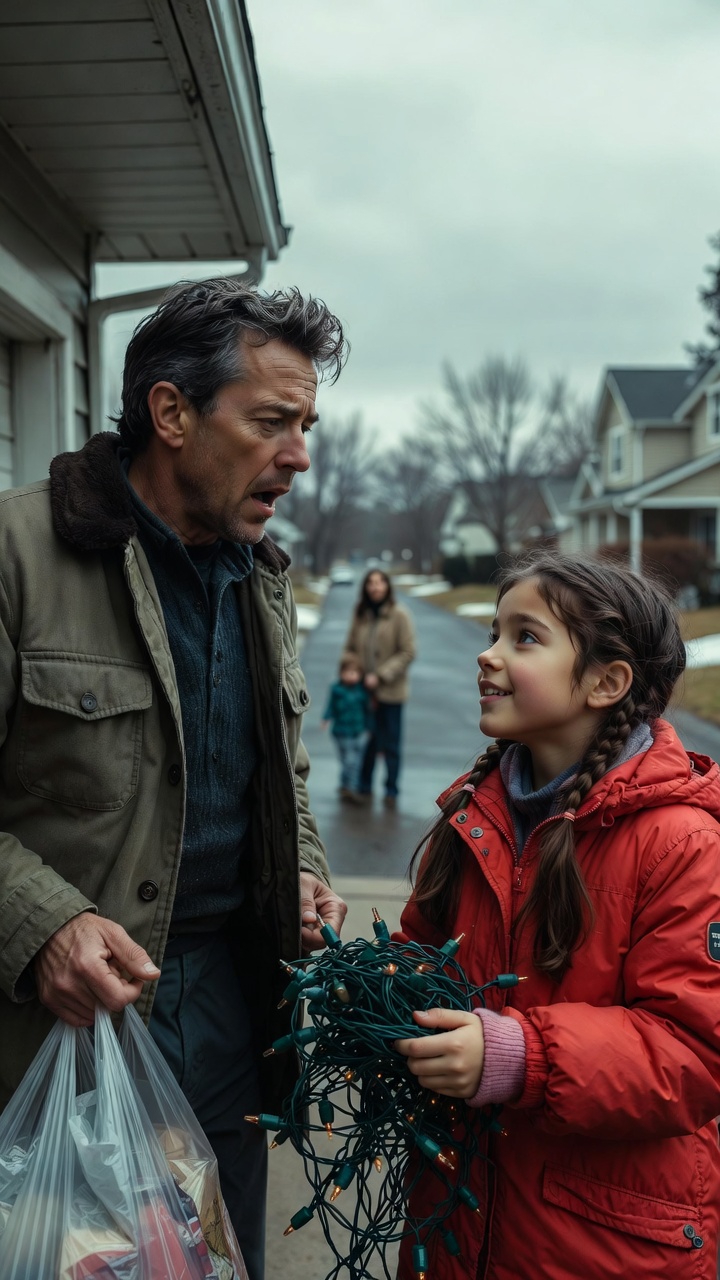
I was carrying groceries from my car when the little girl appeared at the edge of my driveway.
“Excuse me, mister?”
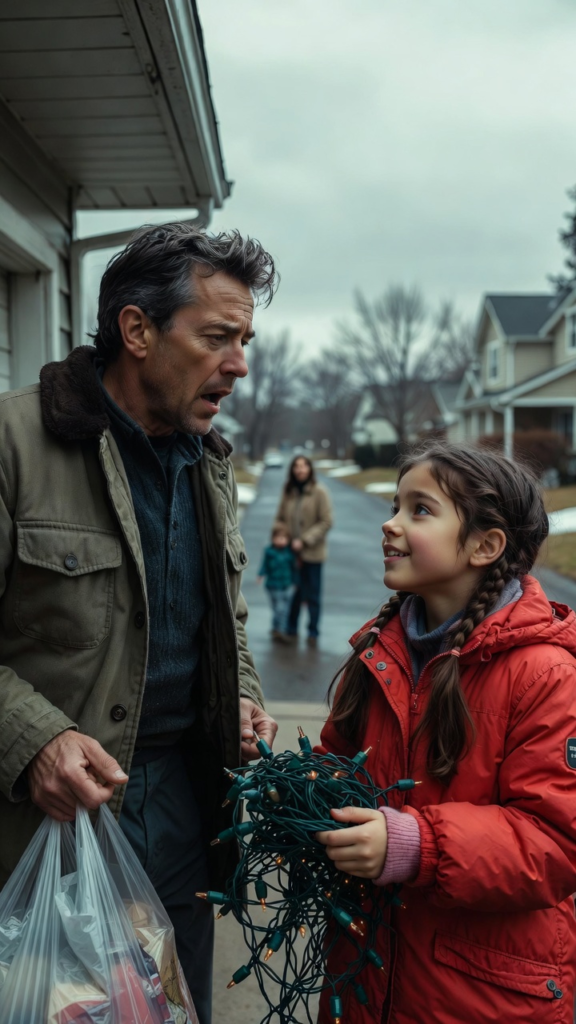
I turned. She couldn’t have been more than seven years old, wearing a too-big winter coat that probably used to belong to someone else, holding a tangled string of Christmas lights that dragged on the ground. Behind her stood a woman I vaguely recognized—my new neighbor from across the street. The one who’d moved in two months ago with three kids and moving boxes labeled in neat handwriting. The one I’d waved to exactly once and then promptly ignored.
“Can you help us hang our Christmas lights?” the girl asked, her voice small and hopeful. “Our dad used to do it, but he’s in heaven now.”
The words hit me like cold water. I stood there holding my grocery bags—frozen dinners and beer, the staples of a man living alone—and stared at this child who’d just casually mentioned her dead father while asking me to hang Christmas lights.
I should have said no. I’d spent fifteen years being the house that stayed dark during Christmas. No lights. No wreath. No inflatable Santa or reindeer or any of the ridiculous lawn decorations my neighbors seemed to accumulate every year. While everyone else on the street transformed their homes into winter wonderlands starting the day after Thanksgiving, mine remained stubbornly, defiantly ordinary.
I told people I was practical. That Christmas decorations were wasteful. That I didn’t need to participate in the neighborhood’s decorating arms race.
But the truth was simpler and sadder: I was alone, and decorating for an audience of one felt pointless.
“Sophie, we talked about this,” the woman said, walking over quickly with an apologetic expression. “You can’t just ask strangers—”
“It’s okay,” I heard myself say. The words surprised me as much as they surprised her. “I can help.”
The relief on her face was immediate and profound. “Are you sure? I really don’t want to impose. It’s just… the boxes are so heavy, and the ladder makes me nervous, and the kids really wanted lights this year. It’s our first Christmas without—” Her voice caught. She cleared her throat. “Without my husband.”
“Tomorrow afternoon,” I said. “I’ll come by tomorrow.”
Her name was Rebecca. Her kids were Sophie (seven), Emma (five), and Noah (five). Her husband Tom had died eight months ago. Heart attack at thirty-six. No warning. Just gone.
I learned all of this the next day when I showed up at their door with my ladder and tool belt.
The First Afternoon
Sophie squealed when she saw me coming across the street. “You came! Mom, he came!”
The twins—Emma and Noah—were already in the front yard, bundled in mismatched winter coats, practically vibrating with excitement.
Rebecca showed me the garage, where six large plastic containers sat labeled in that same neat handwriting: “Lights,” “Ornaments,” “Outdoor,” “Tree,” “Stockings,” “Misc.”
Everything organized. Everything preserved from a life that used to include a father.
“Tom always went overboard with decorations,” Rebecca said quietly, running her hand over one of the boxes. “The kids want to do what he would have done. I just… I can’t do it alone.”
We spent the afternoon hanging lights. Rebecca had a vision—white lights along the roofline, a wreath on the door, luminarias lining the walkway. Nothing extravagant, but warm. Welcoming.
The kids sat on the lawn and watched me work, pointing out every missed spot, every crooked section, every opportunity to add “just a few more” lights.
And something strange happened. Something I hadn’t felt in fifteen years.
I felt useful.
The Stories
While I worked, Rebecca brought out hot chocolate. We sat on her front steps—me, her, and three kids who couldn’t stop talking.
They told me about their dad. How he’d loved Christmas more than any holiday. How he’d always gone overboard with decorations, much to the neighbors’ delight and Rebecca’s mild exasperation. How last year, when he’d been feeling sick (though none of them knew yet that his heart was failing), he’d still insisted on hanging lights even though he could barely stand.
“He made Mom promise we’d always decorate,” Emma said, her small voice serious beyond her years. “So people know we’re home.”
That phrase stuck with me. “So people know we’re home.”
Rebecca caught my expression. “Tom believed houses should look lived in. Loved. He said dark houses made him sad because it meant nobody inside was celebrating anything. That they’d given up on joy.”
I thought about my own dark house across the street. What it said about me. What message I’d been sending for fifteen years to everyone who drove past.
“He sounds like he was a good man,” I said quietly.
“The best,” Rebecca replied. Her kids nodded in solemn agreement.
The Transformation
It took three full days to finish their house. What started as hanging a few strings of lights turned into a complete production. The kids had opinions about everything—where the wreath should hang, how the luminarias should be spaced, whether the inflatable snowman should face the street or the house.
I found myself returning each afternoon. Not because the job required it, but because I wanted to. Because Sophie would run out to greet me when she saw me coming. Because the twins would show me drawings they’d made at school. Because Rebecca would offer coffee and conversation and make me feel less invisible than I’d felt in years.
On the third day, when we finally plugged everything in at dusk, the kids gasped.
Their house glowed. Warm white lights outlined every edge of the roofline. The wreath sparkled with tiny LEDs. The luminarias created a path of soft light leading to the door. The inflatable snowman waved mechanically in the yard.
“It’s perfect,” Sophie whispered, her eyes wide. “Dad would love it.”
And then she hugged me.
This little girl who barely knew me, who’d lost her father eight months ago, who had every reason to be guarded and careful with her affection—she wrapped her arms around my waist and held on tight.
I couldn’t remember the last time someone had hugged me.
I stood there, awkward and overwhelmed, and patted her back gently. Over her head, I saw Rebecca watching with tears in her eyes.
The Question
That night, as I was packing up my tools to head back across the street, Sophie asked the question that changed everything.
“Why doesn’t your house have lights?”
I froze, my hand on the ladder. Rebecca shot her daughter a warning look. “Sophie, that’s not—”
“It’s okay,” I said. I looked at this little girl who’d lost her father but still believed in making houses bright. “I guess I never saw the point.”
“The point is so people know you’re home,” Emma chimed in, repeating what she’d told me earlier. “So they know you’re celebrating.”
“But I live alone,” I said. “There’s nobody to celebrate with.”
All three kids looked at me like I’d said the silliest thing they’d ever heard.
“You could celebrate with us,” Sophie said simply.
Noah nodded enthusiastically. “Yeah! We could help you decorate your house!”
I looked at Rebecca, expecting her to shut this down. To explain to her kids that you can’t just invite your neighbor into your family. Instead, she smiled.
“They’re right. You helped us. Let us help you.”
“I don’t have any decorations,” I protested weakly.
“We have extras,” Rebecca said. “Tom always bought too much. Way too much. He’d want someone to use them.”
Decorating My House
The next Saturday, they invaded my house.
All four of them, carrying boxes of lights and decorations I hadn’t earned but was being given anyway.
Sophie directed operations like a tiny general. “Lights on the roof! Wreath on the door! Candy canes on the walkway!”
The twins tested every strand of lights, giggling hysterically when they found ones that blinked. Rebecca organized everything with the practiced efficiency of someone who’d done this many times before, who knew exactly how Tom would have wanted it done.
And me? I just followed instructions. Climbed the ladder when told. Hung lights where directed. Let these four people I barely knew bring my house back to life.
By the time we finished, my house mirrored Rebecca’s across the street—two beacons of light in the winter darkness.
When we plugged everything in that evening, I stood back and stared. My house didn’t look empty anymore. It didn’t look like a place where someone was just going through the motions of existing.
It looked like someone lived there. Someone who mattered.
“Now you’re home,” Sophie said, taking my hand.
She was right.
Christmas Eve
Christmas Eve, Rebecca invited me over for dinner. “Just casual,” she said. “Nothing fancy. But the kids want you there.”
I almost said no. Old habits die hard. But then I thought about my newly lit house—no longer dark, no longer sending the message that nobody was home—and I said yes.
Dinner was chaotic and perfect. The kids talked over each other. Someone spilled juice. Noah knocked over a candle (unlit, thankfully). Emma insisted we sing carols even though none of us could carry a tune. Sophie wanted to hear stories about what Christmas was like when I was young.
After the kids went to bed, Rebecca and I sat on her couch drinking eggnog, watching the lights on her tree blink slowly.
“Thank you,” she said quietly. “For helping us. For being here. This was the first Christmas I wasn’t terrified of.”
“Terrified?”
“Of doing it wrong. Of not being enough without Tom. Of the kids seeing how scared I am all the time.”
I understood that fear intimately. “You’re doing great,” I told her. “They’re lucky to have you.”
“We’re lucky to have you too,” she said. And she meant it.
Three Years Later
That was three years ago.
Rebecca and I aren’t married—nothing like that. But we’re family in the way that matters most.
Every year, we decorate our houses together. The kids are older now—Sophie’s ten, the twins are eight—but they’re just as bossy about where the lights should go. We’ve started a tradition: the Saturday after Thanksgiving, both houses get decorated. Hot chocolate is mandatory. Crooked lights are permitted. Laughter is required.
Other neighbors have joined in. The couple next door asked for help last year. The family down the street the year before that. Our entire street has become known as “Christmas Street”—people drive through slowly in December to see the synchronized lights.
But it’s not really about the decorations.
It’s about what Sophie said that first day: “So people know you’re home.”
I’m home now. Not just in a house, but in a life. In a community. With people who matter and who make me matter.
All because a little girl asked a lonely stranger to help hang some Christmas lights.
And the lonely stranger finally said yes.
What I Learned
For fifteen years after my wife left, I told myself I was fine alone. That I didn’t need community or connection or any of the messy complications that come with letting people into your life.
But I wasn’t fine. I was just surviving. Going through the motions of living without ever really being alive.
My dark house wasn’t a statement about practicality or minimalism. It was a symptom of isolation. A visible manifestation of internal emptiness.
When Rebecca and her kids brought lights to my house, they weren’t just decorating. They were including me. Seeing me. Saying, “You matter. You’re part of this community. You’re home.”
That’s what saved me. Not the lights themselves, but what they represented: belonging.
Sophie’s father Tom believed houses should be lit so people know you’re home. But he wasn’t really talking about houses. He was talking about lives. About showing up. About being present and open and willing to celebrate even when—especially when—life is hard.
I spent fifteen years with my lights off, telling the world, “Nobody’s home. Don’t bother.”
Now my house glows every December, sending a different message: “Someone’s here. Someone cares. You’re welcome.”
Last week, Sophie asked me to help her with a school project about what “home” means. She interviewed me, her mom, and her siblings.
“What did you learn?” I asked her when she was done.
She thought about it seriously. “I learned that home isn’t a place. It’s people. It’s the people who see you and say, ‘Celebrate with us.’ It’s the people who bring light when everything’s dark.”
She’s ten years old, and she understands something it took me forty-seven years to learn.
This Christmas, my house will glow just as bright as Rebecca’s. And somewhere in our town, families will drive down our street to see the lights.
But I’ll know the real magic isn’t in the decorations.
It’s in the little girl who asked a lonely stranger for help.
And the stranger who finally stopped being afraid to say yes.