The Dog at the Fence
I knew something was wrong the second my dog didn’t bark.
Most mornings, Daisy went insane at the slightest sound—a car door slamming, a jogger on the sidewalk, the mail carrier daring to exist. That morning, as I carried my coffee to the back door, the silence felt wrong. Heavy. Like the air was holding its breath.
When I slid the blinds open, my mug slipped from my hand and shattered on the kitchen floor.
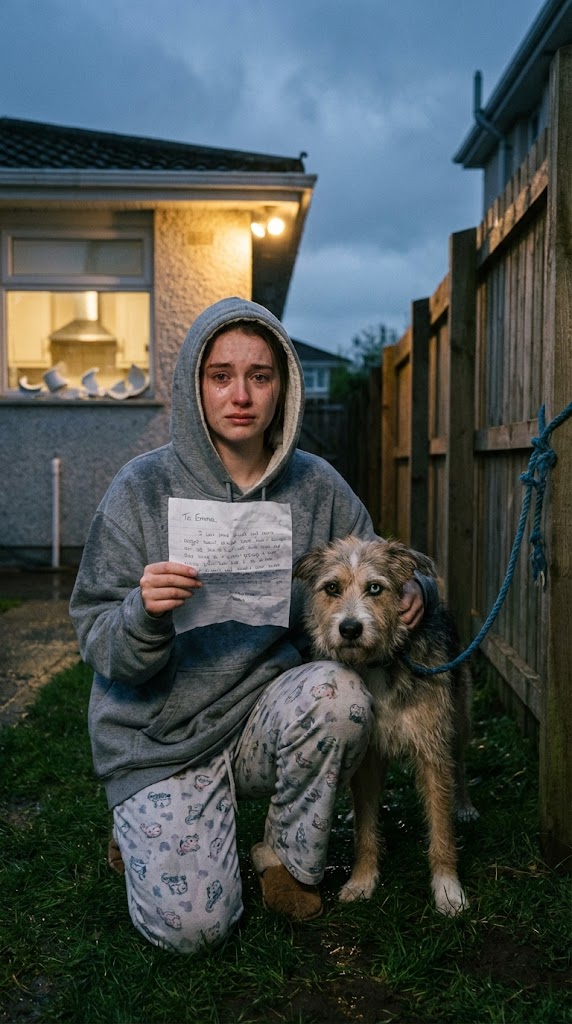
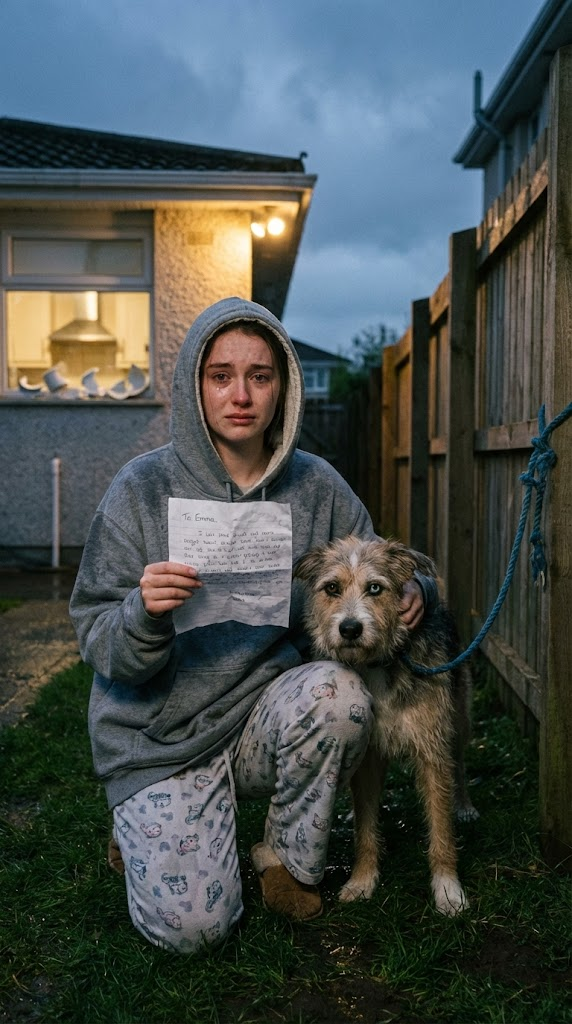
There, tied to my back fence with a frayed blue rope, was a dog I had never seen before. Soaked from the drizzle, shivering, ribs faintly visible under patchy fur. A dirty red bandana was knotted around his neck, and pinned to it with a rusted safety pin was a folded, crumpled piece of paper.
He wasn’t pulling or barking. He was just sitting there, staring straight at my kitchen door, like he’d been told to wait for me.
I rushed outside in my slippers, glass still sparkling behind me on the kitchen tiles.
“Hey, buddy,” I whispered, dropping to my knees in the wet grass. Up close, I could see his eyes—one brown, one icy blue, both filled with a kind of exhausted hope that made my throat close up. His paws were muddy, his nails overgrown. But his fur, where it wasn’t matted, was recently washed.
Someone had cared. And then someone had tied him to my fence in the middle of the night.
That was when I saw it: my name. Written on the outside of the note in shaky blue ink.
“To Emma.”
My hands started to tremble. No one here was supposed to know this fence, this backyard, this quiet corner of my new life. I’d moved across town six months earlier to get away—from my ex-husband, from his family’s constant drama, from neighbors who gossiped more than they breathed.
How did whoever did this know my name?
I unclipped the safety pin with numb fingers and carefully unfolded the damp paper. The dog pressed closer to me, leaning his whole weight against my leg like he already knew I was his last chance.
The first line of the note made my vision blur.
“I’m so sorry. Please don’t hate me. If you’re reading this, it means he made it to you. His name is Milo… and he used to be yours.”
I was shaking. I didn’t know whether to scream or laugh.
Because Milo was the name of the dog my ex-husband had “re-homed” behind my back three years earlier—while I was at work, while our daughter was at school, while he swore he’d never do something like that.
The dog I’d cried over for months. The dog he’d sworn had gone to “a good family in another state.”
And now a strange dog with one brown eye and one blue was tied to my fence… wearing that name like a ghost from a life I thought I’d finally left behind.
Backstory: A Marriage Built on Half-Truths
To understand why seeing that name—Milo—on a damp piece of paper shook me so badly, you have to understand my ex.
Kevin looked perfect from the outside. Charming, funny, always ready with a joke at parties. The kind of man who could talk a cop out of a speeding ticket and a landlord into lowering the rent. People loved him instantly.
He loved that people loved him.
What he didn’t love was responsibility.
Our marriage had been a slow erosion. Not explosive, not dramatic—just little lies that chipped away at trust. Phone calls taken in the other room. “Forgotten” bills. Nights out that ran later and later. A constant, subtle rewriting of reality whenever I questioned anything.
“You’re overreacting, Em.”
“I never said that, you’re remembering it wrong.”
“Why are you always trying to start a fight?”
We got Milo in one of the good moments.
Our daughter, Hannah, had just turned five and was obsessed with dogs. Kevin came home one day with a rescue spaniel mix—big brown eyes, constantly wagging tail—and said, “Every kid needs a dog. I saw him at the shelter and couldn’t say no.”
I fell in love instantly. So did Hannah. That dog slept at the foot of her bed every night. When things with Kevin were tense, Milo and I would go on long walks around the neighborhood, just me and his steady presence and the sound of his collar jingling.
When things started to fall apart for real—when I finally found hard proof of Kevin cheating, when the fights turned from quiet tension to slammed doors—Milo was the one normal thing in our house.
So when I came home one Thursday and his food bowl was gone, his bed was gone, his leash was gone, I knew something was very, very wrong.
“Where’s Milo?” I asked, already feeling that horrible sinking in my stomach.
Kevin didn’t look up from the game he was watching. “Oh. I took him to a family who has a big yard. He wasn’t happy here. Hannah will get over it.”
“You did WHAT?”
He rolled his eyes. “We talked about this.”
“No. You talked. I said absolutely not.”
He scoffed. “Same thing.”
I tore the house apart looking for any trace of Milo. I called every shelter, every rescue, every vet in a fifty-mile radius. Nothing. Kevin wouldn’t give me a name, a phone number, an address. “They don’t want to be contacted,” he said. “Let it go.”
We divorced six months later.
Losing Milo hurt in a way that surprised even me. It wasn’t just losing a pet—it was losing the proof that Kevin could rewrite reality and get away with it. He’d taken something living and breathing that we both loved and erased him like a line item on a budget.
That day, I promised myself I’d never let anyone have that much power over my life again.
A New House, Old Ghosts
Fast forward three years.
New house. New neighborhood. New job. A car that didn’t threaten to die at every stoplight. A sense of peace I hadn’t felt in a decade.
Hannah was eight now, taller, quieter, still sleeping with a stuffed dog because the real one had been “sent away.” She didn’t talk about Milo much anymore, but sometimes I’d catch her glancing at old photos on my phone when she thought I wasn’t looking.
I’d told myself we’d get another dog someday, when things were more stable. But there was always another reason to wait—a rent increase, a car repair, unexpected school fees. Life was a litany of “maybe next month.”
And then, apparently, life decided to tie a dog to my fence with a note.
Back in the yard, I forced my eyes to keep moving down the page.
“I know you probably hate me. You should. I’ve done unforgivable things. But I’m begging you—please keep him safe. I don’t know who else to trust.”
The handwriting was messy but familiar in a way that made my stomach twist.
Kevin’s.
“I lied to you about Milo,” the note continued. “I didn’t send him to a good family. I sold him. He was purebred, and we were three months behind on rent. A man online offered cash, no questions asked. I told myself it was fine, that he’d go to a better home. But I knew I was lying, even then.”
I stopped reading and looked at the dog leaning into my side. He wasn’t a spaniel like our old Milo. He looked more like a husky mix—thick double coat, mismatched eyes, a faint scar across his nose. But the way he watched me, like he was trying to decode my every move, felt heartbreakingly familiar.
“Is your name really Milo?” I whispered.
His tail thumped once against the wet grass.
I went back to the note.
“I never forgot what I did. When you left, I told myself I’d change. I didn’t. I got into some bad things with some bad people. Owed money I couldn’t pay. One of them had this dog. Said he used him for ‘training.’ I don’t want to think about what that means. All I know is he hit him. A lot. He didn’t even call him by a name—just ‘it.’”
My throat closed.
“One night he bragged that he’d picked him up from a guy who couldn’t pay his debts. A guy with a little girl who cried when they took the dog away. He showed me a picture.”
I could picture it: our old tiny yard, Hannah sobbing, me at work, Kevin shaking hands with a stranger for a stack of bills while Milo wagged his tail, trusting everyone.
“He was older, thinner, but it was him. Our Milo. I knew I had to get him out. So I did something stupid. I stole him. And now they’re looking for me.”
I read that line three times.
“I can’t stay in town. If they find me with him, they’ll take him again, and I don’t think he’ll survive another round. You’re the only person I know who loved him enough to try to fix what I broke. Please. Keep him. Or at least take him to someone who will. I left what cash I had in the bandana. It’s not enough, but it’s something.”
I felt around the inside of the bandana and found a small wad of damp bills—tens and twenties, maybe a couple hundred in total.
At the bottom of the page, one last line, barely legible where the ink had bled.
“I’m sorry I didn’t fight for us. Please fight for him. —Kevin.”
The Breaking Point
I sat there in the wet grass, rain soaking through my thin pajamas, note crumpled in my fist, this stranger-dog pressed against me like he was afraid I’d disappear.
Part of me wanted to rip the letter into a thousand pieces and let the wind take it. Another part wanted to drive to wherever Kevin was, throw the dog in his face, and scream until my voice gave out.
Instead, I did what my therapist had been begging me to do for months: I let myself feel it.
All of it.
The grief for the Milo I’d lost. The anger at Kevin for selling him. The guilt for not seeing who he was sooner. The fear that this new dog—this scarred, silent creature—would be taken from me too.
I buried my face in the dog’s wet fur and sobbed in a way I hadn’t sobbed since the night I packed Hannah’s things into trash bags and left our old house behind.
He didn’t flinch. He just leaned harder into me, one paw gently resting on my knee like he was reassuring me.
“Okay,” I whispered finally, voice hoarse. “Okay. I’ve got you. I don’t know who you were, or what you went through, or what they called you. But you’re safe now. Do you hear me? You’re safe.”
His tail thumped again.
For the first time in a long time, I realized I wasn’t just saying it to him.
The Climax: Connecting the Dots
Inside, I toweled him off, checked his body as best I could—old scars, a couple of fresh scrapes, but nothing bleeding. I filled a bowl with food and water. He inhaled both so fast it made my heart hurt.
Hannah padded into the kitchen in her pajamas, rubbing sleep from her eyes. “Mom? Why were you—” She froze when she saw him.
“Is that… Milo?” she whispered.
I opened my mouth to explain, but the dog trotted over to her, sniffed her hand, and gently nudged his nose under her fingers. She burst into tears.
“Milo,” she sobbed, dropping to the floor to hug him. “You came back.”
The name fit him too easily. Like it had been waiting.
I sat down beside them and pulled the note from my pocket.
“Sweetie,” I said gently, “this isn’t the same Milo. He’s older, and he’s been through some stuff. But someone who did a very bad thing is trying to make it right. He wanted him to come to us.”
“Can we keep him?” she asked immediately, eyes wide and desperate.
Every practical instinct screamed no. Vet bills, food, training, the possibility that someone dangerous might come looking for him. The fact that my ex apparently had criminals after him and thought my address was a great place to divert attention.
But watching Hannah’s arms around that dog’s neck, watching his eyes slowly soften, watching his body relax like he was finally allowed to exhale… there was only one answer.
“Yes,” I said. “We’re going to try.”
Trying meant calling my neighbor, who volunteered with a local rescue, to help scan for a microchip. No chip.
Trying meant calling my lawyer to tell him Kevin had resurfaced in a way that might matter.
Trying meant calling an old mutual friend of ours—the only one I still trusted—to see if she’d heard anything about Kevin being “in trouble.”
She had. And what she told me made my blood run cold.
“He’s been mixed up with some guys who run illegal dog fights,” she said quietly. “Training, breeding, selling. He owes them a lot of money. Rumor is, someone’s dog went missing from their ‘facility’ last night and they’re furious.”
I looked at Milo—our new Milo—sleeping on my kitchen floor with his head on Hannah’s foot like it was the most natural pillow in the world.
“Do they know my address?” I asked.
“Not yet,” she said. “But Kev’s not exactly careful. If they think he sent the dog to you…”
That was the moment the fear turned into something else.
Rage.
Kevin hadn’t just lied and stolen and sold a dog once. He’d done it again, only this time to the kind of people who didn’t file polite civil suits—they broke bones.
And now he’d tied the consequences of his choices to my fence.
Revenge, Rewritten
My first instinct was to call Kevin and scream. Demand answers. Demand he fix it. Demand he come get the dog and face what he’d done.
But then I thought about the note. “If they find me with him, they’ll take him again, and I don’t think he’ll survive another round.”
I believed that.
So instead of calling Kevin, I called someone else.
Animal control. The rescue. A friend who worked as a paralegal. We formed a plan.
First, I took Milo to the vet. We documented every scar, every injury, every sign of neglect. The vet, bless her, took one look at him, listened to a very abbreviated version of the story, and quietly said, “If anyone comes asking, he’s been here for weeks. You adopted him last month.”
Next, my neighbor connected me with an investigator who specialized in animal cruelty cases. He’d been trying to gather evidence on this dog-fighting ring for over a year, but he hadn’t had a way in.
Now, apparently, he did.
I gave him a copy of Kevin’s note. He whited out names, kept the rest. Combined with rumors, reports of missing dogs, and now a stolen dog tied to a random fence, he finally had enough to push local law enforcement to act.
Within a week, there were raids. Arrests. News reports about “an alleged illegal dog-fighting operation dismantled after a tip from a concerned citizen.”
They never mentioned Kevin by name. But I heard through the grapevine that he’d taken their money, taken their dog, and then disappeared. For once, his disappearing act wasn’t my problem to solve.
My revenge wasn’t seeing him in handcuffs or getting a tearful apology that would never come. My revenge was knowing that the people who hurt Milo—and dogs like him—were finally facing consequences.
And that the dog they’d treated like property was now curled up on my daughter’s bed, snoring softly, safe.
Resolution: The Dog Who Saved Us
We kept the name.
Maybe it was a bad idea. Maybe it blurred lines. But watching Hannah scratch behind his ears and say, “Good boy, Milo,” watching him roll over and show his belly with absolute trust, it felt less like replacing the past and more like rewriting it.
This Milo wasn’t a symbol of what I’d lost.
He was a symbol of what I’d survived.
He startled at loud noises at first. Flinched at fast hand movements. Hated closed doors. But slowly, with time and patience and so many treats, he softened. He learned that raised voices in our house meant laughing at dumb movies, not fighting. That hands were for petting, not hitting. That fences were for keeping him safe, not tying him out and leaving him.
One night, months later, I was sitting on the back steps watching the sunset while Milo sniffed around the yard. The old fear flickered—what if someone came back? What if that fence, once a place of abandonment, became a place of threat?
Milo trotted back over, nudged my hand, and sat so close his fur warmed my bare arm.
“We’re okay,” I told him. “They don’t get to have you. Or me. Or her. Not anymore.”
He sighed—a big, content dog sigh—and laid his head in my lap.
Sometimes, in the quiet moments, I think about the note.
“I’m sorry I didn’t fight for us. Please fight for him.”
It was the most honest thing Kevin had ever written.
So I did.
I fought for Milo by keeping him safe. I fought for Hannah by giving her back a piece of the childhood Kevin had stolen. And I fought for myself by turning one man’s cowardice into a catalyst for shutting down something truly cruel.
I still don’t forgive Kevin. Forgiveness, I’ve learned, is not owed to people who confuse regret with guilt. But I am grateful—for the first and probably only time—that his desperation led a dog to my fence instead of another nightmare.
I found a dog tied to my fence with a note. Reading it made me sob uncontrollably.
What I did next didn’t just shock everyone who knew me.
It saved all three of us.