I used to think every family had an unspoken rule that you were safe as long as you were trying. You could mess up, forget to take the trash out, even fail a class, but if you were making an effort, your place in the house was secure.
That belief ended on a Tuesday afternoon in October.
It was the kind of autumn day that feels like a memory while it is happening. The leaves were turning the color of old pennies, the school hallways smelled faintly of cafeteria pizza, and I was thinking about how I needed to hurry home because my mom had said she wanted to “talk.” Those words did not sound dangerous. They never had before.
I was fifteen years old.
The Walk Home
I took my usual route: past the soccer field where the junior varsity team was practicing, down Maple Street where the houses all looked like they had been copied and pasted from the same blueprint, and then across the small strip mall with the grocery store at the corner.
The grocery store was important in our family. It was where my mom worked part-time when money was tight, where we bought store-brand cereal and dented cans because they were cheaper. I used to go there after school sometimes just to say hi to her, pretending I needed milk so I would not embarrass her in front of her coworkers.
That day, I did not stop. I was late, and she had said she wanted to talk.
As I turned the corner onto our block, something felt off. The curtains in the living room were gone. The little ceramic pumpkin I had put on the front steps for Halloween was missing. Our porch light was off even though it was getting dark.
Still, I told myself I was being dramatic. Families have bad days. Moms forget to turn lights on.
I took my key out of my backpack.
It did not fit.
At first I thought I was holding it upside down. Then I tried again. The key went in, but it would not turn. I pulled it out and looked at it like it might have changed shape.
It had not.
The lock had.
The Door That Was Not Mine Anymore
I knocked, lightly at first. Then harder.
No answer.
I rang the doorbell. The new doorbell. I noticed it only then — sleek and silver instead of the chipped white one we had for years.
My phone buzzed.
Mom: We talked with your stepdad. You can’t stay here anymore. Your things are on the porch.
I read it three times because my brain could not make sense of the words in the order they were in.
I turned around.
There were two trash bags on the porch. One was ripped slightly, and I could see my old hoodie inside — the blue one with the frayed cuffs that I had worn since middle school.
That was it. Two bags. Fifteen years of my life condensed into what people use for yard waste.
I knocked again, even though I had the text.
“Mom,” I said through the door. “Please. Just open it.”
No answer.
I did not shout. I did not cry yet. I just stood there, backpack on my shoulders, holding a useless key, feeling like I had wandered into someone else’s life.
What I Did Not Know
There are a lot of things you do not understand about adults when you are a kid. You do not see their fear clearly. You do not see how money, stress, and bad relationships grind people down until they start making choices that do not look like them anymore.
My mom had been struggling. I knew that much. Her hours at the store had been cut. My stepdad had been complaining about bills and groceries and how much space I took up.
“You’re almost grown,” he liked to say. “Time to learn responsibility.”
I thought that meant chores. Or maybe a job.
I did not think it meant homelessness.
The Neighbors
Mrs. Jensen from next door opened her door a crack.
“Everything okay, sweetheart?” she asked.
I wanted to lie. I wanted to tell her I had locked myself out. But the trash bags were right there, open to the world.
“She changed the locks,” I said instead.
Mrs. Jensen frowned, the lines around her eyes folding in on themselves.
“That can’t be right.”
I showed her the text.
She read it slowly, then looked back at the door like she could argue with it.
“Come inside,” she said. “Let’s call your mom.”
I followed her into her house, which smelled like lemon cleaner and something baking. It felt like stepping into another universe — a universe where doors still opened.
She dialed my mom on speaker.
It rang. And rang.
Finally, my mom answered.
“What do you want?” she said, her voice flat.
Mrs. Jensen introduced herself. Explained the situation in gentle words, the way adults do when they are trying not to make things worse.
There was a pause.
“He needs to learn consequences,” my mom said. “We can’t handle his attitude anymore.”
My hands were shaking so hard I had to sit down.
“He is fifteen,” Mrs. Jensen said carefully.
“He is almost grown,” my mom replied. “He’ll figure it out.”
The call ended.
Mrs. Jensen covered her mouth with her hand. “I’m so sorry.”
She offered to let me stay the night. She was kind, but I could see the hesitation behind her eyes — the calculation of space, responsibility, trouble.
I told her I did not want to cause problems.
That was the first lie I told that night.
The Grocery Store
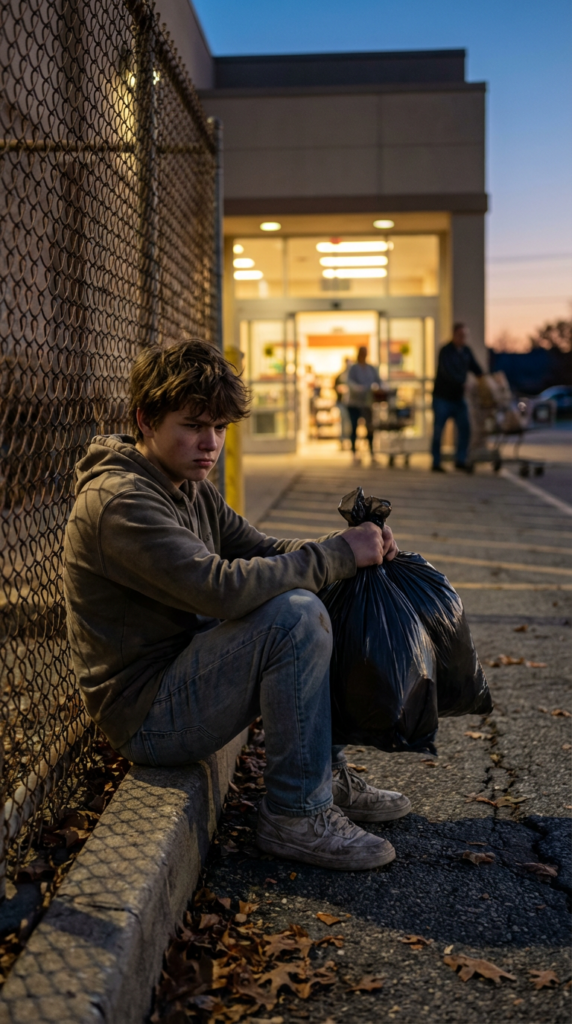
I walked back to the strip mall with the trash bags in my hands. They were heavier than they looked, filled with clothes that smelled like my house — detergent, old carpet, my life.
I did not know where to go.
Friends had parents. Teachers had rules. Police cars passed by and made my heart jump even though I had done nothing wrong.
So I went to the only place that still felt familiar.
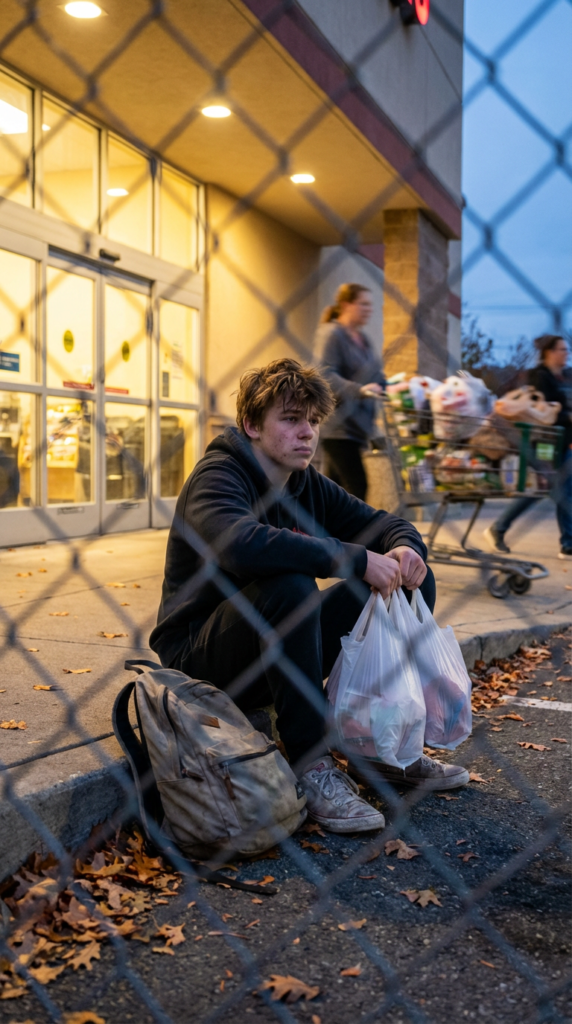
Behind the grocery store, there was a narrow space between the building and a chain-link fence. It was where broken pallets and empty boxes were stacked before trash day.
It was not a place anyone would choose.
But it was dry.
I sat down on one of the pallets and hugged my backpack to my chest.
Through the fence, I could see the parking lot. The automatic doors slid open and shut like the store was breathing.
I watched people push carts full of food, families laughing about what to cook for dinner.
And then I saw her.
My mom walked out of the store wearing her green work apron, laughing with a coworker. She did not look stressed. She did not look afraid.
She looked normal.
She got into her car and drove past me without looking in my direction.
I do not think she knew I was there.
I do not know if that makes it better or worse.
Night Sounds
When it got dark, everything sounded louder. A shopping cart rolling across the pavement. A car door slamming. The hum of the building’s vents.
I tried to sleep sitting up because the pallet dug into my back when I lay down.
I kept checking my phone, hoping for a message that said this was all a mistake. That the locks were temporary. That I could come home.
Nothing came.
I had a math test the next morning.
I had not showered.
I had two trash bags, a backpack, and a phone with 12% battery.
This was how quickly a life could change.
The First Morning
The morning light was gray and thin. My body felt stiff, like it did not belong to me anymore.
I went into the grocery store bathroom to wash my face. I avoided looking in the mirror for too long.
I bought a banana with the last dollar in my pocket.
At school, I told everyone I was tired because I had stayed up too late studying. No one questioned it. No one ever does.
That day, I learned something important: you can be in the middle of a crisis and still be expected to raise your hand in algebra.
The Secret Life
Days blurred together. I started staying behind the store every night. I learned which security guard did not look too closely at the back lot. I learned when the trash was taken out so I could avoid being seen.
I also learned how invisible a person can become.
People walked past me every day — adults, kids, families — and none of them noticed the teenager sitting behind the fence, trying to pretend he still belonged somewhere.
My mom kept shopping at the same store.
Sometimes I would see her standing in line, scrolling on her phone, deciding between brands of cereal.
She never looked behind the building.
What I Wanted to Ask Her
There were a thousand questions burning in my chest.
How could you do this?
Did I really become unlovable overnight?
Was I so hard to live with that you decided I was not worth a conversation?
But I never asked.
Because a bigger question was louder than all of them: If my own family could erase me this easily, what chance did I have anywhere else?
The Beginning of Something Worse
One night, as I was settling onto my pallet, a man I had never seen before walked into the back lot. He looked at me, really looked, the way most people did not.
“You shouldn’t be out here alone,” he said.
I stood up immediately.
“I’m fine,” I replied, even though nothing about me was fine.
He shrugged and walked away, but my heart kept racing long after he was gone.
That was when it hit me: this was not just uncomfortable. It was dangerous.
And it was only the beginning.
Moral Reflection
I do not know yet how this story ends. I am still living it.
But if there is already one lesson, it is this:
A family is not defined by who shares your last name or your roof. It is defined by who protects you when you are most vulnerable.
Children do not stop being children just because adults are tired, stressed, or overwhelmed. And when a young person is pushed out of their home without guidance, safety, or compassion, it is not a lesson being taught — it is a wound being created.
Part 2 will tell you what happened next.