The Birthday That Broke Me
“Blow, buddy! Make a wish!”
My sister’s voice is too loud in our tiny kitchen, bouncing off the chipped tiles and the humming refrigerator. She’s holding her phone vertically, of course, because she’s already thinking about the video she’ll post later with some cheesy caption about “making the best of what we have.”
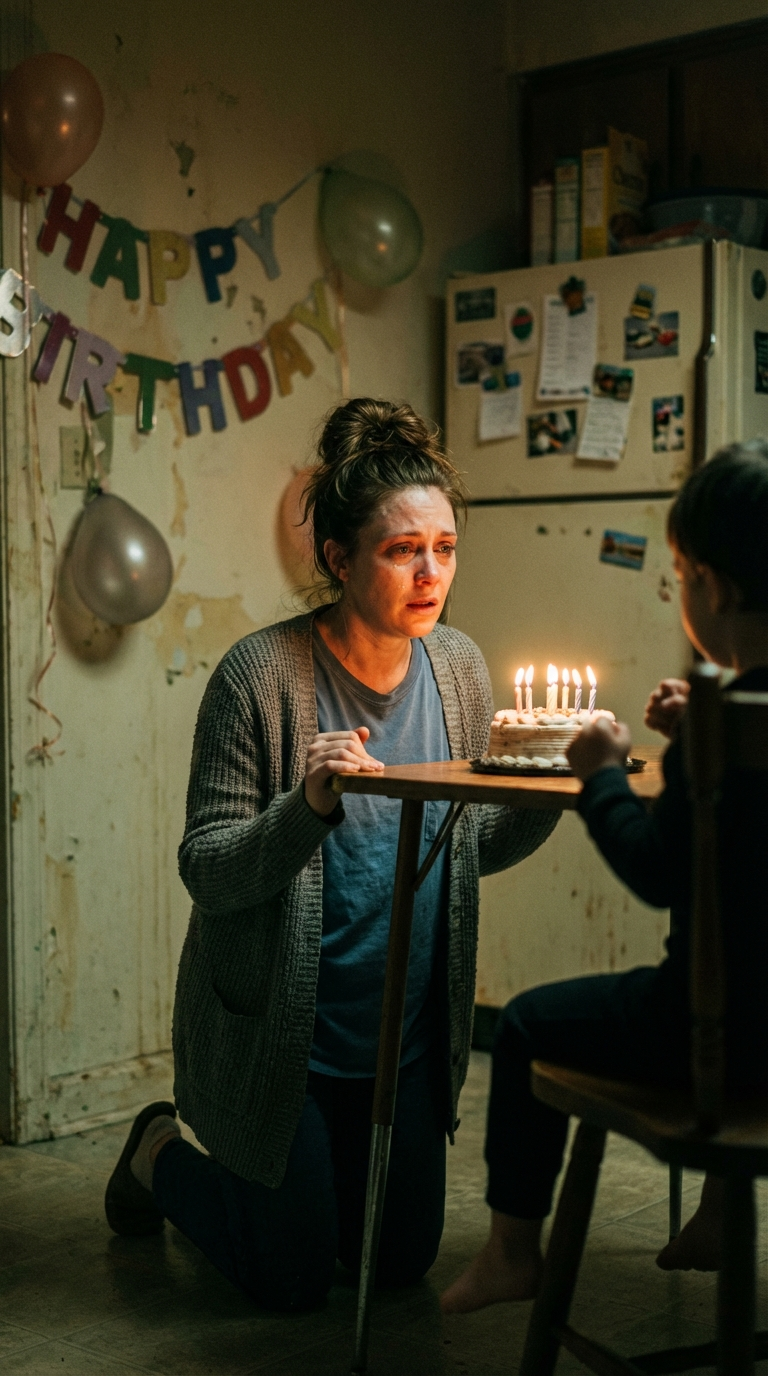
The banner above my son’s head says “HAPPY 8TH BIRTHDAY, LEO!” in bold, cheerful letters. It has a crease down the middle because it was folded in the clearance bin. The tape holding it up keeps peeling from the damp wall, so the “BIRTHDAY” droops like it’s exhausted.
The cake is small. Not one of those towering Pinterest cakes with fondant characters and edible glitter. Just a basic chocolate sheet cake from the supermarket, the kind they write your kid’s name on for free if you ask nicely. Eight skinny candles flicker on top, wax already starting to drip.
The apartment smells like frosting, burnt sugar, and the faint, stale scent of cigarette smoke we can never fully get out of the walls from the last tenants.
“Go on, honey,” I say, pushing my voice into that bright, brittle register that feels like it might snap at any second. “Make a wish.”
I expect him to do what he always does.
Close his eyes. Clamp his face in concentration. Maybe whisper something only he and the universe will hear.
Instead, Leo stares at the candles like they’re accusing him of something.
He’s so small in that second. Eight years old, but with shoulders that already slouch like he’s learned how to carry invisible weight. His Spider-Man T-shirt has a tiny hole near the hem. His dark hair sticks up at the back because our cheap clippers always snag.
“I don’t want to,” he says.
The room freezes.
My sister lowers her phone a few inches. My mom stops mid-clap. The neighbor’s kids, invited mostly because they’re always in the hallway anyway, look between Leo and the cake with confusion.
“What do you mean you don’t want to?” my mom says, frowning. “Blow them out before they melt all over the frosting.”
Leo’s hands curl into fists in his lap.
“I said I don’t want to,” he replies, louder.
I crouch down so I’m at eye level with him. The candles flicker just inches from my face, their heat warming my skin.
“Talk to me,” I say softly. “What’s wrong?”
He won’t look at me at first. His eyes flick to the side—past the sagging curtains, the secondhand microwave, the EBT card stuck on the fridge with a magnet like a scar we’ve decided to display instead of hide.
“What’s the point?” he asks.
“The point of what?”
He swallows. “The point of wishing.”
My heart starts pounding, this slow, heavy thud.
“What do you mean?”
He looks at me then, really looks at me, and for a moment I see my own tired eyes reflected back at me in his.
“Wishes don’t work on poor kids,” he says.
The words land like a punch I never saw coming.
Someone behind me lets out a startled laugh that dies almost immediately. My mom mutters, “Jesus,” under her breath. My sister’s phone drops all the way to her side now; the little red recording light winks off.
“Leo,” I say slowly, my voice shaking despite my best efforts. “Who told you that?”
“No one.” His jaw tightens in that stubborn way he has, the way his father used to do when he was angry and trying not to show it. “It’s just true.”
“Baby, that’s not—”
“Jason wished for a PS5, and he got one,” he cuts in, words tumbling out now like he’s been holding them back for a long time. “Mia wished for a Disney trip, and she went. They were talking about it at recess. They said if you blow out your candles and wish really hard, you get what you want.”
His voice cracks. He looks at the candle flames like they’re mocking him.
“I wished for Daddy to come back,” he continues, quieter now. “And for us not to have to use the blue card at the store. And for you not to cry in the bathroom at night.”
My breath catches. I didn’t think he’d heard me those nights. I thought the fan and the faucet and the thin apartment walls would hide my tears.
“I wished,” he whispers, “and wished, and nothing ever happens. So it doesn’t work. Not for us.”
The kitchen feels smaller. The cheap decorations feel like an insult. The cake suddenly looks pitiful, like evidence in a trial I didn’t know I was on stand for.
Everyone is watching.
Waiting to see what the broke single mom will say to her son who just summed up systemic inequality in one sentence.
I’m shaking. I don’t know whether to scream or laugh. But what I do next shocks everyone.
And it starts with me refusing to lie to my child ever again.
How We Got Here
To understand why my son believes wishes don’t work on poor kids, you need to understand how we ended up being those “poor kids” in the first place.
I didn’t grow up thinking I was poor. I grew up thinking we were “fine.” That’s what my parents always said.
“We’re fine.”
We were fine when the power got shut off and we camped in the living room with candles and called it a “sleepover.” We were fine when my mom cut my sandwiches into fun shapes because there was more bread than meat. We were fine when Christmas meant one present each and a lot of creative re-wrapping of things from thrift stores.
Wishes were free. That’s what made them magical.
You could blow on dandelions, on digital clock 11:11s, on fallen eyelashes, on birthday candles. You could be broke and still want things. The wishing didn’t discriminate. The results did.
When I got pregnant with Leo at twenty-three, I promised myself he would never feel the way I did watching other kids get everything I secretly wanted.
Back then, things looked hopeful:
- I was working full-time as a cashier at a big-box store.
- I had a boyfriend, Matt, who swore he was “all in.”
- We had a tiny one-bedroom, but it was ours. No roommates, no parents.
Matt wasn’t rich. But he wasn’t scared of bills the way I was. He’d grown up solidly middle class—two-car family, annual vacations, soccer camp. Money was a thing to manage, not a constant looming threat.
When Leo was born, Matt cried harder than I did. He held our son and promised him the world.
For a while, it felt like maybe we’d get it.
Then the economy tanked. Matt got laid off. My hours were cut. Rent went up. Groceries got more expensive. We started using credit cards for emergencies, then for non-emergencies that felt like emergencies. Like diapers. Like gas. Like paying the co-pay so Leo could see a pediatrician when he wheezed in the winter.
Stress makes people show you who they really are.
Matt showed me that his love had a price.
It started small:
- Jokes about me “trapping” him.
- Comments about how we “never should’ve had a kid before we could afford one.”
- Nights out with his old friends that turned into mornings home with the smell of alcohol and guilt.
Then came the fights. Always about money.
When Leo was four, Matt left.
He didn’t slam the door. He didn’t scream. He just packed a bag, kissed Leo on the forehead while he slept, and told me he “needed to figure himself out.”
Translation: He didn’t want to be poor, and loving us wasn’t enough to make him stay.
Child support was promised in the divorce papers. It showed up… occasionally. More often, it showed up with excuses:
- “I’m between jobs.”
- “My car broke down.”
- “You’re better with money anyway.”
So it was me and Leo. Food stamps. Medicaid. A rotating cast of part-time jobs:
- Stocking shelves overnight.
- Cleaning offices on weekends.
- Doing Instacart runs until my back ached.
I became intimately familiar with:
- The sound the EBT machine makes when it approves your card.
- The way some cashiers avoid your eyes when you swipe it.
- The way other customers look at what’s in your cart, doing mental math of what they think you “deserve” to buy.
Leo noticed things I didn’t think he would.
He noticed when I put things back on the shelf.
He noticed when I said, “Maybe next time,” a little too often.
He noticed that his friends had things he didn’t:
- New sneakers.
- School field trip money.
- Birthday parties at trampoline parks instead of cramped living rooms.
Kids are sponges. They soak up more than we intend.
And somewhere along the way, my son absorbed a message I never wanted him to hear:
“This world isn’t built for families like ours.”
What I Did After He Said It
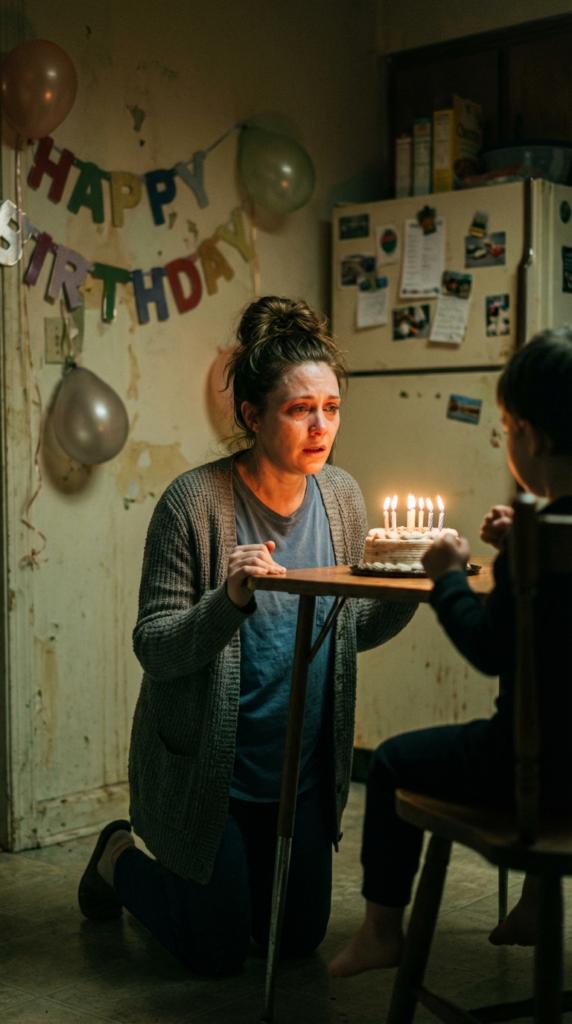
So there I was, kneeling in front of my son, the candles burning down, wax forming little puddles on the cheap frosting, my entire family and half the building staring at us.
“Wishes don’t work on poor kids.”
I could have done what my mom did when I was his age:
- Smile.
- Lie.
- Say, “Oh honey, that’s not true. You just have to believe.”
But I’m tired of lying to protect everyone except the person who deserves the truth the most.
So I took a breath, felt the tremble travel all the way down to my bones, and said, “You’re right.”
The room sucked in a collective breath.
My mom hissed my name under hers. “Claire.”
Leo blinked. “I am?”
“You’re right that wishing isn’t enough,” I said. “If wishes worked by themselves, we wouldn’t be worried about money. Daddy would’ve gotten his life together. I wouldn’t cry in the bathroom.”
His lower lip quivered. “So… it’s true? It doesn’t work for us?”
“It doesn’t work for anyone by itself,” I said. “You just don’t see the boring stuff in between the wish and the getting. You only see the getting.”
My sister cleared her throat. “Claire, maybe—”
I held up a hand. “Not now.”
I turned back to Leo.
“You know what Jason’s dad does?” I asked. “The one with the PS5?”
“He’s a lawyer,” Leo mumbled.
“And Mia’s parents? The Disney one?”
“They own a restaurant,” he said.
“Right. They don’t just wish. They also have money, time, and people helping them. They have things we don’t. That’s not your fault. That’s not because your wishes are wrong. It’s because the game is rigged. For a lot of people.”
He looked at me like he was waiting for the catch. The part where I tell him to just “work twice as hard” and “keep dreaming” and “it’ll all even out.”
I didn’t.
“Here’s what I can promise you,” I said instead. “If you make a wish, I’m not going to tell you the universe will magically grant it. But I will write it down. I will stick it on that fridge. And every day, we will look at it and ask, ‘What’s one tiny thing we can do today that gets us even one inch closer?’ Even if it takes years.”
“Like what?” he asked, suspicious.
“That depends on the wish,” I said. “So you know what? We’re going to do this differently.”
I stood up, grabbed the battered notebook I keep by the microwave for tracking bills, and tore out a clean page.
“Everyone,” I said, turning to our captive audience. “We’re trying something new this year. No blowing out candles unless you’re ready to back your wish up with a plan.”
My mom muttered, “What is she doing?” under her breath.
My sister, eyes wide, started recording again.
I handed the pen to Leo.
“Write your wish,” I said. “One of them.”
He hesitated, then took the pen, tongue sticking out a little as he concentrated. His handwriting was big and uneven:
I WANT US NOT TO BE POOR ANYMORE.
It hurt to see it in ink. But it was already hurting him in silence.
Everyone else shifted uncomfortably. The neighbor boy’s mom looked like she wanted to sink into the floor.
“Okay,” I said. “Big wish. Fair wish.”
I stuck the paper on the fridge with a magnet shaped like a smiling taco, because irony is free.
“Now,” I continued, “we do something we can control. Right here. Right now.”
I walked over to the power strip connected to the TV, the game console that barely works, and the string of decorative lights Leo likes.
I flicked it off.
My mom gasped. “Claire!”
Our kitchen dimmed. The candles, suddenly the brightest thing in the room, cast wild shadows on the walls.
“Tonight,” I said, “while those candles burn, we talk like a family about what we can change. I’ll go first.”
I swallowed, feeling the words burn in my throat.
“I’m applying for the medical billing course at the community college,” I said. “I’ve been putting it off because I’m scared and tired and it costs money we don’t have. But I’m done waiting for life to be less hard before I try to make it better. I’ll find a way. I’ll pick up extra shifts. I’ll beg for a payment plan. I’ll do whatever it takes. Because I am not letting you grow up thinking the only kids with power are the ones who already have it.”
The room went silent.
My mom’s eyes filled with tears. She opened her mouth, probably to say we couldn’t afford it, then closed it again.
My sister whispered, “I’ll watch him for free when you have night classes.”
The neighbor’s mom cleared her throat. “I… know someone at the college. I can ask about scholarships.”
This was not the polished, Hallmark moment I’d seen in movies. It was messy, uncomfortable, tinged with desperation.
But it was real.
I turned back to Leo.
“Now,” I said softly, “if you still don’t want to blow those candles out, you don’t have to. We’ll leave them. We’ll watch them burn all the way down if that’s what you need to do. But if you decide to blow, it’s not because you believe magic fixes everything. It’s because you’re making a promise to yourself to keep going, even when it feels unfair.”
He looked at the candles. At the paper on the fridge. At me.
“Will we stop being poor if I blow them?” he asked.
I didn’t lie.
“Not tonight,” I said. “Not because of the candles. But this—” I tapped the paper on the fridge “—is the last birthday where you have to wonder if you’re allowed to wish at all. From now on, your wishes get a team.”
His eyes filled with tears. One slid down his cheek.
Slowly, he leaned forward.
He took a breath.
And this time, when he closed his eyes, I could see he wasn’t asking the universe to fix everything for him.
He was asking for the strength to help me fix it with him.
He blew.
The flames went out. A curl of smoke rose into the dim kitchen.
Everyone clapped, but it sounded different now. Less like a performance. More like a vow.
Changing What “Poor” Means
In the months that followed, nothing changed—and everything did.
We were still broke. Rent was still due. Groceries still cost more than they should. The EBT card still beeped at the checkout.
But there were new things too:
- A stack of community college brochures on the table.
- Emails from the financial aid office.
- A flyer about a childcare grant for single parents taped next to our “wish list” on the fridge.
I applied for the medical billing and coding program.
I got in.
I started classes with a backpack that made me feel both ancient and brand-new. I did homework at the kitchen table while Leo did his spelling. We made a rule that from 7–9 p.m., the TV stayed off and both of us worked on “future stuff.”
At first, it felt like pretending.
Then it felt like progress.
Our wish list on the fridge grew:
- I want new sneakers that don’t hurt my feet.
- I want to go on a school trip without Mom worrying.
- I want Mom to have a job where she’s not always standing.
Next to each one, we wrote a tiny action:
- Put $2 a week in a jar labeled SHOES.
- Ask the school about fee waivers for trips.
- Pass the certification exam, apply to three jobs a week.
We didn’t always hit the marks. Some weeks, the jar stayed empty because the car needed gas or the light bill was due. Some nights, I fell asleep on my textbook.
But Leo saw all of it.
He saw me panic. He saw me cry. He saw me get back up and email my professor for an extension instead of dropping out.
And slowly, his language changed.
“I can’t, we’re poor,” turned into, “We can’t yet.”
“We don’t have that,” turned into, “We’re working on it.”
The universe didn’t suddenly start doing us favors.
But people did.
Because once I stopped pretending we were “fine” and started telling the truth, help had somewhere to land.
My neighbor’s cousin at the college got me in touch with a scholarship committee. They covered half my tuition.
My boss, the one I thought didn’t even know my name, pulled me aside one afternoon. “I heard you’re in school,” she said. “We have a clerical opening. The pay’s a little better, and the hours might work better around your classes.”
I got that job.
My mom, who’d always been proud in that stubborn, quiet way, started accepting leftovers from the church food pantry and brought them over “because they had too much and it’ll just go bad.”
One evening, Leo came home waving a flyer.
“They’re doing a field trip to the science museum,” he said. “It costs $15.”
My stomach clenched.
Before I could say anything, he added, “I already asked Ms. Rodriguez if there’s a form for kids who can’t pay. She said yes. She said lots of parents fill it out and it’s no big deal.”
Old me would’ve died of embarrassment at the idea.
New me filled out the form.
He went on the trip. He came back buzzing about dinosaur bones and galaxies and a live electricity demo.
“Guess what?” he said breathlessly. “We got to make wishes on this big sphere thing that made our hair go up, and Ms. Rodriguez said wishes are like seeds. They only work if you plant them and water them.”
I smiled. “Ms. Rodriguez sounds smart.”
He nodded. “I told her we planted ours on my birthday.”
A year later, I passed my certification exam.
I got a job in medical billing at a clinic. I sat for most of my shift. I wore clothes that made me feel like a person with a career, not just a name tag. I made enough that the EBT card started collecting dust on the fridge.
We weren’t rich. Not even close. But for the first time in Leo’s life, emergencies didn’t immediately turn into crises.
On his ninth birthday, we had a slightly bigger cake. The banner was still creased, but we hung it up anyway. Tradition.
When it was time for candles, everyone looked at Leo.
He looked at me.
“Can I still wish?” he asked.
“Always,” I said. “Just remember what we talked about.”
He nodded.
“I know,” he said. “Wishes don’t work on poor kids.”
My heart squeezed. “Leo—”
He grinned.
“But we’re not just poor anymore,” he said. “We’re, like… poor but working on it.”
Everyone laughed. The good kind this time.
He closed his eyes, made his wish, and blew out the candles in one strong breath.
I didn’t ask what he wished for. He didn’t tell me. That’s between him and the universe.
But later, when I was cleaning up, I found a scrap of paper near the fridge, written in that big, uneven handwriting I know better than my own:
I WISH MOM WON’T HAVE TO CRY IN THE BATHROOM EVER AGAIN.
Underneath it, in smaller, careful letters, he’d added:
BUT IF SHE DOES, I WISH SHE’LL TELL ME INSTEAD OF HIDING.
I sat on the floor and cried for a minute. Not in the bathroom. In the open.
Because in a world where some kids get yachts and others get food stamps, my son had learned something powerful:
Yes, the game is rigged.
Yes, wishes don’t show up the same way for everyone.
But that doesn’t mean his dreams are invalid.
It means his dreams are revolutionary.
When he eventually outgrows Spider-Man shirts and birthday candles, I hope he remembers that night in our cramped kitchen. The night he said out loud what so many kids like him feel.
The night his single mom stopped selling him fairy tales and started building something with him instead.
Wishes don’t work on poor kids?
Maybe not the way they work for everyone else.
But in this house, wishes get written down. They get plans. They get people. They get fought for.
And that, finally, is a kind of magic we can afford.