Part 1: The Wedding Night
My name is Aarohi Sharma, and I am 24 years old.
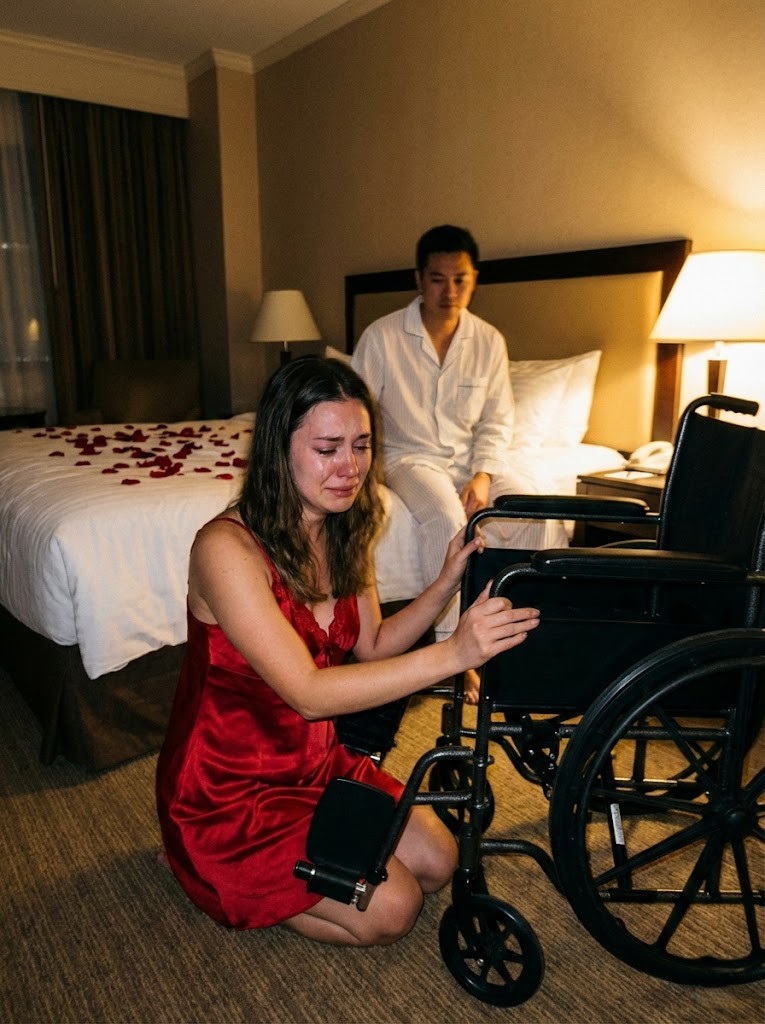
I’m lying on the cold marble floor of a palace bedroom in Jaipur, my red wedding saree tangled around my legs, my face burning with embarrassment. Beneath me is my new husband—Arnav Malhotra, the man everyone said was paralyzed from the waist down.
Except right now, I can feel his arms wrapped firmly around my waist. Strong arms. Steady arms. Arms that just caught me mid-fall with the reflexes of an athlete.
Our eyes meet. His are dark, intense, and filled with something I can’t name—panic? Guilt? Calculation?
“You…” My voice comes out as barely a whisper. “You can move.”
For three agonizing seconds, he says nothing. The candlelight flickers across his sharp jawline, casting shadows that make him look almost dangerous. Then his grip tightens slightly, and he speaks in a low, controlled voice that sends chills down my spine.
“Yes. I can move. I can walk. I’ve been able to for the past three years.”
My mind spins. The wheelchair. The pitying looks from relatives. The hushed conversations about the “tragic accident” that left the Malhotra heir disabled. All of it was a lie.
“But why would you—”
“Because,” he interrupts, his eyes never leaving mine, “I needed to know who would marry me for me, not for the man I appeared to be.” He pauses, and his expression shifts into something almost vulnerable. “And because there are people in my family who want me dead. Being ‘paralyzed’ kept me safe. Until tonight.”
My heart hammers against my ribs. Outside the door, I hear footsteps approaching. Arnav’s body tenses beneath me.
“Someone’s coming,” he whispers urgently. “Listen carefully, Aarohi. In about thirty seconds, my stepbrother is going to walk through that door. He’s been embezzling from the family company for years, and the only thing standing between him and a fortune is me. If he finds out I can walk…” He trails off, but the implication hangs heavy in the air.
The footsteps grow louder. My pulse races.
“What do I do?” I breathe.
Arnav’s hand moves to cup my face, his thumb brushing my cheek in a gesture so tender it makes me forget to breathe. “You have two choices. You can expose me right now and walk away from this disaster of a marriage. Or…” His eyes search mine desperately. “Or you can help me survive the night, and I promise you, Aarohi—I will tell you every truth I’ve been hiding. Including why your stepmother was so desperate for you to marry me.”
The door handle begins to turn.
Every instinct screamed at me to run. To call out. To expose this elaborate deception. But something in Arnav’s eyes stopped me—a raw, desperate honesty that I recognized because I’d seen it in my own reflection for years.
The door swung open.
Without thinking, I scrambled off Arnav and grabbed his arm, pretending to help him back into the wheelchair that sat a few feet away. My hands shook as I positioned myself between him and the intruder.
“Is everything alright?” came a smooth, cultured voice.
I turned to see a tall man in his early thirties standing in the doorway. He wore an expensive navy suit and had the same sharp cheekbones as Arnav, but his eyes were colder, calculating. This had to be the stepbrother.
“We’re fine, Vikram,” Arnav said, his voice suddenly weak and strained—the voice of a disabled man struggling with basic movements. The transformation was so complete, so convincing, that for a moment I doubted what had just happened. “My wife was just helping me. We… we had a small accident.”
Vikram’s eyes swept over the scene—the disheveled bed, my flushed face, Arnav’s rumpled wedding sherwani. A thin smile played at his lips.
“How clumsy of you, brother.” The word “brother” dripped with condescension. “I just wanted to check on you both. Make sure the new bride was… settling in well.”
His gaze lingered on me in a way that made my skin crawl.
“She’s doing wonderfully,” Arnav replied, reaching for my hand. His fingers intertwined with mine, and I felt him squeeze gently—a silent thank you. “We were just about to rest.”
“Of course.” Vikram’s smile widened, but it never reached his eyes. “Sweet dreams, brother. Do try not to have any more… accidents.”
The door clicked shut.
I released a breath I didn’t know I’d been holding. Arnav’s entire body sagged with relief, his weak façade dropping instantly.
“Thank you,” he whispered.
“Don’t thank me yet,” I snapped, my fear transforming into anger. “You have exactly five minutes to explain everything, or I’m walking out that door and telling everyone what I just discovered.”
Arnav pulled himself up from the wheelchair—stood up with perfect balance and walked to the window. In the moonlight streaming through the ornate jali screens, I could see the full truth of his deception. He moved like a man who had never been injured, his stride confident and fluid.
“My name is Arnav Malhotra,” he began, his back still to me. “Five years ago, I was in a car accident. But I wasn’t paralyzed—I was supposed to be dead.”
Part 2: The Backstory
The story Arnav told me that night would haunt me for months.
Five years earlier, Arnav had been the golden heir of the Malhotra empire—a business conglomerate worth over 500 crores, spanning real estate, hospitality, and manufacturing. At twenty-five, he was being groomed to take over from his aging father, Rajesh Malhotra.
But there was a problem: Vikram.
Vikram was the son of Rajesh’s second wife, Kavita, whom he’d married after Arnav’s mother died in childbirth. Kavita had always believed her son deserved the inheritance, not the child of the first wife. For years, she’d poisoned Rajesh’s mind against Arnav, planting seeds of doubt about his capability, his loyalty, his temperament.
“She almost succeeded,” Arnav said quietly, turning to face me. “My father started questioning every decision I made. Started giving Vikram more responsibilities. I knew I was losing my birthright, but I couldn’t prove that Kavita and Vikram were manipulating him.”
Then came the accident.
Arnav had been driving home late one night after a business meeting when his brakes failed. His car careened off a mountain road, rolling down a steep embankment. He survived with minor injuries—miraculous, the doctors said. But while he was unconscious in the hospital, he overheard something that changed everything.
“I woke up in the middle of the night,” Arnav continued, his voice tight with remembered pain. “The nurses thought I was still sedated. Kavita and Vikram were in my room. And I heard Vikram say, ‘If he survives this, we’ll have to try again. The mechanic did exactly what I paid him to do—cut the brake lines. But this bastard has nine lives.'”
My hand flew to my mouth. “They tried to murder you.”
“Yes. And they would have tried again if I’d recovered normally.” Arnav’s jaw clenched. “So I made a choice. I pretended the accident had left me paralyzed. The doctors were confused—my spine was intact, my reflexes normal—but I convinced them it must be psychological trauma. Conversion disorder, they called it.”
For three years, Arnav had lived a lie. He’d spent his days in a wheelchair, his nights practicing walking in secret, building his strength, waiting for the right moment to expose his stepmother and stepbrother.
“But I needed evidence,” he explained. “Vikram is smart. He covered his tracks well. So I stayed ‘disabled’ and watched. And slowly, I discovered the truth.”
Vikram hadn’t just tried to kill Arnav—he’d been systematically embezzling from the family companies for years. He’d created shell corporations, falsified contracts, and siphoned off millions. With Arnav out of the picture, he’d have free rein to loot the entire estate.
“I have proof now,” Arnav said. “Bank records, forged signatures, everything. But if I revealed it while I was ‘paralyzed,’ Vikram would know someone was helping me investigate. He’d destroy the evidence and possibly come after whoever I was working with.” His eyes met mine. “I needed to wait until I could physically defend myself. Until I could fight back.”
“And the marriage?” I asked, my voice barely above a whisper. “Where do I fit into all this?”
Arnav’s expression softened with what looked like genuine regret. “You were never supposed to be part of this, Aarohi. But six months ago, my father’s health started failing. He has stage four cancer—he has maybe a year left. He became desperate to see me settled, married, producing heirs before he dies.”
Kavita saw an opportunity. If she could control who Arnav married, she could control the next generation of Malhotras. She started parading women in front of him—women from families she’d carefully vetted, women who would be easy to manipulate or bribe.
“But I refused them all,” Arnav said. “Every single one. Until my father issued an ultimatum: marry within six months, or he’d sign the company over to Vikram immediately.”
That’s when Arnav’s private investigator brought him information about my stepmother.
“Your stepmother’s name is Priya Sharma, correct?”
I nodded, confused.
“Thirty years ago, she was Priya Malhotra. My father’s younger sister.”
The room tilted. I gripped the edge of the bed to steady myself.
“What?”
“Priya eloped with your father against my grandfather’s wishes,” Arnav explained gently. “He disowned her. Cut her off completely. She disappeared, and the family never spoke of her again. My father has regretted it for decades, but his pride wouldn’t let him reach out.”
My mind reeled. My stepmother—the cold, practical woman who’d raised me—was a Malhotra. Which meant…
“You and I are cousins,” I whispered.
“Distant cousins,” Arnav corrected. “Legal to marry in India. And when I discovered the connection, I realized you were perfect. Priya would push for the marriage because of the money, the restoration of family ties. You would agree because of your father’s debts.” He paused. “And I… I hoped that maybe, just maybe, you’d be different from the others.”
“Different how?”
“Someone who would marry a ‘disabled’ man. Someone who wouldn’t be doing it for status or looks or the ability to parade me at parties. Someone…” He struggled for words. “Someone real.”
Part 3: The Conspiracy Deepens
The next morning, I woke up in the enormous palace bedroom feeling like I’d lived three lifetimes in one night. Arnav was gone—back in his wheelchair, I assumed, playing his role for the household staff.
I dressed in a simple salwar kameez and ventured out of the room. The Malhotra haveli was even more overwhelming in daylight—a sprawling complex of courtyards, fountains, and wings that seemed to go on forever. Servants bustled about, preparing breakfast, but they all avoided my eyes.
I found the dining room where the family was gathering. Arnav sat at the head of the table in his wheelchair, his face carefully neutral. Beside him was an elderly man who could only be Rajesh Malhotra—gaunt and yellow-skinned, clearly ravaged by cancer. Across the table sat Kavita, a beautiful woman in her fifties with sharp eyes and a cruel mouth. And next to her, Vikram, watching me with that same unsettling smile from last night.
“Good morning, Aarohi,” Kavita said, her voice dripping with false sweetness. “Come, sit. We have much to discuss.”
I took the seat next to Arnav, hyperaware of every movement, every word.
“You married into this family yesterday,” Kavita continued, “so there are things you need to understand. Rules we live by.”
I nodded, trying to look like a meek, obedient bride.
“First, Arnav’s… condition requires constant care. You will be responsible for his needs—bathing, dressing, meals. The servants can help, but you are his wife. This is your duty.”
“Of course,” I murmured.
“Second, this household has traditions. The daughter-in-law does not leave the haveli without permission. You will attend family functions, religious ceremonies, and social events as required. Otherwise, your place is here.”
My stomach churned, but I kept my expression neutral.
“Third,” and here Kavita’s eyes glittered with malice, “you will produce an heir. Rajesh-ji is dying. He needs to see his grandchild before he passes. If you cannot fulfill this duty within one year…” She let the threat hang in the air.
Beside me, I felt Arnav’s hand clench into a fist beneath the table.
“That’s enough, Kavita,” Rajesh wheezed. “Leave the girl alone. She just arrived.”
“I’m only explaining the expectations—”
“She understands.” Rajesh turned to me, and I saw a flicker of kindness in his tired eyes. “Welcome to the family, beta. I hope you’ll be happy here.”
I highly doubted that.
The rest of breakfast passed in uncomfortable silence. Afterward, two servants escorted me back to our room, and I realized with growing dread that I was essentially a prisoner. The beautiful palace was a cage.
Arnav returned an hour later, dismissing the servants with a curt nod. The moment the door closed, he stood up from the wheelchair.
“I’m sorry,” he said immediately. “I knew Kavita would try to control you, but I didn’t think she’d start on day one.”
“What’s the plan?” I demanded. “You said you have evidence against Vikram. When are you going to use it?”
“Soon. But we need to be strategic.” Arnav pulled out his phone and showed me a series of photos—documents, bank statements, emails. “Vikram has been working with an accomplice, a woman named Meera Shah. She’s an accountant at one of our subsidiary companies. They’ve been routing money through her accounts, then into offshore holdings.”
“Can’t you just go to the police?”
“Not yet. Vikram has connections—police commissioners, politicians, judges. If I accuse him prematurely, he’ll bury the evidence and potentially have me committed to a mental institution. ‘The paralyzed man with delusions’ would be an easy sell.”
I shuddered. “So what do we do?”
“We gather more evidence. And we wait for the right moment—a moment when my father is lucid enough to hear the truth, when there are witnesses who can’t be bought, and when Vikram feels secure enough to make a mistake.” Arnav’s eyes hardened. “He will make a mistake. They always do.”
Part 4: Playing the Role
Over the next three weeks, I learned to play my part. During the day, I was the dutiful daughter-in-law—helping Arnav with his wheelchair, serving meals to the family, attending prayer ceremonies with Kavita’s constant criticisms ringing in my ears.
“You’re holding the thali wrong, Aarohi.”
“Your saree isn’t pleated properly.”
“Must you walk so loudly? This is a respectable household.”
But at night, behind the locked door of our bedroom, Arnav and I became conspirators. He taught me about the business empire, showed me the evidence he’d compiled, and slowly, I began to understand the full scope of Vikram’s theft.
He’d stolen over 75 crores—nearly 100 million dollars. He’d done it through a complex web of fake contracts, inflated costs, and phantom employees. And the worst part? He was planning something bigger.
“There’s a land deal coming up,” Arnav explained one night, spreading documents across the bed. “A prime plot in Bangalore worth 200 crores. The family is voting next month on whether to purchase it. Vikram has been lobbying hard for approval.”
“Why?”
“Because the seller is one of his shell companies. If the family buys the land, they’ll essentially be paying him 200 crores for property that’s worth maybe 50 crores at most. He’ll pocket the difference and disappear.”
“Can’t your father see what’s happening?”
Arnav’s face darkened. “My father can barely stay awake for more than a few hours a day. He trusts Kavita to manage things. And Kavita… she’s protecting her son.”
I thought about my own stepmother, Priya, who’d pushed me into this marriage. Was she also part of the conspiracy? Did she know about Vikram’s crimes?
As if reading my mind, Arnav said, “Your stepmother isn’t involved. I had her investigated thoroughly. She’s just desperate and greedy—she saw a chance to reconnect with the wealthy Malhotras and took it. But she has no idea what’s really happening here.”
That was some comfort, at least.
But as the days passed, I began to notice other disturbing patterns. Servants would disappear suddenly—fired for minor infractions. Anyone who seemed close to Arnav would be reassigned to different parts of the estate. And Vikram started paying more attention to me.
He’d corner me in hallways, his smile predatory.
“How are you adjusting, sister-in-law?”
“Fine, thank you.”
“It must be difficult, being married to a man who can’t… fulfill certain duties.”
My skin crawled. “That’s none of your business.”
“Of course not.” His hand would brush my arm, lingering just a second too long. “But if you ever need… company… I’m always available.”
I started avoiding him, but the haveli was only so big. And I could feel his eyes on me constantly, watching, calculating.
“He’s testing you,” Arnav said when I told him. “Trying to see if you’ll betray me. If you show any weakness, he’ll exploit it.”
“What kind of exploitation?”
Arnav hesitated, then said quietly, “He’s blackmailed two previous servants into sleeping with him. When they threatened to expose him, he had them fired and spread rumors about their character. They were ruined socially—couldn’t find work, couldn’t get married. One of them killed herself.”
Horror washed over me. “And nobody stopped him?”
“Kavita covered it up. Paid off families. Threatened witnesses.” Arnav’s fists clenched. “That’s who we’re dealing with, Aarohi. Not just thieves, but monsters.”
That night, I barely slept. Every shadow seemed menacing, every creak of the old palace ominous. I kept thinking about the girl who’d killed herself, wondering if I’d end up the same way.
Part 5: The Breaking Point
Everything changed on a Tuesday afternoon in the fourth week of my marriage.
I was in the kitchen helping prepare lunch when I overheard Kavita on the phone in the adjacent room. Her voice was low and urgent.
“No, he can’t know. If Rajesh finds out about the loans, he’ll have questions… Yes, I borrowed against the company assets. It was necessary… The treatment is expensive, you know that… Don’t lecture me about responsibility!”
My ears perked up. Loans? What loans?
I moved closer to the doorway, pretending to arrange dishes on a tray.
“Vikram has it under control,” Kavita continued. “Once the Bangalore deal goes through, we’ll pay everything back and no one will be the wiser… What? No, Arnav is completely clueless. He sits in that wheelchair drooling like an invalid. He’s not a threat… Yes, I’m sure. The doctor confirmed his condition is permanent.”
She hung up, and I quickly busied myself with the dishes. But my mind was racing.
Kavita had taken loans against the company. That meant she was in financial trouble—possibly desperate. And desperate people did desperate things.
I needed to tell Arnav immediately.
But before I could leave the kitchen, Vikram appeared in the doorway, blocking my exit.
“Aarohi. Just the person I wanted to see.”
My heart hammered. “I was just finishing—”
“Walk with me.” It wasn’t a request.
He led me through the haveli to a secluded courtyard I’d never seen before. It was overgrown, clearly unused, hidden behind high walls covered in jasmine vines.
“Do you know what happened in this courtyard?” Vikram asked conversationally.
“No.”
“This is where my mother found Arnav’s mother. She’d been dead for three days. Overdose of sleeping pills, they said. Suicide.”
I went cold. “Arnav’s mother didn’t die in childbirth?”
“Oh, she did. She died giving birth to Arnav. But before that…” Vikram’s smile was cruel. “Let’s just say she couldn’t handle being married to my father. The pressure, the expectations, the constant criticism from his family. She tried to end it all while pregnant. Failed. Gave birth. Then succeeded a few weeks later.”
He stepped closer.
“I’m telling you this so you understand something, Aarohi. Women who marry into this family don’t escape. They either adapt, or they break. And I’ve watched you these past few weeks—you’re not adapting. You’re resisting. Fighting. That’s going to cause problems.”
“I don’t know what you mean—”
“Yes, you do.” His hand shot out and grabbed my wrist. Hard. “You think you’re clever. You think you can play the innocent bride while sneaking around, asking questions, paying attention to things that don’t concern you. But I see you, sister-in-law. I see everything.”
I tried to pull away, but his grip tightened.
“Let me make this very clear,” Vikram hissed. “My brother is a cripple. He will never run this company. I will. And when I do, I’ll need a wife to legitimize my position, to produce heirs of the proper bloodline. You’re young, attractive, already married into the family…” His other hand moved to my face. “It would be so easy to arrange another accident. Poor Arnav, can’t even protect his own wife. And then you’d be a widow, vulnerable, in need of support…”
Rage exploded through me—rage at his touch, his threats, his casual discussion of murdering his own brother.
I slammed my heel down on his instep and drove my elbow into his ribs. Vikram gasped and released me. I ran.
I didn’t stop running until I reached our bedroom and locked the door behind me. My hands shook as I leaned against the wood, trying to catch my breath.
Arnav was there instantly, out of his wheelchair, his hands on my shoulders.
“What happened?”
I told him everything—Kavita’s phone call, Vikram’s threats, his revelation about Arnav’s mother.
When I finished, Arnav’s face was white with fury.
“I should kill him,” he said quietly. “I should walk out there right now and kill him with my bare hands.”
“No.” I grabbed his arms. “That’s what he wants—for you to expose yourself, to lose control. We need to stick to the plan.”
“The plan isn’t working!” Arnav shouted. “He just threatened you! He’s escalating!”
“Then we escalate too,” I said firmly. “You said you need evidence? Let’s get it. Tonight.”
Part 6: The Investigation
Arnav stared at me. “What are you suggesting?”
“Vikram’s confident. Too confident. He thinks you’re helpless and I’m naive. That makes him careless.” I pulled out my phone. “You’ve been investigating him for years, but you’ve been limited because you can’t move freely. I can. I’m the new bride—no one suspects me of anything except being scared and obedient.”
“Absolutely not. It’s too dangerous—”
“It’s already dangerous!” I cut him off. “He threatened to kill you and force me to marry him. We’re past the point of caution.”
Arnav paced the room, clearly torn. Finally, he stopped and looked at me with an intensity that made my breath catch.
“If we do this, you need to understand something. These people—my stepmother, my stepbrother—they’ve killed before. Not just my mother. There was a business partner five years ago who discovered inconsistencies in the books. He died in a ‘robbery.’ A journalist who was investigating the family’s finances had a ‘heart attack’ at thirty-five.” He took my hands. “If they even suspect you’re helping me, they will hurt you. Possibly kill you. I can’t… I can’t let that happen.”
“Then we’ll be careful,” I said softly. “But we have to do something, Arnav. We can’t just wait and hope they don’t strike first.”
He closed his eyes, clearly wrestling with the decision. Then he nodded.
“Alright. Here’s what we know. Vikram keeps his personal files in his office—third floor, west wing. It’s locked, and he has the only key. But there’s a window that faces the courtyard. If we can get in through there…”
We spent the next hour planning. Arnav gave me a crash course in what to look for—specific file names, account numbers, digital drives that might contain evidence. He also gave me a small camera to photograph documents.
“We do this at 2 AM,” he said. “Everyone should be asleep. I’ll keep watch from our window—I can see the west wing entrance from here. If anyone comes, I’ll call you.”
“And if I get caught?”
“Then you tell them you were sleepwalking. Confused in the new house. Play the scared, naive bride.”
At 1:45 AM, I slipped out of our room dressed in dark clothing. The haveli was eerily silent, lit only by dim nightlights along the corridors. Every footstep seemed to echo like thunder.
I made it to the west wing without incident and found Vikram’s office. The door was indeed locked, but the window… I tested it gently. It slid open.
My hands shook as I climbed through, trying not to make noise. The office was large, dominated by a massive desk covered in papers. I turned on my phone’s flashlight and got to work.
The first drawer: personal correspondence, invitations to parties, nothing useful.
The second drawer: financial statements from legitimate accounts.
The third drawer: locked.
I pulled out the lockpick set Arnav had given me—another skill he’d learned during his years of investigation. It took three agonizing minutes, but the lock clicked open.
Inside was a laptop and several folders marked “Confidential.”
Jackpot.
I photographed everything—bank statements showing transfers to offshore accounts, contracts with Meera Shah’s fake companies, emails discussing how to manipulate Rajesh’s medical treatments to keep him weak and confused.
That last one made me sick. They’d been dosing him with unnecessary medications to cloud his judgment.
I was halfway through the fourth folder when my phone buzzed.
Arnav: Someone’s coming. Get out. NOW.
My blood ran cold. I shoved the folders back into the drawer, locked it, and scrambled toward the window.
Too late.
The office door opened.
Kavita stood in the doorway, her eyes widening as she took in the scene—me, frozen halfway out the window, the desk drawer slightly ajar.
“Well,” she said coldly. “What do we have here?”
Part 7: Confrontation
Time seemed to slow down. Kavita’s hand moved toward the light switch. If she turned on the lights, if she saw the camera in my hand, it was over.
I made a split-second decision.
“I’m sorry!” I blurted out, letting my voice crack with fake tears. “I’m so sorry, I didn’t mean—I was just—” I climbed back through the window and collapsed to my knees, sobbing dramatically. “Please don’t tell Arnav! Please!”
Kavita paused, her hand hovering over the switch. “What exactly were you doing in my son’s office?”
“I… I was looking for money,” I whispered, hiding my face in my hands. “My father’s debts—the creditors are still calling, threatening him. I thought maybe Vikram-ji would have some cash I could take, just a little, just enough to help…”
It was a gamble. Banking on Kavita’s contempt for me, her belief that I was nothing but a poor, desperate girl.
She laughed—a harsh, mocking sound.
“Money? You pathetic little thief. You thought you could steal from this family?”
“I’m sorry, I’m so sorry—”
“Get up.” She marched over and grabbed my arm, hauling me to my feet. “Do you have any idea what happens to thieves in this household?”
I shook my head, still crying.
“We make examples of them.” Kavita’s nails dug into my skin. “But you’re married to Arnav now, which complicates things. I can’t simply throw you out. However…” Her eyes glittered with malice. “I can make your life here a living hell. Starting tomorrow, you’ll be under constant supervision. Servants will watch your every move. You won’t leave our sight. And if you ever try something like this again…”
She didn’t finish the threat. She didn’t need to.
“Do you understand?”
“Yes,” I whispered.
“Good. Now get out of here before I change my mind and call the police.”
I fled back to our room, my heart pounding so hard I thought it would burst from my chest. Arnav was pacing frantically, and the moment I stumbled through the door, he caught me.
“Did she see? Did she see the camera?”
“No.” I pulled the camera from my pocket with shaking hands. “I convinced her I was trying to steal money. She thinks I’m just a desperate thief.”
Arnav pulled me into a tight embrace, and for the first time since our wedding night, I let myself lean into him. The fear, the stress, the constant pretending—it all crashed over me at once.
“I’ve got you,” he murmured. “You’re safe. You did incredibly well.”
“Did I get enough? Is it enough evidence?”
He took the camera and scrolled through the photos, his expression growing darker with each image.
“This is… Aarohi, this is everything. The offshore accounts, the fake contracts, proof that they’ve been drugging my father…” He looked up at me with something like awe. “You just gave us everything we need to destroy them.”
Relief flooded through me. “So what now?”
“Now we set the trap.”
Part 8: The Trap
The next two weeks were the most difficult of my life. As Kavita had promised, I was under constant surveillance. Servants followed me everywhere, reported my conversations, monitored who I spoke to. I couldn’t even go to the bathroom without someone noting the time I entered and exited.
But Arnav and I had anticipated this. We communicated through a series of coded gestures—adjusting pillows in certain ways, positioning water glasses at specific angles on tables, even the way I folded his clothes carried hidden messages.
To any observer, I was just a dutiful wife caring for her disabled husband. In reality, I was helping him orchestrate the most important confrontation of his life.
The plan was simple: we would wait until the family board meeting about the Bangalore land deal. All the major shareholders would be present—uncles, cousins, business partners. Rajesh would be there despite his failing health because the deal was too significant to skip.
And in front of everyone, Arnav would reveal the truth.
The day of the meeting arrived. I helped Arnav get dressed in an expensive suit, fixing his tie with trembling fingers. He caught my hands and held them.
“Are you ready for this?” he asked quietly.
“The question is, are you ready?”
He smiled—a real smile, the first I’d seen from him in weeks. “I’ve been ready for five years.”
The board room was on the ground floor, a massive space with a long teak table surrounded by leather chairs. Family members filed in, greeting each other with false warmth while eyeing one another suspiciously. This was a dynasty built on money and power, not love.
Rajesh sat at the head of the table, looking even more frail than usual. Kavita positioned herself at his right hand, playing the devoted wife. Vikram sat across from her, projecting confidence and authority.
And Arnav… Arnav wheeled himself to a spot near the far end, as usual relegated to the sidelines. I stood behind him, the invisible wife.
The meeting began with routine business—quarterly reports, expense reviews, minor decisions. Then Vikram stood up.
“We come now to the Bangalore opportunity,” he said smoothly. “As you all know, there’s a prime plot of land available for purchase. The seller is asking for 200 crores, which I know sounds steep, but the potential returns are enormous. I’ve had it independently appraised—”
“By whom?” Arnav’s voice cut through the room like a knife.
Everyone turned to stare.
Vikram’s smile tightened. “I’m sorry, brother, I didn’t catch that.”
“I asked who did the independent appraisal.” Arnav’s voice was stronger than anyone had heard in years. “Surely you have documentation?”
“Of course I do. The paperwork is—”
“In your office. Third floor, west wing. Locked drawer.” Arnav’s eyes never left Vikram’s face. “Along with some other interesting documents.”
The room went silent.
Vikram’s face paled slightly, but he recovered quickly. “I don’t know what you’re implying—”
“I’m not implying anything.” Arnav reached into his jacket and pulled out a folder. “I’m stating facts. The Bangalore land is owned by a shell company called Meridian Enterprises. Meridian Enterprises is owned by another shell company called Apex Holdings. And Apex Holdings is registered to a woman named Meera Shah—your accountant and your accomplice.”
Gasps rippled around the table.
“This is ridiculous!” Kavita jumped to her feet. “Arnav, your condition has clearly affected your mind—”
“My condition?” Arnav’s voice rose. “You mean the paralysis that I’ve been faking for five years?”
And then, before anyone could react, he stood up.
The room exploded in chaos. People shouted, jumped back, grabbed the edges of the table. Rajesh’s face went white with shock.
Arnav walked—steady, confident, powerful—to the head of the table. He placed the folder in front of his father.
“I’m sorry, Papa,” he said quietly. “I’m sorry I had to lie to you for so long. But I had to stay ‘disabled’ to stay alive. Because Vikram has been trying to kill me since the day you announced I would inherit the company.”
“This is insane!” Vikram shouted. “He’s clearly having a psychotic break—”
“The brake lines on my car were cut. I have the mechanic’s testimony.” Arnav pulled out more documents. “For five years, I’ve been investigating you, Vikram. I know about the embezzlement. I know about the offshore accounts. I know about the 75 crores you’ve stolen. And I know about your plan to steal another 200 crores with this fake land deal.”
He turned to his father. “And I know that Kavita has been drugging you, Papa. Giving you extra medications to keep you confused and weak so you wouldn’t notice what was happening to your company.”
Rajesh stared at the documents, then at his wife, then at his sons. His hands trembled as he reached for the folder.
“Guards,” Arnav called.
The doors opened, and four policemen entered, led by a stern-looking commissioner.
“These are the real police,” Arnav explained. “Not the ones Vikram has in his pocket. I’ve spent the last five years building relationships with honest officers, gathering evidence, preparing for this moment.”
The commissioner stepped forward. “Vikram Malhotra, you are under arrest for embezzlement, fraud, attempted murder, and conspiracy. Kavita Malhotra, you are under arrest as an accomplice.”
What happened next was pure pandemonium. Kavita screamed, hurling accusations and threats. Vikram tried to run but was tackled by officers. Family members shouted questions, demands, denials.
Through it all, I stood frozen, watching as five years of planning came to fruition in a matter of minutes.
Rajesh sat in his chair, tears streaming down his weathered face as he read the evidence of his wife’s and stepson’s betrayal. When he finally looked up at Arnav, his voice broke.
“I’m sorry. I’m so sorry, beta. I should have believed in you. I should have protected you.”
Arnav knelt beside his father’s chair, and for the first time in five years, they embraced as father and son—no barriers, no lies, no wheelchairs between them.
Part 9: Aftermath
The aftermath of that day would reverberate through the Malhotra family for years.
Kavita and Vikram were both convicted. Kavita received twelve years for conspiracy and fraud. Vikram got twenty-five years for attempted murder on top of the financial crimes. The accomplice, Meera Shah, turned state’s witness in exchange for a lighter sentence.
The money—most of it—was recovered and returned to the company. The Bangalore land deal was exposed in the media as one of the most brazen fraud attempts in Indian corporate history.
Arnav took over as CEO of Malhotra Industries. His first act was to implement strict financial oversight and transparency measures. His second was to track down every person Vikram had victimized—including the families of the two servants he’d abused—and provide them with compensation and support.
Rajesh lived for another eight months. In that time, he and Arnav repaired their relationship, and the old man got to see his son operate the company with integrity and vision. He died peacefully in his sleep, surrounded by family.
As for me? My life changed in ways I never could have imagined.
The marriage that had started as a business arrangement, a debt payment, a strategic move in a deadly game… evolved into something real. Arnav and I had been through too much together, trusted each other too deeply, to remain strangers living in the same house.
We fell in love slowly, carefully, like two people learning to trust again after betrayal.
Six months after Vikram’s arrest, Arnav and I renewed our vows in a private ceremony—just us, a priest, and the sunset over the Aravalli hills. This time, there were no wheelchairs, no lies, no hidden agendas. Just two people choosing each other freely.
“I never thanked you properly,” Arnav said that evening as we sat on the palace terrace, watching the stars emerge. “You saved my life. Multiple times.”
“You saved mine too,” I replied. “That night Vikram threatened me in the courtyard… if you hadn’t taught me how to fight back, who knows what would have happened.”
He pulled me closer. “We saved each other.”
And he was right.
Part 10: The Truth About Priya
But there was one final truth I needed to confront: my stepmother.
Three weeks after the trial ended, I received a letter from Priya. She’d been living in the same small house in Delhi, apparently unaware of the drama that had unfolded. The letter was brief:
Aarohi,
I heard about what happened. I need you to know—I didn’t know about Vikram’s crimes. I only knew the Malhotras were wealthy, and I wanted to give you a better life than I had. I wanted to reconnect with my brother before he died.
I know you probably hate me. I pushed you into a marriage you didn’t want, to a man you’d never met. But I need you to understand why.
When I eloped with your father, I lost everything. My family, my money, my identity. For thirty years, I lived in poverty, watching my husband drink away what little we had, raising you on scraps and shame. When Arnav’s people contacted me about the marriage proposal, I saw it as salvation. A chance to undo the mistakes of my youth.
I was selfish. I admit that. But I wasn’t cruel. I genuinely believed Arnav would treat you well, that you’d have the comfortable life I never gave you.
Can you forgive me?
Your stepmother,
Priya
I sat with that letter for days, wrestling with complicated emotions. Anger, yes. Resentment, absolutely. But also… understanding.
Priya had been a victim too—of patriarchal family systems, of poverty, of desperation. She’d made terrible choices, but she’d made them from a place of survival, not malice.
In the end, I wrote back:
Priya,
I don’t hate you. I won’t lie and say I forgive you completely, because trust takes time to rebuild. But I understand why you did what you did.
You should know that Arnav and I are happy. Truly happy. So in a twisted way, your selfish decision led to something good. Not because of your planning, but in spite of it.
If you want to reconnect with Rajesh’s memory, to be part of the Malhotra family again, I won’t stand in your way. But it has to be on honest terms. No more manipulation. No more using people as pawns.
Can you do that?
Aarohi
She wrote back a week later, agreeing to my terms. Slowly, cautiously, we began to rebuild some form of relationship. She attended family events, met with Arnav’s relatives, and even apologized to some of the family members she’d hurt with her secrecy over the years.
It wasn’t a fairy-tale reconciliation. Some wounds don’t fully heal. But it was honest, and that mattered more.
Epilogue: Two Years Later
I’m writing this from the same palace bedroom where my marriage began, but it feels like a different world now.
Arnav is downstairs in a meeting with the board—this time about a legitimate business expansion into renewable energy. The company is thriving under his leadership, and he’s become known in business circles as the CEO who rebuilt an empire on principles of transparency and ethics.
As for me, I went back to school and finished my degree in literature. I now run a non-profit that provides education and job training to young women from poor families—girls like I used to be, who think they have no options except whatever marriage their families arrange.
We’re teaching them that they do have choices. That they can be their own heroes.
And in my free time, I’ve been writing this story. The whole story, from beginning to end.
Because I want other women to know: even when you’re trapped, even when powerful people are trying to destroy you, even when you feel helpless…
You’re not.
You have more power than you realize. More courage than you’ve been allowed to show. And sometimes, the most dangerous thing you can do is exactly what they don’t expect.
Stand up.
Fight back.
Survive.
I did. And so can you.
The End