I didn’t go to therapy because I was dangerous.
I went because I was tired of pretending I was fine.
I had just buried my mother two months earlier, after a year of watching cancer dismantle her body in slow, humiliating increments. She had been the person I called when my car wouldn’t start, when my landlord raised the rent, when I forgot how to boil rice. She knew my coffee order, my childhood fears, the name of the imaginary friend I had when I was six.
When she died, I didn’t feel sad the way people expect you to feel sad.
I felt… hollow. Like my personality had been built around her gravity and suddenly the center of my universe was gone. I showed up to work every day, smiled when people asked how I was doing, then went home and sat on my bed staring at the wall for hours, trying to remember how to be a person.
So I did what every mental health PSA tells you to do.
I asked for help.
Finding Someone “Safe”
I found Dr. Keller through my insurance portal. Her profile said she specialized in grief, trauma, and life transitions. She had kind eyes in her photo, the kind of smile that looks practiced but not fake.
In our intake session, I told her everything I thought was relevant: my mom’s death, the insomnia, the way I kept forgetting to eat, how I felt disconnected from my own life like I was watching it through frosted glass.
She nodded gently and said, “Grief is not a disorder. It’s an injury. And injuries deserve care.”
I cried when she said that.
For the first few weeks, therapy was the only place I felt allowed to fall apart. I talked about the hospital smell, the machines, the way my mom had squeezed my hand even when she couldn’t speak anymore. Dr. Keller would hand me tissues and say things like, “Your reactions make sense,” and “There’s no wrong way to mourn.”
I started to believe her.
The Session That Changed Everything
It was a Thursday afternoon when it happened.
I’d had a rough week. My dad had called me drunk, angry that I hadn’t come over for Sunday dinner like I used to when Mom was alive. My boss had asked if I could “be a little more upbeat” in meetings. I’d forgotten to pay my electric bill and my power got shut off for three hours.
I walked into Dr. Keller’s office already exhausted.
She asked her usual opener: “How are you holding up today?”
And something in me just… cracked.

I said, “I feel like I’m disappearing.”
She encouraged me to explain, so I did. I told her how every morning felt like lifting a car off my chest. How I was afraid I’d forget my mom’s voice. How sometimes I wished I could sleep through the next year just to get past the worst of it.
Then I said the sentence that would ruin everything:
“I’m not planning to hurt myself. But I’m so tired of waking up to this that sometimes I wish I wouldn’t wake up at all.”
I didn’t say it dramatically. I said it quietly, staring at the carpet.
The room changed instantly.
Her posture stiffened. Her eyes went clinical. The warmth drained out of her voice.
She asked, “Have you had any thoughts about harming yourself?”
I shook my head. “No. I don’t want to die. I just don’t want to feel like this.”
She asked if I had a plan. I said no.
She asked if I had ever attempted suicide. I said no.
She asked if I felt safe going home. I said yes, because I did.
There was a long pause. Then she said, “I need to step out for a moment.”
She left the room.
I assumed she was grabbing paperwork or water or something normal.
She didn’t come back.
The Knock on the Door
Ten minutes later, there was a knock — not on her office door, but on the outer clinic door down the hallway.
Dr. Keller walked back in, not alone.
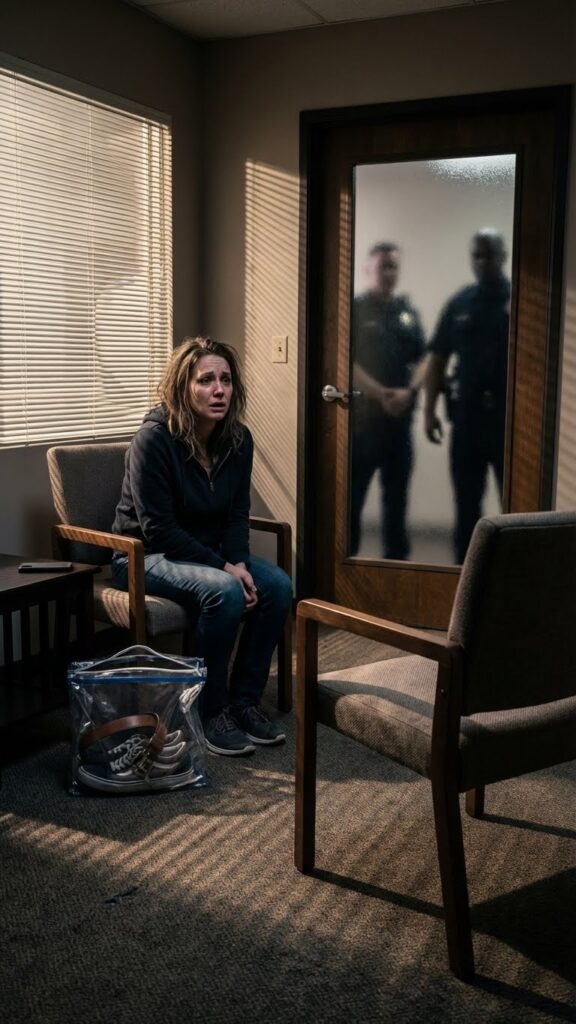
Behind her were two uniformed police officers.
For a split second I honestly thought they were lost.
Then she said, “This is the patient I told you about.”
The world tilted.
I stood up so fast my chair scraped loudly against the floor. “What is happening?”
One of the officers raised his hands gently. “Ma’am, we just need to talk to you for a minute.”
Dr. Keller wouldn’t meet my eyes.
I felt heat crawl up my neck and into my face. “Did you call the police on me?”
She said, “I was concerned about your safety.”
“I told you I’m not suicidal.”
“You said you wished you wouldn’t wake up.”
“That’s not a plan. That’s grief.”
The officers exchanged a look. One of them said, “We’re going to need you to come with us so we can make sure you’re okay.”
“I am okay,” I said, my voice shaking now. “I just told my therapist I miss my mother.”
Dr. Keller finally looked at me then, but there was no apology in her eyes. Only resolve.
“I’m following protocol,” she said.
Being Treated Like a Threat
They didn’t let me drive myself.
They escorted me out of the clinic like I was a risk to public safety, past the receptionist who suddenly couldn’t look at me anymore, past the waiting room where two other patients pretended not to stare.
I remember thinking: I came here for help and now I’m being taken away in a police car.
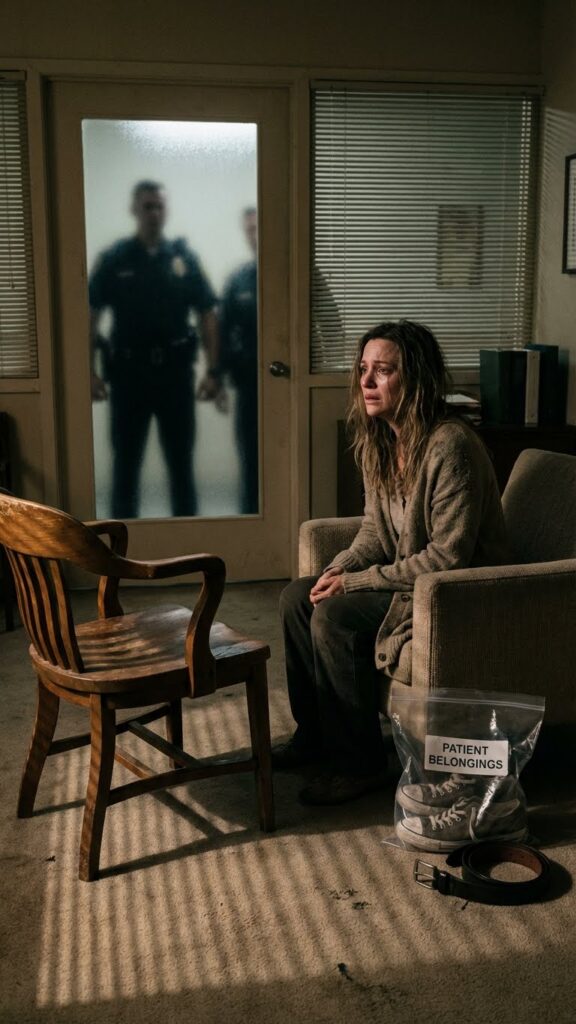
At the hospital, they took my shoelaces, my belt, my phone. They put me in a room with nothing but a plastic mattress and a security camera in the corner of the ceiling.
A nurse asked me if I wanted to kill myself.
I said no.
A social worker asked me if I wanted to kill myself.
I said no.
A doctor asked me if I wanted to kill myself.
I said no.
Every time I explained the same thing: that I was grieving, that I had never harmed myself, that I just felt exhausted by pain.
After six hours, I was discharged with a pamphlet about depression and a bill that would take me months to pay off.
I went home alone, numb, with my shoes in a plastic bag and the echo of Dr. Keller’s voice still ringing in my ears.
The Aftermath
I didn’t sleep that night.
I kept replaying the session in my head, trying to figure out when I had crossed the invisible line from “hurting person” to “dangerous liability.”
I emailed Dr. Keller the next day.
I told her I felt betrayed. That I trusted her. That being reported had made me feel like I’d done something wrong by telling the truth.
Her reply was short:
I’m sorry you feel that way. I acted in your best interest according to clinical guidelines.
No acknowledgment of how humiliating it had been. No recognition of the trauma she had just layered on top of my grief.
Two days later, her office called to inform me she would no longer be my therapist.
What I Learned Too Late
I learned later — from a different therapist, one I found through a friend — that there’s a massive gray area between “passive death wishes” and actual suicidal intent.
That many grieving people express thoughts like mine.
That most clinicians would have slowed down, asked more questions, worked with me on a safety plan instead of calling the police.
But Dr. Keller didn’t do that.
She escalated.
And in doing so, she taught me something I never expected to learn in therapy:
That honesty can be dangerous.
I still haven’t fully recovered from that session.
Not just from losing my mom — but from losing the belief that therapy is always a safe place to land.
And the part I haven’t even told you yet?
It’s what happened when I tried to file a complaint.
Part 2 is where this really gets ugly.