The Tent Where Medals Don’t Matter
I was screaming so loud I couldn’t hear the explosions anymore.
The medics dragged me into the tent on a stretcher, my uniform soaked through with blood that kept pumping from the shrapnel wound in my abdomen. I could feel it—hot, thick, unstoppable. Every breath felt like drowning. The canvas walls of the field hospital shook with each mortar blast, dirt raining down from the ceiling supports.
“Colonel, stay with us!” someone shouted, but their voice sounded like it was coming from underwater.
I’m Colonel James Correa. Twenty-three years of service. Two Bronze Stars. A Silver Star. A chest full of medals that suddenly meant absolutely nothing because I was about to die on a blood-soaked cot in the middle of nowhere.
The last thing I remembered before they threw me in the transport was Private Chen—just a kid, maybe twenty-two—lying face-down in the sand. We’d been ambushed during a routine patrol. The IED took out our lead vehicle. Small arms fire came from everywhere. I’d ordered my men to fall back, to get to cover, but Chen froze. I went back for him.
That’s when the RPG hit fifteen feet to my left.
Now, in this tent that smelled like copper and fear, I could see three other soldiers on cots around me. One was missing his leg below the knee, screaming for his mother. Another was silent, grey-faced, probably already gone. A young Marine—couldn’t have been older than nineteen—sat upright with a rifle still clutched in his hands, eyes vacant, covered in someone else’s blood.
“BP’s dropping—80 over 40—”
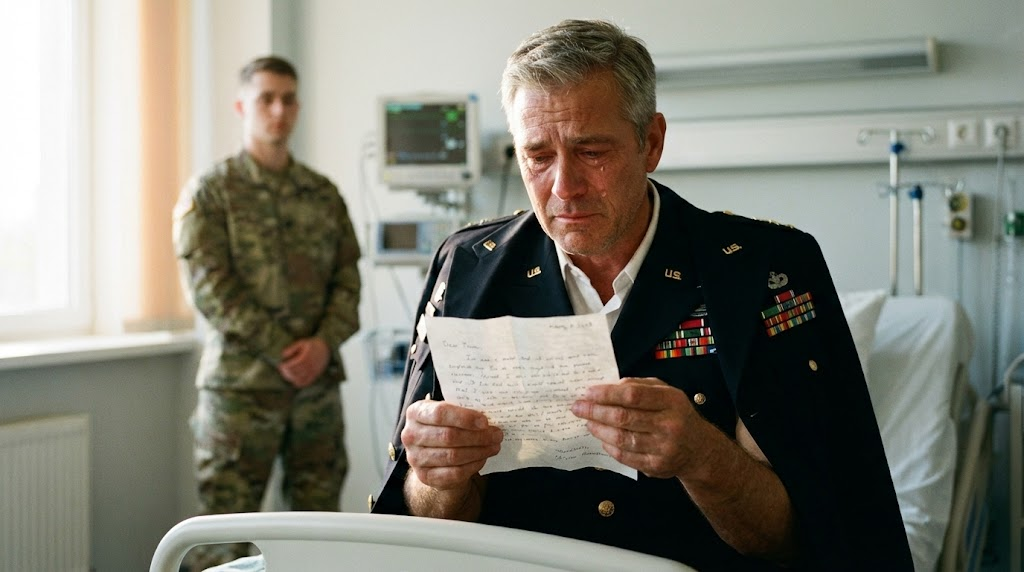
“I need another IV line, NOW!”
“Sir, can you hear me? Colonel Correa, stay awake!”
A medic’s face appeared above mine. Couldn’t have been more than twenty-five. Corporal Williams, according to his name tape. His hands were shaking as he cut away my uniform, revealing the jagged hole in my side where my intestines were trying to escape.
“Oh Jesus,” he whispered.
“How bad?” I managed to choke out.
He didn’t answer. That told me everything.
Another medic—a woman, Sergeant Hayes—appeared on my other side, jamming an IV into my arm. “Got it. Hanging fluids.”
The pain was beyond description. It wasn’t just physical—it was existential. Every nerve in my body was screaming that this was the end. Fifty-one years old. Never married. No kids. Just a career of giving orders and writing letters to parents whose sons I’d sent home in boxes.
Is this what they felt? Is this the fear I saw in their eyes before every mission?
“We’re losing him—pressure’s still dropping—”
My vision started tunneling. The harsh light from the lanterns overhead became a pinpoint. I could hear my heartbeat in my ears, irregular, struggling.
Then I heard a voice. Young. Terrified. Breaking.
It was Private Morrison, one of my riflemen, standing just outside the medic’s workspace. His face was covered in dirt and tears. He was looking directly at me.
“Please don’t die, sir,” he said, voice cracking. “You’re the only one who still believes we get out of here. You’re the only one who makes us think we’re gonna make it home.”
Something in those words hit me harder than the shrapnel.
The monitor started beeping faster—erratic, desperate. Williams was shouting for morphine, for pressure, for something, anything. Hayes had her hands inside my abdomen now, I could feel her literally holding my insides together.
“Colonel, you need to fight!” Williams yelled in my face. “You hear me? FIGHT!”
But I was so tired. So ready to let go.
Morrison’s voice came again, closer now: “Sir, please. We need you.”
The beeping turned into a steady tone.
The Man Behind the Rank
I need to tell you who I was before that tent. Before the blood and the beeping and the realization that I was about to become another name on a wall.
I enlisted at eighteen. Straight out of a small town in Pennsylvania where the options were factory work or military service. I chose the uniform because my old man wore one, and his old man before him. The Correas served. That’s what we did.
I was good at it. Disciplined. Focused. I could compartmentalize better than anyone in my unit. While other guys were calling home, crying about missing their kids’ birthdays, I was studying tactical manuals. While they were forming friendships, I was maintaining professional distance.
By thirty, I was a captain. By forty, a major. At forty-eight, they pinned the eagle on my collar and gave me a battalion.
I was respected. Feared, even. “Iron Correa,” they called me. The man who never flinched. Who made the hard calls. Who could send eighteen-year-olds into hell and sleep soundly afterward because it was necessary, strategic, right.
But here’s what they didn’t know: I didn’t sleep soundly. I didn’t sleep at all.
I had a drawer in my quarters—locked, always locked—filled with letters. Not the official condolence letters I sent to families. These were the ones I wrote and never sent. The real ones.
Dear Mrs. Patterson, your son died because I ordered him to check a building I knew might be rigged. I made a tactical decision. He paid for it with his life. I’m sorry doesn’t cover it, but I don’t know what else to say.
Dear Mr. and Mrs. Chen, your boy froze under fire today. I went back for him. We both made it out. But I wonder every day if I’m training these kids right, if I’m preparing them for reality or just sending them into a meat grinder with a pat on the back and a speech about duty.
I had forty-three letters in that drawer. Forty-three soldiers I’d lost over twenty-three years. I knew every name. Every face. Every detail of how they died.
That’s what Morrison didn’t understand when he begged me not to die. I wasn’t someone who believed we’d all get out. I was someone who’d watched too many people not get out, and I carried every single one of them.
The Breaking Point
“Clear!” Williams shouted, and I felt electricity slam through my chest.
My back arched. Pain exploded through every nerve. The flatline on the monitor jumped, spiked, then… a beep. Weak. Irregular. But there.
“Again!” Hayes commanded.
“Clear!”
Another jolt. This time I could feel my heart trying to remember how to beat. Trying to find its rhythm again.
Beep… beep… beep…
“We got him back,” Williams gasped. “Jesus Christ, we got him back.”
But I was still fading. The blood loss was too much. My pressure was bottoming out again. I could hear them arguing about whether to give me more fluids or if that would just make the bleeding worse. Medical decisions made in split seconds with incomplete information.
Just like the tactical decisions I’d made for twenty-three years.
Hayes had her hands literally inside me, applying pressure to what I assumed was my abdominal aorta. Her face was inches from mine, covered in my blood, her eyes locked on mine.
“Colonel Correa, I need you to listen to me,” she said, her voice steady despite everything. “You’re going to feel like giving up. Your body is going to tell you it’s easier to just let go. But I need you to fight that feeling. I need you to stay here.”
“Why?” I whispered. The first honest question I’d asked in years.
“Because Private Morrison is right. These men need you. They need someone who still gives a damn.”
“I’ve gotten… so many of them… killed…”
“And you’ve kept hundreds more alive. You think anyone else could’ve led this unit through the last six months? You think any other CO would’ve gone back for Chen today?”
“He’s twenty-two… he shouldn’t even be here…”
“None of them should. But they are. And they trust you to bring them home.”
Through my fading vision, I could see Morrison still standing there, along with three other soldiers from my unit. Sergeant Ramirez, who’d been with me for four years. Corporal Davis, whose sister had just had a baby he’d never met. Specialist Kim, who played guitar at night and talked about opening a music school when he got out.
They were all looking at me. Not with the professional respect soldiers show their commanding officer. With something raw. Something human.
Fear. Hope. Desperation.
They actually believed I could make it. They actually thought I was worth saving.
The Choice
I’d like to tell you I had some profound revelation. Some cinematic moment of clarity where my life flashed before my eyes and I saw all the reasons to keep fighting.
But that’s not what happened.
What happened was much simpler, and much harder.
I heard Morrison’s voice again: “You’re the only one who still believes we get out of here.”
And I realized he was wrong. I didn’t believe we’d all get out. I’d never believed that. You don’t survive twenty-three years of war by believing in fairy tales.
But these kids believed it. These exhausted, terrified, brave-beyond-measure kids still had hope. And if I died right now, on this table, I’d be taking that hope with me.
So I made a choice.
Not for duty. Not for honor. Not for the medals on my chest or the oath I’d sworn.
I chose to fight because four young men were standing in a blood-soaked tent, watching their CO die, and they needed to see that sometimes you can beat the odds. Sometimes you can survive the unsurvivable. Sometimes the person who leads you into hell can actually lead you back out.
“Not… done… yet…” I forced out through gritted teeth.
Williams looked at Hayes. She looked back at him. Some kind of medic telepathy passed between them.
“Then let’s get to work,” Williams said. “Kim! Get over here and hold this IV bag higher. Ramirez, I need you putting pressure right here. Morrison, talk to your CO. Keep him conscious.”
Suddenly my soldiers weren’t just watching. They were part of the team keeping me alive.
Morrison knelt beside my cot, his young face streaked with tears and dirt. “Sir, remember when you told us about that bar in Germany? The one with the beer garden?”
I did. During a rare moment of downtime, I’d told them about my first deployment. About finding this tiny gasthaus in Bavaria during a training exercise. About sitting in the garden drinking Hefeweizen and pretending, for just one evening, that the world was normal.
“Yeah…” I managed.
“When we get out of here, we’re all going there. You, me, Chen, everyone. We’re gonna sit in that garden and drink that beer and you’re gonna tell us every embarrassing story from your early days until we can’t breathe from laughing. Deal?”
“Deal,” I whispered.
The Long Night
The surgery—if you could call it that—took three hours.
Three hours of Hayes and Williams working inside my abdomen with nothing but field supplies and sheer determination. Three hours of my soldiers rotating who held the IV, who applied pressure, who kept talking to me to keep me conscious.
They told me about home. About their families. About their dreams for after deployment. Ramirez wanted to be a firefighter. Davis wanted to go to college for engineering. Kim wanted that music school. Morrison wanted to teach high school history.
Normal dreams. Beautiful dreams.
And somewhere in those three hours, I started telling them things I’d never told anyone. About the letters I wrote and never sent. About the nightmares. About how every decision I made as their CO was calculated against the weight of forty-three names I carried.
“That’s why you go back,” Morrison said quietly. “When someone’s in trouble. You go back because you can’t carry another name.”
“I go back because I’m supposed to protect you,” I corrected.
“No sir,” Ramirez said. “You go back because you actually care. There’s a difference.”
At hour two, my pressure stabilized. At hour two-thirty, the bleeding slowed enough that Hayes could start actually repairing instead of just containing. At hour three, Williams stepped back, wiped his forehead with a blood-covered arm, and said:
“I think we got it. I think he’s gonna make it.”
The tent erupted. Not in cheers—we were all too exhausted for that—but in this collective exhale of relief so profound it felt like a physical presence.
Morrison put his head down on the edge of my cot and cried. Just sobbed like a kid. Ramirez squeezed my shoulder so hard I thought he might dislocate it. Kim started laughing, this slightly hysterical sound that was pure emotional release.
And Hayes, this incredible surgeon who’d just performed a miracle with her bare hands in a tent lit by kerosene lanterns, leaned down and whispered in my ear:
“You’re still here, sir. We’re not letting you go.”
The Recovery
They medevaced me out the next morning. The helicopter ride to the field hospital, then to Landstuhl Regional Medical Center in Germany, then eventually to Walter Reed.
Three surgeries to repair the damage properly. Six weeks in the ICU. Four months of recovery and physical therapy.
But the hardest part wasn’t physical.
The hardest part was lying in that clean hospital bed, with real doctors and real equipment and no explosions shaking the walls, and realizing what had actually happened in that tent.
Four medics and four soldiers had refused to let me die. They’d fought for me with the same intensity I’d supposedly fought for them. They’d seen me not as Colonel Correa, the tactical decision-maker, the man with the medals and the mission briefings—but as a human being worth saving.
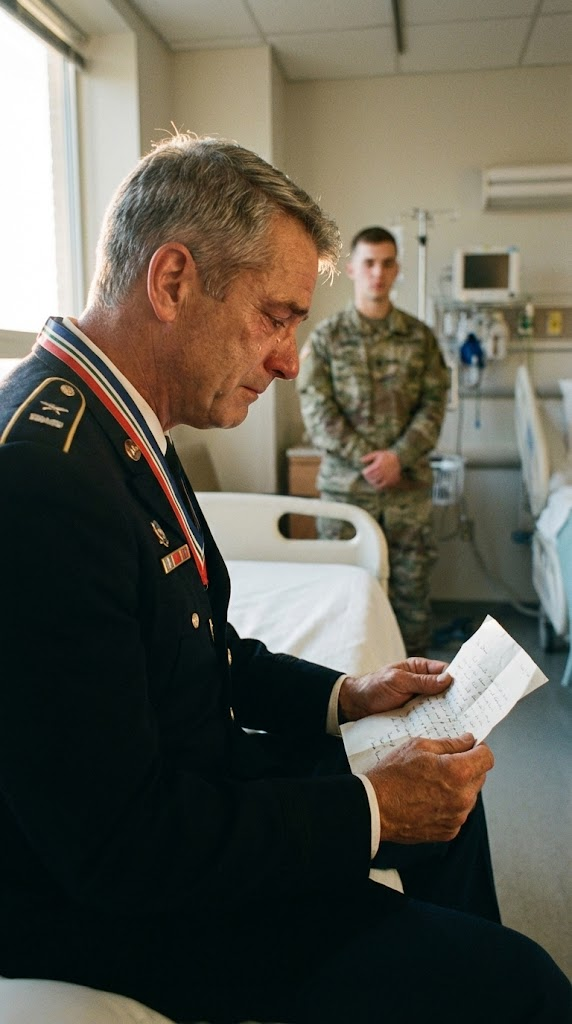
Morrison visited me at Walter Reed. He’d been rotated stateside after our unit took heavy losses in another engagement two weeks after I was evacuated. He showed up in dress uniform, looking older than his twenty-three years.
“Sir,” he said, standing at attention beside my bed.
“At ease, Private. Actually, sit down. And stop calling me sir. I’m in a hospital gown. There’s no rank here.”
He sat, but he looked uncomfortable. “I wanted to thank you. For going back for Chen that day. He made it out. He’s stateside now, doing physical therapy. He lost some mobility in his left arm, but he’s alive.”
“I’m glad.”
“And I wanted to apologize.”
That surprised me. “For what?”
“For what I said in the tent. About you being the only one who believes we get out. That wasn’t fair. That was… that was too much pressure to put on one person.”
“Morrison—”
“No, let me finish. I’ve been thinking about it a lot. You’re not supposed to be our hope. You’re supposed to be our CO. And you’ve been a damn good one. But we made you into something more than that, something you couldn’t be. And that night, when you were dying, I realized I was asking you to live for us instead of for yourself. That was wrong.”
I looked at this kid—this man—who’d grown up so fast in such a terrible place.
“You saved my life,” I said simply.
“The medics saved your life.”
“No. Hayes and Williams kept my body alive. You gave me a reason to want to stay in it. There’s a difference.”
He wiped his eyes. “The beer garden in Germany. Is that real?”
“Yeah. It’s real.”
“When you’re cleared for travel, we should go. All of us who made it back. Chen, Ramirez, Davis, Kim. Everyone.”
“I’d like that.”
The Man Who Learned to Live
I retired from active duty eight months later. Medical retirement with full honors. They offered me a desk job, a cushy position at the Pentagon where I could advise on strategy without having to deploy.
I turned it down.
Instead, I started a foundation for combat medics. Full scholarships for medics and corpsmen who wanted to go to medical school after their service. Because Corporal Williams and Sergeant Hayes had saved my life with skill they’d learned in twelve weeks of training and perfected under fire, and they deserved every opportunity the world could give them.
Williams is in his third year of medical school now. Wants to be a trauma surgeon. Hayes is doing her residency in emergency medicine. I talk to both of them regularly.
I also started writing those letters. Not the ones in my drawer—those stay locked away, a private memorial. But new letters. Letters to the families of soldiers I served with, telling them the truth about their sons and daughters. Not the sanitized, official version. The real version.
About how their child was brave. How they made jokes to keep morale up. How they talked about home and dreams and the life they wanted to live. How they mattered. How they’re remembered.
Some families wrote back. Some didn’t. But I send them anyway, because it’s what I should’ve been doing all along.
Morrison organized that trip to Germany. Seven of us went—everyone who’d been in that tent, plus Chen and two others from our unit. We sat in that beer garden for six hours, drinking Hefeweizen and telling stories and laughing until we couldn’t breathe.
We toasted the friends who didn’t make it. We toasted Hayes and Williams. We toasted survival and the future and the simple miracle of sitting in a garden on a summer evening, alive.
At one point, Morrison raised his glass and said, “To the colonel who refused to die.”
But I corrected him.
“To the medics who refused to let me. And to the soldiers who gave me a reason.”
The Promise
It’s been three years since that night in the tent. I’m fifty-four now. I teach military history at a small college in Virginia. I have a one-bedroom apartment with too many books and a picture on my desk of seven soldiers in a German beer garden, all of us smiling like we’d just gotten away with something.
I sleep better now. Not great—the nightmares don’t completely go away. But better.
I have dinner every Sunday with Hayes, who matched to a hospital two hours away. Once a month, Williams drives down from medical school and we cook together. Chen sends me pictures of his daughter—he named her Jamie, after me, which made me cry for an hour when he told me.
Morrison is engaged to a high school teacher he met at the school where he works. He asked me to be part of his wedding party. I said yes immediately.
But here’s the thing I want you to understand. The thing I learned in that tent while four medics and four soldiers literally held me together:
Medals don’t make you a leader. Orders don’t make you important. Rank doesn’t make you valuable.
What makes you matter is whether you’re willing to fight—not just for victory, not just for mission success, not just for duty—but for the people beside you. And whether you’re willing to let them fight for you.
For twenty-three years, I thought my job was to be the strong one. The one who made the hard calls and never flinched. The one who couldn’t show weakness because these young soldiers needed someone unbreakable.
But in that tent, bleeding out and terrified and ready to give up, I learned the truth:
Strength isn’t refusing to fall. Strength is letting people catch you when you do.
Last week, I gave a lecture to a group of ROTC cadets about leadership. At the end, one of them—a serious young woman who reminded me of Hayes—asked me what the most important lesson I’d learned in twenty-three years of service was.
I told her about the tent. About Morrison’s plea. About Hayes with her hands inside my abdomen. About Williams and his shaking hands doing the impossible. About the choice I made to keep fighting, not for duty or honor, but for the people who refused to give up on me.
“The most important lesson,” I told her, “is that you’re not supposed to be a hero alone. You’re supposed to be part of a team where everyone’s a hero for each other. Where the medic saves the colonel and the colonel goes back for the private and everyone fights to keep everyone else alive. That’s what service actually means.”
She wrote it down. I hope she remembers it.
I hope when she’s lying in some tent somewhere, scared and hurt and ready to give up, someone gives her a reason to keep fighting.
And I hope she’s built the kind of team that won’t let her go.
Because that’s the only thing that matters in the end. Not the medals. Not the rank. Not the mission briefings or the tactical victories.
Just the people who look at you bleeding out on a table and say: “You’re still here. We’re not letting you go.”
That’s what saved my life.
That’s what gave me a life worth saving.