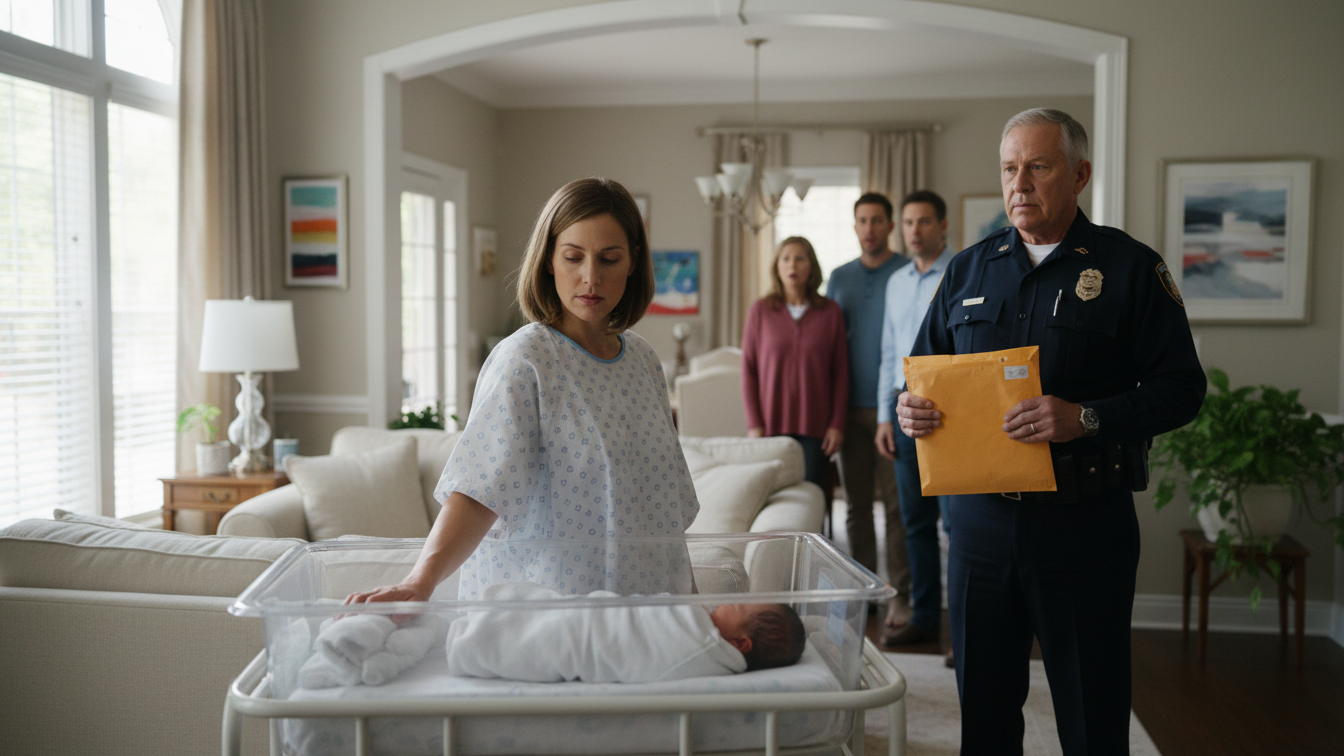
I was still wearing my hospital gown when the knock came.
Not a polite knock. Not a neighborly tap.
A firm, official knock — the kind that doesn’t ask permission to change your life.
My newborn son was asleep in the clear plastic bassinet beside me, his tiny chest rising and falling in soft, steady breaths. The house was filled with the gentle chaos of family — my mother bustling in the kitchen, my father arguing with my brother about parking, my aunt rearranging flowers that didn’t need rearranging.
It was supposed to be the happiest day of my life.
I had brought my baby home.
Instead, it became the day everything I thought I knew about my family collapsed.
We had just pulled into my parents’ driveway an hour earlier.
I hadn’t even changed out of my hospital gown yet. I remember laughing about it — how ridiculous I must have looked, waddling through my childhood home pushing a hospital bassinet instead of a stroller. But my mom insisted I rest first. The nursery upstairs wasn’t ready yet. “Just put him here in the living room,” she said, smoothing my hair like she used to when I was little.
So that’s what I did.
I sat in the familiar armchair beneath the window where I used to read after school, watching my son sleep, thinking about how strange it felt to be here as a mother now instead of a daughter.
That’s when the doorbell rang.
At first, no one moved.
We assumed it was another relative arriving late. My aunt rolled her eyes and muttered something about how people never read the group chat.
My father stood up with a sigh. “I’ll get it.”
I didn’t see the man at the door at first. I only saw my father’s face.
The color drained from it so fast I thought he might faint.
“Dad?” I called. “What is it?”
He didn’t answer.
Instead, he stepped aside.
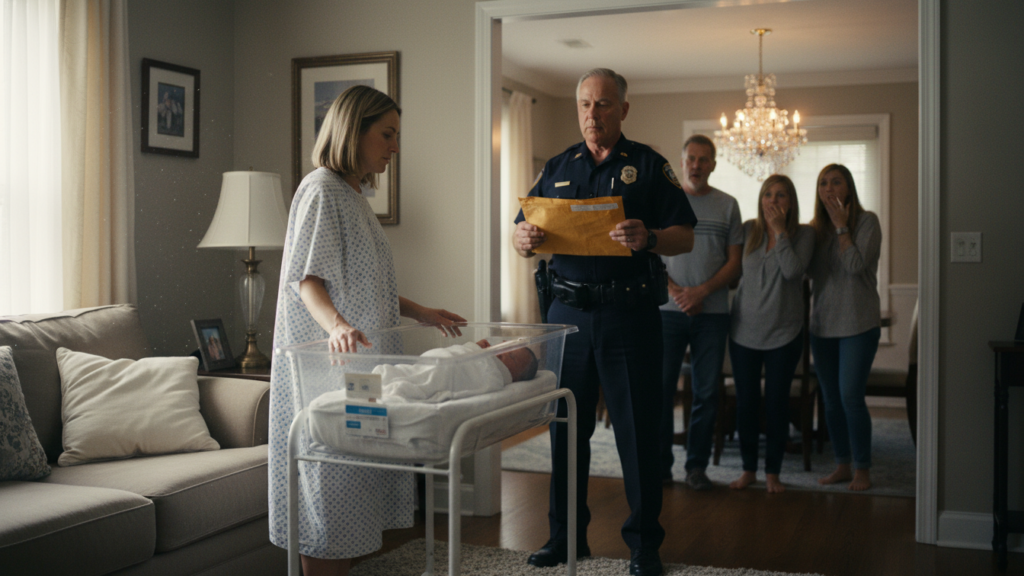
A police officer stood in the doorway, tall and broad-shouldered, wearing a neutral expression that made my stomach twist.
He held a large sealed yellow envelope in his right hand.
The room went silent.
“I’m Officer Reynolds,” he said calmly. “I’m looking for Margaret Collins.”
My mother froze mid-step, a dish towel clutched in her hands. “That’s me.”
He glanced past her — at my bassinet. At my hospital wristband. At my sleeping baby.
Then he looked back at her. “Ma’am, I need to speak with you and your family.”
The way he said family made my heart start pounding.
My aunt whispered, “What is this about?”
“I’m afraid I can’t discuss it at the door,” he replied. “But it concerns a case reopened last month.”
Reopened.
That word echoed in my head.
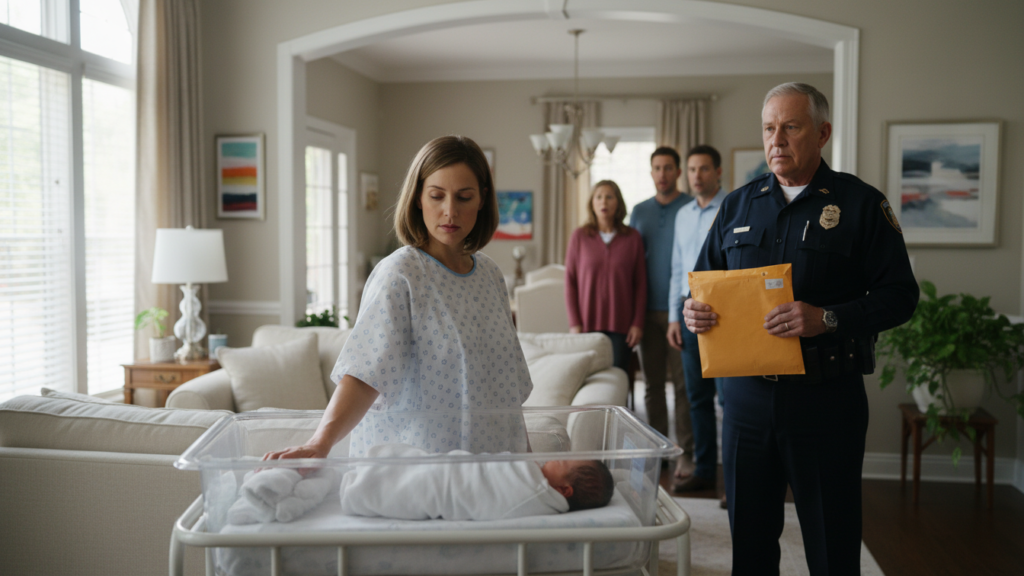
We all crowded into the foyer, forming an awkward half-circle around the officer like he was about to deliver a verdict.
My brother, Mark, crossed his arms. “You’re making everyone nervous. Can you just tell us why you’re here?”
The officer hesitated, then held up the envelope.
“This was recovered during a property audit tied to a decades-old investigation,” he said. “It was sealed and never properly logged. It belongs to your family.”
My mother stared at it like it was radioactive. “That’s impossible.”
“Is it?” he asked gently.
She swallowed hard. “We would have known.”
I felt my baby stir beside me. I instinctively placed my hand on the bassinet.
Something was wrong. Deeply wrong.
The officer handed the envelope to my father.
His hands were shaking.
“Dad,” I said softly. “What is this?”
He opened his mouth — then closed it again.
The officer cleared his throat. “For legal reasons, I’m required to deliver this in person. It contains evidence from a missing person’s case from 27 years ago.”
Twenty-seven years.
My mother made a small, broken sound.
My aunt dropped into a chair.
My brother turned to me, eyes wide. “That’s before you were even born.”
I was holding my newborn son when I heard the words that would rewrite my entire life:
“The missing person was your mother’s sister.”
I had never heard my family speak about a missing aunt.
Not once.

My mother had two siblings — Mark and Aunt Lila. That was the story I grew up with. No photos on the wall. No holiday memories. No whispered stories.
There was no room in our family history for a missing person.
My father’s voice was barely audible. “She didn’t go missing.”
Officer Reynolds met his eyes. “Sir, according to reopened records, she did. And this envelope contains items that suggest foul play.”
My mother’s knees buckled.
I watched her slide down the wall, her towel falling forgotten to the floor.
“No,” she whispered. “We buried that.”
Buried.
I tightened my grip on the bassinet rail.
My brother stepped forward. “You’re saying my mom had a sister who disappeared and nobody told us?”
My aunt looked like she might throw up. “Maggie… you promised.”
My mother stared at the floor. “I was sixteen,” she said. “I didn’t know what else to do.”
The officer looked at her carefully. “Ma’am, this envelope contains personal items belonging to your sister — and a partial confession letter.”
The word confession sucked the air out of the room.
A partial confession.
From who?
About what?
I don’t remember standing up, but suddenly I was on my feet, my voice shaking.
“Officer, why today?” I demanded. “Why are you here now? I just brought my baby home.”
His eyes softened. “I’m sorry, ma’am. I didn’t know about your baby. But the case was reassigned after your parents’ property was listed for sale. During the inspection, the envelope was found behind a wall panel in the basement.”
Behind a wall.
Hidden.
For decades.
My mother finally looked at me.
Her eyes filled with tears. “I was trying to protect you,” she whispered.
“From what?” I asked.
She didn’t answer.
Instead, Officer Reynolds opened his notebook.
“Ma’am,” he said gently, “we need to talk about what happened to your sister the night she vanished.”
I looked down at my newborn son, still sleeping peacefully, unaware that the family he’d been born into was built on a lie.
And I realized something chilling.
My baby wasn’t just coming home to grandparents and cousins.
He was coming home to a crime scene that had been disguised as a family for nearly three decades.