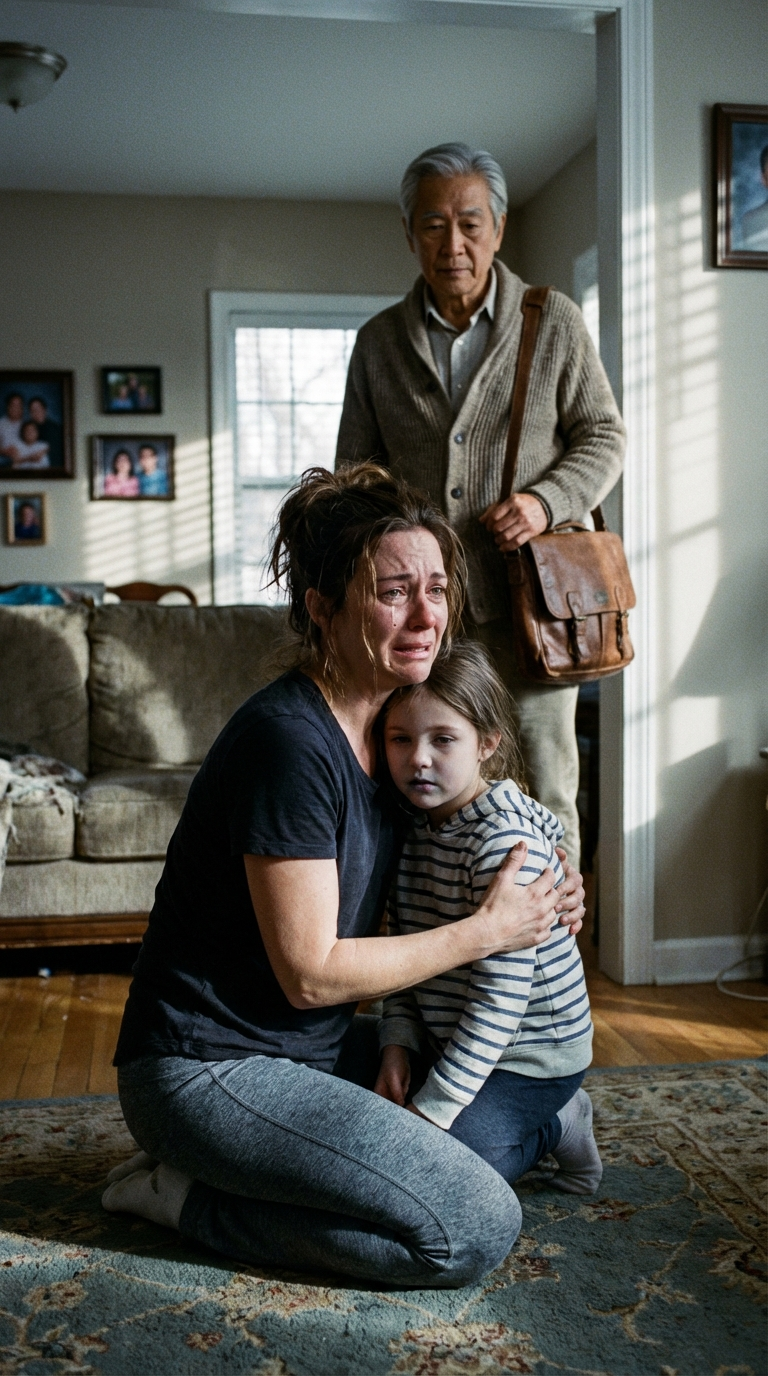
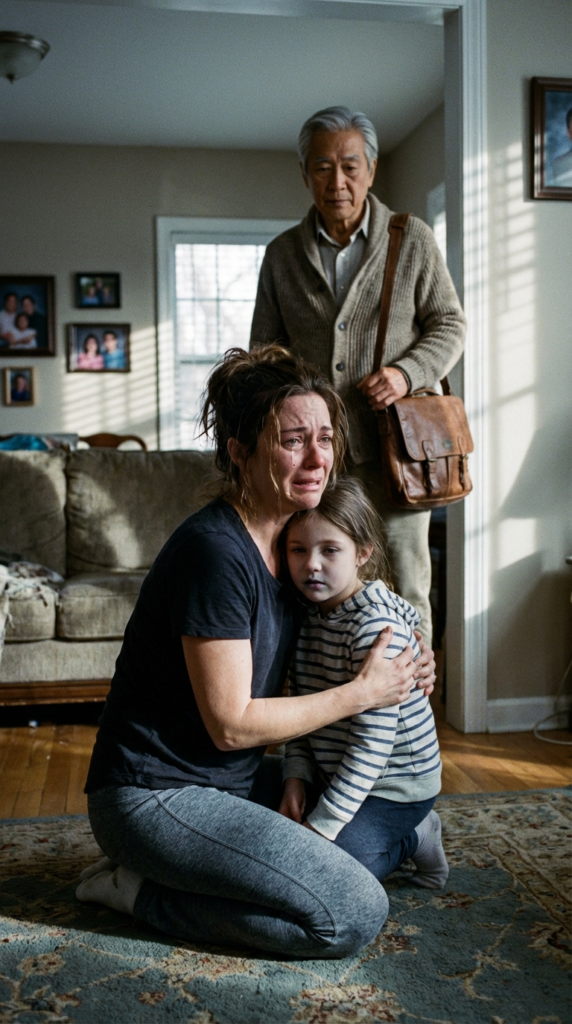
I was screaming at my phone, begging the 911 operator to send someone faster, when I heard the knock at my door.
My daughter Sofia wasn’t breathing right. Her lips were turning blue. The ambulance was still twenty minutes away in our rural neighborhood, and I could feel her slipping away in my arms.
I threw open the door, praying it was the paramedics who’d somehow arrived early.
It was Dr. Chen.
Old Dr. Chen from down the street. The ancient doctor everyone in the neighborhood whispered about. The one who still made house calls like it was 1950. The one I’d literally laughed at two weeks ago when he offered to “check on Sofia” after seeing her cough at the grocery store. I’d smiled politely and said we had a pediatrician, thanks.
“I heard you scream from my porch,” he said, already pushing past me with his worn leather medical bag that looked older than me.
“I called 911, they’re coming, I don’t need—”
“How long has she been like this?” He was already kneeling beside Sofia on the couch, his weathered hands moving with surprising speed and precision.
“Five minutes, maybe ten, I don’t know, she just started gasping and I—”
He cut me off, his face deadly serious. “Did she eat anything unusual today?”
“No! I mean, just her regular lunch, some peanut butter and jelly, crackers—”
“Does she have an EpiPen?”
“What? No! She’s not allergic to anything! She’s eaten peanut butter since she was two!”
His eyes met mine, and I saw something that made my blood freeze—absolute certainty mixed with urgency.
“Yes, she is. She’s going into anaphylactic shock. This is a new allergy. Where’s your kitchen?”
I couldn’t move. Couldn’t process. This man had to be wrong. Sofia had eaten peanut butter a thousand times. The ambulance was coming with real, modern doctors. I should wait for them.
But Sofia made a horrible gurgling, wheezing sound, and Dr. Chen was already moving to my kitchen, ripping open drawers with purpose.
“What are you doing?!” I screamed, following him.
He found the Benadryl in my medicine cabinet like he had X-ray vision, along with a measuring spoon. His hands were completely steady even though mine were shaking so hard I’d dropped my phone twice.
“Trust me,” he said, his voice calm but commanding. “I’ve been doing this for forty-seven years. This is anaphylaxis. If we don’t act right now, the ambulance won’t get here in time.”
I looked back at my daughter. Her face was swelling. Her neck was blotchy and red. Her breathing was barely a whisper.
I had two choices: trust this old man everyone thought was outdated and crazy, or wait for the ambulance and pray my eight-year-old baby survived.
To understand why I hesitated, you need to understand who Dr. Samuel Chen was in our neighborhood—and why everyone thought he was stuck in the past.
Dr. Chen was 72 years old and had been practicing medicine since the 1970s. While every other doctor had moved to big medical centers with sleek offices and online booking systems, Dr. Chen still ran a tiny practice out of a converted house on Maple Street.
And he still made house calls.
In 2026, nobody does house calls anymore. It’s inefficient. It’s outdated. It’s not covered by most insurance. Modern medicine happens in hospitals and clinics with all the latest technology, not in someone’s living room with a doctor who carries a leather bag that probably predates the internet.
My neighbors joked about him constantly. “Oh, Dr. Chen stopped by to check on my cold—like I’m a Victorian lady with consumption,” someone would laugh at the book club. The younger families used the modern pediatric practice fifteen miles away, with their patient portal app and same-day appointments.
I’d moved to the neighborhood three years ago after my divorce. Sofia and I needed a fresh start, and this quiet suburb seemed perfect. Dr. Chen had knocked on our door the first week with a pie and a business card.
“I’m the neighborhood doctor,” he’d said with a kind smile. “If you or your daughter ever need anything, I’m just down the street. I make house calls.”
I’d thanked him politely and thrown the card in a drawer. House calls? What century was this?
Two weeks before the day Sofia stopped breathing, I’d seen Dr. Chen at the grocery store. Sofia had been coughing—just a normal kid cough, nothing serious. He’d stopped me in the produce section.
“That cough sounds chesty,” he’d said gently. “I’d be happy to stop by and listen to her lungs, just to be safe.”
I’d actually laughed. “Oh, we’re fine! It’s just a cold. But thank you, Dr. Chen.”
He’d nodded, but something in his eyes had looked… concerned. Persistent. “My door is always open. And I mean that literally—I live above my practice. Anytime, day or night.”
I’d smiled and walked away, thinking how sweet but totally impractical he was. Who needs a doctor who makes house calls when you have urgent care centers and telemedicine?
Apparently, I did.
Standing in my kitchen, watching Dr. Chen measure out liquid Benadryl with the precision of a chemist, I had maybe three seconds to decide.
“This will buy us time until the ambulance gets here,” he said. “But I need you to trust me right now. Can you do that?”
I looked at Sofia. Her eyes were rolling back.
“Yes,” I whispered.
He moved fast. He administered the Benadryl, elevated her legs, loosened her clothing. His hands never shook. His voice never wavered. He checked her pulse, her breathing, her pupils, all while talking to me in a calm, steady voice.
“Late-onset allergies can develop anytime, even to foods she’s eaten before. Her body is overreacting, but we’re going to help it calm down. The ambulance will be here soon, and they’ll have epinephrine. But right now, we’re keeping her airways open.”
I was crying, nodding, completely useless.
“Breathe with me,” Dr. Chen said. “You need to stay calm for her. In through your nose. Out through your mouth.”
I obeyed. Somehow, this old man I’d dismissed as outdated was the only thing standing between my daughter and death.
The ambulance arrived twelve minutes later. Sofia’s breathing had stabilized slightly, though she was still in serious distress. The paramedics rushed in, saw Dr. Chen, and their entire demeanor changed.
“Dr. Chen! What do we have?”
“Anaphylaxis, likely peanut allergy, first occurrence. I’ve administered Benadryl, 25mg, approximately eight minutes ago. Airways are compromised but stable for now. She needs epinephrine immediately.”
They moved like a choreographed team, clearly having worked with him before. One paramedic administered the EpiPen while the other prepared the stretcher.
“You saved her life, Doc,” one of them said quietly. “Another five minutes and…”
He didn’t finish the sentence. He didn’t have to.
At the hospital, the ER doctor confirmed everything. Sofia had developed a sudden, severe peanut allergy. If Dr. Chen hadn’t intervened immediately with the antihistamine and kept her calm, she likely would have died before the ambulance arrived.
I sat in the waiting room while they monitored her, completely numb.
Dr. Chen had stayed with us the entire time. He’d ridden in the ambulance, consulted with the ER staff, and now sat beside me in the uncomfortable plastic chairs, his ancient medical bag at his feet.
“I don’t understand,” I finally said. “How did you know?”
“I heard her cough two weeks ago,” he said simply. “It had a particular quality—slight wheezing, inflammation in the upper airways. Could have been nothing. Could have been the start of new allergies. I’ve heard that sound ten thousand times in forty-seven years.”
“But… it was just a cough. At a grocery store.”
He smiled gently. “When you make house calls, you learn to see the whole patient. Not just symptoms, but patterns. I’ve watched children in this neighborhood grow up. I know what normal looks like for each of them. When something changes, I notice.”
“But how did you hear me scream? How did you know to come?”
His eyes crinkled. “I live three houses down. I sit on my porch most evenings. I heard you scream, and I ran. When you’re a doctor who makes house calls, you’re always on call.”
I started crying again. “I laughed at you. Two weeks ago, I literally laughed when you offered to help.”
“I know,” he said kindly. “Most people do. That’s alright.”
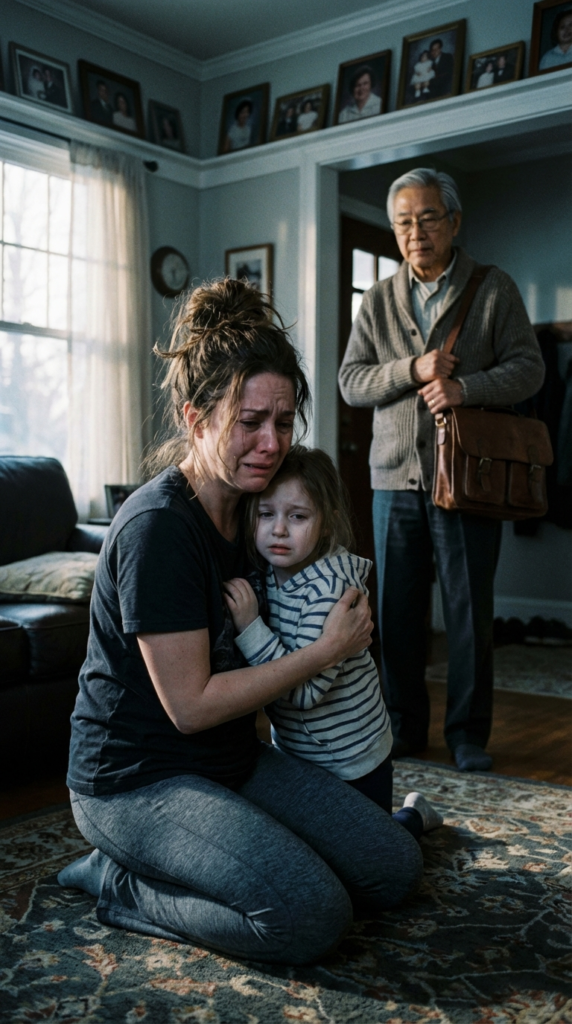
Over the next few days, while Sofia recovered, I couldn’t stop thinking about Dr. Chen. I started asking neighbors about him—really asking, not just listening to jokes.
What I discovered shocked me.
Mrs. Patterson, the elderly widow at the end of the street: “Dr. Chen caught my husband’s heart condition three years ago during a routine house call. He heard something wrong with his heartbeat, insisted we go to the hospital. They found a 90% blockage. He saved Tom’s life.”
The Rodriguez family: “Our son has diabetes. Dr. Chen visits once a month to check on him, teach him about nutrition, make sure he’s managing his insulin. He doesn’t charge us because he knows we’re struggling. He just… cares.”
Young couple with a new baby: “Dr. Chen stopped by the day after we brought Emma home from the hospital. Just to check on us. He noticed I had postpartum depression before I even knew what it was. He got me help. He probably saved my life.”
Story after story. Lives saved. Illnesses caught early. Families supported. All because one old doctor refused to give up a practice everyone else thought was obsolete.
I found out he’d been trying to close his practice for years. His daughter, a hospital administrator in the city, kept pressuring him to retire. “You’re going to work yourself to death,” she’d say. Insurance companies barely reimbursed him. He’d lost money on house calls for decades.
But he kept going because he believed medicine wasn’t just about treating symptoms. It was about knowing your patients as whole people, in their homes, in their lives.
Three weeks after Sofia’s incident, I was at the neighborhood coffee shop when I overheard Dr. Chen’s daughter talking loudly on her phone.
“Dad, you’re being ridiculous. You’re 72. You can’t keep doing this. What if you have a heart attack running to someone’s house? What if you make a mistake because you don’t have the proper equipment?”
I couldn’t help myself. I walked over.
“Excuse me,” I said. “Are you Dr. Chen’s daughter?”
She looked annoyed. “Yes. And you are?”
“The mother of the child your father saved three weeks ago. The child who would be dead if your father had retired like you want him to.”
Her face went pale.
I didn’t stop. “Your father is the best doctor in this neighborhood. Maybe the best doctor period. Not because he has fancy equipment or a modern office, but because he actually sees his patients. He knows us. He catches things other doctors miss because he’s paying attention.”
“I… I’m trying to protect him,” she said weakly.
“He doesn’t need protection. He needs support. He needs people to recognize that what he’s doing isn’t outdated—it’s the future we forgot we needed.”
That conversation changed something. Dr. Chen’s daughter visited him the next week. I know because I saw her car outside his practice, and I saw them hugging on the porch when she left.
Two months later, Dr. Chen made an announcement to the neighborhood: he wasn’t retiring. Instead, he was expanding.
His daughter had helped him apply for grants to fund a “community house call program.” Two young doctors were joining his practice, learning his methods. Insurance companies had agreed to pilot a program covering house calls for elderly and at-risk patients.
“House calls aren’t outdated,” Dr. Chen told the neighborhood meeting. “They’re preventative medicine at its finest. They’re how we catch problems before they become emergencies. They’re how we build relationships that save lives.”
The program launched six months ago. The results have been remarkable. Hospital admissions in our neighborhood have dropped 40%. Chronic disease management has improved. Patient satisfaction is through the roof.
But more than that, people feel cared for. They feel seen.
Last week, Sofia and I brought Dr. Chen a gift—a new medical bag to replace his ancient leather one.
He opened it and smiled. Then he carefully removed items from his old bag and placed them in the new one—his stethoscope, his blood pressure cuff, his otoscope.
“You know what the best part of house calls is?” he asked Sofia.
She shook her head.
“I get to see people in their homes. I get to meet their dogs and see their artwork and understand their lives. Medicine isn’t just about bodies. It’s about people. And you can’t really know people if you only see them in an exam room for seven minutes.”
Sofia hugged him. “You’re my favorite doctor ever.”
“Well,” he said with a twinkle in his eye, “I’m the doctor who makes house calls. That’s a pretty small club these days.”
Here’s what I learned from Dr. Chen: modern medicine is amazing. Technology saves lives. Advanced equipment and procedures are miraculous.
But we’ve lost something in our rush to modernize. We’ve lost the relationship. The intimacy. The deep knowledge that comes from seeing patients as whole people in context, not just symptoms to treat.
Dr. Chen proved that sometimes the old ways aren’t outdated—they’re essential.
House calls allow doctors to see things they’d never catch in a clinic: the fall hazards in an elderly patient’s home, the food insecurity affecting a child’s health, the isolation contributing to depression, the environmental factors triggering allergies.
They allow doctors to build relationships that make patients feel safe sharing difficult truths. They allow for preventative care that stops emergencies before they happen.
They save lives.
Sofia’s eighth-grade class just did a project on “Modern Heroes.” She chose Dr. Chen. Her presentation talked about how heroism isn’t always dramatic—sometimes it’s quiet, consistent dedication to serving others, even when it’s not efficient or profitable.
Dr. Chen attended her presentation. He cried.
Dr. Chen still makes house calls. He’s training the next generation to do the same. His practice has become a model for other communities.
And me? I’m one of his loudest advocates. I speak at medical conferences about the importance of house calls. I write letters to insurance companies demanding coverage. I organize neighborhood fundraisers to support the program.
Because Dr. Chen didn’t just save my daughter’s life that terrifying afternoon. He saved my understanding of what medicine should be.
It should be personal. It should be accessible. It should recognize that health happens in context, in community, in relationship.
It should be a doctor who hears a scream and runs toward it with a worn leather bag and forty-seven years of experience.
It should be someone who cares enough to knock on your door, to check on a cough, to sit on their porch listening for neighbors in distress.
That’s not outdated. That’s not inefficient.
That’s love in action. That’s medicine at its finest.
The doctor who made house calls didn’t just practice medicine. He practiced humanity. And in doing so, he reminded all of us that sometimes the most radical thing we can do is refuse to give up on the old-fashioned idea that people matter more than efficiency.
My daughter is alive because one man refused to modernize away his compassion.
I’ll spend the rest of my life making sure no one forgets that.