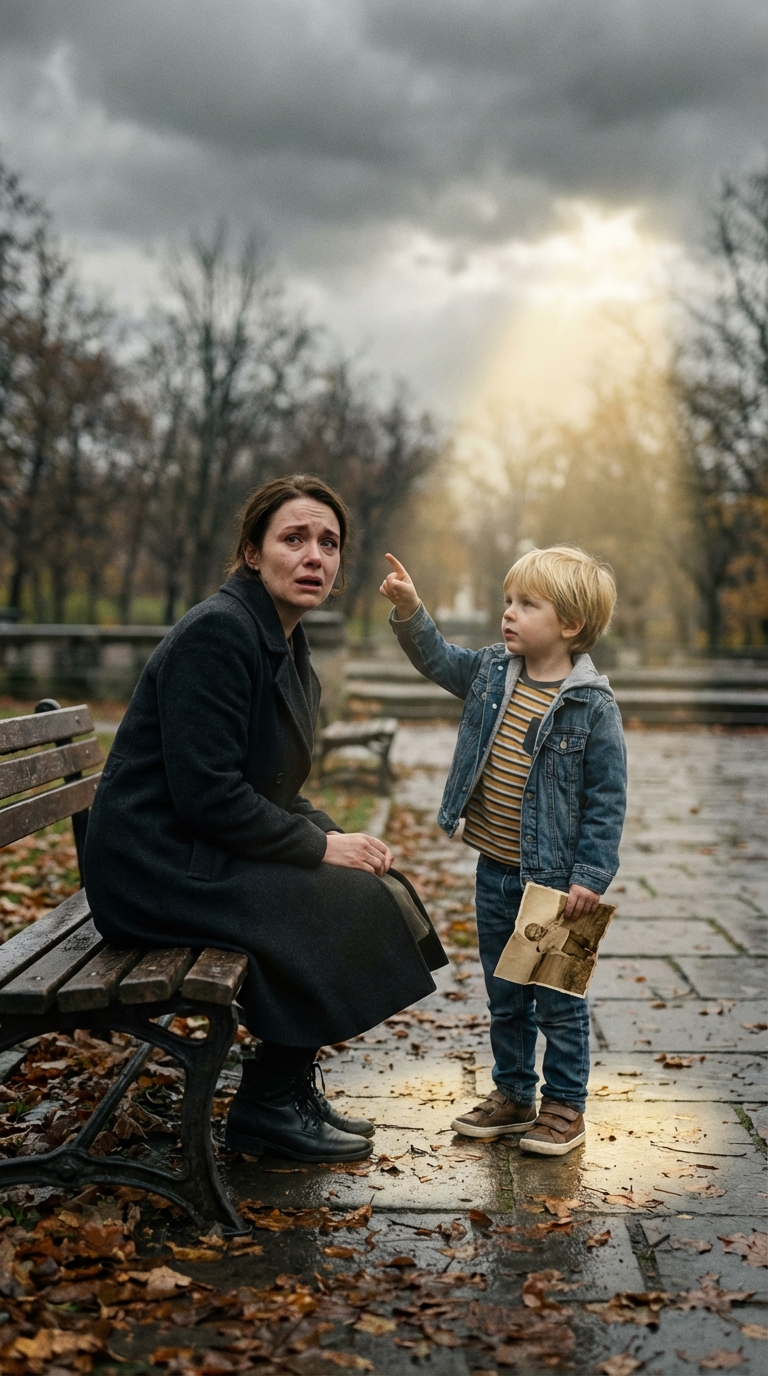
I wasn’t sitting on that park bench to enjoy the view. I was sitting there to say goodbye.
It was October 14th—the fifth anniversary of the hydroplaning accident on I-95 that killed my husband, David, and my six-year-old daughter, Mia. Since that day, I had convinced myself I was cursed. It wasn’t just grief; it was a statistical anomaly of tragedy. My mother died a year later. My best friend was diagnosed with leukemia shortly after I moved in with her.
I had come to believe that I was a blackened match—that anyone I touched would eventually burn. So, I extinguished myself. I isolated in a tiny, third-floor apartment, working a remote data entry job, ordering groceries online, and speaking to no one. I was a ghost in my own life, haunting a world that had moved on without me.
I had a letter in my pocket. It was a resignation letter—not just from my job, but from everything. I was done. The weight of the silence in my apartment had finally become heavier than my will to survive it. I was ready to walk to the bridge at the edge of town.
The park was grey and damp, empty except for a woman chasing a golden retriever in the far distance. I wiped a hot tear from my freezing cheek, ready to stand up.
Then, a shadow fell over my sneakers.
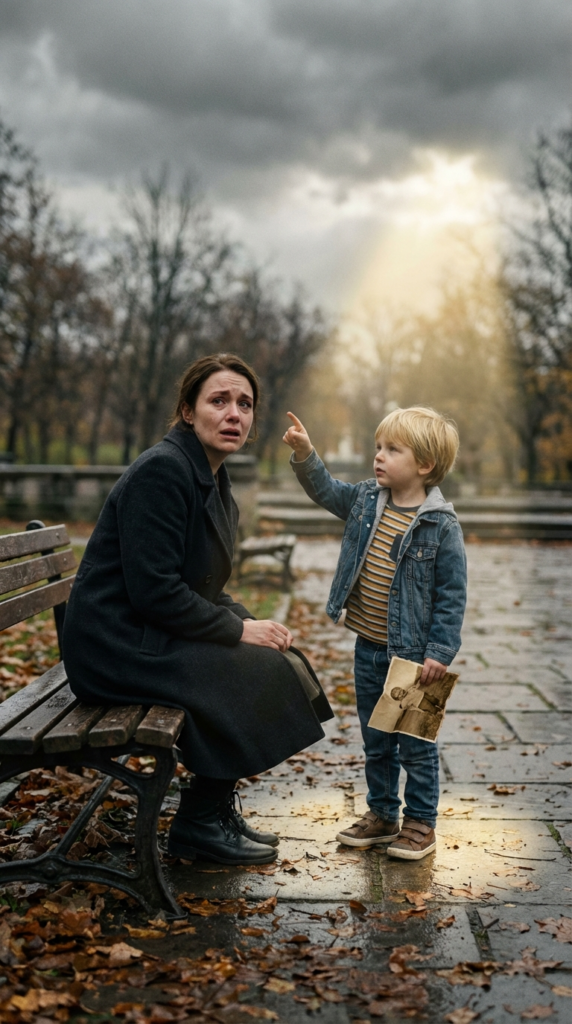
I looked up, startled. Standing there was a little boy, about seven years old. He had messy blond hair, a band-aid on his knee, and a striped shirt stained with grass. He was staring at me with an intensity that felt ancient—eyes that seemed too old for his face.
“Are you Elena?” he asked.
My heart hammered against my ribs. I hadn’t told a soul I was coming here. I hadn’t heard my name spoken aloud by a stranger in years.
“Who are you?” I whispered, my hand instinctively clutching my purse as if to shield myself. “Where are your parents?”
The boy didn’t answer. Instead, he pointed a small, dirt-smudged finger straight up at the sky. The heavy grey clouds were breaking, letting a single, blinding ray of sunlight hit the wet grass behind us.
“They sent me to check on you,” he said, his voice calm and matter-of-fact. “They said you were sad today.”
I froze. A chill that had nothing to do with the wind ran down my spine. “Who? Who sent you?”
He took a step closer. He reached into the pocket of his cargo shorts and pulled out a small, creased, water-damaged photograph.
It was a picture of me.
But it wasn’t just any picture. It was a Polaroid of me and David, laughing, with Mia on his shoulders. It was taken on a beach trip six years ago. It was a photo that I kept in my wallet. A wallet that had been lost in the wreckage of the car.
“How do you have that?” I gasped, the air leaving my lungs. “Give that to me.”
The boy smiled. It wasn’t a creepy smile; it was warm, familiar. “My heart told me where to find you.”
I was shaking. I didn’t know whether to scream or laugh. I stood up to back away, convinced I was hallucinating or being pranked.
That’s when a woman came running up the path. She was out of breath, frantic. “Noah! Noah, I told you not to run off!”
She grabbed the boy’s shoulder, panting. She looked at me, apologetic. “I am so sorry. He just took off running. He’s… he’s very intuitive.”
Then, she saw my face. She stopped. She looked at the photo in Noah’s hand.
“Oh my god,” the woman whispered. She covered her mouth. “You’re her. You’re Elena.”
I looked between the woman and the boy. “Who are you people? How do you have my photo?”
The woman’s eyes filled with tears. “My name is Sarah. This is Noah. Five years ago… Noah was in the ICU. He was two years old. He had dilated cardiomyopathy. His heart was failing. We were told he had twenty-four hours to live.”
The world tilted on its axis.
I remembered the hospital. I remembered the fog of the worst night of my life. The doctor asking me, while I was still covered in the dust of the airbags, if I would consider donating Mia’s organs. I remembered screaming “Yes” just to make them stop asking, just to make something good come out of the horror. It was a closed donation. I never wanted to know. It hurt too much.
“You…” I stammered, looking at Noah.
“We tried to find you,” Sarah said, weeping openly now. “The agency wouldn’t tell us who you were. But when we got Noah’s personal effects back from the hospital after the transplant… that photo was tucked into the blanket they transferred him in. It must have been in the ambulance with your daughter. It got mixed up with his things.”
She took a breath. “We kept it. We called you ‘ The Angel Lady.’ We’ve been looking for you for five years to say thank you.”
I looked at Noah. He was alive. He was standing there, smelling like rain and grass, breathing air that my daughter should have been breathing.
“And the park?” I asked, my voice trembling. “How did you know I was here?”
“We didn’t,” Sarah shook her head. “We were driving past. Noah started screaming. He said, ‘Stop the car! She’s here! She’s right there!’ He pointed at the bench. He grabbed the photo from the glovebox and ran out before I could park.”
Noah stepped forward. He reached out and took my hand. His hand was warm.
“Can you feel it?” he asked.
He placed my hand on his chest.
Thump-thump. Thump-thump.
It was strong. It was rhythmic. It was the sound of life.
It was Mia.
I fell to my knees on the wet grass. The resignation letter in my pocket crumpled as I bent over, sobbing. I wasn’t crying out of grief this time. I was crying because the silence was broken.
“They didn’t want you to go,” Noah whispered, hugging my neck. “David and Mia. They told my heart to find you.”
I don’t know if I believe in ghosts. I don’t know if I believe in cellular memory. But I know that a seven-year-old boy spotted me from a moving car on the one day I had decided to end my life.
I didn’t go to the bridge that day. I went to dinner with Sarah, her husband, and Noah.
I learned that Noah loves strawberries—just like Mia did. I learned he hates wearing socks—just like David did.
The curse wasn’t real. The isolation was a prison I had built, and all it took to break the walls was a little boy pointing at the sky.
I’m not alone anymore. I’m “Auntie Elena” now. I go to Noah’s soccer games. I help him with his homework. And every time he hugs me, I hear the rhythm of the daughter I lost, beating in the chest of the boy who lived.
She saved him. And five years later, he came back to save me.