The Most Important Hearing
The lawyer’s words kept echoing in my head as I stared at the boy sitting across from me in the sterile conference room. Eight-year-old Marcus, the kid who’d been bounced through seven foster homes in three years. The kid with the behavioral issues and the thousand-yard stare. The kid nobody wanted.
“Mr. Chen,” the estate attorney had said twenty minutes ago, her voice careful and measured. “I need you to understand something before we proceed. This changes everything about your adoption case.”
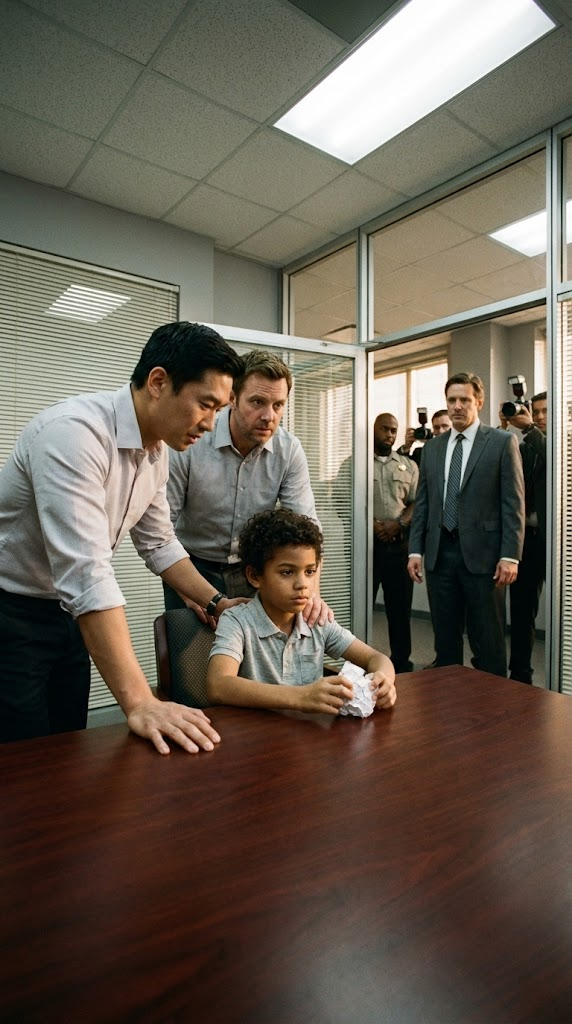
Marcus was drawing on a piece of scrap paper, oblivious to the tension crackling in the air. His social worker, Janet, kept glancing between us with an expression I couldn’t read. My husband Tom squeezed my hand so hard it hurt.
We’d been trying to adopt Marcus for six months. Six months of home visits, background checks, and psychological evaluations. Six months of being told by well-meaning social workers that maybe we should consider an “easier” child. A younger one. One without Marcus’s “complications.”
But something about this kid had grabbed my heart from the moment I met him. Maybe it was the way he’d looked at me during our first supervised visit—like he was waiting for me to disappoint him, to leave like everyone else had. Maybe it was how he’d carefully shared half his sandwich with me even though I could see he was starving.
“What do you mean, ‘changes everything’?” Tom asked.
The attorney slid a thick manila folder across the table. “Three days ago, we received DNA test results that were part of a routine inquiry into Marcus’s background. The state requires these for adoption cases involving unknown parentage.”
My mouth went dry. “And?”
“Marcus isn’t who we thought he was.” She paused, choosing her words carefully. “His biological father was Richard Castellan.”
The name hit me like a freight train. Richard Castellan. The real estate mogul. The man whose face had been plastered across every news outlet six months ago when he died in a helicopter crash. The billionaire who’d left behind an empire and no known heirs.
“That’s impossible,” I whispered.
“The DNA match is conclusive. Ninety-nine point nine percent probability.” The attorney opened the folder, revealing documents that made my vision blur. “Richard Castellan had a brief relationship with Marcus’s mother nine years ago. She never told him about the pregnancy. When she died of an overdose three years ago, Marcus entered the foster system under her name only. No father listed.”
Janet leaned forward, her voice urgent. “There are already three law firms trying to contest the adoption proceedings. They represent distant relatives of Castellan’s—cousins, an ex-wife, business partners. If they can prove Marcus is the heir before your adoption is finalized…”
“They’ll fight for custody,” Tom finished, his face pale. “For control of the estate.”
“Exactly. Marcus is worth approximately 2.3 billion dollars.”
I looked at the boy—my boy, even though the papers weren’t signed yet. He’d stopped drawing and was watching us with those too-old eyes. Eyes that had seen his mother die. Eyes that had learned not to trust anyone.
The conference room door suddenly burst open. A man in an expensive suit strode in, flanked by two security guards. Behind them, I could see reporters in the hallway, cameras flashing.
“I’m Douglas Castellan, Richard’s first cousin,” the man announced. “And I’m here to stop this adoption. That boy is family. He belongs with blood.”
Marcus’s hand tightened around mine, his whole body going rigid. The battle had begun.
How We Found Marcus
Eighteen months earlier, Tom and I had made a decision that would change our lives. After years of failed fertility treatments and one devastating miscarriage, we’d decided to pursue adoption. Not a newborn, though—we wanted an older child. A kid who’d been overlooked. Someone who needed a family as much as we needed them.
Our caseworker had warned us it wouldn’t be easy. “Older kids come with trauma,” she’d said bluntly. “They test boundaries. They push you away because they’re waiting for you to leave. It takes patience, commitment, and a lot of love.”
“We have all three,” Tom had replied.
We met Marcus at a group foster home in Queens. He was seven then, small for his age, with watchful dark eyes and a habit of standing in corners where he could see all the exits. His file was thick—behavioral issues, difficulty bonding, aggressive tendencies. Three families had tried fostering him. All three had sent him back within weeks.
“He’s a runner,” the foster coordinator told us. “Soon as he feels uncomfortable, he bolts. We’ve found him at the subway station four times. Once he made it all the way to the Bronx before the police picked him up.”
“Where was he trying to go?” I’d asked.
The coordinator had looked sad. “His old apartment. The one he lived in with his mother before she died. It’s been rented to someone else for two years, but he keeps trying to go back.”
That detail had broken something open in my chest. This kid wasn’t running away—he was running home. Or trying to, anyway. Trying to get back to the last place he’d felt safe, even though that place no longer existed.
Our first supervised visit was in a park. Marcus sat on a bench, refusing to look at us, his body language screaming that he wanted to be anywhere else. Tom tried talking to him about sports. Nothing. I tried asking about school. Silence.
Then I noticed him staring at my lunch—a turkey sandwich I’d brought from home.
“You hungry?” I asked.
He shrugged, which I was learning was Marcus-speak for “desperately but I won’t admit it.”
I held out half the sandwich. “Want some?”
He took it carefully, like he expected me to snatch it back. Then he did something that made my eyes burn with tears. He broke his half in two and offered a piece back to me.
“Fair,” he said quietly. “You share with me, I share with you.”
That was the moment. That was when I knew this kid was ours.
The Battle Begins
The custody hearing arrived like an execution date. Tom and I barely slept the night before. We’d spent hours with our attorney, reviewing every detail of our case. Our financial stability. Our home evaluation reports. The bonding documentation from supervised visits. Character references from friends, employers, Marcus’s teachers.
“You have a strong case,” our attorney assured us. “You’ve done everything right. But Douglas Castellan has money and influence. He’ll come at you hard.”
She wasn’t exaggerating.
The courtroom was packed. Douglas sat at the plaintiff’s table with three attorneys, all wearing suits that probably cost more than our car. Behind them, I recognized faces from news articles—members of the Castellan family, various hangers-on, people who’d suddenly discovered they cared deeply about Richard Castellan’s long-lost son.
Marcus sat between Tom and me, wearing the new button-down shirt we’d bought him. His leg bounced nervously, and I could feel the tension radiating off him in waves.
Judge Morrison entered—a woman in her sixties with steel-gray hair and an expression that gave nothing away. She reviewed the files in silence for what felt like hours.
“This is an unusual case,” she finally said. “We have a minor child with newly discovered biological relatives seeking custody, and prospective adoptive parents who initiated proceedings before the child’s parentage was known. Mr. Castellan, you may present your case.”
Douglas’s lead attorney stood—a silver-haired man named Whitmore who looked like he ate opposing counsel for breakfast. “Your Honor, this case is simple. Marcus is a Castellan. He has a large, loving family eager to welcome him. These men”—he gestured dismissively at Tom and me—”are strangers who have known the boy for mere months. Blood matters. Family matters. And the Castellans can provide opportunities and resources that two middle-class men simply cannot match.”
“Objection,” our attorney said. “Counsel is making assumptions about—”
“Sustained,” Judge Morrison said. “Mr. Whitmore, stick to facts.”
“Of course, Your Honor. The facts are these: Douglas Castellan is Marcus’s first cousin once removed. He has a six-bedroom home in Connecticut, a spotless record, and the means to provide the best education money can buy. He’s married with two children of his own—Marcus would have siblings, cousins, an entire family structure.”
Whitmore pulled up photos on a screen—Douglas’s sprawling estate, his smiling wife and kids, professionally shot images that looked like they came from a magazine spread. “This is what we’re offering Marcus. Stability. Legacy. His birthright.”
Our attorney stood. “Your Honor, may I cross-examine Mr. Castellan?”
“Proceed.”
She walked toward Douglas with a predatory grace I hadn’t seen before. “Mr. Castellan, when did you first learn of Marcus’s existence?”
“Four days ago, when my attorney informed me of the DNA results.”
“And in the three years since Marcus entered the foster system, how many times did you or any member of the Castellan family inquire about potential unknown heirs to Richard’s estate?”
Douglas shifted. “We had no reason to believe—”
“That’s not what I asked. How many times?”
“None.”
“So for three years, while Marcus was moved through seven different foster homes, while he was sleeping in crowded shelters, while he was being labeled ‘unadoptable,’ your family made zero effort to find him?”
“We didn’t know he existed!”
“Richard Castellan died six months ago. His estate has been in probate since then. Surely extensive searches were conducted for potential heirs?”
Whitmore objected. “Your Honor, the complexity of estate law—”
“I’ll allow it,” Judge Morrison said. “Answer the question, Mr. Castellan.”
Douglas’s jaw tightened. “The estate attorneys conducted standard searches. Nothing indicated Richard had children.”
“Because Marcus’s mother never listed a father. She was a struggling addict who died alone. Not exactly the kind of connection your private investigators would prioritize, is it?”
“That’s not fair—”
“What’s not fair,” our attorney shot back, “is that you ignored this child’s existence until you learned he was worth billions. You didn’t want him when he was just another foster kid with trauma and behavioral issues. You want him now because he’s an asset.”
The courtroom erupted. Reporters scribbled frantically. Judge Morrison banged her gavel. “Order!”
Our attorney returned to our table, and I saw the slight nod she gave us. Round one to our side.
But Whitmore wasn’t finished. He called a parade of witnesses—child psychologists who testified about the importance of biological family connections, financial experts who detailed the resources the Castellans could provide, even a private school headmaster who’d already offered Marcus a scholarship.
“This child deserves the very best,” Whitmore argued. “The Chens, while well-meaning, simply cannot compete with what we’re offering. They’re a high school guidance counselor and a freelance graphic designer. Marcus is destined for greatness. He needs a family that can match that destiny.”
When it was our turn, our attorney called Marcus’s social worker.
Janet took the stand with visible nervousness. “I’ve been Marcus’s caseworker for two years. I’ve overseen every foster placement, every home visit, every attempt at finding him a permanent family.”
“In your professional opinion, what does Marcus need most?”
Janet didn’t hesitate. “Stability. Consistency. Someone who sees him as a person, not a project. Marcus has been abandoned too many times. What he needs is someone who won’t leave, no matter how hard he pushes them away.”
“And in your observations, who provides that?”
“James and Tom Chen. I’ve watched them with Marcus over the past months. I’ve seen how patient they are when he has meltdowns. How they show up to every visit, even when he ignores them. How they’ve learned his triggers, his fears, what makes him feel safe.” Janet’s voice grew thick with emotion. “Those men love that boy. Not because of who his father was. Because of who he is.”
Our attorney then called Marcus’s therapist, who testified about the progress Marcus had made since beginning visits with us. His reduction in nightmares. His improved behavior at school. The way he’d started talking about “when I live with my dads” instead of “if.”
Then came the character witnesses. My principal, who talked about my decade of working with troubled teens. Tom’s former cancer patients, who drove in from as far as Boston to testify about his compassion and dedication. Our neighbors, who described how we’d spent months baby-proofing our apartment even before the adoption was approved.
But the most powerful moment came when Judge Morrison asked if Marcus wanted to speak.
The courtroom went silent. Marcus’s hand gripped mine so tightly I lost feeling in my fingers. Our attorney had warned us this might happen—judges sometimes interviewed children in chambers, but Marcus had asked to speak publicly.
“I’ll allow it,” Judge Morrison said gently. “But Marcus, you don’t have to if you don’t want to.”
Marcus stood up. He was shaking, his face pale, but he walked to the witness stand with his shoulders back. Tom and I exchanged terrified glances.
Judge Morrison smiled at him—the first warm expression I’d seen from her. “Hi, Marcus. I know this is scary. You can stop anytime, okay?”
He nodded.
“Can you tell me, in your own words, what you want?”
Marcus’s voice was quiet but steady. “I want James and Tom.”
“Why?”
“Because…” He swallowed hard. “Because when I had a nightmare and punched a hole in their wall during a visit, James didn’t get mad. He just asked if I was okay. Because when I stole food from their kitchen and hid it in my backpack—because I was scared there wouldn’t be food later—Tom didn’t yell. He just started packing extra snacks for me.”
Tears were streaming down my face. Tom wasn’t even trying to hide his.
“Because they’re teaching me to cook. And they let me pick the paint color for my room—my room, not a foster room, mine. And James reads to me every night, even though I’m too old for that. And Tom is teaching me to draw, and he’s really bad at it, which makes it more fun.”
A ripple of laughter went through the courtroom.
“And I know…” Marcus’s voice cracked. “I know I’m supposed to want the big house and the money and the family with the same blood. But James and Tom wanted me when I was nobody. They wanted me when I was just the weird kid nobody else wanted. That matters more than blood.”
He looked directly at Douglas. “You didn’t want me before. You don’t really want me now. You just don’t want them to have the money.”
Judge Morrison’s expression remained neutral, but I saw something flicker in her eyes. “Thank you, Marcus. That was very brave. You can sit down now.”
As Marcus returned to his seat, Douglas leaned over to whisper furiously to his attorney. Whitmore stood immediately. “Your Honor, the child has been coached—”
“Careful, counselor,” Judge Morrison warned. “That’s a serious accusation.”
“I withdraw the statement. But Your Honor, a child cannot be expected to understand the complexities of his situation. He’s been manipulated by false promises and—”
“I’ve heard enough,” Judge Morrison said, her voice sharp. “We’ll take a thirty-minute recess while I review the documentation. Then I’ll render my decision.”
The Longest Thirty Minutes
We waited in a small room down the hall. Marcus sat curled up against Tom, exhausted from the emotional toll of testifying. I paced like a caged animal.
“You did so good, buddy,” Tom whispered into Marcus’s hair. “So, so good.”
“Did I mess it up?” Marcus asked. “When I said that thing about the money?”
“You didn’t mess up anything,” I assured him. “You told the truth.”
Our attorney sat reviewing notes, her expression unreadable. Finally, I couldn’t take it anymore. “What do you think?”
“I think… Marcus was extraordinary. And Judge Morrison is smart. She sees through the Castellans’ bullshit. But Douglas has resources and connections. This could go either way.”
Tom looked up, Marcus still tucked against his shoulder. “If we lose—”
“We’ll appeal,” our attorney said firmly. “This doesn’t end today, no matter what happens.”
But we all knew an appeal would take months, maybe years. And in that time, Marcus would be in Douglas’s custody, disappearing into a world of private schools and family pressure, learning to be a Castellan instead of just being a kid.
A knock at the door made us all jump. A court officer poked his head in. “Judge is ready.”
We filed back into the courtroom. The air felt thick, suffocating. Marcus held both our hands, standing between us like he could physically keep us together through sheer will.
Judge Morrison took her seat. Her face gave away nothing.
“This case,” she began, “represents a fundamental question about what family means. Is it blood? Resources? Legacy? Or is it something more intangible—love, commitment, presence?”
She looked at Douglas. “Mr. Castellan, you’ve presented a compelling case. Your family can indeed provide material advantages that few could match. But I’m troubled by the timing of your interest in Marcus. For three years, this child was available. For three years, he needed a family. Yet you only appeared when his value became apparent.”
Douglas started to object, but Whitmore put a hand on his arm.
“Mr. Chen, Mr. Chen,” she continued, looking at us. “Your case is equally compelling, but for different reasons. You sought out a child others had given up on. You committed to him when he was considered ‘difficult’ and ‘unadoptable.’ You’ve demonstrated patience, love, and consistency over months of supervised visits and evaluation.”
My heart was hammering so hard I thought I might pass out.
“I’ve reviewed the social worker reports, the therapist evaluations, the home studies. I’ve heard testimony from people who know all parties involved. And most importantly, I’ve heard from Marcus himself.”
She leaned forward, her gaze moving between us and Douglas. “In custody cases, we ask what’s in the best interest of the child. Not the estate. Not the biological family’s wishes. The child.”
A pause that felt like eternity.
“Marcus Castellan will remain in the custody of James Chen and Thomas Chen. The adoption proceedings will continue as originally planned. Mr. Douglas Castellan’s petition for custody is denied.”
The courtroom exploded. Reporters surged forward. Douglas was shouting something at his attorneys. But all I could hear was Marcus—sobbing against my chest, his small body shaking with relief.
“You’re ours,” I whispered into his hair. “You’re really ours.”
Judge Morrison banged her gavel repeatedly. “Order! I’m not finished.”
The room quieted.
“However,” she continued, “there is still the matter of Richard Castellan’s estate. That will be settled this afternoon in probate court. Whatever the outcome regarding inheritance, it will not affect this custody decision. Marcus’s home is with the Chens. That is final.”
She signed the documents with a flourish. “This adoption is approved. Congratulations, gentlemen. You have a son.”
The Will Reading
Four hours later, we sat in a different courtroom for the reading of Richard Castellan’s will. Douglas was there, his face purple with rage. Various other Castellan relatives filled the benches, all eyeing Marcus with expressions ranging from resentment to calculation.
Marcus sat between us, holding a new stuffed elephant Tom had bought him during our celebration lunch. “Whatever happens here doesn’t change anything,” I reminded him. “You’re our son now. The money doesn’t matter.”
But even as I said it, I felt the weight of the moment. 2.3 billion dollars. That kind of wealth could crush a child, or worse—make him a target for the rest of his life.
Richard Castellan’s estate attorney—a formidable woman named Patricia Greene—stood at the front. She was ancient, probably in her eighties, with sharp eyes that missed nothing.
“Before I read the primary will,” she began, “I need to address a sealed codicil that Richard Castellan added two weeks before his death.”
Douglas sat up straighter. The room buzzed with whispers.
“Richard was aware he might have a biological child. He’d been searching for the woman he’d had a relationship with nine years prior—Marcus’s mother, Elena Rodriguez. He’d recently learned she’d died and that a child matching the timeline had entered foster care in New York.”
My blood ran cold. “He knew,” I whispered.
Patricia continued, “Richard attempted to locate the child, but the foster system’s privacy regulations prevented him from accessing records without proof of paternity. He died before he could complete DNA testing.”
She opened the sealed codicil, her voice taking on a formal tone. “Richard Castellan’s will contains very specific instructions regarding any biological children discovered after his death. I quote: ‘If genetic testing reveals I have a biological child, that child shall inherit my entire estate, with the following non-negotiable condition: Said child must be in the permanent custody of individuals who initiated adoption proceedings before my death and without knowledge of the child’s connection to me.'”
The room went silent.
“‘This condition exists,'” Patricia read, “‘because I was raised in wealth and saw how it corrupted my family. I saw cousins fight over scraps of inheritance. I saw children valued only for their last name. If my child exists, I want them raised by people who wanted them for themselves, not for my money. If this condition cannot be met—if my child is claimed by relatives seeking control of my wealth—then my entire estate shall be liquidated and donated to organizations supporting foster children and at-risk youth.'”
Douglas exploded from his seat. “That’s insane! He can’t—”
“He can and he did,” Patricia said coolly. “The will is ironclad. I helped him write it. Now, let’s review the facts. James and Thomas Chen filed adoption papers for Marcus eight months ago—two months before Richard’s death. They had no knowledge of Marcus’s paternity. Therefore, the condition is met.”
She turned to us. “Gentlemen, Marcus Castellan is the sole heir to the Castellan estate. You, as his legal guardians, will oversee the inheritance until he reaches age eighteen. At that time, he may choose to claim it or donate it as he sees fit.”
I felt like the floor had dropped out from under me. Tom looked equally stunned. Marcus just seemed confused, clutching his elephant.
Douglas was screaming now. “This is fraud! They must have known! They—”
“Mr. Castellan,” Patricia interrupted, “if you’re suggesting the Chens somehow learned about Marcus’s paternity eight months ago, when even our private investigators couldn’t confirm it until this week, you’re welcome to prove it. Otherwise, I suggest you accept reality. Richard didn’t want his son raised by people who valued money over the child. You’ve proven him right.”
She gathered her documents. “The estate will be transferred to a trust with the Chens as trustees. Congratulations. And Marcus, when you’re old enough to understand all this, know that your father loved you enough to protect you from vultures—even if he never got to meet you.”
One Year Later
Marcus—Marcus Chen now, officially—sat at our kitchen table doing homework. He’d grown three inches, put on healthy weight, and his thousand-yard stare had been replaced by something that looked almost like childhood. He still had nightmares sometimes. Still tested boundaries. Still asked, occasionally, if we were going to send him back.
But mostly, he was just a nine-year-old kid who complained about math homework and begged for extra screen time.
The money sat in trust, earning interest. We’d used some to hire excellent therapists for Marcus, to fund his education, to secure his future. But we still lived in the same apartment, still worked the same jobs. The wealth hadn’t changed us because we’d never wanted it in the first place.
“Dad?” Marcus called out. He’d started calling us Dad and Papa about six months ago—Dad for me, Papa for Tom.
“Yeah, buddy?”
“Can we get pizza tonight? With the works?”
I smiled. “Sure. But you’re eating vegetables too.”
“Deal.”
Tom came in from his studio, paint-splattered and grinning. “Marcus, want to see the new piece I’m working on?”
Marcus jumped up, homework forgotten. As they disappeared into Tom’s studio, I heard Marcus laughing—a sound that had been rare for so long, now becoming wonderfully ordinary.
My phone buzzed. A text from Janet, Marcus’s old social worker: “Saw the article about the Castellan trust funding a new foster care reform initiative. Tell Marcus his dad would be proud. Tell him I’m proud. You too.”
I looked at the framed photo on our fridge—the three of us at Marcus’s official adoption ceremony, all grinning like fools. Marcus was making bunny ears behind Tom’s head. It was perfect.
The kid nobody wanted had become the kid who had everything—not because of billions in a trust account, but because he had something money couldn’t buy. He had us. And we had him.
That, in the end, was the only inheritance that mattered.