THE RED MIST
I was laying on my horn so hard I thought the plastic casing of the steering wheel would crack under the pressure of my thumbs.
“MOVE!” I screamed, the sound raw and ugly in the enclosed space of my Audi. I slammed my hand against the dashboard. My travel mug jumped in the cup holder, splashing scalding black coffee onto my thigh. The pain was sharp, but it was nothing compared to the fire burning in my chest.
I was already twenty minutes late. This was it. The “final warning” meeting. My boss, Marcus—a man who tracked employee bathroom breaks on a spreadsheet and considered empathy a weakness—had made it clear: if I wasn’t in the boardroom by 9:00 AM sharp to present the quarterly logistics figures, I was done.
“Do not test me, David,” he had sneered yesterday. “You’re distracted. You’re sloppy. One more slip-up, and you’re out.”
My mortgage, my alimony payments to Sarah, my daughter’s private school tuition—my entire life hung in the balance of this commute. And I was stuck behind a beige 1998 Toyota Camry doing fifteen miles per hour in a forty-five zone.
The driver was oblivious. No brake lights, no turn signal, just a slow, agonizing, meandering drift down the center of the winding two-lane highway. There was no passing lane here. The trees blurred past in a mockery of speed while I crawled. Behind me, a line of six cars had formed, a symphony of angry horns joining mine in a chaotic, dissonant chorus.
Then, the unthinkable happened. The Camry didn’t just drive slow; it stopped.
Dead center. In the middle of the road.
I snapped. The stress of the last year—the divorce papers, the empty apartment, the crushing debt—it all exploded. I threw my car into park, unbuckled my seatbelt with a violent click, and kicked my door open.
I marched toward the beige car. I was going to scream at this person. I was going to unload every ounce of my frustration on them. I reached the driver’s side window, my face red, my veins bulging in my neck.
“Are you insane?” I roared, ready to pound on the glass. “People have lives! Move your—”
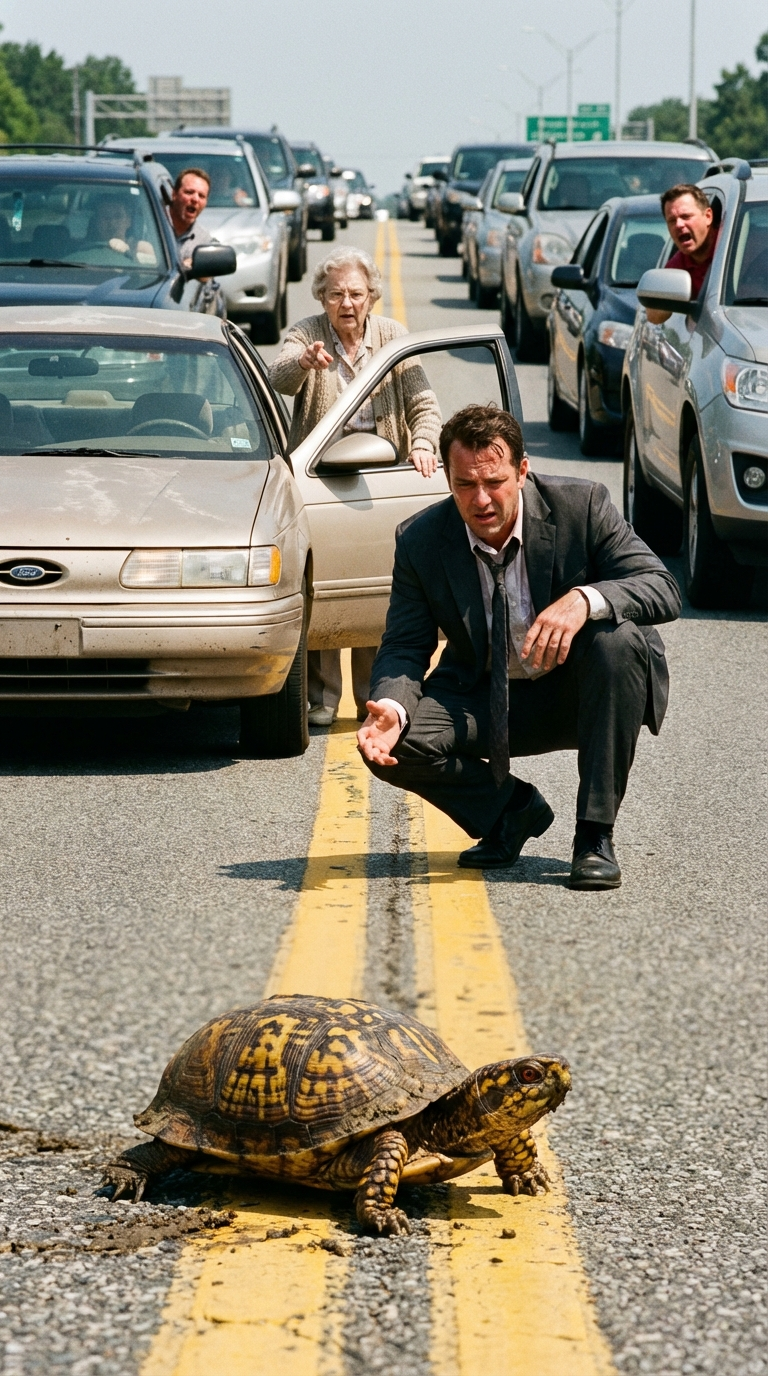
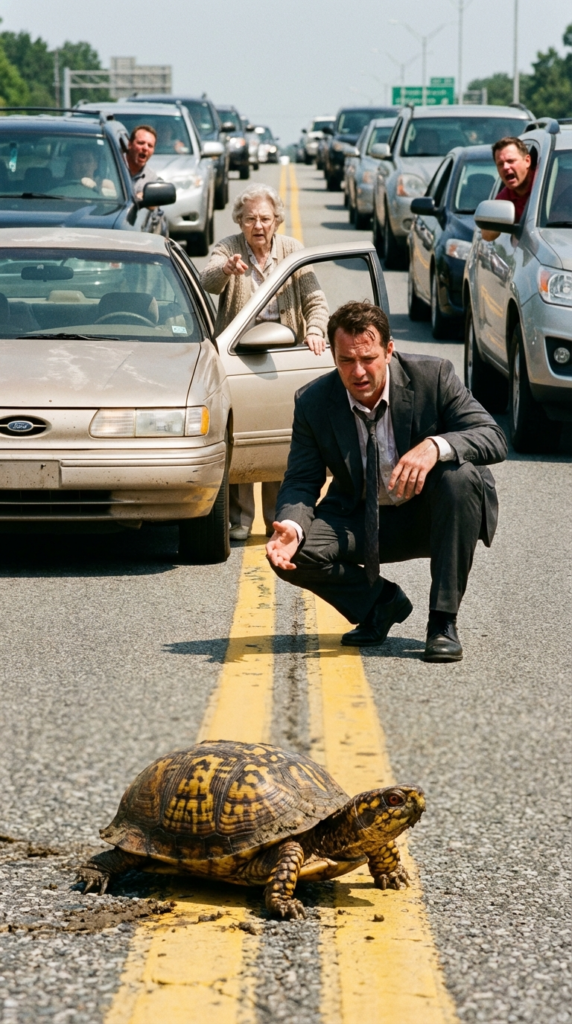
The driver’s door creaked open before I could finish. A tiny, trembling old woman stepped out. She wore a knitted cardigan that looked too warm for the weather. She didn’t even look at me. She wasn’t looking at the line of angry traffic. She was looking at the asphalt in front of her bumper.
She raised one shaking hand to silence me, and pointed down.
I looked. And all the anger, all the heat, all the noise… it just vanished.
There, inching across the double yellow line, completely terrified by the vibration of the idling engines, was a box turtle. It was no bigger than a hamburger, its shell scarred and muddy. It had tucked its head in, freezing in the face of the mechanical giants surrounding it.
The woman looked up at me. Her eyes were a piercing, watery blue, filled with a kindness that felt foreign to my world.
“I couldn’t run him over,” she whispered, her voice barely audible over the idling engines. “He’s trying so hard to get home. He’s just slow. Like me.”
THE COST OF VELOCITY
To understand why I was ready to assault a stranger over a traffic delay, you have to understand the velocity at which I was living.
I was a VP of Operations. My life was measured in nanoseconds and profit margins. I had optimized everything. I drank meal replacements because chewing took too long. I listened to audiobooks at 2.5x speed. I scheduled calls with my own daughter in fifteen-minute blocks.
Sarah left me because, as she put it, “You’re physically here, David, but your soul is always three meetings ahead.”
She was right. I was running a race that had no finish line. And now, facing the loss of the job that I had sacrificed my marriage for, I felt like a cornered animal.
Standing on that asphalt, looking at the turtle, I checked my watch. 8:52 AM.
If I got back in the car now and drove like a maniac, I might make it to the parking lot by 9:05. Maybe Marcus would be late. Maybe I could salvage it.
“Sir?” the woman asked. She looked helpless. She couldn’t bend down. “Could you…?”
I looked at her. I looked at the turtle. I looked at my watch.
Inside my head, a war raged. Leave it, the voice of my ambition screamed. Drive around. Let someone else deal with it. You have to survive.
But then I looked at the woman’s hands. They were arthritic, gnarled like old tree roots. She reminded me of my grandmother, who used to tell me that character is what you do when nobody is watching.
Well, ten people were watching from the cars behind us, honking and shouting obscenities.
“Get out of the road!” someone yelled from a pickup truck.
I made a choice. A stupid, career-ending choice.
“I got him,” I said.
I crouched down. I didn’t rush. I picked up the turtle. It was surprisingly heavy, cool to the touch. I walked it gently to the grassy embankment on the other side of the road, placing it near the tree line in the direction it was heading.
“Go on, buddy,” I whispered. “Stay off the road.”
I walked back. The old woman was beaming. She reached out and patted my arm. “Thank you. You’re a good man. You have a good heart.”
“I’m a late man,” I muttered, but I didn’t pull away. “You need to get moving, ma’am. It’s dangerous here.”
“I’m going,” she said. She climbed slowly back into her Camry.
I got back into my Audi. It was 8:56 AM.
I arrived at the office at 9:15 AM.
THE CRASH
I walked into the boardroom. The presentation was already up on the screen. Marcus stopped talking mid-sentence. He turned slowly to face me. The room was silent. My colleagues looked down at their notepads, terrified of the blast radius.
“Nice of you to join us, David,” Marcus said, his voice dangerously quiet. “Did you stop for a latte? Or was the traffic just too much for a VP to handle?”
“I…” I hesitated. How could I explain? Sorry, Marcus, I was moving a reptile. “I ran into an obstruction. Unavoidable.”
“Unavoidable,” Marcus mocked. “You know what else is unavoidable? The consequences I promised you.”
He pointed to the door. “Get out. Pack your desk. Security will escort you in ten minutes.”
“Marcus, please. I have the numbers right here. I—”
“Out!” he roared. “I need reliability, David! I need killers! I don’t need people who can’t manage a commute!”
I walked out. I packed my box. A picture of my daughter. A stapler. My nameplate.
I sat in my car in the parking garage for an hour. I didn’t cry. I just felt… hollow. I had lost the race. I was unemployed, divorced, and broke.
THE RIPPLE EFFECT
Three days later, I was sitting in a coffee shop, scanning job boards on my laptop. I was applying for junior positions, anything to pay the mortgage. My phone rang. Unknown number.
“Hello?”
“Is this the young man who likes turtles?” a voice crackled.
I froze. It was her. The woman from the road.
“How… how did you get this number?”
“I wrote down your license plate,” she said. “I have a nephew in the DMV. I can be quite resourceful when I want to be. My name is Eleanor. Eleanor Vance.”
“Look, Eleanor,” I sighed, rubbing my temples. “I’m glad the turtle is safe. But because of that stop, I lost my job. I’m really not in the mood to chat.”
There was a silence on the line. Then, a sharp, authoritative tone I hadn’t heard before.
“You lost your job? Because you stopped for me?”
“Yes. My boss fired me for being fifteen minutes late.”
“I see,” Eleanor said. “Meet me at the Kensington Hotel downtown. One hour. Lobby.”
“I can’t afford the Kensington, Eleanor.”
“I didn’t ask you to buy it. Just be there.” Click.
I went. Mostly out of curiosity, partly because I had nothing else to do.
The Kensington was the most expensive hotel in the city. When I walked in, I expected to see Eleanor sitting in a corner with a cup of tea.
Instead, I was directed to the penthouse suite.
I knocked. The door opened. Eleanor wasn’t wearing a cardigan. She was wearing a sharp, tailored blazer. Standing next to her was a man I recognized from the covers of Forbes magazine.
“David,” Eleanor said, gesturing to the man. “This is my son, Robert. He’s the CEO of Vance Logistics.”
My jaw dropped. Vance Logistics was the biggest competitor to my old firm. They were the industry titans.
“Mom tells me you saved her day,” Robert said, extending a hand. “She has a soft spot for strays. And apparently, for executives with a conscience.”
“I…” I stammered. “I didn’t know.”
“My mother owns fifty-one percent of the voting shares in this company,” Robert smiled. “She’s retired, but she still has… opinions. She told me you were fired for being late because you were helping her.”
“That’s right,” I said, standing a little taller.
“Marcus stopped by our office yesterday,” Eleanor interjected, sipping her tea. “He was trying to poach a contract. I asked him about his former VP. He laughed and said you were ‘soft.’ That you lacked the ‘killer instinct.'”
She looked me dead in the eye.
“I don’t want killers running my company, David. I want humans. I want people who understand that sometimes, the small things are the big things. If you’ll stop for a turtle when your life is on the line, I know you’ll take care of my employees when times get tough.”
Robert slid a contract across the coffee table.
“Senior VP of Strategy,” Robert said. “Starting salary is twenty percent higher than what Marcus was paying you. And we have a strict ‘no meetings before 9:30 AM’ policy. Mom insists on it.”
THE SLOW LANE
I took the job.
Six months later, Vance Logistics acquired my old company. It was a hostile takeover.
I walked into the boardroom—the same one I had been kicked out of. Marcus was sitting at the head of the table, sweating. When he saw me walk in, not as an applicant, but as his new boss, all the color drained from his face.
“David,” he choked out. “I… I hope there are no hard feelings. It was just business.”
I placed my folder on the table. I looked at him, then I looked at my watch.
“You’re right, Marcus. It is business. But here at Vance, we value… pace.”
I didn’t fire him. That would have been too easy. I demoted him to data entry. He now tracks bathroom breaks for himself.
I still drive that road every day. I don’t honk anymore. I leave twenty minutes early. And every now and then, I look for the slow movers, the ones struggling to cross the dangerous parts of life.
And I stop. Because you never know when a small act of kindness is actually a job interview for the rest of your life.