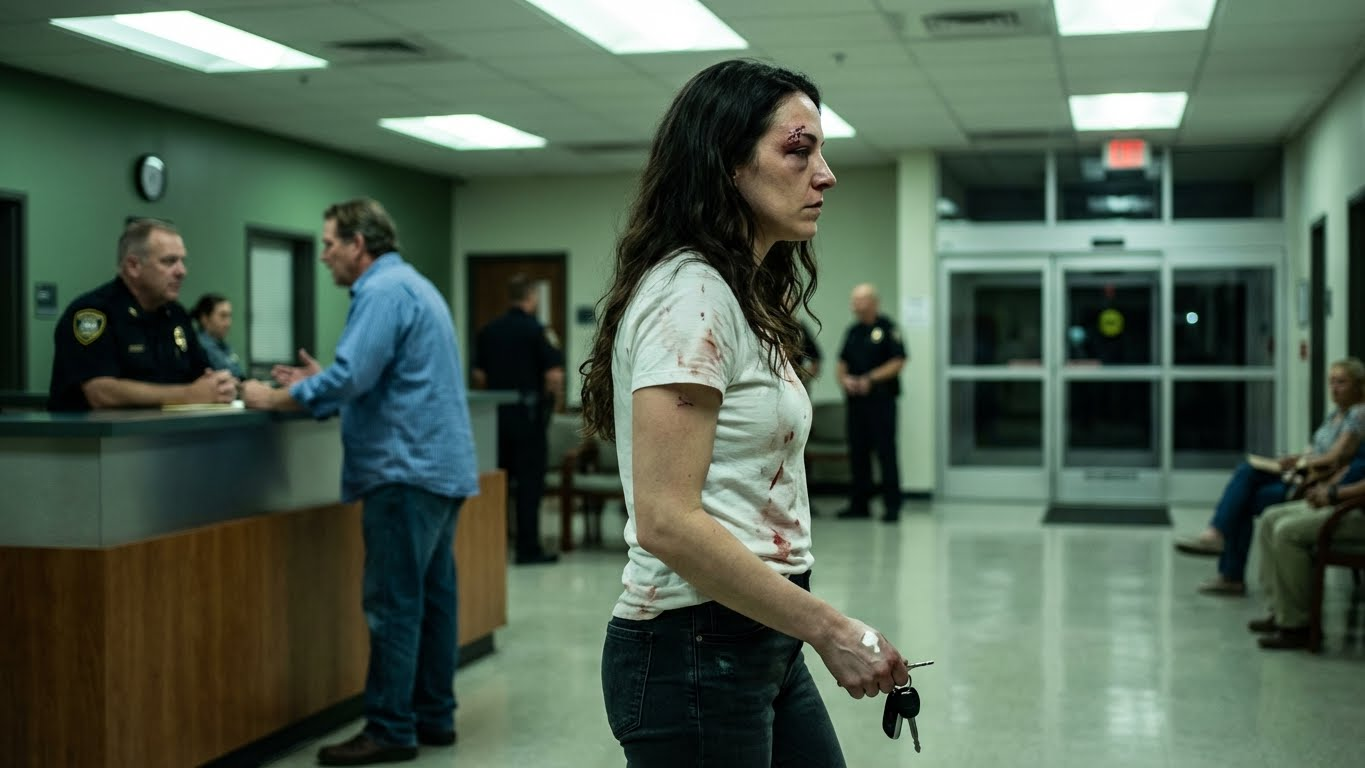
I stood in the fluorescent-lit lobby of the 14th Precinct police station at 9:47 PM on a Tuesday, my car keys gripped so tightly in my hand they were leaving deep red marks in my palm, watching my husband of nine years beg the desk sergeant to let his mother out of holding.
“She didn’t mean it,” Marcus was saying, his voice cracking with desperation. “My wife is overreacting. She always overreacts. My mother would never intentionally hurt anyone. She’s a good person. She goes to church every Sunday. She volunteers at—”
“Sir,” the desk sergeant interrupted, his patience clearly wearing thin. “Your mother assaulted your wife. We have photographic evidence, witness statements, and a 911 call. That’s a felony. I can’t just let her go.”
I felt every eye in that station turn to me. The other officers pretending to work at their computers. The people sitting on hard plastic chairs waiting to file reports. A woman with a black eye and a split lip who gave me a small, knowing nod of solidarity.
Marcus spun around, his face red and blotchy from crying, his designer shirt wrinkled and untucked. “Sarah, please. Please. Just tell them you don’t want to press charges. She’s seventy-two years old. Do you really want to send an elderly woman to jail? What kind of person does that?”
I’d heard those words before. Different variations, same meaning, repeated like a prayer for nine years of marriage.
She didn’t mean it. She’s just old-fashioned. She’s from a different generation. She loves you in her own way. You’re too sensitive. Can’t you just let it go? Why do you always have to make everything so difficult? Why can’t you just be the bigger person?
My left eye was swelling shut. I could feel the pressure building, my vision narrowing. The ER doctor who’d examined me an hour earlier had said I’d need six stitches above my eyebrow where Linda’s three-carat diamond ring had split the skin. My ribs ached with every breath—bruised, possibly fractured. My throat still burned from where her manicured fingers had dug into my windpipe, leaving angry purple marks the officers had photographed for evidence.
But Marcus wasn’t looking at my injuries. He wasn’t seeing the blood that had soaked through my shirt. He wasn’t acknowledging that I was standing in a police station at nearly 10 PM because his mother had tried to kill me in my own kitchen.
He was looking at me like I was the villain in this story.
“Your mother tried to kill me,” I said quietly, my voice hoarse.
“She was upset! She was emotional! You provoked her, Sarah! You know how she gets when you disrespect her!”
That’s when something inside me snapped. Not like glass breaking—like chains falling off. Like a door I’d been pushing against for years suddenly swinging open.
I looked directly at the desk sergeant. “I want to press full charges. Assault with a deadly weapon, battery, attempted murder if applicable under state law.”
“Sarah!” Marcus lunged toward me. An officer I hadn’t noticed standing nearby stepped smoothly between us, one hand raised.
“Sir, stay back.”
“And I need to add something to my statement,” I continued, my voice growing steadier with each word. “My husband, Marcus Brennan, drove his mother to my house tonight knowing she had an active restraining order. He had a key to my house—a key I asked him to return after our divorce was finalized. He let her in. He watched her attack me. And when I managed to get to my phone, he tried to physically stop me from calling 911. I want all of that on record.”
The temperature in that police station lobby seemed to drop ten degrees.
Marcus’s face went from red to white in an instant. “You’re going to get me arrested? Are you insane?”
The desk sergeant was typing now, his expression professionally neutral. “Sir, if you knowingly helped someone violate a restraining order, provided access to a protected residence, and interfered with an emergency call, that’s criminal conspiracy, aiding and abetting, and obstruction. I’m going to need you to stay here while we sort this out. Officer Mills?”
A female officer approached. “Sir, please come with me.”
“What? No! Sarah, tell them! Tell them the truth! Tell them I was trying to help! I was trying to calm the situation down!”
I picked up my purse from the chair where I’d left it. I checked to make sure I had my phone, my wallet, my keys. Everything I needed.
I walked toward the glass exit doors. Behind me, I could hear Marcus shouting my name. Begging. Making promises I’d heard a thousand times before. Promises that had never, not once, been kept.
I’ll change. I’ll set boundaries with my mother. I’ll go to therapy. I’ll choose you. I’ll protect you. Just give me one more chance.
I pushed open the door and stepped into the cool October evening air. The door closed behind me, muffling his voice.
I walked to my car in the parking lot. I got in. I locked the doors.
And then I drove away.
I left my husband at the police station.

Let me take you back to the beginning. Because this story doesn’t start with blood and police stations. It starts with a ring and a promise and a woman in a white dress at my wedding.
I met Marcus Brennan when I was twenty-four. He was twenty-eight, charming, successful, everything a young woman thinks she wants. He worked in finance. He had an apartment in a nice neighborhood. He took me to restaurants I couldn’t pronounce.
He also had a mother who hated me on sight.
Linda Brennan came from money—the kind of old money that thinks new money is vulgar. The Brennan family had been in banking for four generations. They had a summer house in the Hamptons and a “winter residence” in Palm Beach. They attended charity galas and knew senators by their first names.
I was a second-grade teacher from a middle-class family in New Jersey. My father was a plumber. My mother was a nurse. We were good people, but we weren’t Brennan people.
At our engagement party, Linda pulled me aside. “You seem like a nice girl,” she said, her smile not reaching her eyes. “But you need to understand that Marcus has certain expectations. Certain standards. His future wife will need to fit into our world.”
I should have run. Instead, I tried harder.
Our wedding was at the country club Linda had chosen. The guest list was 80% people I’d never met—Marcus’s parents’ friends and business associates. Linda insisted on approving my dress. She rewrote our vows. And yes, she wore white.
Cream, technically. “It’s not the same as white,” she’d said when I’d gently suggested maybe another color. Marcus had taken her side. “It’s her son’s wedding. Let her wear what she wants. Don’t be petty.”
The first year of marriage, I tried to make it work. I attended Linda’s charity luncheons wearing clothes she’d bought me because mine weren’t “appropriate.” I smiled through her comments about my weight, my hair, my job, my family, my entire existence. I learned which fork to use for which course and how to make small talk with people who thought teachers were “sweet” but not “serious professionals.”
Marcus would tell me I was doing great. That his mother was “warming up” to me. That I just needed to give it time.
By year two, Linda had a key to our apartment. I never gave her a key. Marcus did. “She likes to drop off care packages,” he explained. “Isn’t that nice?”
Those care packages included notes about how I was keeping the apartment, what I should be cooking, articles about women who’d “let themselves go” after marriage.
I’d come home from work to find her rearranging our furniture. Our kitchen. Once, our bedroom. She’d gone through my dresser and replaced my “trashy” underwear with “classy” pieces she’d bought at some boutique.
When I told Marcus I felt violated, he said I was ungrateful.
Year three brought our first child—a son we named David, after my father. Linda cried when we told her. Not happy tears. Angry tears. She’d wanted us to name him Charles, after Marcus’s grandfather.
She refused to call him David. In her presence, he was “the baby” or “Charles.” She’d correct our son when he was old enough to speak, telling him his “real” name was Charles.
Marcus said she’d get over it. She never did.
Years four through six were a blur of boundary violations that Marcus always minimized. Linda showing up unannounced. Linda contradicting my parenting in front of our children. Linda telling David that “Mommy doesn’t know what she’s doing.”
I started therapy in year five. The therapist gently suggested I might be in an emotionally abusive situation. Not from Linda—from Marcus. Because Marcus was enabling her. Choosing her. Letting her destroy our marriage while he played referee and blamed me for not “trying harder.”
Year seven, we had our second child—a daughter I insisted on naming Emma, after my mother. Linda didn’t speak to me for three months.
Year eight, I found out Linda had been intercepting my mail. Bills, letters from my family, even my medical records. She had a mail forwarding set up from our address to hers. Marcus had helped her set it up because she “wanted to help with the bills.”
That’s when I filed for divorce.
Marcus was shocked. Genuinely shocked. “I can change,” he said. “I’ll set boundaries. I’ll choose you.”
We tried marriage counseling. Three sessions in, the therapist said to Marcus, “Your mother is destroying your marriage, and you’re handing her the tools.”
Marcus never went back. He said the therapist was biased against mothers-in-law.
The divorce took eighteen months. Linda hired Marcus’s lawyer. She testified against me in custody hearings, claiming I was mentally unstable. She brought up my therapy as evidence.
The judge saw through it. I got primary custody. Marcus got weekends. And I got a restraining order against Linda after she showed up at my new house at 2 AM, pounding on the door, screaming that I’d “stolen her grandbabies.”

The restraining order should have been the end of it. It wasn’t.
Linda violated it twice. Both times, Marcus bailed her out. Both times, he begged me to drop the charges. Both times, he said she “just missed the kids” and I was being cruel.
The third violation happened last Tuesday.
I was making dinner. David and Emma were doing homework at the kitchen table. It was a normal evening—until I heard the key turn in my lock.
I’d changed the locks after the restraining order. But Marcus still had a key to the new locks. I’d asked him to return it six times. He always “forgot.”
The door opened. Linda walked in. Marcus was right behind her.
“Grandma!” David jumped up, excited. He didn’t understand why he hadn’t seen her in months.
“My babies!” Linda swept past me like I didn’t exist.
“Linda, you need to leave,” I said, keeping my voice calm. “You’re violating a court order.”
“Oh, that silly piece of paper? Marcus explained that was all just a big misunderstanding. We’re family, Sarah. You can’t keep me from my grandchildren.”
I looked at Marcus. He wouldn’t meet my eyes. “I just thought… maybe if we all talked… we could work this out.”
“Get out. Both of you. Now.”
That’s when Linda’s mask dropped. “You poisonous little bitch. You’ve turned everyone against me. Destroyed my relationship with my son. Stolen my grandchildren. You’re nothing but a gold-digging whore who—”
“Mom!” Marcus tried to grab her arm.
She shoved him away. And then she came at me.
I’ve never been in a physical fight in my life. I didn’t know how to defend myself. She grabbed a cast iron skillet from the stove and swung it at my head. I ducked. It hit the cabinet behind me.
She came at me again, this time with her hands. Her nails raked across my face. Her ring split my eyebrow. I fell backward, hitting the counter. She was on top of me, her hands around my throat, screaming obscenities.
David was crying. Emma was screaming. And Marcus was yelling, “Mom, stop! Mom, please!”
But he wasn’t pulling her off me. He was just yelling.
I managed to kick her in the stomach. She fell back. I scrambled for my phone and dialed 911. Marcus tried to grab it from me. I ran to the bathroom and locked the door.
The 911 operator stayed on the line until police arrived. Eight minutes that felt like eight hours.
They arrested Linda at the scene. Marcus tried to convince the officers it was a “family dispute” and I was “being dramatic.” One officer took photos of my injuries. Another took statements from my terrified children.
They asked if I wanted to press charges. I said yes. They asked if Marcus had provided access to the house. I told them everything.
At the station, I gave my full statement. They had me examined by an ER doctor. Photos were taken from every angle. And then I was brought back to wait while they processed Linda.
That’s when Marcus showed up, expecting me to save his mother. Expecting me to back down. Expecting me to be the same woman who’d spent nine years making myself smaller so his mother could feel bigger.
But I wasn’t that woman anymore.
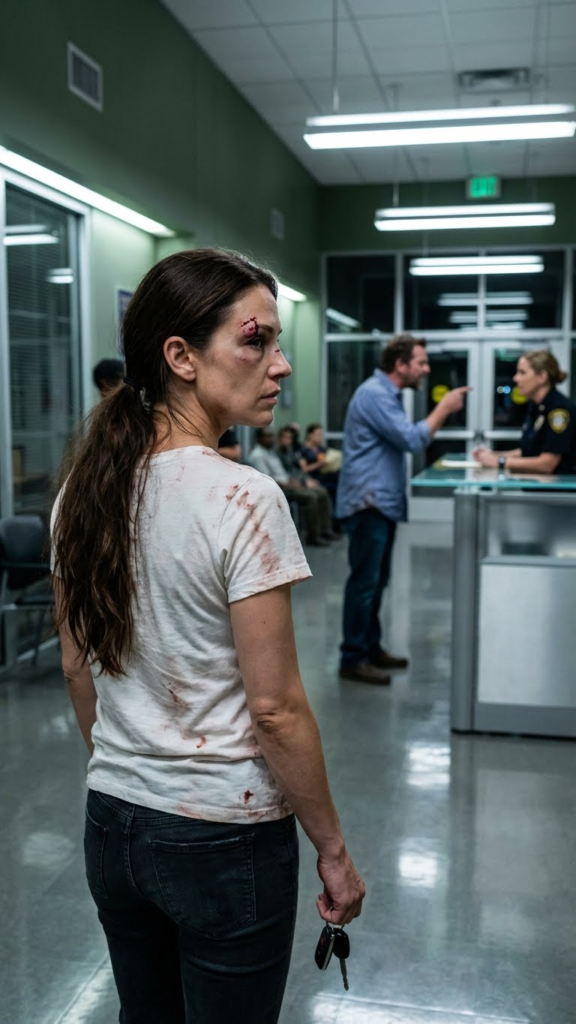
When I left that police station, I drove straight to my lawyer’s office. Yes, at 10 PM. I called her from the car and she met me there.
We filed for an emergency custody modification. We filed for a permanent restraining order with a wider radius. And we submitted everything—every police report, every medical photo, every text message from Marcus minimizing his mother’s behavior.
Marcus was arrested that night and charged with conspiracy and aiding and abetting. He bonded out the next morning. He called me sixty-three times. I didn’t answer.
Linda was held without bail. Given her previous violations and the severity of the assault, the judge deemed her a danger. Her trial is set for next month. The prosecutor told me she’s looking at three to five years.
Marcus’s family has disowned him. His father—who’d always been quiet and distant—called me to apologize. He said he’d failed to protect me from his wife, and he’d failed to raise his son to be a man who protects his family.
He’s filing for divorce from Linda. After forty years of marriage, he’s finally had enough.
It’s been three months since that night. My stitches healed. The bruises faded. My ribs still ache when it rains, but the doctor says that’s normal.
David and Emma are in therapy. They’re processing what they witnessed. They’re angry at their father. They’re confused about their grandmother. But they’re safe. That’s what matters.
Marcus has supervised visitation only. He shows up, but the kids don’t want to talk to him. He chose his mother over their safety. They understand that now.
He sent me a letter last week. Ten pages of apologies and explanations and promises. He’s in therapy now. He’s cut off his mother. He’s a changed man.
I didn’t read past the first page. I’ve heard it all before.
My lawyer tells me his defense strategy is to claim he was manipulated by Linda his entire life. That he’s a victim too. Maybe that’s true. But it doesn’t change what he did. It doesn’t change the nine years I spent begging him to choose me. It doesn’t change that when it mattered most, he opened the door and let his mother try to kill me.
People ask me if I regret leaving him at the police station. If I feel guilty about the charges. If I think I went too far.
I don’t.
Because the truth is, I didn’t leave him at the police station. I left him years ago—emotionally, mentally, spiritually. I left him every time he chose his mother over me. Every time he made me feel crazy for having boundaries. Every time he told me I was overreacting.
That night at the police station was just the moment I finally walked away physically.
There’s a quote I saw in my therapist’s office: “You can’t set yourself on fire to keep other people warm.”
For nine years, I was burning. And Marcus handed his mother the matches.
I learned that love isn’t supposed to hurt. Marriage isn’t supposed to be a battlefield. And if someone asks you to choose between your safety and their comfort, you choose yourself.
Every time.
I learned that “but she’s family” isn’t an excuse for abuse. That “she didn’t mean it” doesn’t matter when you’re covered in bruises. That “you’re overreacting” really means “your pain is inconvenient for me.”
I learned that leaving isn’t failure. Sometimes leaving is the bravest thing you can do.
And I learned that you can’t help someone who won’t help themselves. Marcus chose his mother. Again and again and again. Maybe he couldn’t help it. Maybe Linda’s manipulation ran so deep he couldn’t see it. Maybe he’s a victim too.
But I can’t save someone who’s drowning if they’re pulling me under with them.
So I let go.
My life now is quieter. Smaller in some ways, but bigger in the ways that matter. I wake up without dread. I don’t check my phone constantly wondering what Linda has done now. I don’t walk on eggshells in my own home.
David is doing well in school. Emma started dance classes. We eat dinner together every night. We laugh. We’re healing.
Sometimes they ask about their dad. I tell them the truth in age-appropriate ways: “Daddy made choices that weren’t safe for our family. We still love him, but we can’t be around him right now.”
Sometimes they ask about grandma. I tell them that grandma is sick—not the kind of sick where you get better with medicine, but the kind of sick in your heart that makes you hurt people you’re supposed to love.
They seem to understand.
Last week, David asked me, “Mom, are you happy?”
I thought about it. Really thought about it.
“Yeah, buddy,” I said. “I really am.”
And I meant it.
I left my husband at the police station. And in doing so, I found myself.