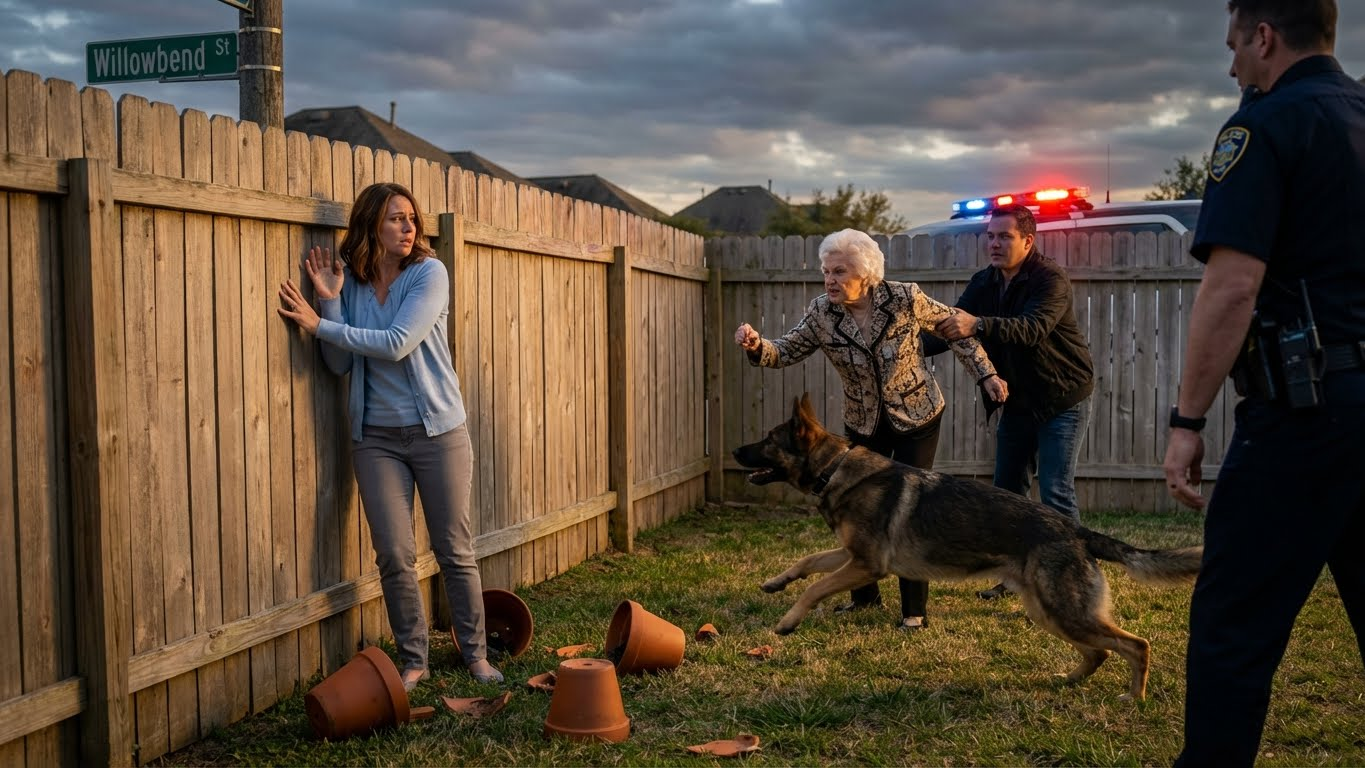
I was pressed against my own fence, my seventy-two-year-old mother-in-law screaming in my face, when I heard the sirens.
My hands were shaking. Not from fear—I’d been afraid of Linda for eight years. This was something else. This was rage mixed with the kind of clarity you only get when you’ve finally, finally had enough.
“You think you can keep my son from me?” she shrieked, her perfectly manicured nails clawing at my cardigan. “I’ll destroy you, you little—”
That’s when I saw the K-9 unit pull up on Willowbend Street.
I’d called 911 twenty minutes earlier when she showed up at my house—again—violating the restraining order for the third time in two weeks. But I didn’t tell the operator everything. I didn’t tell them she’d been sending my children letters telling them their mother was evil. I didn’t tell them about the fake CPS reports. I didn’t tell them she’d hired a private investigator to follow me to therapy.
I told them I feared for my life. Because I did.
My husband—ex-husband now—stood between us, his face twisted in that familiar expression. The one that said he was caught between his mommy and his wife. The one that had destroyed our marriage.
“Sarah, just apologize to her,” Marcus begged. “She didn’t mean—”
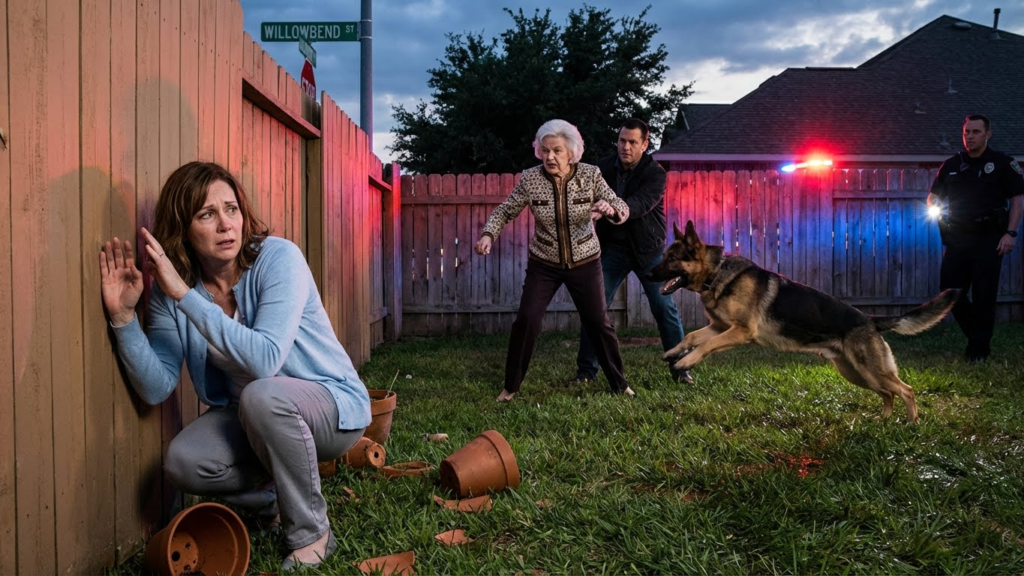
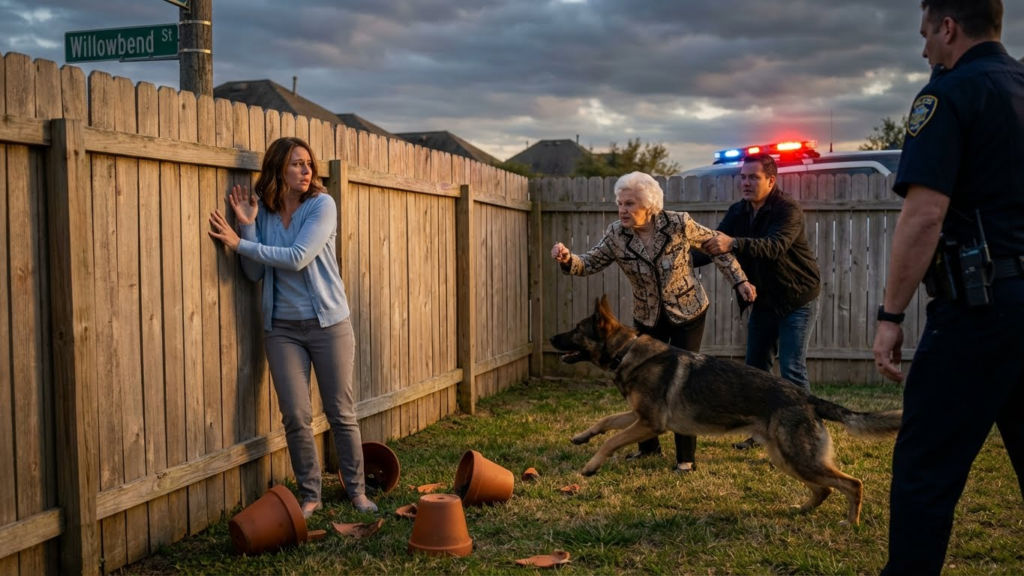
“She broke three flowerpots over my head, Marcus!” I screamed, terra cotta shards still scattered across my garden like evidence of a crime scene.
The German Shepherd was out of the car now. I could see the officer’s hand on its collar. Linda saw it too. Her eyes went wide.
“You called the police on me?” She looked at Marcus, genuine shock on her face. “Your wife called the police on your mother?”
“Ex-wife,” I said quietly.
That’s when she lunged.
Let me back up. Because this story doesn’t start with police dogs and broken flowerpots. It starts with a wedding where my mother-in-law wore white.
I should have known then. I should have seen the red flags waving like surrender banners. But I was twenty-six and in love, and Marcus promised me his mother would “come around.”
She never did.
Linda Hartwell came from old money. The kind of family that had a crest and a history of marrying within their social circle. I was a public school teacher from a middle-class family in Ohio. To Linda, I was the help who’d seduced her precious son.
The first year of marriage, I tried. God, I tried. I attended her charity luncheons. I wore the “appropriate” dresses she picked out. I smiled through her comments about my weight, my job, my family, my cooking, my decorating, my existence.
Marcus always defended her. “That’s just how she is. She means well.”
By year three, I’d had our first child—a daughter we named Emma. Linda cried when we told her the name. Not tears of joy. Tears of rage.
“That was supposed to be my name for my granddaughter,” she’d said. “We discussed this.”
We hadn’t. She’d told us she wanted us to name a girl Victoria. We’d politely declined.
Linda showed up at the hospital with a “Victoria” onesie. She’d taken photos with Emma and posted them on Facebook with the caption: “Welcome to the world, Baby Victoria! Grandma’s little princess!”
I made Marcus call her and demand she take it down. He did. Reluctantly. She cried. He apologized to her.
That became the pattern. Linda would cross a boundary. I’d be upset. Marcus would minimize it. I’d push back. He’d defend his mother. She’d play victim. He’d apologize to her. I’d be the villain.
By year five, Linda had keys to our house. I never gave her keys. Marcus did. “In case of emergencies,” he said.
She used those keys to let herself in while I was at work. I’d come home to find furniture rearranged, my kitchen reorganized, my children’s toys sorted by color instead of type because “that’s how they should be arranged.”
Once, I found her in my bedroom, going through my nightstand.
“I was looking for a hair tie,” she said, holding up a box of tampons like evidence.
I changed the locks. Marcus changed them back. “She’s my mother, Sarah.”
Year six brought the CPS reports. Anonymous calls claiming I was neglecting our children. They were baseless. The social worker even apologized after the second visit. But Linda’s goal wasn’t to have them taken away—it was to terrorize me.
I knew it was her. Marcus refused to believe it.
“My mother would never do that. You’re being paranoid.”
Year seven, I found the private investigator. A man in a gray sedan had been following me for weeks. I confronted him. He admitted Linda had hired him to “document my activities” for a potential custody case.
Custody case. I was married to her son. Living with my children. What custody case?
That’s when I learned the truth: Linda had been planning to convince Marcus to divorce me and claim I was an unfit mother. She had a lawyer. She had a timeline. She had plans.
I showed Marcus the evidence. He stared at it for a long time.
“She’s just worried about the kids,” he finally said.
I filed for divorce the next day.
The divorce was brutal. Linda funded Marcus’s legal team. They painted me as unstable, paranoid, a bad mother. They used my therapy records against me—therapy I’d started because of Linda.
But I had evidence too. Eight years of text messages. Emails. The private investigator’s confession. Witnesses who’d seen her harassment.
The judge granted me primary custody. Linda lost her mind.
She showed up at the kids’ school. She sent them gifts with notes saying “Mommy is keeping you from Grandma.” She created fake social media accounts to message my friends and family, claiming I’d brainwashed Marcus.
That’s when I got the restraining order. The judge granted it immediately after seeing the evidence.
Linda violated it within forty-eight hours.
She showed up at my house at 6 AM, pounding on the door, screaming that I was “poisoning her grandchildren against her.” The police came. She cried. She played the “confused elderly woman” card. They gave her a warning.
She violated it again three days later. This time at my work. She cornered me in the parking lot and told me she’d “make sure I never worked in this town again.”
I called the police. They arrested her. Marcus bailed her out within two hours.
“You’re ruining her life,” he texted me. “She’s an old woman. She’s not a criminal.”
The third violation happened two weeks later.
It was a Sunday evening. I was planting flowers in my side yard—trying to rebuild the garden Linda had destroyed during her second violation—when I heard the gate creak open.
I turned. Linda stood there, dressed like she was going to church, her face twisted into something I’d never seen before. Pure hatred.
“You took everything from me,” she said quietly.
“Linda, you need to leave. Now. You’re violating—”
“The restraining order!” she screamed. “Yes, I know! You’ve made sure everyone knows! You’ve humiliated me! Turned my son against me! Poisoned my grandchildren!”
“I didn’t do any of that. You did this to yourself.”
That’s when she picked up the flowerpot.
The first one hit me in the shoulder. The second grazed my head. The third shattered against the fence behind me.
I ran. She followed. I was faster, but she was driven by eight years of rage. I made it to my phone, dialed 911, and that’s when Marcus showed up.
Marcus. My ex-husband had driven his mother to my house. Waited in the car. Let her violate the restraining order.
“Sarah, please,” he said, trying to grab Linda. “Let’s all just calm down.”
“Calm down?” I was screaming now. “She’s assaulting me in my own yard! You brought her here!”
“She just wanted to talk!”
The dispatcher was still on the line. I told her I needed police immediately. I told her my attacker was violent. I told her I feared for my life.
And then I added: “The subject is elderly but extremely aggressive. She’s attacked me multiple times. Please send backup.”
That’s why they sent the K-9 unit.
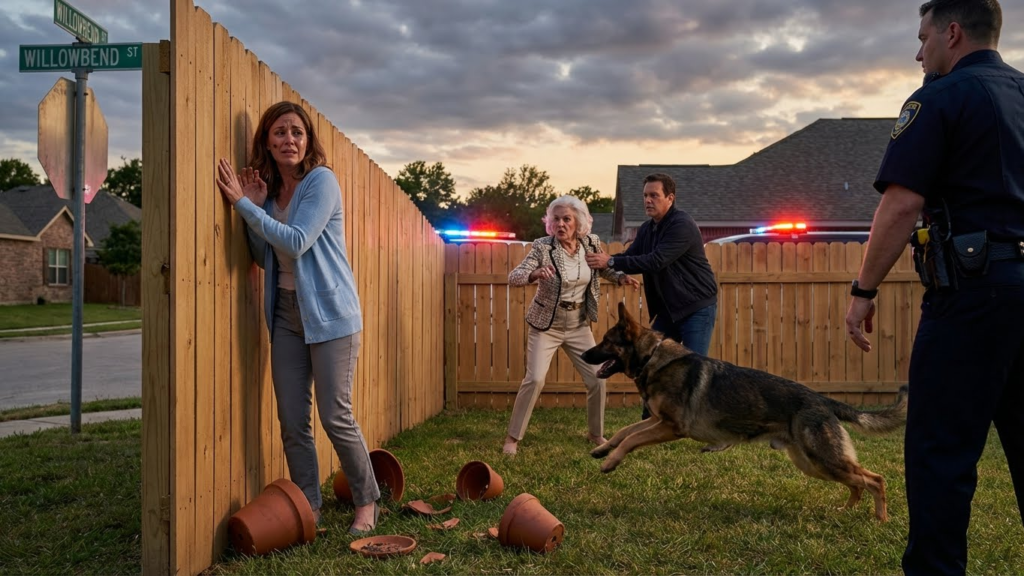
When Linda lunged at me with her hands around my throat, the police officer reacted instantly. He released the German Shepherd with a single command.
The dog didn’t attack. It did exactly what it was trained to do—it intimidated and subdued.
Linda went down hard. The dog stood over her, barking, while the officer pulled her hands behind her back and cuffed her.
Marcus was screaming. “She’s seventy-two years old! You’re letting a dog attack an elderly woman!”
“Sir, step back,” the second officer said, restraining Marcus against the fence.
I stood there, my throat bruised, my head bleeding from the flowerpot, and I watched.
I watched Linda—the woman who’d tormented me for eight years, who’d tried to destroy my life, who’d turned my marriage into a battlefield—being read her rights.
I watched Marcus—the man I’d loved, who’d chosen his mother over his wife every single time—realize his mother was going to jail.
The officer approached me. “Ma’am, do you need medical attention?”
“Yes,” I said. My voice was hoarse.
“We’re arresting her for assault, violating a restraining order, and criminal trespassing. Given this is her third violation, the judge likely won’t grant bail. Do you want to press charges?”
I looked at Marcus. He was crying.
“Please,” he begged. “She’s my mother. She didn’t mean—”
“Yes,” I interrupted. “I want to press full charges.”
Linda was denied bail. The prosecution argued she was a flight risk and a continued threat. Marcus spent his entire savings trying to get her out. It didn’t work.
The trial took six months. Linda’s lawyer painted me as vindictive, but the evidence was overwhelming. Eight years of harassment. Three restraining order violations. Assault caught on my neighbor’s ring camera. The private investigator’s testimony.
She was convicted of felony stalking, assault, and violating a court order. She received eighteen months in county jail and five years probation.
Marcus blamed me. His entire family blamed me. I was called every name imaginable on social media. “Monster.” “Cruel.” “Heartless.”
But my children were safe. I was safe.
Six months after the trial, Marcus’s sister reached out to me. She apologized. She told me she’d witnessed her mother’s behavior her entire life but had been too afraid to speak up. She told me she’d gone no-contact with Linda.
“You did what I should have done twenty years ago,” she said. “You stood up to her.”
A year later, Marcus filed for a restraining order against his own mother. She’d started harassing his new girlfriend.
He called me to apologize. I didn’t answer.
It’s been three years since that day in my side yard. Emma is ten now. Our son Jake is seven. They’re thriving. They’re happy. They don’t ask about Grandma Linda anymore.
I rebuilt my garden. Every spring, I plant new flowers in the exact spot where Linda broke those pots. It’s my way of reclaiming that space. Reclaiming my life.
People ask me if I regret calling the police. If I regret pressing charges against an elderly woman. If I regret “tearing apart a family.”
I don’t.
Because I didn’t tear anything apart. Linda did that herself, over eight years of psychological warfare, harassment, and abuse. I just finally refused to be her victim.
The restraining order wasn’t enough. The warnings weren’t enough. Sometimes, you have to let the system do its job. Sometimes, you have to let the K-9 unit handle it.
And sometimes, standing up for yourself means being called the villain by people who enabled your abuser.
I’m okay with that.
My children are safe. I’m safe. And my garden has never looked better.