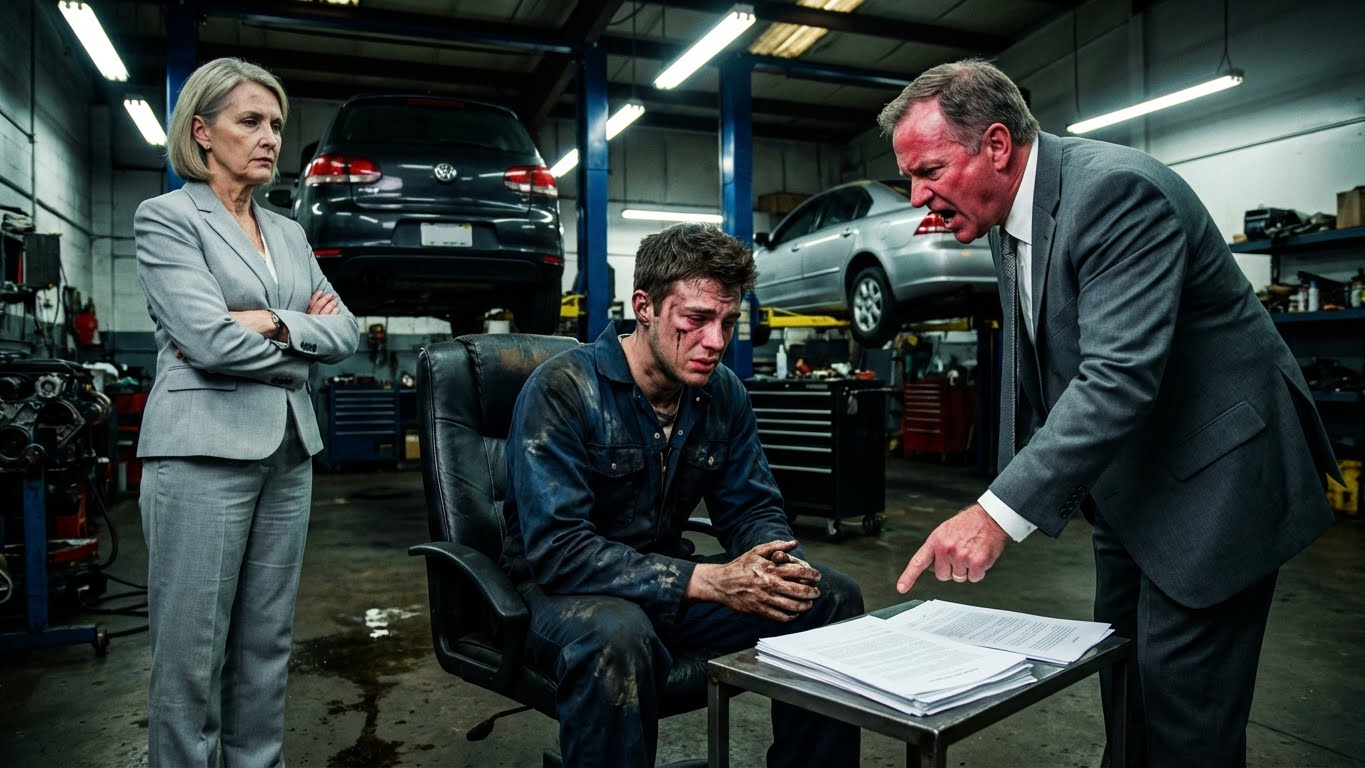
My hands were shaking so badly I could barely hold the pen. Black grease and motor oil stained my fingers—I’d been lying under Mrs. Patterson’s Honda Civic for the past six hours, replacing her entire exhaust system, when I heard the garage door chime.
I rolled out from under the lift expecting a customer.
Instead, I found my parents standing in my garage, my father in an expensive gray suit and my mother in her church clothes, both looking at me like I was something stuck to the bottom of their shoes.
“We need to talk,” my father said, his voice flat and emotionless. “Now.”
I stood up, wiping my hands on my already-filthy coveralls. “I’m working, Dad. Can this wait until—”
“No.” He walked past me to my small office in the back, my mother following silently behind him like a shadow. “Come here. Sit down.”
Something in his tone made my stomach drop. I followed them into my cramped office—barely more than a desk, a filing cabinet, and two folding chairs in a corner of the garage I’d converted into an administrative space.
My father pulled a thick stack of papers from his briefcase and dropped them on the desk with a heavy thud.
“Sign these,” he said simply, sliding them toward me along with an expensive-looking fountain pen.
“What are they?” I asked, not touching them.
“Business documents. Legal transfers. Things that need your signature.” His eyes were cold, calculating. “Just sign them. All of them. Every page that’s marked with a tab.”
I picked up the papers with trembling hands. My eyes were already burning—something about the way he was looking at me, the tone in his voice, made tears start forming before I even knew why.
The words on the first page swam in my vision: “Transfer of Business Ownership and Assets.”
“What is this?” I whispered, flipping through the pages. “Transfer of Ownership? Dad, what are you—”
“Just sign it, son.” His voice was still cold, mechanical, like he was discussing a business transaction with a stranger. “It’s time you understood how the real world works.”
I kept reading, my horror growing with each page. Transfer of the garage. Relinquishment of all inheritance rights from my grandfather’s estate. Acknowledgment of debt owed to Richard Morrison (my father). Assignment of business profits and assets.
This wasn’t just paperwork. This was my entire life being stripped away, documented in legal language, ready to be made official with my signature.
“I built this garage,” I said, my voice barely above a whisper. “This is mine. I—”
“You built it with MY money!” my father exploded, slamming his fist on the desk and making me jump. “That makes it MINE! You’re just the labor! And frankly, you’re not even good at that!”
The words hit me like a punch to the gut. Not because they were true—they weren’t—but because this was my father, the man who was supposed to protect me, support me, believe in me.
“You didn’t give me any money,” I said quietly, tears now streaming down my face, leaving clean tracks through the grease and grime on my cheeks. “I took out loans. I worked three jobs. I slept here for eight months because I couldn’t afford rent anywhere else. You didn’t—”
“DON’T YOU DARE LIE TO ME!” His face was purple now, veins standing out on his forehead. “I gave you the startup capital! Twenty thousand dollars! You’d be NOTHING without me!”
My mother finally spoke, her voice quiet but firm. “Marcus, your father is right. He invested in you, and now it’s time to pay him back. This is just… formalizing the arrangement. Making it legal.”
I stared at her in disbelief. “Mom, he’s lying. He never gave me anything. I have bank statements, loan documents, everything is in my name—”
“You’re being dramatic,” she interrupted, crossing her arms in that familiar gesture of disapproval I’d seen my entire life. “Your father knows what’s best for this family. This is for your own good.”
“How is stealing my business for my own good?” My voice cracked. I hated how weak I sounded, how young and pathetic.
My father leaned across the desk, his face inches from mine. I could smell coffee and cologne and something darker underneath—rage, maybe, or contempt.
“Stealing?” he hissed. “I’m SAVING you from yourself. You’re twenty-three years old. You have no idea how to run a business. You’re going to crash and burn, and when you do, you’ll drag our family name down with you. So I’m taking control before that happens.”
“This place is profitable!” I protested. “I have customers, good reviews, I’m booked out three weeks in advance—”
“For NOW,” he snapped. “But how long will that last? You’re a kid playing businessman. I’m offering you a way out before you embarrass yourself—and us—further.”
“A way out?” I looked down at the papers again, really reading them this time. “These say you get full ownership. That I’ll work here as an employee. That I owe you money I never borrowed. This isn’t a way out, this is—”
“This is reality,” my mother said sharply. “Sign the papers, Marcus. Stop being difficult. You’re making this harder than it needs to be.”
I looked at their faces—my father’s twisted with anger and something that looked almost like satisfaction, my mother’s set in cold disapproval—and I didn’t recognize either of them.
That’s when I saw it.
Buried on page seven, in small text at the bottom of a dense legal paragraph, was a clause that made my blood run cold.
“Transfer of beneficiary rights to the Morrison Family Trust, established by Gerald Morrison (deceased), to be reallocated from Marcus James Morrison (grandson) to Richard Morrison (son) upon execution of this agreement.”
My grandfather’s trust. The inheritance he’d left me—not my father, but ME specifically—in his will.
This wasn’t about the garage at all.
This was about my grandfather’s money.
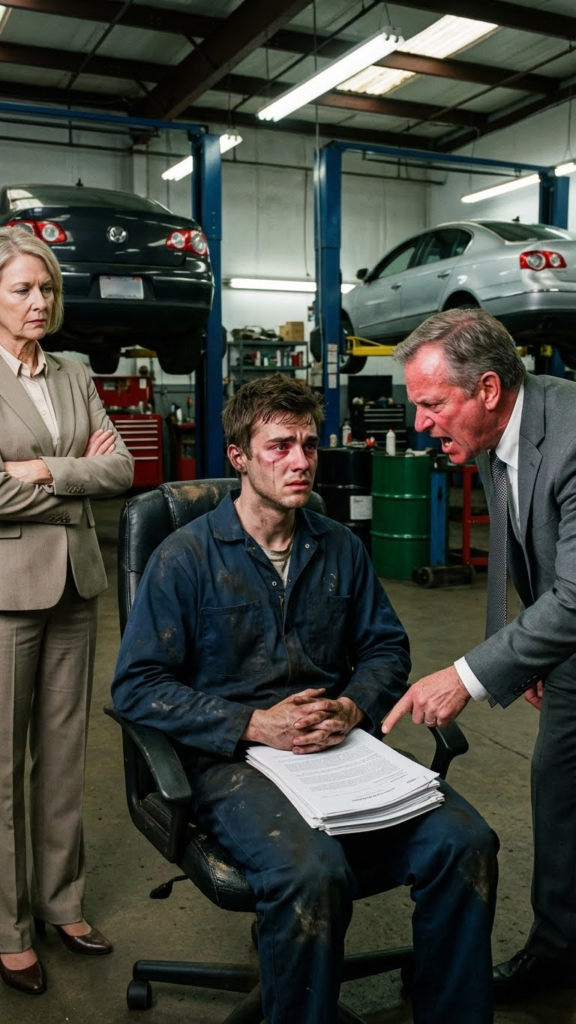
Let me back up and explain how I ended up here, at twenty-three years old, covered in grease and crying while my own parents tried to steal everything I’d built.
My grandfather, Gerald Morrison, raised me more than my own parents did.
My father, Richard Morrison, was a corporate lawyer who measured success in billable hours and corner offices. My mother, Patricia, was a real estate agent who measured worth in property values and social standing. They were busy people. Important people. People who didn’t have time for a kid who liked taking things apart to see how they worked.
But my grandfather did.
Grandpa Gerry owned Morrison’s Auto Repair for forty years. It was a small shop in a working-class neighborhood, the kind of place where people brought their cars because they trusted the mechanic more than they trusted their own family sometimes.
From the time I was eight years old, I spent every weekend and summer in that garage. Grandpa taught me everything—how to diagnose an engine problem by sound, how to treat customers with respect, how to run an honest business in a world that rewarded shortcuts.
“A man’s word and his work—that’s all that matters, Marcus,” he used to say, his hands perpetually stained with oil that never quite washed out. “Build something you’re proud of, and nobody can ever take that away from you.”
My father hated it. Hated that I loved the garage. Hated that I wanted to be a mechanic instead of a lawyer. Hated that his father and I had a bond he’d never had with either of us.
“You’re wasting your potential,” he’d say whenever he saw me working on cars. “You’re smart enough to be a doctor, a lawyer, something important. Instead, you want to be a grease monkey like the old man?”
When I was nineteen, still in community college studying automotive technology, Grandpa Gerry died suddenly. Heart attack while working under a Chevy Silverado.
The funeral was brutal. I cried more than anyone, probably more than was “appropriate” for a teenage grandson. My father gave the eulogy in his lawyer voice—professional, detached, full of generic platitudes about “a life well-lived” and “a generation that valued hard work.”
He didn’t mention that Grandpa Gerry called him twice a week and got ignored.
He didn’t mention that my grandfather died disappointed in the man his son had become.
Then came the will reading.
Grandpa Gerry had been more successful than anyone realized. That “small shop” had actually been quite profitable. He’d invested wisely, saved carefully, and built up a trust worth just over $400,000.
In the will, he left the shop itself to my father—”hoping he might remember where he came from.”
But the trust? The money? That went to me, with one condition: I couldn’t access it until I was twenty-five, or until I started my own business, whichever came first. The money was meant to help me build something, not waste it on “being young and stupid,” as Grandpa put it in his letter to me.
I watched my father’s face during that reading. Watched it go from confident, to confused, to absolutely furious.
He’d expected to inherit everything. Instead, his father had given the money to his twenty-three-year-old grandson.
“This is ridiculous,” my father had said to the lawyer afterward. “My father was clearly not of sound mind when he wrote this. A nineteen-year-old kid can’t be trusted with that kind of money.”
“The will is ironclad,” the lawyer had responded. “And Gerald was thoroughly evaluated. He knew exactly what he was doing.”
My father didn’t speak to me for three months after that.
When he finally did, it was to tell me that the garage—Morrison’s Auto Repair—was being sold. “Can’t keep it running without the old man,” he said. “I’m liquidating the asset.”
He sold it to a chain repair shop for pennies on the dollar and pocketed the money.
I was devastated. That garage was my grandfather’s legacy, the place where we’d spent countless hours together, and my father had sold it like it meant nothing.
That’s when I made my decision.
I dropped out of college, took out business loans, and started my own garage. Morrison & Son Auto Repair—named in honor of Grandpa Gerry and the son he actually believed in, not the one who’d sold his legacy for a quick payout.
It took four years of brutal work. I started in a tiny rented space with two vehicle lifts and more debt than sense. I worked sixteen-hour days, seven days a week. I built a reputation one customer at a time—honest work, fair prices, the way Grandpa taught me.
Slowly, it grew. I hired two employees. Moved to a bigger space. Started making real money.
And through it all, my parents barely acknowledged I existed.
Until now. Until the garage was successful and my twenty-fifth birthday was three months away—the day I’d gain full access to Grandpa’s trust fund.
Suddenly, my father was very interested in my business.
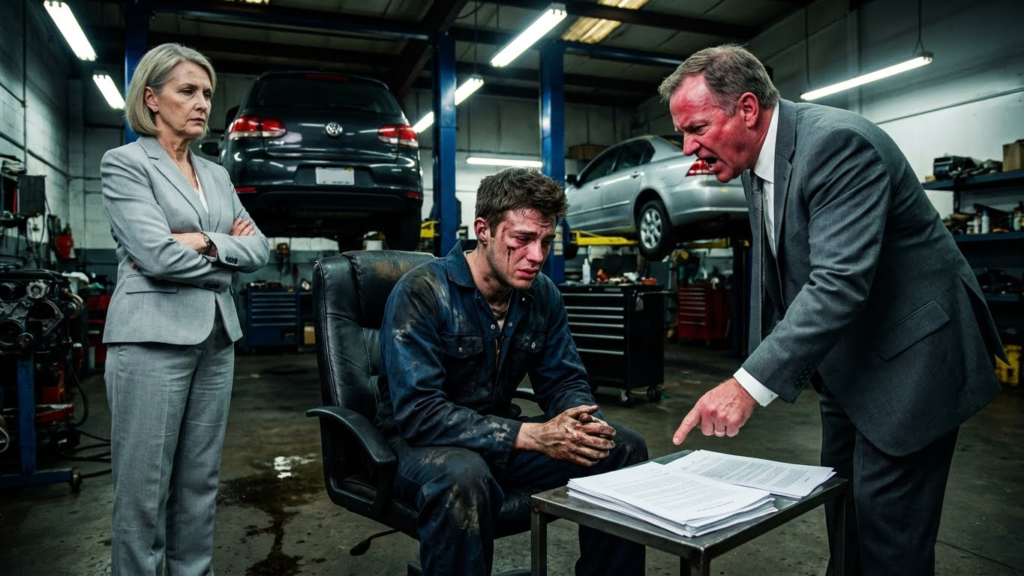
I sat in that office chair, staring at the clause about the trust fund, and everything clicked into place.
“This is about Grandpa’s money,” I said quietly.
My father’s expression didn’t change, but something flickered in his eyes. “I don’t know what you’re talking about.”
“Yes, you do.” I stood up, the papers clutched in my shaking hands. “You want me to sign over the trust fund. That’s what this is really about. The garage is just leverage.”
My mother shifted uncomfortably. “Marcus, that money should have gone to your father in the first place. Your grandfather was being spiteful when he—”
“He was being smart,” I interrupted. “He knew exactly what Dad would do with it. The same thing he did with the original shop—sell it for cash and move on.”
“Watch your mouth,” my father warned, standing up to his full height. He was bigger than me, always had been, and he knew how to use physical presence to intimidate.
But I’d spent four years rebuilding myself. I wasn’t the scared kid who’d watched his grandfather’s legacy get sold off anymore.
“The trust is mine,” I said firmly. “Grandpa left it to me specifically. You can’t have it.”
“Sign the papers, and we’ll leave you alone,” my father said. “Refuse, and I’ll tie you up in legal battles for years. I’ll challenge the will, claim undue influence, drag your grandfather’s name through the mud if I have to. By the time the lawyers are done, there won’t be anything left for either of us.”
“You’d destroy Grandpa’s memory just to get money that was never yours?”
“I’d do what I have to do to correct an injustice,” he said coldly. “My father humiliated me with that will. Left his fortune to a kid barely out of high school instead of his own son. Well, I’m taking it back.”
I looked at my mother. “And you’re okay with this?”
She wouldn’t meet my eyes. “Your father works very hard. He deserves security in his retirement. You’re young—you’ll have plenty of time to earn your own money.”
“I am earning my own money! This garage—”
“Which you built on your grandfather’s coattails,” my father snapped. “Using his name, his reputation, his legacy. You’re nothing but a parasite living off what he built.”
The words stung more than I wanted to admit. Maybe because part of me had always worried he was right.
But then I thought about the last four years. The all-nighters fixing cars. The customers I’d won over with honesty and skill. The employees who depended on me. The life I’d built with my own hands.
“No,” I said quietly.
“What?”
“No. I’m not signing.” I dropped the papers on the desk. “The garage is mine. The trust fund is mine. Grandpa left them to me because he believed in me. And you can’t take that away.”
My father’s face went from red to purple. “You ungrateful little—”
“GET OUT!” I shouted, louder than I’d ever raised my voice to him. “Get out of my garage! This is my property, my business, and you’re trespassing!”
For a moment, I thought he might hit me. His fist clenched, his whole body tensed.
But my mother grabbed his arm. “Richard, let’s go. We’ll handle this through lawyers.”
He shook her off but backed toward the door. “You just made the biggest mistake of your life, boy. I’m going to destroy you. I’m going to take everything you think you’ve built and burn it to the ground. And when you’re broken and begging, don’t come crying to us.”
“I won’t,” I said. “I have nothing to cry about. I’m free of you.”
They left without another word.
I stood alone in my office, surrounded by the smell of motor oil and the sound of pneumatic tools from the main garage, and I realized I was smiling.
For the first time in my life, I’d stood up to him.
And it felt incredible.
My father wasn’t bluffing about the lawyers.
Within a week, I was served with papers. He was challenging the trust fund, claiming my grandfather had been coerced by me (a teenager at the time), wasn’t of sound mind, and that the entire will was invalid.
He was also suing me personally, claiming I owed him $20,000 in “startup capital” that he’d “loaned” me for the garage—a complete fabrication, but one he’d apparently been preparing for by creating fake documentation.
The legal battle consumed the next six months of my life.
I had to hire a lawyer I couldn’t really afford. I had to provide bank statements, loan documents, business records—everything to prove that every penny in my garage had come from my own work and legitimate business loans.
I had to sit through depositions where my father’s lawyers called me ungrateful, spoiled, and incompetent.
I had to listen to my own mother testify that I’d always been “difficult” and “manipulative,” even as a child.
It was brutal.
But here’s what my father didn’t count on: my grandfather had been thorough.
The trust fund had been set up by one of the best estate lawyers in the state. Every detail was documented. Multiple doctors had evaluated Grandpa Gerry and certified he was completely competent. The lawyer had even included a video recording of my grandfather explaining exactly why he was leaving the money to me and not his son.
“Richard forgot where he came from,” Grandpa said on that video, his voice strong despite his age. “He forgot that money is supposed to serve life, not the other way around. Marcus understands that. Marcus has my heart, my values. I’m trusting him to build something good with this. If Richard contests this will, it’ll just prove I was right about him.”
The judge threw out my father’s challenge in less than twenty minutes.
The lawsuit about the fake “loan” lasted longer, but eventually collapsed when my lawyer proved my father couldn’t produce any actual evidence of the money changing hands—no checks, no wire transfers, nothing but a document he’d clearly fabricated recently.
In the end, not only did I win—my father was sanctioned by the court for bringing a frivolous lawsuit and ordered to pay my legal fees.
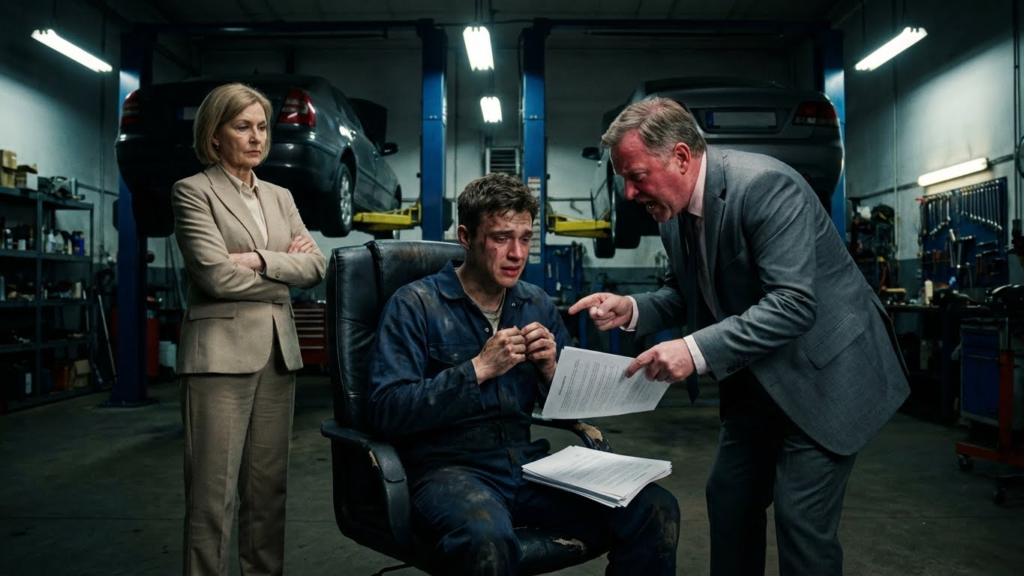
On my twenty-fifth birthday, I walked into the bank and signed the paperwork to access my grandfather’s trust fund.
$400,000.
I used $150,000 to pay off all the business loans and legal fees.
I used $100,000 to buy the building where my garage was located, so I’d never have to worry about rent increases or losing my location.
I used $50,000 to give my two employees bonuses and hire two more people.
And I put the remaining $100,000 in investments, exactly the way my grandfather had taught me—slow, steady, building for the future.
My parents didn’t come to my birthday. Didn’t call. Didn’t acknowledge it at all.
I didn’t expect them to.
What I did get was a letter from my grandfather’s lawyer.
Inside was another message from Grandpa Gerry, written to be delivered on my twenty-fifth birthday.
Marcus,
If you’re reading this, it means you made it. You built something, and you protected it.
Your father is my son, and I love him, but I failed him somewhere along the way. I taught him to work hard, but I forgot to teach him why that matters. He values money over people, success over integrity.
I saw something different in you. You understood that the cars weren’t the point—the people were. That a good business serves its community. That a man’s character is worth more than his bank account.
I’m proud of you, son. Prouder than I ever could have been of a lawyer or a doctor or whatever your father wanted you to be.
You’re a good mechanic. More importantly, you’re a good man.
Build something beautiful with this gift. Not just a business—a life. One you can be proud of.
Love,
Grandpa
I read it three times, sitting alone in my office with tears streaming down my face.
Then I framed it and hung it on the wall where I could see it every day.
I’m twenty-seven now. Morrison & Son Auto Repair has eight employees, three locations, and a reputation as the most honest garage in the city.
I still get under cars. I still come home covered in grease. I still work too many hours.
But I love it. Every single day, I love it.
My parents and I haven’t spoken in almost three years. I heard through extended family that my father had some financial troubles—bad investments, apparently—and had to downsize his lifestyle significantly.
I felt nothing when I heard that. Not satisfaction, not sympathy. Just… nothing.
They made their choices. I made mine.
Last week, a kid came into the garage. Seventeen years old, interested in cars, wanted to know if I was hiring for summer help.
I saw something in him. That same spark I must have had when Grandpa first let me hold a wrench.
I hired him on the spot.
“Work hard, be honest, treat people with respect,” I told him on his first day. “That’s all that matters in this business. Can you do that?”
He nodded enthusiastically. “Yes, sir.”
“And don’t call me sir,” I said with a smile. “Call me Marcus. We’re a team here.”
As I watched him start learning the trade, I thought about my grandfather. About the legacy he’d left me—not just money, but values. A way of being in the world.
My father tried to steal that from me. Tried to take everything I’d built and everything I’d been given.
But he failed.
Because you can’t steal character. You can’t take someone’s integrity with legal documents and intimidation.
And in the end, that’s the only inheritance that really matters.
My grandfather taught me that.
And someday, when I’m old and gray and covered in a lifetime of oil stains, I’ll pass it on too.
Just like he would have wanted.