The Setup: The Night Everything Burned
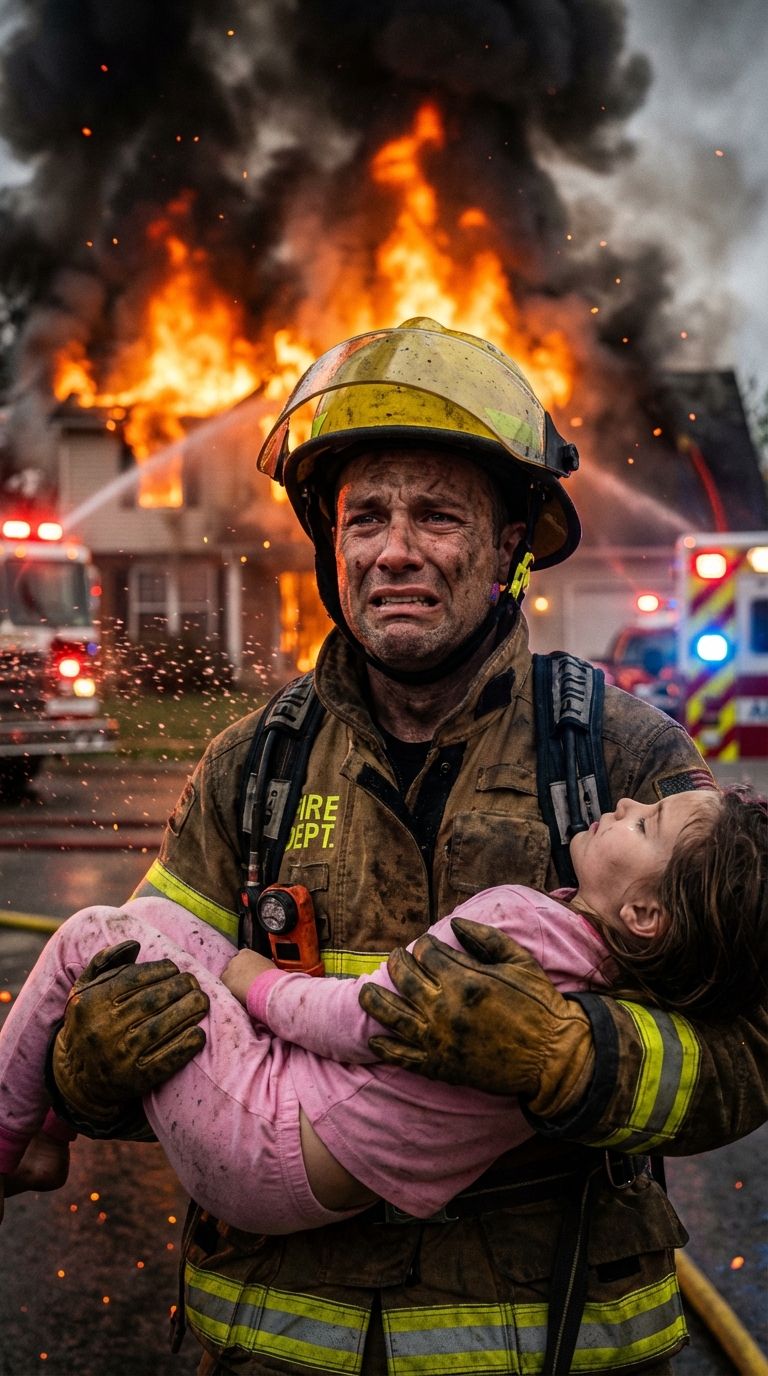
I was standing in my driveway at 3 a.m., barefoot in my pajamas, watching the firefighter carry my unconscious seven-year-old daughter out of my burning house.
The world moved in slow motion. Smoke billowed thick and black against the moonlit sky, curling into itself like a living thing. The sirens screamed, piercing and relentless. Neighbors gathered on the sidewalk in their robes and slippers, their phones out, recording everything. But all I could see was Emma’s limp body cradled in his arms, her blonde hair hanging over his gloved hand like a rag doll, her Spider-Man pajamas covered in soot.
The firefighter moved with precision, his boots crunching over broken glass and debris. He wasn’t panicking. He wasn’t rushing. He was efficient—the kind of calm that only comes from years of training, from having done this a hundred times before.
He laid her gently on the stretcher, stepped back so the paramedics could swarm in, and for just a second—one brief, shattering second—our eyes met.
I knew that face.
Not because he’d just saved my daughter’s life. But because I’d seen it before. Six years ago. In a newspaper article I’d clipped and saved in a folder I kept hidden in my desk drawer, labeled “Things I Can’t Forget.”
The headline had read: “Local Firefighter Loses Wife and Son in Tragic House Fire While on Duty—Community Mourns.”
There had been a photo. A man in dress blues at a funeral, his face hollow, his eyes empty. The article had detailed the cruel irony: Captain Ryan Mitchell had been across town saving a family of four from an electrical fire when his own home caught fire from a faulty space heater. His wife and five-year-old son had died from smoke inhalation before the first responders even arrived.
The article said he’d tried to go back to work two weeks later. It said his colleagues worried he’d never forgive himself.
My chest tightened. My knees buckled. I grabbed onto the ambulance door to keep from collapsing.
It couldn’t be him. It couldn’t be the same man.
But it was.
Captain Ryan Mitchell. The man who’d been twenty miles away saving strangers when his own family burned. The man who’d returned home to find police tape, a closed casket funeral, and guilt so crushing the article said he’d nearly quit the fire department entirely.
The same man who had just pulled my daughter from the exact same fate.
“She’s breathing!” one of the paramedics shouted, and I heard myself sob—a raw, ugly sound I didn’t recognize. Emma coughed, sputtered, and her eyes fluttered open. She looked confused, scared, but alive.
She was alive.
I turned to thank him, to say something—anything—that could match the weight of what he’d just done. But Captain Mitchell was already walking away, his shoulders stiff, his head down, like he couldn’t bear to be thanked.
“Wait!” I called out, stumbling toward him over the wet grass. “Please, wait.”
He stopped but didn’t turn around.
“You saved her,” I said, my voice cracking. “You saved my little girl.”
His hands clenched into fists at his sides. When he finally looked back at me, his face was carved from stone, but his eyes—God, his eyes—were drowning.
“Yeah,” he said quietly. “I did.”
And then he said something that made my blood run cold.
“I’m glad one of us got a second chance.”
Before I could respond, he turned and walked back toward the fire truck, disappearing into the chaos of hoses and flashing lights.
I didn’t understand what he meant. Not then.
But three days later, when I opened the envelope he’d left on my doorstep, everything changed.
The Backstory: Six Years of Guilt
Let me take you back to the beginning—not of my story, but of his.
After the fire that took Emma, after the hospital visits and the insurance paperwork and the temporary hotel room, I did what any traumatized person does in the digital age: I Googled him.
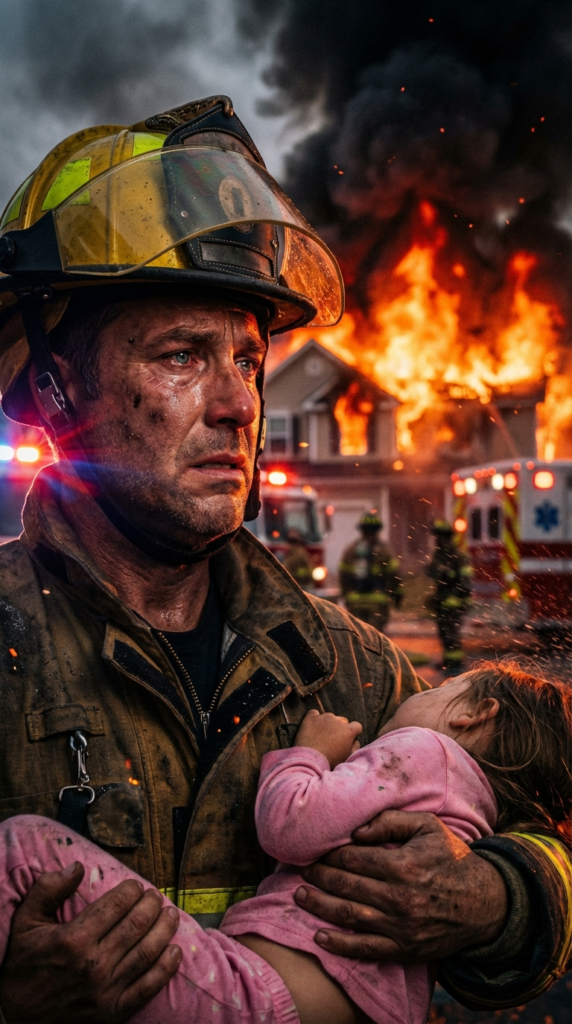
Captain Ryan Mitchell, 38 years old. Decorated firefighter. Fifteen years of service. Recipient of multiple commendations for bravery.
And a widower.
The articles about his family’s death were everywhere. Local news. National outlets. Even a GoFundMe that raised over $80,000 for funeral costs and grief counseling he reportedly never used.
I read every word.
His wife, Grace, had been a kindergarten teacher. Their son, Liam, had just turned five. They’d died on a Tuesday night in February while Ryan was pulling a teenager out of a car engulfed in flames on the interstate.
The fire investigators determined it was an old space heater in the basement—a cheap one they’d been meaning to replace. It short-circuited. The flames spread fast. Grace had called 911, but by the time the trucks arrived, the smoke had already done its damage.
Ryan had been unreachable, mid-rescue, radio turned down.
He’d come home to find his street blocked off, his house a smoldering skeleton, and his entire world erased.
One article quoted a fellow firefighter: “Ryan hasn’t been the same since. He works twice as many shifts now. I think he’s trying to save enough people to make up for the two he couldn’t.”
That line haunted me.
Because the night he saved Emma, he’d been off-duty. He’d heard the call on his scanner at home and showed up anyway, still in his civilian clothes, pulling on gear from the truck.
He didn’t have to be there.
But he came.
And now, three days later, I was standing on my front porch holding the envelope he’d left with no return address, no note—just a photograph.
A burnt photograph.
The edges were charred black, the center warped from heat. But I could still make out the image: a woman with dark curly hair and a warm smile, holding a little boy with gap-toothed grin. They were standing in front of a house—a house with the same brick facade, the same bay window, the same front porch as mine.
On the back, in shaky, barely legible handwriting:
“This was my fault.”
My hands started to shake.
Why would he leave this for me? What did it mean?
I turned the photo over again, studying the house in the background. It was almost identical to mine. Same neighborhood, maybe even the same street—older photo, same builder, same layout.
And then it hit me.
Ryan Mitchell used to live in my house.
The Discovery: Unraveling the Truth
I called the fire chief the next morning.
“Chief Ramirez, this is Claire Thompson. Captain Mitchell saved my daughter last week. I need to ask you something, and I need you to be honest with me.”
There was a pause. “Go ahead.”
“Did Captain Mitchell used to live at 482 Maplewood Drive?”
Silence.
“Ma’am, I’m not sure why that’s—”
“Did he?” I pressed.
Another pause. Then, quietly: “Yes. That was his house. He sold it about five years ago. Couldn’t stand to be there after… after what happened.”
My stomach dropped. “So when he came to my house that night…”
“He was walking into the place where his family died,” Chief Ramirez finished. “Yeah. I didn’t realize you’d moved into that property. I don’t think he knew either until he saw the address on the dispatch.”
I hung up and sat down hard on the couch, the photograph still in my hand.
Ryan Mitchell had run into a burning building—not just any building, but the same house where his wife and son had died—to save my daughter.
He’d faced his worst nightmare head-on and won.
And then he’d left me a photograph with four words: This was my fault.
I couldn’t let that stand.
The Confrontation: Finding Him
It took me two days to track him down.
He wasn’t at the fire station—he’d taken a leave of absence after our fire. His colleagues wouldn’t give me his address, but one of them, a younger guy named Torres, slipped me a piece of paper with a location scribbled on it.
“He goes there sometimes,” Torres said quietly. “When things get bad.”
The address led me to a cemetery on the north side of town.
I found him kneeling in front of two headstones, one large, one small. Grace Mitchell. Liam Mitchell.
He didn’t look up when I approached, even though I knew he’d heard me.
“You shouldn’t be here,” he said, his voice flat.
“You left me a photograph,” I said. “You wrote that it was your fault. I need you to explain that to me.”
He let out a bitter laugh. “What’s there to explain? I was out saving strangers while my family burned to death. That’s the story. That’s always the story.”
“That’s not your fault,” I said firmly.
“Isn’t it?” He finally looked up at me, and his face was wrecked—red-rimmed eyes, days-old stubble, deep lines carved by grief. “I’m a firefighter. I’m supposed to protect people. And I couldn’t protect the two people who mattered most.”
“You were doing your job.”
“My job got them killed,” he snapped. “If I’d been home, I would’ve smelled the smoke. I would’ve gotten them out. But I wasn’t. I was twenty miles away playing hero for people I didn’t even know.”
I knelt down beside him, the wet grass soaking through my jeans.
“You saved my daughter,” I said quietly. “You ran into that house—your house, the place where you lost everything—and you pulled her out. You didn’t have to do that. You weren’t even on duty. But you did it anyway.”
He shook his head. “That doesn’t bring them back.”
“No,” I agreed. “It doesn’t. But it gave Emma a future. It gave me my daughter. And whether you believe it or not, that matters.”
His jaw clenched. “I don’t know how to live with what I didn’t do.”
“Then live with what you did do,” I said. “You saved her. You’ve saved dozens of people. You can’t undo the past, Ryan. But you can stop punishing yourself for being human.”
He stared at the headstones, his shoulders shaking.
“I see them every time I close my eyes,” he whispered. “Liam’s laugh. Grace’s smile. And I wonder if they knew I wasn’t coming. If they called for me. If they thought I chose someone else over them.”
Tears burned my eyes. “They knew you loved them. That’s what they knew.”
“You don’t know that.”
“Yes, I do,” I said. “Because Emma knows I love her. Because when she woke up in that hospital, the first thing she asked was if you were okay. She wanted to thank the man who saved her. She doesn’t remember the fear or the smoke. She remembers that someone came for her. That’s what your family would remember too—that you spent your life coming for people.”
He broke then. Fully, completely. His shoulders crumpled forward, and he buried his face in his hands, sobbing in a way that sounded like it had been trapped inside him for six years.
I didn’t say anything. I just stayed.
The Resolution: What He Did Next
Two weeks later, Ryan called me.
“I’d like to meet Emma,” he said. “If that’s okay.”
I brought her to the fire station on a Saturday. She wore her favorite dress and carried a drawing she’d made—a picture of a firefighter carrying a little girl out of a house, with the words “Thank you for saving me” written in crayon across the top.
When Ryan saw it, his eyes filled with tears.
“You’re welcome,” he said, his voice thick.
Emma hugged him. And he hugged her back like she was the most precious thing in the world.
Over the following months, something shifted in him.
He started attending a grief support group for first responders. He began talking to a therapist. He even started volunteering at a burn survivor camp for kids, teaching fire safety and helping families navigate trauma.
And he stayed in our lives.
Not as a hero. Not as the man haunted by his past. But as a friend. Someone who showed up to Emma’s school play. Someone who taught her how to check smoke alarms. Someone who proved that survival isn’t just about escaping the fire—it’s about learning to live after it.
One night, almost a year after the fire, Ryan and I sat on my back porch while Emma played in the yard.
“I used to think I didn’t deserve to be saved,” he said quietly. “That if I couldn’t save them, I didn’t deserve to save anyone else.”
“And now?” I asked.
He watched Emma chase fireflies, her laughter ringing out into the evening air.
“Now I think maybe saving people is how I keep their memory alive,” he said. “Grace and Liam would’ve wanted me to keep going. To keep showing up. I couldn’t do that for them. But I can do it for everyone else.”
I reached over and squeezed his hand.
“You already are,” I said.
Ryan Mitchell didn’t save his own family. That truth will never stop hurting him.
But he saved mine.
And in doing so, he saved himself.
Not from the guilt. Not from the grief.
But from the belief that he didn’t deserve to keep living.
The firefighter who saved my daughter didn’t save his own family.
But he proved that sometimes, the second chance isn’t for the person who survives.
It’s for the person who keeps saving others, even when they couldn’t save the ones they loved most.
And that’s a different kind of heroism altogether.