The Day I Finally Snapped
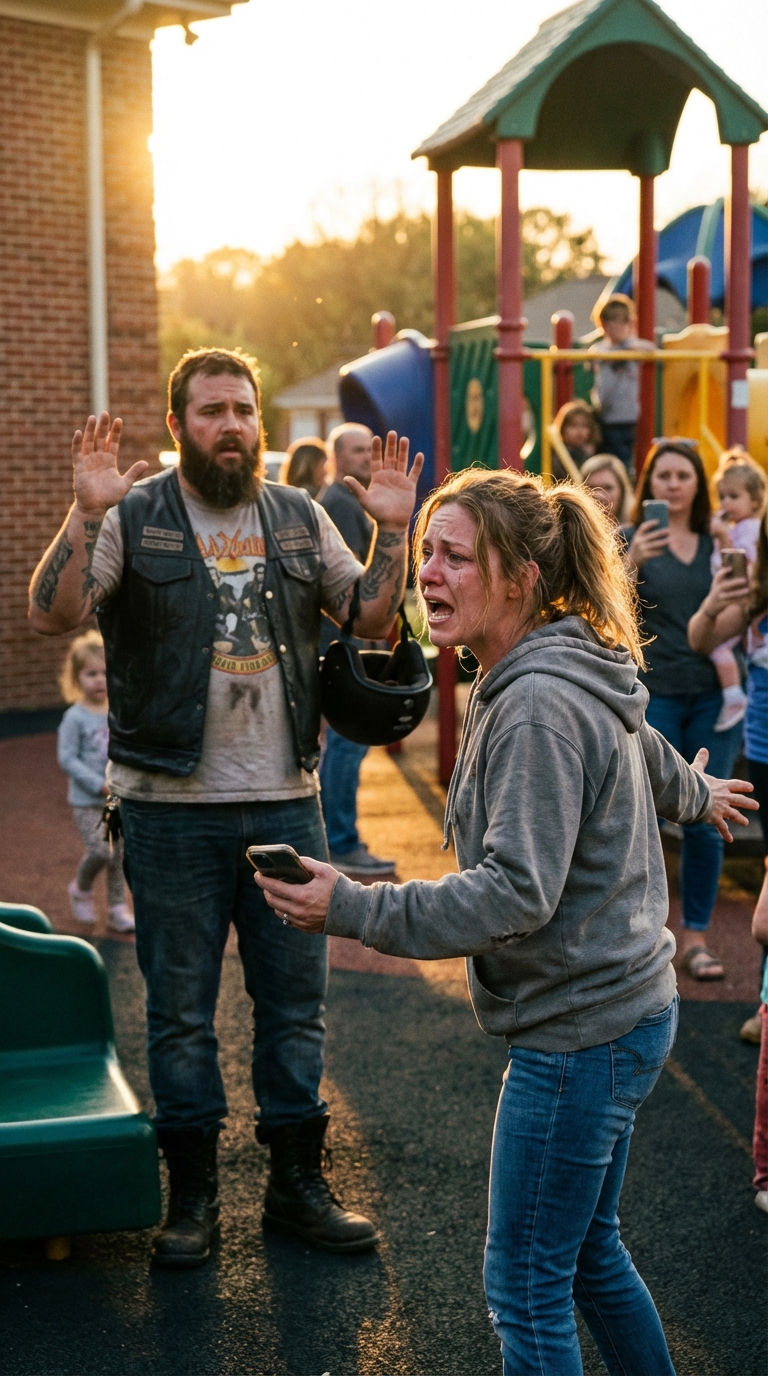
“I said get away from my son!”
My voice cracked down the length of the playground like a whip.
The late afternoon sun turned everything too bright—plastic slides, metal benches, the glint of chrome from the motorcycle parked just beyond the fence. Parents froze mid‑push on swings, mid‑sip of iced coffee, mid‑scroll on their phones.
And between me and my eight‑year‑old son stood the man I’d been afraid of for years.
He looked like every stereotype I had ever been warned about:
- Black leather vest over a faded band T‑shirt.
- Thick arms covered in ink—skulls, flames, names I couldn’t read from here.
- A silver ring in his eyebrow.
- Heavy boots that made the ground thud when he walked.
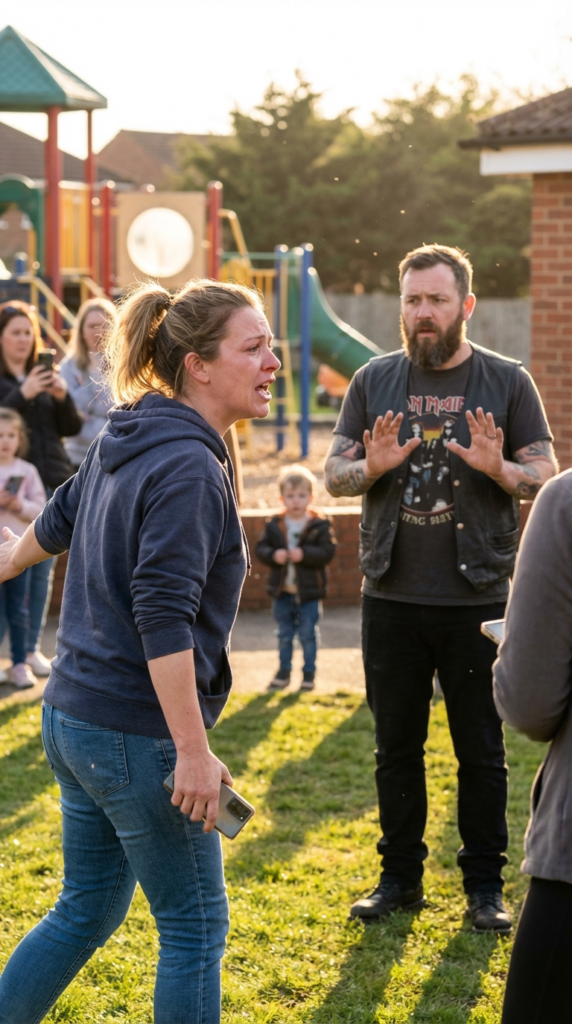
His motorcycle helmet hung loosely from his left hand. His right hand was in the air, fingers curled into a shape that made no sense to me.
Behind him, Noah sat on the low brick wall, his feet not quite touching the ground, his dark curls sticking to his forehead with sweat. His hands were up too, mirroring the biker’s gestures—faster, lighter, more fluid.
They both froze when I shouted.
“M’am, it’s okay,” the biker said, lowering his hands slowly like he was surrendering. His voice was rough, deeper than I expected. “We were just—”
“Just what?” I snapped, stepping closer, putting myself squarely between him and my child. “You were just what? Doing your little routine? Playing whatever weird game this is?”
Noah tugged on the back of my shirt. I didn’t look at him.
“Mom,” he said, his voice soft, small. He tugged again, harder this time. “MOM.” I felt his fingers forming a sign against my hip, one I didn’t recognize.
I didn’t take my eyes off the biker.
“I have seen you,” I said, jabbing a finger toward his chest. “Every Saturday at this park. Outside the grocery store. Standing across from the school when I pick Noah up. You always find a way to get near him. You always start… doing things with your hands. He can’t even explain what you’re doing because you scare him.”
The biker’s jaw clenched. “I don’t scare him.”
“You don’t get to decide that,” I snapped.
I could feel people watching. A dad in cargo shorts stepped a little closer to his toddler, his expression wary. A woman in yoga pants raised her phone just enough that I could see the camera app open.
The biker glanced around, his eyes suddenly sharp, calculating.
“M’am,” he said again, quieter now. “Please. I’m not—”
“I’m calling the police,” I said, pulling my phone from my back pocket. My hands were sweating so badly that I almost dropped it. “I warned you last time. I told you if you ever approached my son again—”
“Mom!” Noah’s voice cracked. He stepped around me, putting himself back in the biker’s sightline. He signed something fast—hands flying, face animated, like he was trying to cram a whole conversation into three seconds.
The biker looked at him, something like concern flickering across his face.
“No,” I snapped, grabbing Noah’s shoulder and yanking him gently back toward me. “Stay behind me, baby. I’ve got this.”
He pulled away, his brows knitting together in a way I knew meant he was both frustrated and hurt.
“M’am,” the biker said again, louder now, his own temper starting to show. “You need to calm down. I’m not some creep. I’m trying to help.”
“Oh really?” I said, laughing harshly. “You? The strange man who just happens to be everywhere my deaf son is? You’re helping?”
He took a step forward, then stopped when a few dads near us shifted their weight, ready to intervene.
“I was a sign language interpreter,” he said, the words coming out like he had to push each one past something heavy in his chest. “For ten years. At the children’s hospital. My daughter was deaf.”
“Was?” I repeated.
His throat worked. “She died.”
The words hit the ground between us like a dropped weight.
He shook his head, angry now—but not at me. At something else. Something older.
“I know what it’s like to have a kid who can’t just yell for help,” he said. “I know what happens when the world doesn’t understand what they’re saying. I’m not mocking your boy. I’m teaching him.”
I stared at him, thrown completely off my axis.
“Teaching him what?” I demanded.
“Signs no one bothered to teach you,” he said bluntly. “How to tell someone he’s hurt. How to say ‘I need an interpreter’ instead of just shutting down. How to tell a cop ‘I’m deaf, I’m not ignoring you.’ How to fingerspell his street in case he gets lost.”
He looked at Noah, then back at me.
“How to survive,” he added quietly.
Before I could respond, someone cleared their throat.
“Is everything okay here?”
A man in navy scrubs stood a few feet away, a hospital badge clipped to his chest. I recognized him instantly.
“Dr. Patel?” I said, stunned. “What are you doing here?”
He smiled faintly. “I live two blocks over. I heard shouting.” His eyes flicked between me, the biker, and Noah. “Is this… about him?” He nodded toward my son.
I swallowed. “We have an appointment with you next month. For his… you know. Assessment.”
Dr. Patel nodded. “I remember. Noah, right?”
He stepped closer, then did something that made my stomach twist.
He raised his hands and signed to my son. Not the basic baby signs I’d learned from YouTube. But fast, complex, adult signing—eyebrows moving, shoulders shifting, whole sentences poured into the space between them.
Noah lit up.
He answered.
Not in the choppy, broken way he sometimes did with me, where he’d mash signs together and hope I understood.
He answered in full sentences.
He answered with nuance.
He answered like someone who had been having whole conversations without me for a very long time.
Dr. Patel’s face changed. The professional detachment slipped.
“Wow,” he breathed. “Noah, that’s… that’s incredible.”
He turned to me, eyes wide.
“Mrs. Harris,” he said, “do you realize your son is signing at a level I don’t usually see until at least mid‑teens? Higher, even. Where did he learn all of this?”
My mouth went dry.
I looked at Noah.
Then at the biker.
Then at their hands—calloused, inked, small, soft—moving in the exact same rhythm.
Everything I’d told myself for years, every story I’d spun to make sense of what I didn’t understand, shattered at once.
“I… I don’t know,” I whispered.
But I was starting to.
And what I did next shocked everyone—including me.
Fear, Guilt, and a Stranger at the Park
Before the biker, before Dr. Patel, before the screaming at the playground, I was just a tired mom in a small house with a big secret:
I was terrified that I was failing my son.
Noah was diagnosed as deaf when he was fourteen months old. The official word on the paper was “profound bilateral sensorineural hearing loss,” but all I saw at the time was one word:
Broken.
Everyone rushed in with advice:
- “Get him cochlear implants.”
- “Don’t get him cochlear implants.”
- “Teach him to lip read.”
- “Don’t rely on lip reading, it’s not enough.”
- “Use sign language.”
- “Don’t use sign, it will stop him from learning to speak.”
Experts disagreed. Strangers in Facebook groups acted like they had a PhD in my child. My husband, Dan, drowned in the noise and decided to cling to the one message that hurt us most:
“If you try hard enough, he can be ‘normal.’”
He hated sign language.
“It looks weird,” he’d say. “It’ll make him stand out more. Kids are brutal, Sara. We should focus on speech therapy. On mainstreaming.”
“We can do both,” I’d argue. “We can give him access to language while he’s learning to speak.”
“Or we confuse him,” he’d counter. “Or we make him lazy. If he knows he can sign, he won’t push himself to talk.”
We weren’t rich. We weren’t poor. We were that precarious middle—the one where insurance barely covered anything, but we still “made too much” for most assistance.
We chose speech therapy because that’s what our insurance favored.
I watched my little boy sit in fluorescent‑lit rooms with smiling therapists who held pictures and exaggerated words, hour after hour, while his frustration climbed and his shoulders curled inward.
He learned some sounds. Broken words. Labored attempts at sentences that never matched the speed of his thoughts.
I learned some signs from apps and YouTube videos late at night. Basic things:
- MORE.
- ALL DONE.
- EAT.
- SLEEP.
- MOM.
- DAD.
Our conversations were a patchwork of pointing, guesswork, and half‑understood signs.
When Noah was five, Dan left.
He said it wasn’t about Noah. It was about “us.” About “money” and “stress” and “how everything is about the kid now.”
But I saw the way he flinched when Noah tried to speak. I heard the way he snapped, “What?” with more anger than patience when our son repeated himself three times.
“I can’t do this,” he said one night, pushing back from the table. “I can’t spend the next ten years pretending this is normal.”
I never saw him again after that.
Noah saw him twice more, at court‑ordered visitations. Then Dan moved states for a job and stopped calling.
I filled the gaps as best I could:
- Two jobs.
- Cheap hearing aids after the insurance fight of my life.
- An overfilled calendar with appointments, evaluations, IEP meetings.
I told myself I was doing enough.
Then we started going to the park more, because it was free—and that’s where I first saw him.
The biker.
The First Time I Saw Him
Noah was six, tiny for his age but fearless on the climbing frame. He liked the park because he could watch other kids without having to keep up with their conversations. Physical play was universal.
I was on the bench, scrolling emails from his school, when I felt the bench shift.
He sat at the far end. Black boots, heavy vest, patches with names like “Road Dogs” and “Chapter 13.” I remember thinking, Great. Just what I need. A gang member at the playground.
He didn’t look at me. Didn’t take out a phone. Just watched the kids.
Then his gaze zeroed in on Noah.
My stomach dropped.
You hear stories. Creeps at the park. People who “like kids” too much. I found myself mentally rehearsing the descriptions I’d give the police.
A few minutes later, Noah climbed down and wandered toward the water fountain. He never saw the biker standing up.
I did.
He walked in a straight line toward my son.
“Noah!” I called, leaping up. “Stay where you are.”
Noah didn’t hear me, of course. He kept walking, focused on the fountain.
The biker reached him first.
I broke into a run, my heart pounding so hard I could taste metal.
By the time I got there, the biker was crouched in front of Noah, one arm resting on his knee. His hands were moving slowly, deliberately.
Noah’s hands moved back.
They were… signing.
It wasn’t the clumsy, simple stuff we did at home. This was complicated. Their faces changed with their hands—eyebrows, mouth shapes, body posture.
I froze a few feet away, invisible.
Noah pointed at his chest, then at the playground. The biker nodded. He signed something that made Noah crack a grin.
Then he pointed at his own chest.
The shape he made on his shirt looked a bit like a “J.” Then he traced the tattoo on his arm and signed something that looked like DAUGHTER.
I snapped out of it.
“Hey!” I shouted, storming over. “What do you think you’re doing?”
They both startled. Noah whipped around, eyes wide. The biker rose slowly.
“Just talking to him,” he said.
“With your hands?” I demanded. “Who are you? Why are you talking to my son?”
He swallowed. “Name’s Jake. I used to—”
“I don’t care,” I snapped. “Don’t approach him like that. He can’t… he doesn’t understand strangers. You’re freaking him out.”
Noah frowned. He tugged my sleeve, signing MAN GOOD with a questioning look.
“He’s fine,” I told him firmly, guiding him away. “We don’t talk to strangers, okay?”
Jake watched us go. His face was unreadable.
I told myself I’d done the right thing.
The Years of “Coincidences”
After that day, I started seeing him everywhere.
At the park, leaning against the fence.
Outside the grocery store, sitting on his bike as we walked in.
Across the street from Noah’s school, helmet on, engine off, like he was waiting for someone.
Every time, his eyes found my son.
Every time, my skin crawled.
I tried to rationalize it:
- Maybe he lived nearby.
- Maybe he worked weird shifts and just… hung around.
- Maybe he was harmless.
But then I’d see his tattoos, his rings, the way people gave him a wide berth, and every true crime podcast I’d ever listened to compiled itself into a horror reel in my head.
Once, at the park, I went to throw something in the trash and came back to find Jake on the bench next to the swing set, hands moving again.
Noah sat on the swing, his little legs dragging in the sand to keep him still, watching Jake’s hands like they were the most fascinating thing in the world.
“STOP,” I signed sharply as I approached. Both of them flinched.
Jake stood up. “M’am—”
“This is harassment,” I snapped. “I’m serious. Stay away from my son.”
“He came to me,” Jake said. “He wanted to show me the new signs he learned. I was just—”
“New signs?” I repeated. “We haven’t had time to—”
I stopped.
Because I realized I had no idea what new signs Noah knew. Our lives had become a blur of logistics. Homework. Dinner. Bed. There hadn’t been much room for learning anything new lately.
Jake’s jaw tightened. “Ask him,” he said. “Ask your son what he can say now.”
I didn’t.
I took Noah home, shaking with anger.
That night, when Noah tried to tell me something with his hands, fast and fluid, I snapped, “Slow down. I don’t understand when you do it like that.”
He deflated, his shoulders slumping. He signed SORRY, then got ready for bed in silence.
I told myself I was protecting him.
From the biker.
From stranger danger.
From something sinister I couldn’t name.
What I was really protecting was my own fear.
The Park, the Doctor, and the Truth
Back at the playground, with Dr. Patel standing between us, there was nowhere left for fear to hide.
He’d just watched my son sign like a fluent native in a language I only knew in pieces.
He’d just asked me where Noah learned all of that.
I had no answer that didn’t implicate the man I’d been treating like a threat.
“I… I don’t know,” I stammered. “We do some sign at home, but not like that. I’ve been waiting for the school to… and the district won’t pay for… I thought he was behind, not—”
“Behind?” Dr. Patel repeated, incredulous. “Mrs. Harris, your son is advanced. He’s incorporating grammatical structure, facial markers for questions, conditionals… this is sophisticated language use.”
Jake rubbed the back of his neck, suddenly looking uncomfortable.
“I told you,” he muttered.
Dr. Patel turned to him. “You know ASL?”
“Interpreter for ten years,” Jake said. “Children’s hospital. PICU. Oncology. Deaf and hard‑of‑hearing unit. My little girl, Lily, was born deaf. Thought I’d be her voice until she could use hers however she wanted.”
His mouth twisted. “Didn’t work out that way.”
Something in his voice made my chest ache.
“What happened?” I asked before I could stop myself.
He looked at me like he wasn’t sure I deserved the answer.
“Car accident,” he said finally. “Three years ago. Drunk driver. Wrong lane. I lived. They didn’t.”
Silence slammed down over us.
“I quit everything after that,” he continued. “My job. My friends. The world. Sold the house, bought the bike, moved into a garage apartment. Spent a year trying to drink my brain quiet.”
He looked at Noah then, really looked at him, like he was seeing someone else superimposed over my son’s face.
“Then I saw him at the park one day,” Jake said. “He was five. Sitting on the swing. Kids yelling all around him. His mouth was moving like he was trying to copy them, but his eyes…”
He shook his head.
“The look Lily used to give me when she knew there was a whole conversation happening and she only had crumbs of it,” he said. “I signed HELLO. He lit up like someone had flipped a switch.”
My throat felt tight.
“I asked where his interpreter was,” Jake went on. “He didn’t know the sign for INTERPRETER. Or HOSPITAL. Or POLICE. Or HELP. He knew ‘eat,’ ‘sleep,’ ‘more.’ That was it.”
He flicked his gaze to me, not unkind, but not gentle either.
“I knew what that meant,” he said. “It meant someone was telling him to wait. To be patient. That resources were ‘in process.’ That he’d get real language later.”
He looked back at Noah.
“Deaf kids don’t have time to wait,” he said quietly. “Their brains are building pathways right now. You starve them of language long enough, and they never catch up. I couldn’t save my own kid. I thought maybe I could help yours not get left behind.”
Dr. Patel nodded slowly. “He’s right,” he said. “We’ve known this for years. Deaf children need language access early. Any language. Sign is often the fastest, most accessible route.”
My cheeks burned.
“So you just… decided to what?” I asked Jake. “Become his secret teacher?”
“I decided to show up,” he said. “Same time you did at the park. I hoped you’d ask, that you’d see, that we could work together. But every time I got close, you froze up.” He shrugged. “Didn’t blame you. I look like everything your mom warned you about.”
“I thought you were mocking him,” I admitted, my voice raw. “The way you moved your hands in his face. The way he couldn’t explain it to me.”
Jake winced. “I was checking his receptive skills,” he said. “His ability to understand sign when someone else used it. You only ever saw the last two seconds when I’d correct him or joke with him. You never saw the hours we spent building vocabulary.”
“Hours?” I echoed, stunned.
He nodded. “Little ones. Ten minutes here. Fifteen there. Asking him to show me signs for things at the park. Teaching him ‘pain’ and ‘doctor’ and ‘stranger.’ Practicing how to tell a grown‑up, ‘I can’t hear you. Please look at me.’”
Noah tapped my arm.
He signed something slowly, deliberately, matching signs with the words he mouthed so I could follow.
“HE,” (pointing at Jake) “TEACH ME SAY,” (fingerspelling SAY, then signing TALK) “NO TOUCH,” (sharp movement, like pushing something away) “NO HURT,” (hand chopping onto other hand) “I TELL MOM.”
My eyes blurred.
“So when that older kid pushed you off the swing and you signed something at him…” I started.
Noah nodded. He signed STAHP. NO. THEN I GO MOM.
“He set a boundary,” Jake said. “In a language that kid probably recognized from TikTok more than school, but hey. It worked. The kid backed off.”
Dr. Patel cleared his throat, pulling out his phone.
“If you don’t mind,” he said, “I’d like to do a quick informal assessment, right here. Just to… confirm what I’m seeing.”
He signed to Noah again, this time more complex questions:
- “If you get lost in a store, what do you do?”
- “If a police officer talks to you and you don’t understand, what do you say?”
- “If someone touches you and you don’t like it, how do you tell them to stop?”
Noah answered each one clearly:
- “FIND WORKER. SAY I LOST. I DEAF. CALL MOM.” (He fingerspelled my full name.)
- “I SIGN I DEAF. I SAY WRITE. I POINT EAR AND SHAKE HEAD.”
- “I SIGN STOP. I MOVE AWAY. I TELL TRUST GROWN‑UP.”
Dr. Patel looked like he’d just discovered a new species.
“This is exceptional,” he said. “His strategies… his clarity… Most kids his age are still struggling to label basic feelings, let alone articulate self‑advocacy in high‑risk situations.”
He turned to Jake.
“You did this?” he asked.
Jake shifted his weight, suddenly self‑conscious. “We did it,” he said, nodding at Noah. “I just gave him the tools. He did the work.”
I wanted to sink into the ground.
For years, I had:
- Ignored my son’s excited attempts to show me new signs.
- Brushed off his insistence that “man park GOOD.”
- Complained about a “creepy biker” who “wouldn’t leave us alone.”
And all this time, while I was drowning in fear and paperwork, a stranger had been quietly building a bridge for my son out of a world that couldn’t hear him.
The guilt hit so hard I had to grab the back of the bench to steady myself.
“I’m so sorry,” I blurted, the words spilling out faster than I could arrange them. “I—God, I am so sorry. I thought you were… I thought you wanted something from him. I thought you were taking advantage. I was so scared I couldn’t see straight.”
Jake shrugged one shoulder, but his eyes softened.
“You were protecting your kid,” he said. “That’s your job.”
“But I was protecting him from the wrong person,” I said. “I should’ve been beating down the school district’s door for sign language support instead of glaring at you across the playground.”
Dr. Patel nodded. “That part we can change,” he said. “Now that we know the extent of Noah’s skills, we can advocate for proper accommodations. An interpreter. Deaf mentors. Real language support in his IEP.”
I looked at Noah, who was watching our faces like a tennis match.
“Can… can you help us?” I asked Jake, the words tasting strange and new in my mouth. “Not just at the park. With… all of it. With learning to talk to him like that.”
Jake blinked.
“Me?” he said.
“Yes, you,” I said. “You clearly know what you’re doing. And he clearly trusts you. I don’t want to keep being the mom who stands on the sidelines of her own kid’s life pretending this is enough.”
His throat worked. When he spoke, his voice was rough.
“I don’t usually…” He trailed off, then tried again. “I haven’t gone back to interpreting. Or anything like it. Too many ghosts.”
He looked at Noah.
“But she’d kick my ass if I said no,” he murmured, half to himself.
“Who?” I asked.
“Lily,” he said. “My girl.”
Noah stepped forward.
He signed GIRL NAME? with a curious tilt of his head.
“L‑I‑L‑Y,” Jake fingerspelled. “My daughter. She DEAF, SAME YOU.” (He pointed between Noah and his own chest.) “SHE DIE.” (His face shifted, the sign heavy, final.) “I SAD LONG TIME. THEN MEET YOU. YOU MAKE ME HAPPY‑SAD.”
Noah considered this, then signed SORRY, followed quickly by FRIEND with a hopeful, circular motion.
Something in Jake’s face cracked open.
“Yeah, buddy,” he said, voice thick. “I’d like that.”
From Fear to Family
If you’d told me a year ago that a tattooed biker would be sitting at my kitchen table teaching my son and me how to sign “intersection,” “accommodation,” and “discrimination,” I would’ve laughed you out of the room.
But there we were.
My fridge was covered now in:
- Vocab lists.
- Illustrations of handshapes.
- A calendar of park meetups turned into “lessons” I actually knew about and attended.
Our living room wall had a poster with:
- “I AM DEAF. PLEASE LOOK AT ME WHEN YOU TALK.”
- “I NEED AN INTERPRETER.”
- “WRITE IT DOWN, PLEASE.”
All in English and ASL gloss.
Jake came over twice a week. Sometimes more.
- He refused payment at first.
- I insisted.
- We compromised: I cooked, he tutored, and occasionally I slipped gas money into his jacket pocket when he “forgot” it on the chair.
He helped me:
- Rewrite Noah’s IEP.
- Prepare talking points for meetings.
- Threaten the district with legal phrases like “language deprivation” and “least restrictive environment” that made them suddenly move faster.
Dr. Patel wrote letters backing us up. Doors that had been “processing” for years creaked open.
The first time an interpreter showed up at a school assembly, Noah spotted her from across the room and nearly vibrated out of his seat.
“She YOUR FRIEND?” he asked Jake, signing fast.
“CO‑WORKER,” Jake signed back, grinning. “SAME JOB BEFORE. NOW JOB HERE FOR YOU.”
The interpreter signed the principal’s whole speech. Jokes. Instructions. Acknowledgments.
For once, my son laughed at the same time as everyone else.
At home, our dynamic changed.
Instead of:
- Saying “Never mind” when Noah didn’t understand.
- Spelling things out in exasperated English.
- Talking about him over his head.
We started:
- Pausing to sign our main points.
- Allowing time for him to reply.
- Asking him what he thought about decisions that affected him.
It was messy. Imperfect. Slow.
Sometimes my hands felt like they were made of bricks. Sometimes my brain scrambled grammar. Sometimes Noah corrected me with a giggle and the patience of a saint.
Jake would snort and say, “You sound like Google Translate. Try it like this,” and show me a smoother way.
I learned that:
- “Deaf” isn’t a bad word.
- The Deaf community exists. Capital D.
- There are whole cultures and histories I’d never been told about because everyone was too focused on “fixing” my son to introduce him to his own people.
We started going to Deaf events.
At the first one, my knees shook.
Noah walked in like he’d come home.
Kids who signed like him. Adults who moved like him. Laughter you could see as much as feel. Music you could feel through the floor.
Jake introduced us to people:
- Former colleagues.
- Community advocates.
- A woman who’d known Lily and squeezed my hand so hard it hurt when she talked about her.
“This is the family I thought I’d never come back to,” he signed once, hands a little shaky. “And you dragged me here, you and your kid.”
“No,” I signed back, clumsy but clear. “HE DRAG YOU.” (I pointed at Noah.) “HE DRAG ME TOO.”
Jake laughed, the sound rusty but real.
The day Dr. Patel officially tested Noah, six months after the park confrontation, he sat us all down in his office—me, Noah, and Jake, who insisted on being “moral support” but sat in the back chair like he was ready to bolt.
“I’m going to be honest,” Dr. Patel said, folding his hands. “I’ve been doing this for over a decade. I don’t often get to give news this good.”
My heart jumped into my throat.
He pulled out charts. Percentiles. Graphs. I braced for the words “delayed,” “behind,” “needs more support.”
Instead, he said:
- “Advanced language skills in ASL.”
- “Strong receptive and expressive abilities.”
- “Exceptional self‑advocacy for his age.”
He looked at Noah.
“You have a lot to be proud of,” he signed.
Then he looked at me.
“You do too,” he added, in both speech and sign.
I shook my head, tears burning.
“This wasn’t me,” I said. “I dragged my feet for years. I believed people who said we had time. I almost… I almost kept him from all of this because I was afraid of being ‘the deaf kid’s mom.’”
Jake spoke up from the corner.
“In my experience,” he said, “the problem is rarely the kids. It’s the world that doesn’t bother to meet them halfway.”
Dr. Patel nodded. “And sometimes,” he said, “it’s the world that shows up in unexpected packaging.”
He looked pointedly at Jake’s tattoos.
“However it happened,” he continued, “the fact is this: your son is not language‑deprived. He’s blooming. That will affect every part of his future—from mental health to education to independence.”
I was openly crying by then.
“Thank you,” I blurted. “Both of you. I’m so sorry it took me this long to see what was right in front of me.”
Afterward, in the parking lot, I turned to Jake.
“You know you’re stuck with us now, right?” I said. “You don’t get to just ride off into the sunset and leave us with all this knowledge and no sarcasm to go with it.”
He snorted. “Stuck, huh?”
“Yes,” I said. “Stuck. Like an uncle. Or a very grumpy fairy godmother.”
He barked out a laugh.
Noah tugged on his vest.
He signed FAMILY, then YOU, then ME, then MOM, looping them in a circle.
Jake swallowed hard.
“Yeah, kid,” he signed back. “Family.”
Now, when we go to the park, no one stares when the scary biker sits next to the deaf kid. They’re too used to seeing us together:
- Me, hands moving slower but steadier.
- Noah, hands flying.
- Jake, hands guiding, correcting, celebrating.
People still look sometimes. You can’t really miss a tattooed man teaching a little boy how to sign “reasonable accommodation” on a park bench.
But now, when new parents edge closer, uncertainty on their faces, I don’t pull my son away.
I smile and say, “Do you want to meet my son’s mentor?”
Because that’s what he is.
Not a threat.
Not a creep.
Not a symbol of everything I was afraid of.
A man who lost his daughter and refused to let another child slip through the cracks she left behind.
The scary biker who “bothered” my deaf son for years?
He was giving him a voice.
And once I finally stopped screaming long enough to listen, he gave me one too.