The Door I Refused to Open
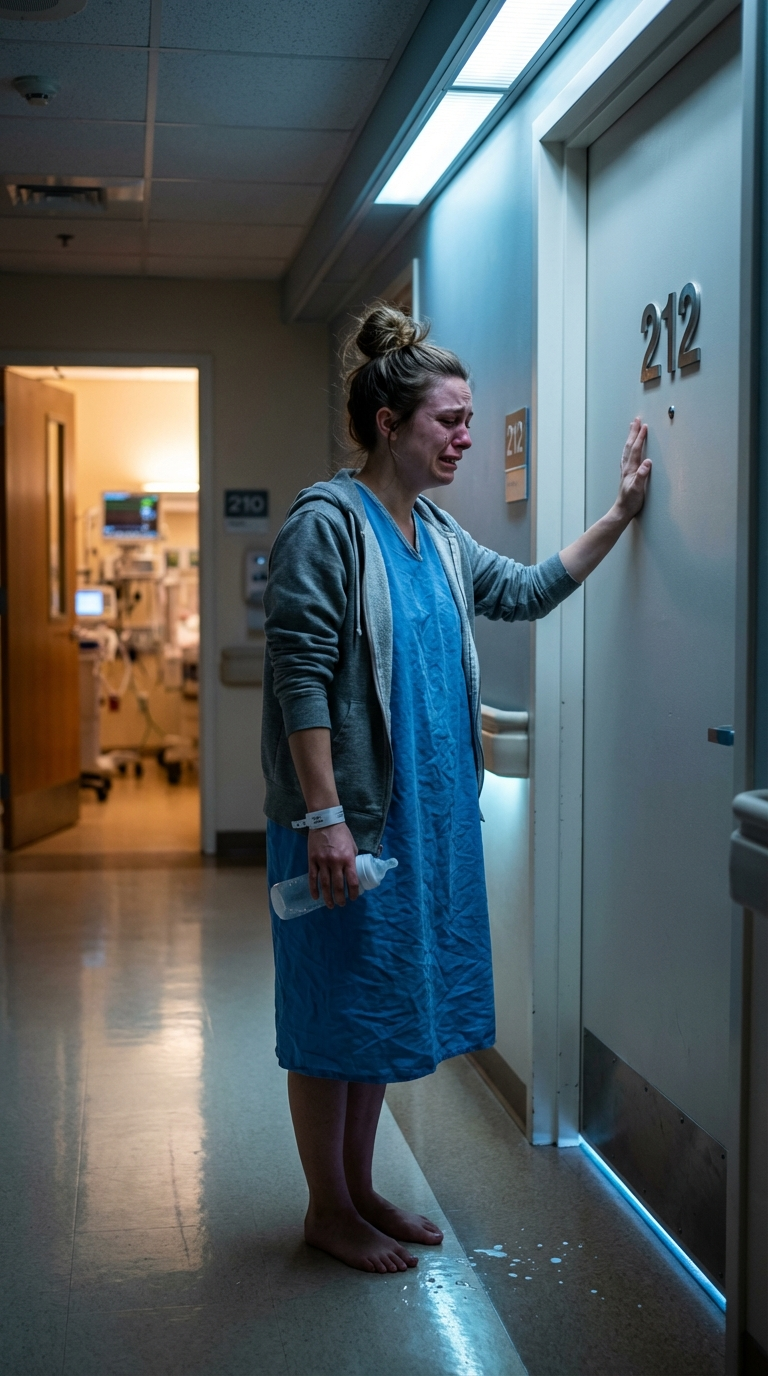
The first time the NICU nurse asked me why I never visited Room 212, I dropped the bottle of pumped milk.
It hit the floor in front of Room 210—our room—and burst open, milk splattering across my socks and the polished linoleum like a crime scene. Thirty precious milliliters, gone. I stared at the cloudy puddle as if I could will it back into the bottle, back into my aching breasts, back into the body of the baby I had almost lost.
“I—what?” I croaked, finally dragging my gaze up.
Steph, the night‑shift NICU nurse with the calm voice and tired eyes, bent down and scooped up the empty bottle. The fluorescent lights reflected off her glasses. Her badge swung forward: Steph, RN – NICU.
“Sorry,” she said, wincing. “Didn’t mean to scare you. I just… I’ve noticed you come in every day for Room 210, but never…” She nodded down the hall, toward the only door that was closed. The silver numbers read 212. “…never over there.”
The hallway smelled like antiseptic and coffee. The soundtrack was a symphony of monitors:
- Beep, beep, beep.
- Whoosh.
- Soft alarms that made the nurses move faster.
“This is my daughter,” I said automatically, nodding at the open door of 210. “Baby A. She’s… she’s the one who made it.”
The word “one” caught on something sharp inside me.
Steph’s eyes searched my face. She was used to exhausted parents—NICU parents are a species all their own—but there must have been something different in my expression. Something hollow.
“You have twins,” she said gently. “Baby A in 210. Baby B in 212. That’s what your chart says.”
For a split second, I thought she was joking. Then my body betrayed me—I laughed. A short, brittle sound that made my chest hurt.
“No,” I said. “I had twins.”
I pointed past her, into 210, where my surviving daughter lay sprawled inside the isolette, skin almost translucent, a forest of tubes and wires surrounding her.
“She made it,” I whispered. “She’s here.”
My hand drifted toward 212, then dropped uselessly to my side.
“She didn’t.”
Steph’s brow knit. “Mrs. Clarke… someone’s been updating the notes in 212 every day. Vent settings. Feeding tolerance. Lab results. That baby is still here.”
The world narrowed to the space between those two doors.
I remembered:
- The rush to the OR.
- The doctor’s face above the mask saying “We need to move now.”
- The sensation of my body splitting open.
- Two cries—no, one cry and one awful silence.
Later, in the recovery room, someone had said, “I’m so sorry about Twin B.” Another voice: “Twin A is critical but stable. She’s in 210.”
They handed me one baby wrapped in a white blanket with a pink and blue stripe. She was too still. Too quiet. I held her for what they told me was forty minutes and what my body remembers as both four seconds and four years. I kissed a forehead that was already cooling.
Then they took her away.
No one said “come see her later.”
No one said “she’s in 212.”
They said, “Do you want us to handle… arrangements?”
I signed papers with hands that didn’t feel like mine.
In the haze that followed—a blur of pain meds, blood draws, lactation consults, blood pressure checks—Room 210 became my universe. Twin A. My fighter. The one attached to machines and possibilities.
212 became a number I refused to look at. A door I pretended didn’t exist. A grave I walked past every day because I thought I knew what was on the other side.
Steph’s question cracked that delusion open.
“Has anyone actually taken you into 212,” she asked, “since delivery?”
I replayed the last twenty‑one days in my mind:
- Nurses saying, “Time to see your girl in 210?”
- Doctors meeting me at the foot of that bed.
- Social workers pulling up chairs in that room.
- Me shuffling in and out past 212 with my eyes glued to the floor.
“No,” I realized, the word barely more than breath. “No one has.”
Steph took a slow breath.
“I can’t override what your doctors told you,” she said carefully. “But I can tell you this: there is a baby in 212. On oxygen. Gaining weight. Trying very hard to be here.” Her throat worked. “I think you need to see her.”
My heart stuttered.
“If you’re wrong…” I whispered.
“If I’m wrong,” she said gently, “then we’ll march this straight to administration, because your chart is a disaster. But if I’m right…”
She didn’t finish.
She didn’t have to.
She stepped forward and wrapped her fingers around the handle of Room 212.
My hand shot out on instinct, grabbing her wrist.
“Wait,” I choked. “I can’t…”
Because if she opened that door and it was empty, my heart would break all over again.
And if she opened that door and it wasn’t—
I was shaking. I didn’t know whether to scream or laugh.
But I let go of her wrist.
And what I did next changed everything I thought I knew about my own grief.
How I Lost Two Daughters and Only Buried One
To understand why I avoided Room 212 for three weeks, you need to understand what came before it.
Before the NICU. Before the labels “Baby A” and “Baby B.” Before the hallway that split my heart in half.
You need to understand the pregnancy that felt like a miracle and a punishment wrapped together.
I’d always wanted kids. Plural. My husband, Mark, liked the idea of kids in the abstract but liked control more:
- Control of our time.
- Our money.
- Our plans.
We tried for years.
Every month was a roller coaster:
- Two weeks of hope.
- One week of overanalyzing every twinge.
- One day of bleeding and crying in the bathroom with the shower running so he wouldn’t hear.
When we finally got pregnant, it felt like we’d won the lottery.
When we found out it was twins, Mark joked about “buy one, get one free” and I laughed even though the ultrasound tech’s eyes were serious.
“Twin pregnancies are considered high‑risk,” she said. “We’ll need to monitor you closely. Especially Baby B. She’s measuring a little smaller.”
From that moment, “Baby B” became a problem to solve instead of a person to love.
The pregnancy was a blur of:
- Extra appointments.
- Extra scans.
- Charts with two heartbeats instead of one.
Mark coped by pretending nothing could go wrong. He painted the nursery. He made spreadsheets about feeding schedules and college funds. He got annoyed when I cried over news stories about premature births.
“Stop doom‑scrolling,” he’d say. “You’re going to manifest something.”
I coped by obsessing.
I memorized:
- Survival rates by gestational week.
- The terrifying acronyms—TTTS, IUGR, NEC—that haunt twin forums.
- Every possible outcome for twins born too early.
We picked names quietly, in the dark.
“If they’re girls?” I whispered once.
“Amelia and Grace,” he said. “Amelia for your grandmother. Grace because we’ll need it.”
We taped the ultrasound pictures to the fridge.
Baby A, always a little bigger, sprawled in every photo like she owned the place.
Baby B, our little shadow, curled up tight as if she knew she was on borrowed time.
At thirty‑one weeks, my body revolted.
Contractions. Back pain. A pressure low in my pelvis that felt like someone was trying to pry me open from the inside.
At the hospital, they strapped monitors to my belly. Two heartbeats flickered across the screen. Doctors frowned. Nurses moved fast.
“Baby B’s heart rate is concerning,” someone said. “We need to move.”
They wheeled me into the OR so fast the ceiling lights became a strobe.
I remember:
- The cold of the table.
- The tugging sensation of the C‑section.
- The nurse saying, “Here comes Baby A—she’s crying, good girl.”
- The absence of sound when they pulled Baby B out.
I didn’t see her face clearly. I saw a flash of purple, a flurry of hands, the anesthesiologist leaning over me and saying, “They’re doing everything they can, okay? Focus on breathing.”
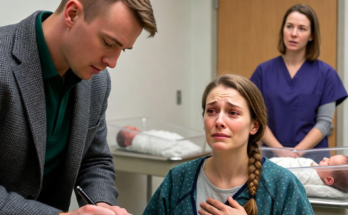
In recovery, Mark sat in the chair by my bed, pale and shaking.
“They said Amelia is critical but stable,” he choked out. “She’s in Room 210. On a ventilator, but they say she’s fighting.”
“And Grace?” I whispered.
His face collapsed.
“Grace didn’t make it,” he said. “They tried, but…”
The rest of the sentence drowned in the sound of my own heartbeat in my ears.
They asked if I wanted to hold her.
Of course I did.
A nurse brought her in, swaddled in a blanket that seemed too big. She was impossibly small. Her skin was still, waxy. Someone had closed her eyes.
“This is Grace,” I whispered, because if I didn’t say her name out loud, I was terrified she’d disappear completely.
I held her. I kissed her forehead. I told her I was sorry. Over and over.
“Do you want to see her again later?” the nurse asked gently.
I shook my head, numb.
“I don’t think I can,” I said. “Please just… take care of her.”
They put a clipboard in my hand with forms about remains and cremation and “final disposition.”
I signed.
In that moment, my brain built a story to survive:
- Amelia is alive in 210.
- Grace is gone.
- 212 is where they took her.
The next day, a social worker came by with a pamphlet titled Coping with the Loss of a Twin and said, “It’s very common to focus on the survivor and avoid the other baby’s room. Don’t feel guilty. Grief is complicated.”
No one corrected her.
No one said, “Actually, there is another baby’s room.”
I assumed 212 was where they had taken Grace’s body for me to say another goodbye I couldn’t bear.
So I didn’t look.
For twenty‑one days.
I poured all my love, my terror, my milk into Amelia in 210 and treated 212 like a haunted house in a horror movie. You don’t open the cursed door. You don’t say the ghost’s name.
You survive by pretending the hallway only goes one way.
The Door, the Chart, and the Twin I Erased
Back in the NICU, Steph’s hand was still on the handle of Room 212.
Mine was shaking from where I’d grabbed her wrist.
“I’ll be with you the whole time,” she said softly. “If at any point you want to step out, you tell me. But I don’t think you’re going to want to.”
I nodded, even though every muscle in my body screamed to run.
She turned the handle.
The door opened with a soft click.
The room was dimmer than 210. The shades were half‑drawn. The familiar machinery hummed—monitors, ventilators, pumps. The air smelled the same: antiseptic and plastic and something faintly sweet.
At the center of it all, under the blue glow of a phototherapy lamp, was an isolette.
A tiny baby lay inside.
She was the same size Amelia had been when I first saw her in 210:
- Skinny limbs.
- Paper‑thin skin.
- A nest of blankets and rolled‑up cloths holding her in position.
A nasal cannula fed oxygen into her nose. Electrodes dotted her chest. An IV line snaked from her hand.
She frowned in her sleep, her mouth making tiny sucking motions.
My legs carried me forward without permission.
“The chart,” Steph murmured, pulling a clipboard from the end of the isolette. “Baby B. Clarke, Girl. Delivered at 31 weeks, 2 days. Birth weight 2 pounds, 4 ounces. Currently 3 pounds, 1 ounce.”
Her voice faded into a buzz.
Because I was staring at the name on the card taped to the isolette:
BABY B – CLARKE, AMELIA GRACE.
“Amelia,” I whispered.
Steph glanced at me. “They listed both names here,” she said. “Did you know—”
I shook my head, tears blurring everything.
“No,” I choked. “We… we decided… if they both survived, the bigger one would be Amelia, the smaller one Grace. But I never…” I swallowed. “They told me Amelia was in 210. They told me Grace was gone. I thought—”
I thought they’d split my daughters by life and death.
I hadn’t realized they’d split them by room number and miscommunication.
“Sometimes in emergencies, the names get… messy,” Steph said carefully. “They’ll list them as Baby A and Baby B, and then someone adds the names later from whatever’s in the chart. If nobody double‑checks with the parents…”
Her jaw tightened. “You said your husband told you it was Grace who didn’t make it?”
I nodded, images flashing:
- Mark, pale and shaking.
- The doctor’s mouth moving as drugs fogged my brain.
- The nurse placing a still, swaddled body in my arms and saying, “This is Baby B.”
“I assumed,” I whispered. “We’d always called the smaller one Grace. I thought…”
I looked between 210 and 212 in my mind’s eye.
Two babies. Two names. One dead.
Only now, standing in 212, it hit me:
I’d buried a name, not a person.
“Who—who did I hold?” I whispered. “Which twin…?”
Steph placed a hand gently on my arm. “We can get you those records,” she said. “We can go through everything with the charge nurse and the attending. But right now, I need you to look.”
I looked.
The baby in 212 opened her eyes.
They were dark, unfocused, scanning the ceiling.
Then they found my face.
She blinked, slow and owlish, like she was trying to figure out who I was.
My hands pressed flat against the plastic wall of the isolette.
“Hi,” I breathed. “Hi, baby. I’m… I’m Mom.”
She kicked weakly.
The monitor beeped a little faster.
“Her vitals just improved,” Steph murmured, half in awe. “They know. They always know when their parents are here.”
My knees buckled. I grabbed the isolette to keep from collapsing.
“Oh my God,” I sobbed. “I left you alone. I left you alone for three weeks. I thought you were… I thought…”
Words disintegrated.
Guilt rushed in, hot and suffocating.
How many times had a nurse sat in here, holding a tiny hand through the portholes, wondering why the mother never came?
How many times had the night‑shift team whispered about the mom in 210 who “couldn’t handle” her other baby?
How many times had I walked past this door, head down, clutching bottles of milk with my surviving daughter’s name on the label, not realizing there was another mouth that should have been on them too?
“I’m a monster,” I choked.
“No,” Steph said firmly. “You are a mother who was told she lost a baby and wasn’t given the full picture. That’s not on you. That’s on us. On this system.”
The word “system” ricocheted around the room.
Somewhere under the grief, a spark of anger flared.
“You’re telling me,” I said, “that my daughter has been in this room—alive—while I mourned her? That no one thought to… to bring me here? To explain?”
Steph’s jaw flexed. “I’m telling you that sometimes,” she said, “we get so used to our routines and our shorthand and our assumptions that we forget there are parents on the other side of the curtain who only get one version of the story.”
My fingers curled into fists.
I thought of:
- The social worker with the pamphlet about “the lost twin.”
- The doctor who only ever said “baby” in the singular when we discussed progress.
- The way every chart, every whiteboard, every conversation revolved around Room 210.
“I need answers,” I said, my voice low and shaking. “I need to know exactly who died. I need to know who I buried. I need to know how my surviving daughter ended up alone in this room without me.”
Steph nodded.
“And you’re going to get them,” she said. “But first, you’re going to put your hand in that incubator and let her hold your finger. Because she doesn’t know any of this. All she knows is that her mother is here now.”
My hand hovered over the porthole.
Fear, guilt, joy, and rage twisted together in my chest.
Then I opened it.
Her fingers were the size of matchsticks. They curled around the tip of my index finger with surprising strength.
Something inside me finally, finally clicked into place.
Not one daughter.
Two.
Not one room.
Two.
Not one story.
Two versions, tangled, waiting to be sorted out.
Revenge, Repair, and Room 212
The “revenge,” if you can call it that, didn’t come in the form of screaming at nurses or threatening to sue the hospital into bankruptcy.
It came in the form of refusing to let anyone look away from what had happened.
The next day, I requested a meeting with:
- The attending neonatologist.
- The charge nurse.
- The hospital’s patient advocate.
Steph sat beside me, a silent witness.
I laid out what I’d pieced together:
- At delivery, the medical team labeled the twins as Baby A and Baby B based on position, not size.
- Somewhere between the OR and recovery, the names Amelia and Grace got attached to the wrong labels.
- No one sat down with us, sober and calm, after the chaos to double‑check which name belonged to which baby.
- We buried Baby B as “Grace” based on an assumption.
- The charts for Room 210 and 212 were technically accurate—Baby A and Baby B—but every human conversation we’d had had collapsed my daughters into a single narrative: Amelia the survivor, Grace the lost twin.
“And in that collapse,” I said, gripping the armrests of my chair, “my surviving daughter in 212 became a ghost in your system. A baby with no visitors. A baby whose mother walked past her room every day because she thought that was where her dead child was.”
The doctor’s face was grave. “Mrs. Clarke,” he said, “you’re right to be furious. This should never have happened.”
The patient advocate added, “We failed to communicate clearly and compassionately. There were multiple points where someone should have re‑oriented you to both babies’ locations and statuses. We are so, so sorry.”
“Sorry doesn’t change that I missed twenty‑one days with my daughter,” I said. “It doesn’t change that I held one baby for the last time without even knowing which twin she was.”
There it was.
The wound under all the others.
“We can request an exhumation and DNA testing,” the doctor said quietly. “If you want to confirm—”
I held up a hand. “No,” I said. “I don’t need to dig up my grief to validate it. I loved the baby I held. I said goodbye to her. Whether that was Amelia or Grace on paper doesn’t change what she was to me.”
I took a shaky breath.
“But going forward,” I continued, “you’re going to make damn sure no other parent walks past a room thinking it holds a corpse when it’s holding their child.”
The patient advocate nodded vigorously. “We can—no, we will—review our protocols for:
- Name assignment in multiple births.
- How and when we update parents post‑operatively.
- Ensuring families are physically shown each baby’s location.”
Steph spoke up for the first time.
“And maybe,” she said, “we stop treating ‘Baby A’ and ‘Baby B’ like their identities for more than a day. They’re people. With names. With parents who are clinging to any piece of certainty they can get.”
We left that meeting with:
- An apology in writing.
- A promise of policy changes.
- An invitation for me to participate in a parent advisory council.
It wasn’t enough to erase what had happened.
But it was a start.
The real healing happened in the space between 210 and 212.
Once I knew both rooms held life, not death, my routine changed:
- Mornings in 210.
- Afternoons in 212.
- Evenings sitting in the hallway between them, back against the wall, one hand resting on each doorframe like I could hold both babies at once through sheer stubbornness.
As they grew stronger, the need for two rooms lessened.
One miraculous day, weeks later, the neonatologist said, “We’re thinking about moving them together. They’re stable enough to share.”
Twins. Together, finally.
They wheeled two isolettes into a new room—214—and shifted monitors and tubes and wires until both of my girls lay side by side under the same heat lamp.
Amelia flailed an arm and smacked her sister in the face. The monitor beeped a little faster. The nurses rushed in.
Then Baby B—my little shadow—turned her head toward the chaos, as if she recognized the familiar presence.
“They know,” Steph said, smiling. “They remember.”
We kept both names.
We decided, in the end, that the one who’d grown up in 210 would be Amelia and the one from 212 would be Grace. Not because of size or birth order or which body I’d held that first awful night.
Because that’s what their personalities seemed to demand:
- Amelia, loud and opinionated, ripping off her leads the second a nurse looked away.
- Grace, quiet but fierce, watching everything with solemn eyes before making her move.
At home, after their eventual discharge, the NICU nightmare became:
- A story we told carefully.
- A scar tissue we pressed gently.
When they were old enough to ask, “Why do we have baby pictures with tubes?” we didn’t lie.
“You were very early,” I’d say. “You had to live in the hospital for a while.”
“And why does this one say 210 and this one 212?” Amelia asked once, tracing the numbers on the back of a photo.
“Because,” I said, looking at them both, “your mother spent a long time learning that love doesn’t fit neatly into room numbers. Or charts. Or the stories adults tell themselves to survive.”
The first time we went back to the hospital for their follow‑up appointment, years later, the NICU hallway looked smaller.
Steph wasn’t there anymore—different shift, different unit—but her influence was in the new signs on the wall:
- “Ask us to show you where your baby sleeps.”
- “You have the right to understand your baby’s care plan.”
- “Twins and multiples: each baby matters.”
We walked past Room 210. A different family sat inside, hunched over a plastic box.
We walked past 212. The door was open now, light spilling into the hall.
“Can we see?” Grace whispered.
We stood in the doorway for a moment, not going in, just watching:
- A tiny baby.
- A nurse adjusting a tube.
- A father with red‑rimmed eyes, whispering something through the porthole.
“Let’s leave them their space,” I said softly. “They’re in the middle of their own story.”
As we turned to go, a young mom in scrubs approached, eyes swollen, hair in a messy bun. She looked like I remembered feeling—split open, inside and out.
“Excuse me,” she said hoarsely. “Are you… have you been here before?”
I nodded.
She swallowed. “They just told me one of my twins might not make it,” she blurted. “I don’t… I don’t know how to be happy and devastated at the same time. I feel like a monster for wanting to run away from one room and never leaving the other.”
I met her eyes.
“You’re not a monster,” I said. “You’re a mother in a place that doesn’t make room for contradictions.”
I told her—briefly, gently—about 210 and 212.
About the milk bottle.
About Steph.
About the door I refused to open and the baby I found on the other side.
Her face crumpled.
“Did you… did you ever forgive yourself?” she asked.
I looked at my daughters.
At the way Amelia absentmindedly reached for Grace’s hand.
At the way Grace squeezed back without looking.
“I stopped thinking forgiveness was something I had to earn by punishing myself,” I said slowly. “I started thinking of it as something I owed them. Both of them. The one I held and the one I avoided. They needed a mother who could walk down a hallway without flinching.”
She nodded, tears spilling over.
I gave her the only piece of advice that had ever felt true to me.
“Visit both rooms,” I said. “Even if one is just for five minutes. Even if all you can do is cry. Don’t let fear write the whole story for you.”
On the way out, the girls pulled me toward the elevator.
“Can we get ice cream?” Amelia asked.
“Can it be chocolate?” Grace added.
“Chocolate it is,” I said.
In the car, with the hospital shrinking in the rearview mirror, I thought about Room 212.
For a long time, it had been:
- A symbol of everything I’d lost.
- The place where I put my grief so I wouldn’t have to feel it.
Now, it was something else too.
The place where I’d learned:
- That systems fail.
- That miscommunication can steal entire weeks of a life.
- That “revenge” can look less like screaming at the universe and more like refusing to be quiet about what went wrong.
The NICU nurse asked why I never visited Room 212.
The real question was why no one had walked me to that door sooner.
I can’t change what happened to the daughter I held for the last time.
But I can make damn sure both of my girls grow up knowing this:
They were both wanted.
They were both loved.
And no matter what the charts, the room numbers, or the hospital protocols said, they were always, always mine.