Pulled Out First
“Ma’am, I need you to stay down!”
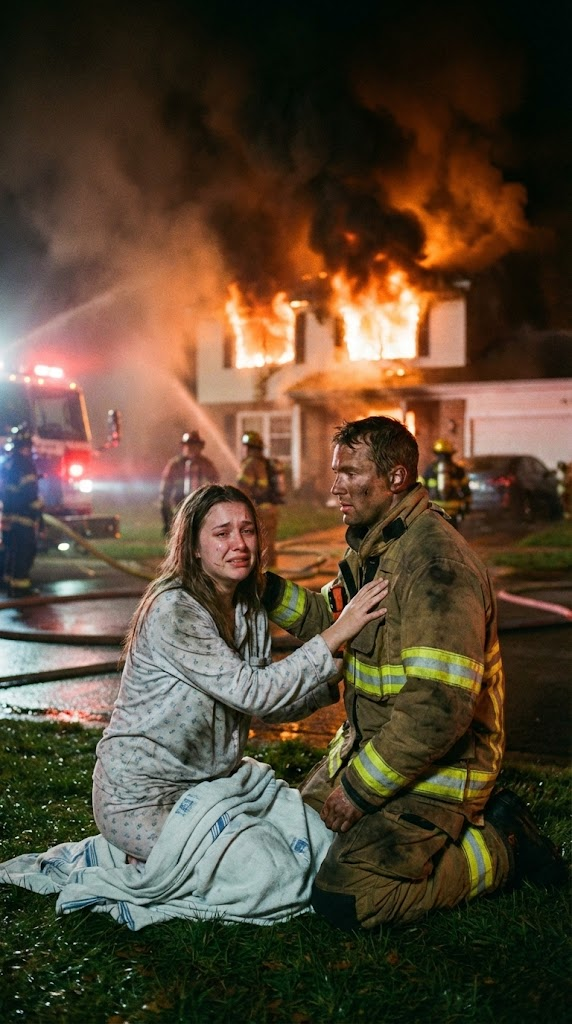
The grass was cold and wet beneath my knees, but my skin felt like it was still on fire.
The world narrowed to three things:
- The roar of the flames inside my house.
- The weight of the oxygen mask digging into my cheekbones.
- The fact that my baby’s bedroom window was still dark.
My lungs burned from the smoke I’d already taken in. Every breath tasted like chemicals. There was blood on my hands that I couldn’t remember earning. I clutched at the turnout coat of the firefighter kneeling in front of me.
“My son,” I gasped. “My son is still inside.”
He was close enough that I could see my own wild reflection in his visor. He flipped it up, just for a second, to look me in the eye.
“We know,” he said. “We’re going in for him now. You were—”
“I don’t care about me,” I snarled, surprising us both with the sound of it. “You pulled me out first. Why would you leave him—”
My voice collapsed into a cough. The medic at my side tried to ease me back, but I fought to stay upright.
I remembered everything in fractured snapshots:
- The pop of the outlet in the living room.
- The sudden burst of orange along the old curtains.
- The way the smoke had dropped from the ceiling like a curtain before my brain caught up and registered “fire.”
I’d grabbed Noah from the playmat, run for the front door, then turned back—why did I turn back? Oh. The diaper bag. My phone. The stupid, useless things you think matter when your brain is in denial.
When I opened the hallway door again, the smoke hit me like a wall. I felt my hair flash hot. I screamed, “NOAH!” and choked on my own name for him.
I never reached his room.
The last thing I remembered before waking up on the lawn was a pair of arms locking around my waist from behind and dragging me backward through the darkness while I clawed at the air.
Now, those same arms were between me and the house.
“You were on fire,” the firefighter said, shouting to be heard over the crackle and the wail of engines. “Your clothes were catching. If I hadn’t pulled you, you’d be down in that hallway right now and no one would know there was a baby.”
“Good,” I rasped. “Then you should’ve stepped over me and gone for him.”
Something twisted in his expression.
“Don’t say that,” he snapped. “Don’t you ever say that.”
Sirens wailed. Radio chatter crackled at his shoulder. A voice barked, “Second victim confirmed, infant, rear bedroom,” and the world tilted.
“There!” I coughed, pointing with a shaking hand. “You see? You knew. You knew and you left him—”
He grabbed my wrist, not hard enough to hurt, but enough to make me stop flailing.
“Look at me,” he ordered.
I did.
“Fire doesn’t work like the movies,” he said. “We don’t just run past people on the ground to grab who we think deserves saving more. We go for who we can get out right now. You were right there. He wasn’t.”
I hated him for sounding reasonable.
I hated him for being alive and breathing and not where I wanted him to be.
“I would’ve switched,” I whispered, voice breaking. “You should’ve left me.”
He flinched like I’d hit him.
For the briefest moment, something else flashed in his eyes:
- An old hurt.
- A memory of someone he hadn’t been able to pull out first, or at all.
“Yeah,” he said, voice suddenly rough. “You and every parent I’ve ever dragged out of a burning house.”
He squeezed my shoulder once.
Then, before I could curse him or beg him or cling to him, he turned.
He ran back toward the front door.
Back into the heat he’d just escaped.
Back into the kind of hell most of us only see in nightmares.
The medic swore under her breath. “He just came out,” she muttered, adjusting the flow on my oxygen. “He’s going to push himself into a heart attack.”
Good, I thought savagely. Let him feel something.
Let him feel what I felt when he chose me over my son.
I watched the doorway, waiting for him to reappear with a bundle in his arms.
He didn’t.
Smoke thickened. The roof groaned.
A chief shouted something about “pulling crews back” and “untenable conditions.”
I screamed until my throat gave out.
They sedated me at the hospital when I tried to rip off my IV and go back.
When I woke up, my husband was standing at the foot of my bed, eyes red, hands shaking.
“Where is he?” I croaked.
The firefighter saved me first. Then the fire department almost broke me with the next sentence.
A House of Dry Kindling
Before the fire, our house was already a tinderbox.
Not literally—although, judging by how fast it went up, probably that too—but emotionally.
My marriage to Ryan had been… frayed for a long time.
We weren’t the yelling kind of toxic. We were the silent kind. The kind where conversations turned into logistics and logistics turned into resentment and resentment turned into two people who lived parallel lives under the same roof, careful not to bump into each other.
We met in college. Fell in love over cheap coffee and late‑night study sessions. Got married two years after graduation in a courthouse ceremony because we were “too practical” to waste money on a big wedding.
Then real life happened:
- Student loans.
- Crappy apartments.
- Jobs that never quite paid enough.
When I got pregnant with Noah, I thought, This will bring us closer.
Ryan thought, This will lock us in.
He never said that out loud. But the version of him who used to spend Sundays wrapped around me in bed became a man who spent Sundays at Home Depot finding reasons to stay out.
Parenthood magnifies what’s already there.
Noah was colicky. He had reflux. He slept in 45‑minute increments for the first six months of his life. My maternity leave was a blur of:
- Milk stains.
- Panic Googling.
- Counting the minutes until I could hand him off to Ryan for an hour and pretend to shower.
Ryan, for his part, tried.
At first.
He got up at night sometimes. He walked the floor. He learned the trick with bouncing on the exercise ball until his knees hurt.
But every time he held our screaming son, his jaw clenched a little tighter.
“I’m trying,” he’d say through gritted teeth. “He just never stops.”
We were tired. Broke. Trapped inside a house that smelled like spit‑up and resentment.
We fought about stupid things:
- Who forgot to pay the gas bill.
- Who left dishes in the sink.
- Who “got” to go to work and who was “stuck” at home.
Firefighters talk about “fuel load”—how much in a structure will burn and how fast.
Our marriage’s fuel load was high.
Dry trust.
Old grudges.
That one time he didn’t show up to Noah’s pediatric appointment because he “lost track of time.”
That one time I threw it in his face six months later.
We were a house full of kindling, waiting for a spark.
We just didn’t expect the spark to be literal.
The Day Everything Ignited
It was a Tuesday. Not that it matters. Catastrophes sound more poetic when they fall on holidays or anniversaries, but most of them don’t. They show up on ordinary days when you’re wearing old sweatpants and there’s a half‑eaten PB&J on the counter.
Noah had just turned one. He’d finally started sleeping in three‑hour stretches. I was back at work part‑time, doing remote admin for a dental office. Ryan was working full‑time for an HVAC company, which meant our house’s heating and cooling were perfect even when everything else was falling apart.
That afternoon, Noah was doing laps around the coffee table in his walker, squealing at the cartoon animals on TV.
I was folding laundry, half‑listening to a podcast, basking in the rare feeling that things felt… almost normal.
That’s why I didn’t see the outlet.
It was behind the couch, hidden by a cheap floor lamp we’d bought on clearance. The plug was loose. The cord had a kink in it from the time Noah had pulled on it and I’d jammed it back in, promising myself I’d replace it “soon.”
“Soon” came with a shower of sparks.
I heard the pop first.
Then smelled it—sharp, hot, like burning plastic.
When I looked up, the base of the curtain was already glowing, a tiny orange bloom spreading along the cheap polyester.
“Shit,” I breathed.
I lunged for the lamp to pull it away. The curtain flared, like it had been waiting for me to add oxygen.
In seconds, flames were racing upward, licking the ceiling.
Noah laughed in the walker, clapping, thinking it was some new game.
The smoke was faster than the flames.
It dropped from the ceiling like a thick gray blanket, rolling toward us. The alarms started screaming. Noah did too.
Training videos tell you to stay low.
Instinct tells you to grab your child and run.
I scooped Noah out of the walker and bolted for the front door.
Halfway there, I realized my keys, my phone, my entire life—wallet, IDs, the emergency contact list I’d painstakingly printed—were in the diaper bag sitting on the armchair.
The smoke wasn’t that bad yet.
The flames were mostly confined to the corner.
I could see the bag.
Later, in the hospital, a fire investigator would tell me, “You had thirty seconds, maybe less, from the first visible flame until that room was untenable. Smoke kills faster than fire.”
I used those seconds to make the worst decision of my life.
I turned back.
“Hold on, baby,” I coughed, pulling my shirt over Noah’s face as if cotton could stop carbon monoxide.
The air was thicker.
My eyes stung.
I grabbed the bag, slung it over my shoulder, and that’s when the ceiling in the hallway coughed out a lungful of black smoke directly into my path.
I choked.
I dropped to my knees.
Noah slipped.
He landed on the floor with a thud and started to wail.
I tried to find him through the darkness, but the world had turned into a choking, burning maze.
One hand found the hardwood. The other found… nothing.
Panic clawed up my throat.
“NOAH!” I screamed, gulping in more poison.
My head spun.
I heard a door slam open somewhere behind me. Boots. Shouting.
Then arms—huge, unyielding—wrapped around my waist and hauled me backward.
I screamed and thrashed, trying to twist free, but the smoke, the cough, the terror—all of it crashed into black.
When I came to on the lawn, the firefighter was there.
And my baby wasn’t.
The Sentence That Broke Me
In the hospital, the white ceiling tiles looked a lot like the ones in the NICU I’d seen on TV.
Sterile.
Patterned with tiny dots that my brain tried to count so it wouldn’t have to think about why I was there.
Ryan sat in the chair by my bed, elbows on his knees, hands steepled under his chin. He looked like he’d aged ten years in one hour.
His jeans were soaked at the cuffs. His T‑shirt smelled faintly of smoke.
“What happened?” I croaked.
“We got a call at the shop,” he said. “Neighbors. The fire. They said you were out but they couldn’t find Noah. I drove here like a maniac—”
I grabbed his wrist.
“Where is he?” I demanded. “Is he in the pediatric unit? The NICU? Is he—”
“He’s gone,” Ryan said.
Two words.
That’s all.
My brain rejected them.
“What?” I said. “No. No, he can’t be. The firefighter—he went back in. He said he was going to get him. He went back into the house. I saw him.”
“He did,” Ryan whispered. “He tried. The chief said he made it all the way to the hallway. But the fire… it was already through the ceiling. The heat was… they had to pull him back or they would’ve lost him too.”
“I don’t care about him,” I snapped, ugly. “I care about my son.”
Ryan flinched like I’d thrown something.
“He found Noah,” he said. “In the hallway. They think… they think you dropped him when you went back for the bag.”
The words went in like shrapnel.
I could see it. In the dimming hallway. The smoke. The panic. My hand losing his weight.
“He was gone by the time they reached him,” Ryan continued, voice breaking. “They tried. They tried CPR. But…”
He didn’t finish.
He didn’t need to.
I saw red.
Hot, blinding rage flooded everything else.
“At least he’s safe at home,” a neighbor had said once when their kid had a scary allergic reaction. “At least you did everything you could,” a coworker had told me when Noah was sick.
No one had a platitude ready for the mother whose story was, “I went back for a bag and dropped my baby in a burning house.”
I lurched forward, ripping at my IV.
“Where is he?” I demanded. “I need to see him.”
Ryan tried to press me back. “They’re… they’re doing… paperwork,” he said weakly.
“Paperwork,” I repeated, disbelieving. “My son is dead and they’re doing paperwork?”
I shoved him away and swung my legs off the bed. Pain shot up my side, but I didn’t care.
“I need to talk to him,” I snarled. “To the firefighter. The one who decided my life was worth more than Noah’s.”
Ryan stood up fast. “Emma—”
“I want to look him in the eye,” I said, shaking. “I want to ask him why he chose me. I want to know if he has kids, and if he would have made the same call if it was his house. I want him to tell me to my face that he stepped over my son to drag out a woman who would’ve traded places.”
My heart hammered.
My throat burned.
“I want him to live with this,” I whispered. “Like I have to.”
Ryan’s shoulders sagged.
“He already does,” he said quietly.
“What does that mean?”
“The chief came by,” he said. “After they… after the coroner left. He said the firefighter who pulled you out has been here before. Couple years ago. He was on the other side of it.”
“What side?” I snapped.
“The side where his family didn’t make it,” Ryan said. “House fire. Faulty heater. He was out on a call when it happened. They said he’s been half‑in, half‑out of this job ever since. That he runs into fires like he’s hoping not to come back out.”
The world wobbled.
“So?” I spat. “So now he makes penance by picking the wrong people to save?”
Ryan shook his head. “He made the only choice he could,” he said. “You were in front of him. Noah wasn’t. He didn’t flip a coin. He didn’t weigh you against each other. He saw someone he could grab in that second and he grabbed you.”
It didn’t feel like enough.
It didn’t feel like anything.
Grief is a bonfire. It needs somewhere to burn.
I decided to aim mine at the man with the hose.
When they finally wheeled me into a small family room to talk to the fire department’s liaison, he was there.
The firefighter.
Out of gear now. In a navy T‑shirt with the department’s logo. Hair damp from a shower that hadn’t washed the soot from the lines around his eyes.
He stood when I came in, like we were at a job interview.
“Mrs. Lane,” he said.
“Don’t call me that,” I snapped. “My name is Emma. Mrs. Lane is the woman who had a baby.”
He flinched.
“I’m sorry,” he said.
It sounded too small. Too polite. Too rehearsed.
I hated it.
“I need you to explain something to me,” I said, sinking into the chair across from him because my legs wouldn’t hold me. “Why did you pull me out first?”
He sat slowly, as if someone had cut his strings.
“I was on the front porch,” he said. “We had a report of an adult and an infant trapped. We can’t see through walls, ma’am. We follow the smoke, the heat, the layout. I got to the hallway and found you on your hands and knees. Your hair and shirt were on fire. You were crawling in the wrong direction. If I’d gone past you, you’d have been unconscious in seconds.”
“You could have stepped over me,” I said. “You could have thrown a blanket on me and kept going.”
“No,” he said simply. “I couldn’t.”
“You don’t know that,” I snapped.
He looked up, and in his eyes I saw something that froze me.
Not defensiveness.
Not irritation.
Just bone‑deep exhaustion.
“Yes, I do,” he said quietly. “Because I tried that once. It didn’t work.”
I frowned. “What are you talking about?”
He swallowed, his throat working around words he didn’t want to say.
“Three years ago,” he said, “my house caught fire while I was on shift. Old wiring in the attic. My wife and little girl were inside. I was ten minutes away. By the time my crew got there, the front of the house was gone.”
He stared at the floor.
“I pulled neighbors out,” he said. “That’s what the reports say. ‘Firefighter rescues local couple.’ Hero story. What they don’t say is that I stood on my own lawn and watched my house burn because there was no safe way in by the time I arrived. That if I’d gone in, I’d have died in the hallway and no one else would have gotten out either.”
Silence pressed in.
“So when I saw you crawling into that hallway,” he continued, “I didn’t see a choice between you and your son. I saw a choice between pulling you and having a chance to go back for him… or losing you both in the same place.”
He rubbed his face.
“You can hate me for that,” he said. “I won’t argue with you. But I need you to understand—I did not choose you instead of him. I chose you first. Because you were there.”
My anger sputtered.
Grief rushed in to fill the gap.
“I went back for a bag,” I whispered. “I dropped him.”
He looked up sharply.
“You went back into a burning room to grab what you thought you needed to keep him safe after,” he said. “That doesn’t make what happened your fault. It makes you a parent whose brain wouldn’t accept that there might not be an ‘after’ without the boring, practical things we cling to.”
I shook my head, tears spilling.
“I left him,” I said. “You said you saw him. In the hallway.”
He nodded once, jaw clenched.
“Did he… was he…”
“Don’t,” he said gently. “Don’t make me give you those details. Let me carry that.”
I hated him for asking me to trust him with that.
I hated him for already carrying so much.
I hated him for being the only person who understood exactly what kind of hell I’d stumbled into.
And underneath all of that, I hated the way a small, treacherous part of me was relieved he’d dragged me out.
Because if he hadn’t, Noah would have lost both of us.
I would have left my son alone in the world with a man who could barely make eye contact with him when he cried.
“Why are you telling me about your family?” I asked, wiping my face with my wrist. “Is this supposed to make me feel better? Like ‘hey, we both lost kids in fires, solidarity’?”
“No,” he said. “It’s supposed to make you understand why pulling you out and not being able to get him will haunt me every day of my life. Why I will never, ever try to pretend I did enough.”
He took a breath.
“And why I need you to be alive to tell his story,” he added. “Because if you die too—now, or in five years when this grief eats you from the inside out—then the fire wins twice.”
I laughed then.
It was ugly and wet and half‑hysterical.
“Is that your big firefighter speech?” I asked. “I’m supposed to feel inspired?”
“No,” he said. “You’re supposed to feel pissed off enough to get out of bed every morning just to spite the universe.”
We stared at each other.
In that moment, I realized something I didn’t want to see:
I had two choices:
- Spend the rest of my life aiming a blowtorch of rage at the only person who jumped into the fire with me.
- Or aim it at the things I could actually change.
What I did next shocked every person who had watched me scream at him in that hospital family room.
I asked him for help.
The Fire We Set On Purpose
“Help?” Ryan repeated later, when we were alone. “From him?”
We were sitting on Noah’s bedroom floor.
What was left of it.
The fire had taken almost everything: the crib, the mobile, the stuffed elephant he chewed on when he was teething.
All that remained were:
- Soot‑stained walls.
- A warped picture frame.
- A singed corner of the baby blanket my sister had made, folded now in my lap like a relic.
We’d been allowed back into the wreckage under escort, just long enough to collect what little could be salvaged.
“I don’t mean moving in and braiding my hair,” I said. “I mean… he knows this. The grief. The fire reports. The way the investigation works. The way the department will talk about this like a statistic and then move on to the next call.”
Ryan stared at the blackened crib rail.
“You want to become friends with the guy who couldn’t save our kid,” he said flatly.
“I want information,” I said. “I want to know exactly how long it took from the first spark to the 911 call. I want to know how many seconds passed between the neighbor seeing smoke and the first engine pulling up. I want to know how many other houses on this block have outlets wired wrong and cheap curtains like ours.”
I looked at him.
“I want to make sure no one else does what I did,” I said, voice trembling. “Goes back for a bag. Drops their baby. I want to scream every mistake we made from a rooftop so maybe someone out there hears it and changes one thing in their house.”
Ryan’s eyes filled.
“How?” he whispered.
“By lighting a different kind of fire,” I said.
We started small.
A meeting with the fire marshal about:
- Housing codes.
- Tenant awareness.
- The fact that our rental contract said nothing about old wiring or overloaded circuits.
To their credit, they listened.
So did the firefighter.
His name was Adam, I learned.
He showed up to that meeting in uniform, stood next to me while I listed every flammable, flippant decision that had led to my son dying on our living room floor.
He backed me up when the landlord tried to shrug.
He walked us through the timeline in painful detail—not to torture us, but to answer the questions that would have otherwise eaten me alive.
Then he asked for something in return.
“Come talk at the station,” he said. “To the new recruits. To the guys who think they’ll always be fast enough, strong enough, smart enough to beat the flame. They need to hear from someone whose life doesn’t fit in the margins of the report.”
I almost said no.
Standing in front of firefighters felt like standing in front of the jury and judge and executioner all at once.
But I went.
I told them everything:
- About the outlet I ignored.
- About the curtain I never replaced.
- About going back for a bag.
- About the way I’d wanted to rip Adam’s face off for dragging me out instead of finding Noah.
I told them how the department’s phrase “primary victim removed” felt like a knife.
“You’re trained to go for whoever you can reach first,” I said. “I get that. But the people you pull out? We’re the ones who have to live with the words you use after. Don’t call us ‘lucky.’ Don’t tell us ‘at least you’re okay.’ Say ‘I’m sorry your child died and I wish I could’ve done more.’ It’s the truth, and we can handle it.”
When I finished, the room was quiet.
It was quiet in a different way than the fire.
Less roaring.
More thinking.
Afterward, one young recruit came up to me, eyes shiny.
“My sister has a baby,” he said. “I’m going to go home tonight and check every outlet in her apartment.”
That became the first spark.
From there:
- The department started a campaign on electrical safety in older rentals.
- Our landlord was forced to update wiring in all his properties.
- The local news did a story—not on “hero firefighter saves mom” but on “small safety mistakes that turn deadly.”
They used my face.
They used my voice.
They used Adam’s, too.
“We don’t want applause,” he said on camera. “We want people to stop giving us so much to put out.”
People online called me brave.
I didn’t feel brave.
I felt like a woman whose house had already burned down, who had nothing left to lose by telling the truth.
Adam came over one night after a particularly brutal call. He sat at our kitchen table, hands still stained with soot, and said, “We lost a kid today.”
I poured him coffee and didn’t tell him, “At least you tried.”
He already knew.
I said, “Tell me about her,” and he did.
Grief, like fire, needs oxygen.
You can smother it.
Or you can build a structure around it and let it light something useful.
Years later, when people see the scar on my forearm and ask how I got it, I tell them, “House fire. My fault. Want to hear the story? It might save your life.”
Sometimes they look uncomfortable.
Sometimes they lean in.
Sometimes they joke, “Wow, thank God the firefighter got you out, huh?”
I always say the same thing.
“He pulled me out first,” I say. “Not instead.”
I know that now.
Because I’ve seen Adam leave his halligan bar on the lawn and run into another stranger’s house like he’s still trying to rewrite mine.
I’ve seen him sit in his truck afterward, head in his hands, like the smoke followed him there.
And I’ve chosen—over and over—not to aim my rage at the one person who grabbed me when I didn’t know I needed grabbing.
The firefighter pulled me out first.
My baby was still inside.
Both of those truths will always be true.
So is this one:
Every time I tell our story and someone goes home and:
- Replaces a frayed cord.
- Moves a crib away from a vent.
- Tests their smoke alarms.
My son’s life echoes.
It doesn’t fix what happened.
Nothing can.
But it means the fire didn’t get the last word.
We did.