The Forty-Seven Minutes That Changed Everything
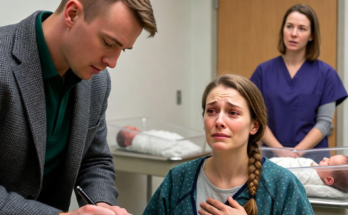
I held my daughter for forty-seven minutes. That’s all the time we had.
The nurse wouldn’t let me hold her any longer. Hospital policy, she said. My arms were still warm from where Emma had been pressed against my chest, her tiny fingers wrapped around mine like she’d never let go. But they made me let go.
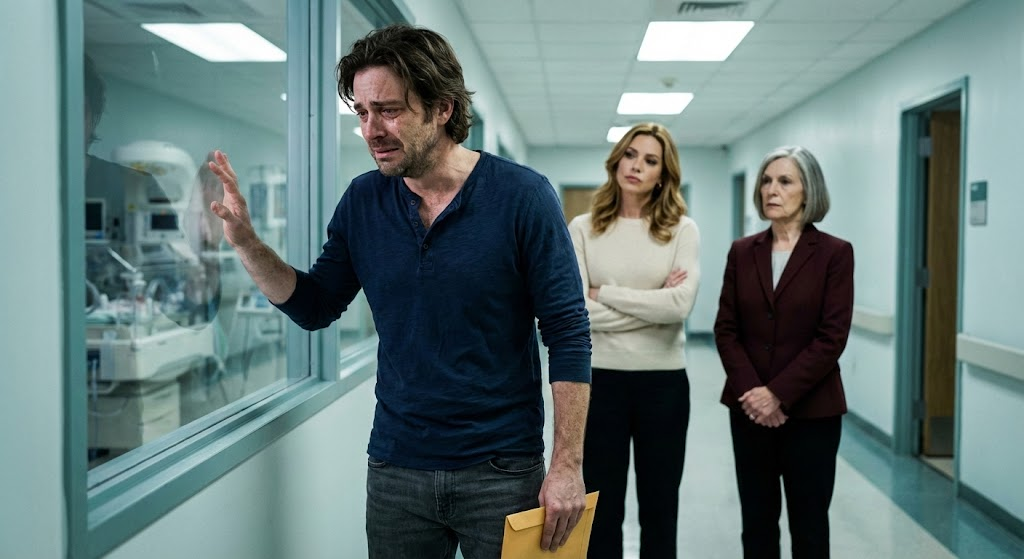
My wife Sarah stood in the doorway with her mother, both of them crying those perfect, camera-ready tears. The kind that don’t smudge mascara. I remember thinking that was strange—who wears makeup to a hospital at 3 AM?
“We need to talk,” Sarah whispered, her voice cracking in that way I’d learned to recognize over six years of marriage. The way it cracked when she wanted something. When she was about to deliver news that would destroy me.
Her mother handed her a manila envelope. The same kind of envelope I’d seen in her purse three days earlier, hidden under receipts and old gum wrappers. The same envelope I’d convinced myself was nothing—maybe insurance paperwork, maybe medical bills.
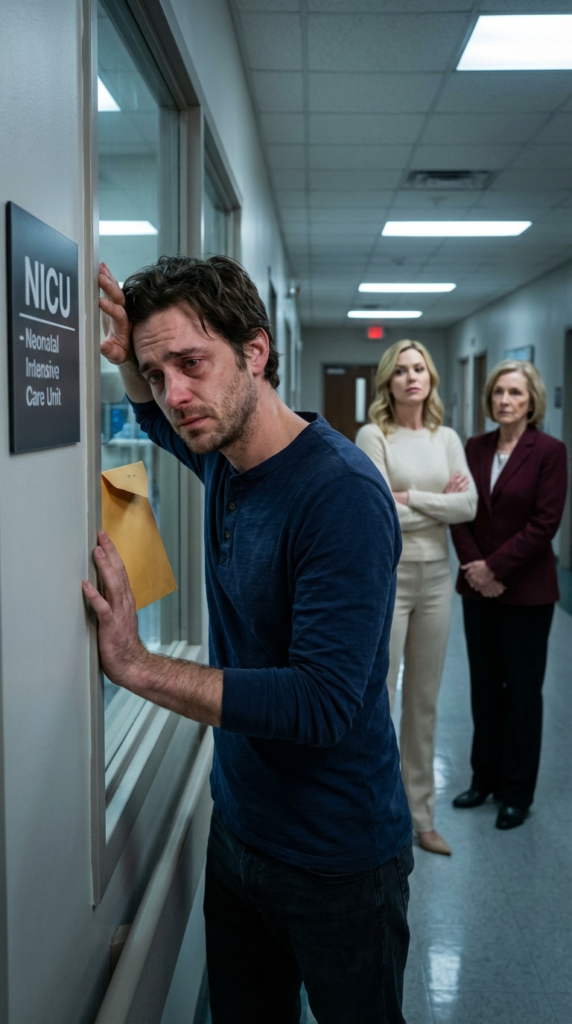
Emma had stopped breathing twenty minutes after birth. They brought her back, but the doctors said the next forty-eight hours were critical. And here was Sarah, in the hallway of the NICU, holding an envelope like it was more important than our daughter fighting for her life fifteen feet away.
“Not now,” I said. My voice sounded foreign. Hollow.
“Yes, now.” She pushed the envelope toward me. “Before you sign anything. Before you make any decisions about her care.”
Her. Not our daughter. Not Emma. Her.
My hands shook as I took the envelope. I could feel the weight of papers inside, the sharp edges of what felt like photographs. Through the small window in the NICU door, I could see Emma’s tiny chest rising and falling with the ventilator, tubes running everywhere, monitors beeping a rhythm that had become my heartbeat.
“Open it,” Sarah’s mother said. Not Sarah. Her mother.
The Documents That Shattered Everything
I tore open the envelope right there in the hospital corridor, under the fluorescent lights that made everything look like a crime scene. Inside were three things: a paternity test, a series of photographs, and a letter from Sarah’s attorney.
The paternity test was dated two weeks before Emma’s birth. Sarah had ordered it while she was still pregnant. The results showed a 0% probability that I was Emma’s biological father.
The photographs showed Sarah with Marcus—her “just a friend” from her yoga class. The same Marcus who’d been at our house for dinner a dozen times. The same Marcus who’d helped me move furniture and fix the fence last summer while making jokes about what a lucky guy I was.
The attorney’s letter outlined Sarah’s demands: she wanted full custody, the house, alimony, and child support. For a child that wasn’t mine. The letter explained that under state law, because we were married when Emma was born, I was legally presumed to be the father regardless of biology. Unless I contested paternity within the next thirty days, I’d be financially responsible for Emma for the next eighteen years.
But there was more. A handwritten note from Sarah, tucked behind the legal documents:
“I’m sorry you had to find out this way. Marcus and I have been together for two years. I tried to time things so you wouldn’t know, but Emma came early. We want to be a family—the three of us. I need you to walk away. Sign the papers. Don’t make this harder than it has to be. You were always too soft for me anyway. Marcus is everything you could never be.”
Too soft. After six years of working seventy-hour weeks to pay for her lifestyle. Too soft, after putting her through graduate school while I deferred my own dreams. Too soft, after every dinner with her critical mother where I smiled through comments about how I’d “trapped” her daughter with marriage.
I looked up at Sarah. Her makeup was perfect. Her hair was styled. She’d planned this moment down to the lighting.
“You ordered a paternity test two weeks before she was born,” I said slowly. “You knew there was a chance. And you said nothing.”
“I had to be sure,” Sarah replied, her voice cold now that the performance was over. “And now I am. Marcus is going to be an amazing father. You… you’re just the mistake I made before I found him.”
The Backstory: Six Years of Calculated Cruelty
I met Sarah during her first year of law school. I was working as a junior architect at a firm in downtown Portland, pulling long hours but loving every minute of designing spaces where families would build their lives. She was brilliant, beautiful, and had this way of making you feel like you were the only person in the room.
The red flags were there from the beginning, but I was too in love to see them.
Her mother, Patricia, never approved of me. I wasn’t from the right background—my dad was a contractor, my mom a schoolteacher. We were comfortable, but we weren’t country club comfortable. Patricia made sure I knew it at every family gathering. “Architecture is a nice hobby,” she’d say with that smile that never reached her eyes. “But Sarah is going to need stability. Real financial security.”
Sarah would defend me in public and criticize me in private. “Mom has a point,” she’d whisper after we left another uncomfortable dinner. “When are you going to make partner? When are we going to be able to afford the life I deserve?”
I proposed anyway. I thought marriage would change things, that her family would finally accept me, that Sarah would stop comparing me to her father’s hedge fund manager friends.
Instead, it got worse.
Sarah graduated law school and joined her father’s firm. Suddenly, she was making three times my salary. Her friends were all wealthy couples with vacation homes and designer wardrobes. I became the embarrassing husband who drove a practical Honda and wore suits from Men’s Wearhouse.
“You’re holding me back,” she said one night after I declined another expensive vacation I couldn’t afford. “Everyone at the firm is asking why my husband is still working for someone else. Why haven’t you started your own practice? Why are you so afraid to take risks?”
I started working more. Took on freelance projects. Saved every penny to start my own firm. I wanted to prove I could be the man she needed.
Meanwhile, Marcus appeared.
He was everything I wasn’t—confident, wealthy, with a trust fund and a family name that opened doors. He’d sold a tech startup in his twenties and now “consulted” between sailing trips and mountain retreats. Sarah started going to yoga. Then spin class. Then weekend wellness retreats where phones were “prohibited” and I couldn’t reach her.
“You’re being paranoid,” she’d say when I asked about the late nights. “Marcus is just a friend. You’d really like him if you weren’t so insecure.”
So I invited him over for dinner. I wanted to prove I wasn’t insecure, that I could be the bigger person. He showed up with expensive wine and stories about Bali. He was charming. He asked about my work with genuine interest. He seemed like a decent guy.
I didn’t know they’d been sleeping together in our bed while I was at work.
Then Sarah got pregnant. She cried when she told me—happy tears, she said. I cried too. I thought maybe this was the fresh start we needed, that a baby would remind her why we fell in love.
But she was distant during the pregnancy. Anxious. She snapped at me constantly, started sleeping in the guest room because she “needed space.” Her mother visited more, always watching me with that knowing look, like she was waiting for something to happen.
Now I knew what she was waiting for. They’d all known. Sarah, Marcus, Patricia—they’d all known Emma might not be mine, and they’d let me paint the nursery, attend the childbirth classes, and fall in love with the idea of being a father.
The Moment of Truth
I stood in that hospital hallway, holding papers that proved my entire marriage was a lie, watching my wife—my soon-to-be ex-wife—check her phone. She was texting. Probably Marcus.
Emma’s monitor started beeping erratically inside the NICU. Nurses rushed toward her incubator. A doctor shouted for equipment. Through the window, I could see Emma’s tiny body convulsing, machines flashing red.
I dropped the papers and ran toward the door.
Sarah grabbed my arm. “Wait. We need to finish—”
I shoved past her. Security tried to stop me, but I showed my hospital bracelet, the one they’d given me as Emma’s father. They let me through.
The next six hours were a blur of surgeries, consultations, and prayers to a God I wasn’t sure I believed in. Emma had suffered a brain hemorrhage. The doctors stabilized her, but they warned us about long-term complications—developmental delays, possible paralysis, a lifetime of medical interventions.
Sarah stayed in the hallway with her mother. I stayed by Emma’s side.
At 11 PM, a different doctor came in—Dr. Chen, the head of pediatric neurology. She pulled up a chair next to me.
“Mr. Cooper, I need to discuss treatment options. Given Emma’s condition, she’ll need specialized care for potentially the rest of her life. We’re looking at multiple surgeries, intensive therapy, constant monitoring. The costs will be substantial, and the emotional toll on the family will be severe. I need to know you’re prepared to commit to this.”
I looked at Emma, this tiny person who shared none of my DNA but had somehow become my entire world in forty-seven minutes.
“What do I need to sign?” I asked.
Dr. Chen hesitated. “I spoke with your wife. She mentioned there might be questions about… your legal standing as Emma’s father.”
“I’m her father,” I said. “Whatever she needs, I’ll provide. Whatever it costs, I’ll pay. However long it takes, I’ll be here.”
“Even if—”
“Even if she’s not biologically mine. Even if her mother wants nothing to do with me. Even if the next eighteen years bankrupt me. She’s my daughter.”
Dr. Chen nodded slowly. “The hospital attorney will need you to sign some additional paperwork then. Given the circumstances, they want to ensure—”
“I’ll sign everything,” I interrupted. “Just save her.”
The Counter-Move
Over the next three days, while Emma fought for her life, I made phone calls.
First, to a family law attorney—not one of Sarah’s father’s friends, but a woman who’d made her career destroying wealthy men who underestimated her. Her name was Rebecca Torres, and her reputation was legendary.
“I won’t lie to you,” Rebecca said during our first consultation. “Texas law presumes you’re the father because you were married when the child was born. Your wife is trying to use that against you—trap you with financial responsibility while giving you no parental rights. But we can flip this.”
“How?”
“You formally acknowledge paternity now, immediately. Before she can contest it. You establish yourself as Emma’s legal father on the record, with the full weight of the law behind you. Then you file for full custody based on Sarah’s abandonment during Emma’s medical crisis. Three days ago, you found out about her affair. Three days ago, Emma nearly died. And where was Sarah? In the hallway with her lawyer, trying to avoid medical decisions. That’s abandonment.”
“But the DNA test—”
“Is irrelevant if you claim paternity first. Biology and legal parenthood are two different things. You’re choosing to be Emma’s father, and once you do that, Sarah can’t take it away without proving you’re unfit. Can she prove that?”
I thought about the last seventy-two hours. Me, sleeping in a chair by Emma’s incubator. Sarah, showing up for an hour each day, always with Patricia, always leaving before having to make any medical decisions.
“No,” I said. “She can’t.”
“Then we move fast.”
Within twenty-four hours, I’d signed legal acknowledgment of paternity, filed for emergency custody, and documented every moment Sarah had chosen her attorney over her daughter. Rebecca also hired a private investigator.
What we found changed everything.
The Investigation
Marcus wasn’t a successful entrepreneur who’d retired young. He was a con artist who’d been engaged to three different women simultaneously across two states. The “tech startup” he’d sold never existed. The trust fund was a lie. He made his money running investment schemes targeting wealthy, lonely women—and Sarah wasn’t his first lawyer’s daughter.
Marcus had been systematically draining Sarah’s bank accounts for eighteen months. The weekend retreats weren’t romantic getaways—they were opportunities for him to meet with other marks while keeping Sarah isolated. The pregnancy wasn’t planned romance—it was Marcus’s exit strategy. Once Emma was born and he could establish paternity, he planned to sue Sarah for child support using her own family law firm’s tactics against her.
But Emma came early. The DNA test revealed Marcus wasn’t the father either.
There was a third man.
The Truth Unveiled
The private investigator tracked him down in three days. His name was David Chen—Dr. Chen’s nephew, a nurse who’d worked at the fertility clinic where Sarah had gotten prenatal vitamins. He was twenty-three, drowning in student loans, and had no idea Sarah existed beyond the one-night encounter at a medical conference.
When Rebecca showed me the evidence—credit card receipts, hotel records, David’s testimony—I felt something break inside me that had nothing to do with heartbreak. It was the final thread of who I’d been, the man who’d tried so hard to be enough for a woman who’d never intended to let anyone be enough.
Sarah had been sleeping with at least three men during our marriage. She’d gotten pregnant, hoped it was Marcus’s, and when the timing didn’t match, ordered a paternity test that excluded both Marcus and me. Rather than come clean, she’d decided to trap whoever was legally easiest to manipulate.
That was me. The soft husband. The one who’d never fight back.
The Courtroom Reckoning
The emergency custody hearing was held eight days after Emma’s birth. She was still in the NICU, still fighting, but stable enough that Dr. Chen testified she’d likely survive with proper care and support.
Sarah showed up with her father’s best attorney, a man who’d built his career on destroying fathers in custody battles. He stood up with confidence, ready to argue that I had no biological claim to Emma and therefore no right to make medical or custodial decisions.
Then Rebecca handed the judge a folder.
Inside was everything: the affair with Marcus, the con Marcus had been running, the third man Sarah had been with, the timeline of Sarah’s abandonment during Emma’s medical crisis, and most damning of all—text messages between Sarah and Patricia discussing their plan to “trap the soft one with child support and take the house.”
The judge read in silence for ten minutes. When he looked up, his expression was ice.
“Mrs. Cooper,” he said, “you ordered a paternity test while pregnant, discovered your husband wasn’t the biological father, and said nothing. You allowed him to bond with this child, invest emotionally and financially in her future, and then attempted to use his legal presumption of paternity as a weapon to extract financial support while denying him parental rights. Is that correct?”
Sarah’s attorney jumped in. “Your Honor, my client was protecting herself from—”
“I’m asking Mrs. Cooper.”
Sarah’s voice was small. “I… I was confused. The pregnancy was complicated, and I—”
“You were texting your co-conspirator mother about taking his house while your daughter was having brain surgery,” the judge interrupted. “The hospital has timestamps. You spent forty-seven minutes total with your daughter in eight days. Mr. Cooper hasn’t left her side except to attend this hearing.”
He turned to me. “Mr. Cooper, you knowingly acknowledged paternity of a child who isn’t biologically yours. You understand this makes you legally and financially responsible for her upbringing?”
“Yes, Your Honor.”
“Even though your wife committed fraud, betrayed your marriage, and attempted to manipulate you into financial servitude while excluding you from this child’s life?”
“Emma needs a parent who chooses her,” I said. “Biology doesn’t make someone a father. Showing up does. I’m showing up.”
The judge nodded. “Full custody to Mr. Cooper, effective immediately. Mrs. Cooper will have supervised visitation if she chooses to pursue it, pending a psychological evaluation and completion of parenting classes. Given the evidence of financial manipulation and conspiracy, I’m also freezing marital assets pending a full audit and investigation into Mrs. Cooper’s conduct. This court does not look kindly on parents who treat their children as pawns in financial schemes.”
Sarah’s face went white. Her attorney started arguing, but the judge had already moved on to the next case.
Rebecca leaned over and whispered, “She’s going to lose everything. The house, her credibility at her father’s firm, possibly her law license if the bar association investigates the fraud. You just won.”
But I didn’t feel like I’d won. I felt like I’d survived.
The Months After
Emma came home from the hospital after six weeks. She had a feeding tube, required physical therapy three times a week, and would need at least two more surgeries before her first birthday. The medical bills were astronomical. I sold the house Sarah had wanted so badly and moved into a smaller apartment near the children’s hospital.
Sarah never showed up for her supervised visitations. She filed for divorce, accepted a settlement that left her with nothing but her car and half her retirement account, and moved to California with Marcus—who was arrested three months later for wire fraud in an unrelated scheme.
Patricia tried to contact me once, claiming she’d been protecting her daughter. I blocked her number.
David, the biological father, met Emma when she was four months old. He was terrified, broke, and overwhelmed—but he was there. We worked out an informal arrangement where he could visit when his nursing shifts allowed. He never asked for custody, never demanded rights. He just showed up sometimes with stuffed animals and sat with her while I grabbed coffee or took a shower.
“I don’t know how to be a dad,” he told me once. “But you’re showing me it’s possible.”
Emma is two years old now. She has developmental delays, wears leg braces, and will likely need assistance for many years. She’s also the funniest, most determined person I’ve ever met. She says “Dada” when I walk in the room. She laughs at terrible jokes. She fights through every therapy session with the kind of courage I’m still learning to have.
Last week, I took her to the park. Another father was there with his daughter, and they started talking about biology, about how his daughter had his eyes, his smile.
“Does she look like you?” he asked, nodding toward Emma.
I looked at Emma, this tiny warrior who’d survived so much, who chose to love the world despite the world’s cruelty.
“She looks exactly like my daughter,” I said.
Because that’s what she is. Not biology. Not a legal document. Not forty-seven minutes that should have been forever.
She’s my daughter because I chose her, and I keep choosing her, every single day.
Epilogue: What Happened Next
Six months ago, Sarah’s law license was suspended pending an ethics investigation. Her father’s firm quietly asked her to resign after clients started questioning the family’s integrity. She’s working as a paralegal in Orange County, posting inspirational quotes on Instagram about “new beginnings” and “releasing toxic people.”
Marcus is serving eighteen months for fraud. He’s already lined up his next mark—a woman who teaches meditation classes at the prison.
David graduated nursing school and got a job at the children’s hospital where Emma receives her care. He stops by our apartment once a week for dinner. Emma calls him “Dabid” and makes him read “Goodnight Moon” approximately forty-seven times per visit.
Rebecca became a friend. She sends Emma birthday presents and sometimes texts me articles about custody reform. “You’re why I do this work,” she told me once. “Most people walk away when it gets hard. You ran toward it.”
As for me, I started my own architecture firm last year. It’s small—just me and two junior associates—but we specialize in designing accessible homes for families with special needs children. I understand now what I’m building toward.
Emma starts preschool in three months. She’s nervous. So am I. But we’ll figure it out together, because that’s what families do.
Not families bound by blood or legal documents or forty-seven-minute counting.
Families bound by choice. By showing up. By loving someone not because you have to, but because you can’t imagine doing anything else.
I held my daughter for forty-seven minutes, and it changed my entire life.
But I’ve held her every day since, and that’s what made me a father.