I couldn’t feel my legs anymore. The cold had stopped burning and started numbing, which I knew from training was a bad sign. Really bad.
My vision blurred as I tried to lift my head from the snow. The last thing I remembered was responding to a domestic disturbance call on Maple Street—a routine winter wellness check that should’ve taken twenty minutes. Then my chest started hurting. Not the sharp pain you see in movies, but a dull, crushing weight that spread down my left arm like someone was squeezing my heart in a vice.
I’d radioed for backup before I hit the ground. Or did I? Everything after that moment was fragments—the taste of metal in my mouth, the sound of my own breath getting shallower, the feeling of falling into the deepest snow I’d ever seen.
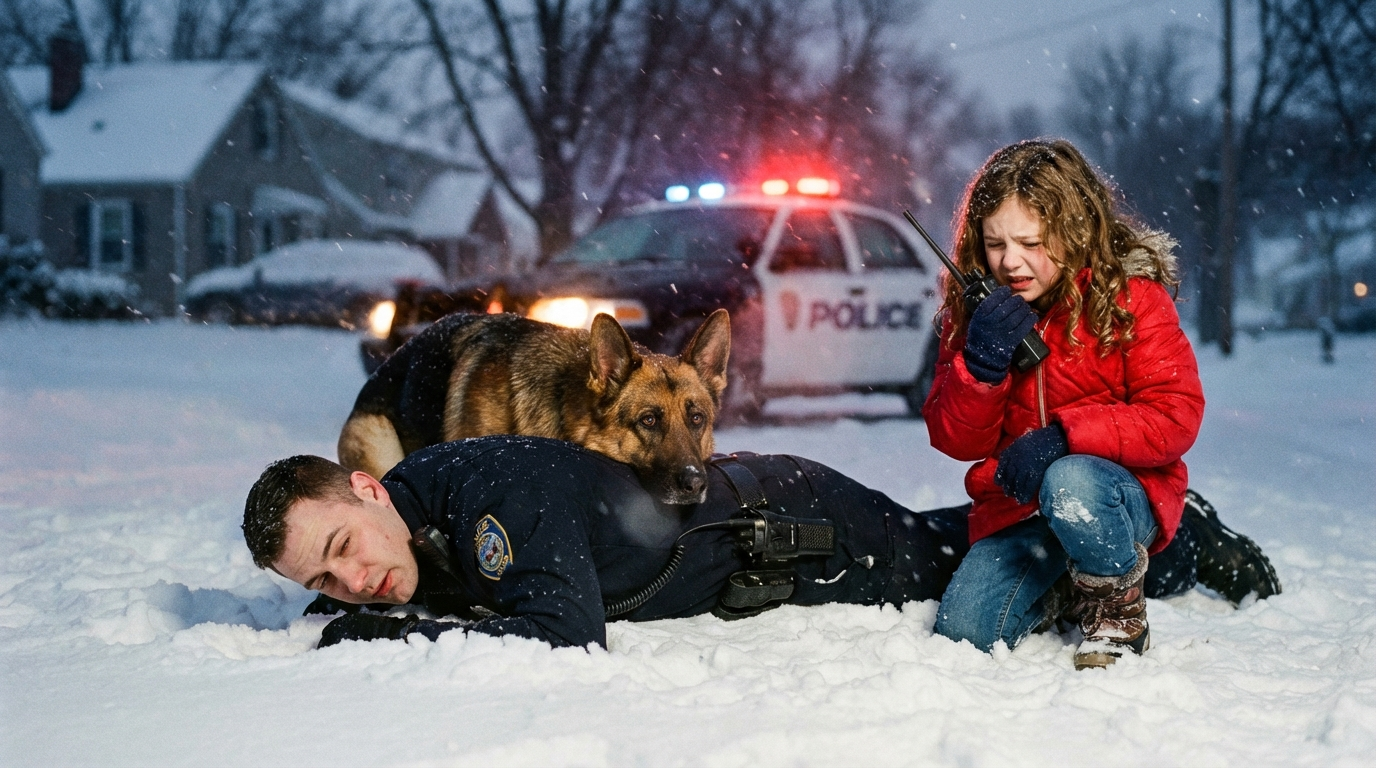
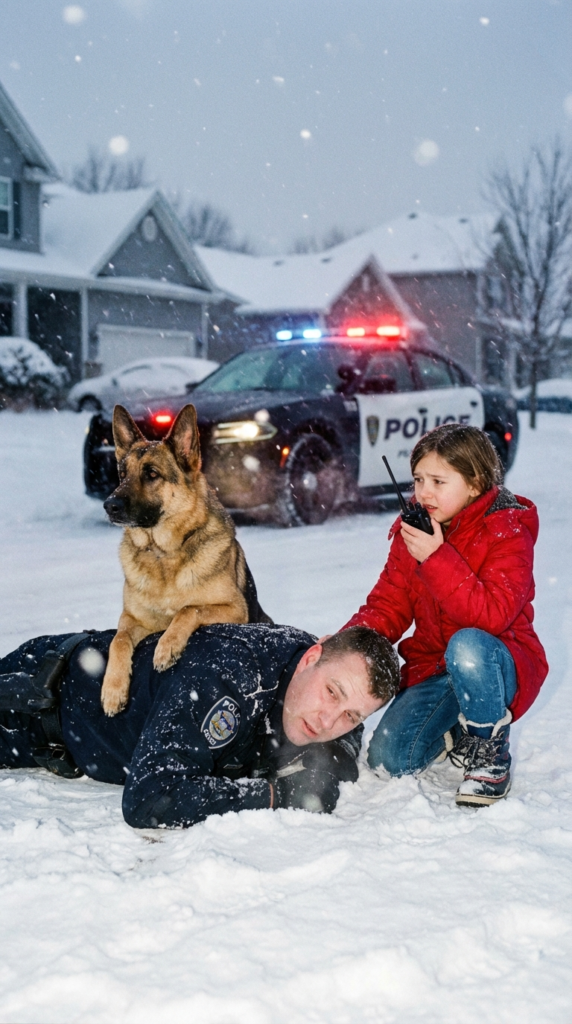
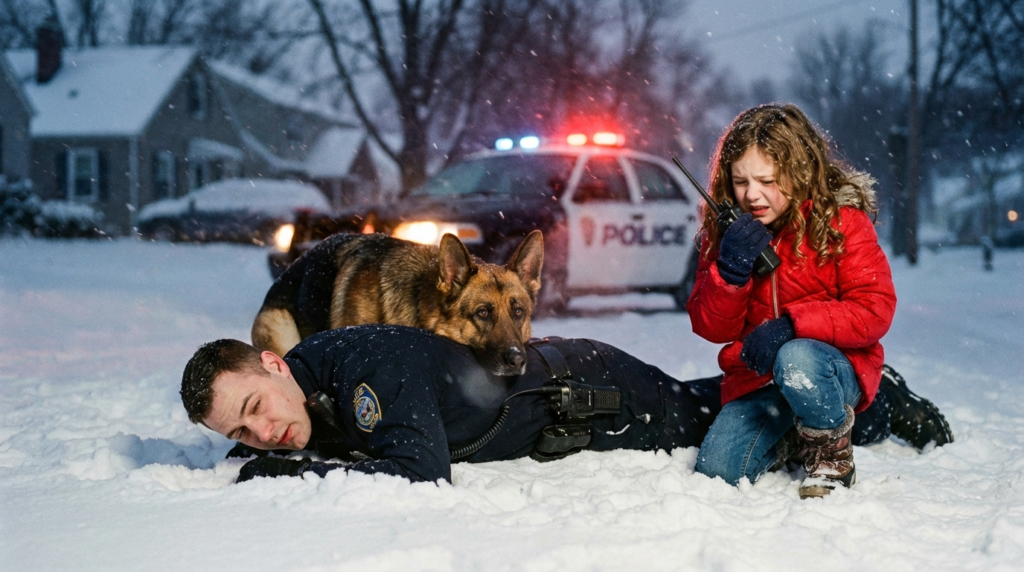
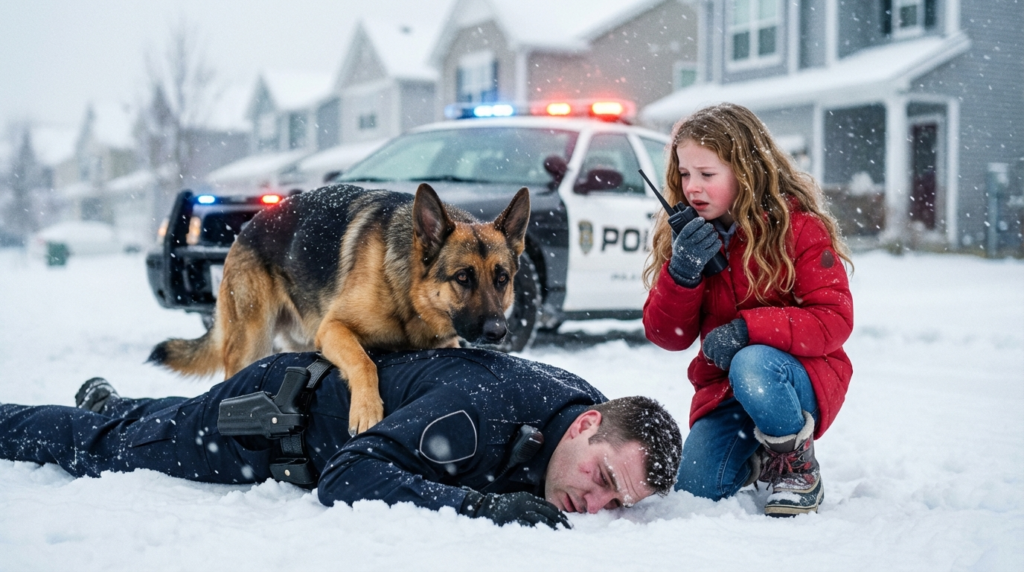
Then I felt Rex. My German Shepherd partner, all ninety pounds of him, pressing his warm body against my chest. His hot breath on my face. The desperate whining sound he only made when something was seriously wrong.
Through the white haze, I heard a small voice. “Mister? Mister, are you sleeping?”
A little girl. Red coat. Maybe six or seven years old. Her face was so close to mine I could see the snowflakes caught in her eyelashes.
“My mommy says not to talk to strangers,” she whispered, her voice shaking. “But you look really cold. And your doggy looks scared.”
I tried to speak. Tried to tell her to run, to get help, to go back inside where it was warm. But my mouth wouldn’t work. My radio was somewhere under me in the snow. My phone was dead. My backup wasn’t coming fast enough.
Her name was Emma. I wouldn’t learn that until later, but in that moment, she was just a small figure in a red coat who refused to follow the rules.
“I’m going to get my blanket,” she announced, already running toward a nearby house. Rex barked—once, sharp and commanding—and she stopped. “He wants me to stay?”
Rex pressed harder against my chest, his weight becoming almost uncomfortable. But I understood. He was using his body heat. Trying to keep me warm. Trying to keep me conscious.
Emma knelt beside us, her small gloved hand touching my shoulder. “My grandpa had a heart thing,” she said matter-of-factly. “He turned all white like you. Mommy called 911 really fast.”
Through my fading consciousness, I felt her unzip my jacket. Felt her tiny hands fumbling for my radio. She couldn’t have weighed more than fifty pounds, but she was yanking equipment off my belt with determination I’d only seen in seasoned officers.
“Hello?” Her voice crackled over the radio. “This is Emma Rodriguez at… um… I live at 2847 Maple Street. There’s a police man in the snow and he looks really sick. His dog is here too. Please come fast.”
The dispatcher’s voice came back immediately, professional but urgent. “Sweetie, this is Officer Williams. You’re doing great. How old are you?”
“Six and three-quarters.”
“That’s wonderful. Can you tell me if the officer is breathing?”
Emma leaned close to my face, her cold nose almost touching mine. “I can feel his breath. It’s warm but really slow.”
“Perfect. Now I need you to do something very important. Can you unzip his jacket more and feel if his chest is moving up and down?”
I wanted to tell them no. Wanted to tell Emma to run inside, to let the adults handle this. I was a fourteen-year veteran of the Chicago Police Department. I’d survived two shootings, countless dangerous calls, and a divorce that nearly broke me. I didn’t need a six-year-old saving my life.
But Emma didn’t care what I needed. She cared about what I needed to survive.
I’d become a cop for all the wrong reasons. Not to serve and protect—though I told myself that lie for years—but because I was running from something. My father had been a cop. A bad one. The kind who used his badge to intimidate, to control, to hurt people who couldn’t fight back.
When he died of a heart attack at fifty-three, the department gave him a hero’s funeral. They folded a flag and handed it to my mother. They said things like “he gave his life to this city” and “he was one of the good ones.”
I knew different. So did my mom, though she never said it out loud. So did the people in our neighborhood who crossed the street when they saw him coming.
I joined the force thinking I could be different. Better. Kinder. I’d be the cop who actually helped people instead of making them afraid. I got Rex three years ago after my divorce, and he became my only real friend. My only family.
But somewhere along the way, I’d become cold. Not cruel like my father, but distant. Professional. I responded to calls, filled out reports, and went home to an empty apartment. I stopped seeing people as people and started seeing them as calls to be cleared, problems to be solved, boxes to be checked.
I’d forgotten why I’d become a cop in the first place.
And now, lying in the snow with my heart failing, a six-year-old girl was reminding me.
The dispatcher kept Emma on the radio for what felt like hours but was probably only twelve minutes. She talked Emma through checking my pulse, keeping me warm, and watching for signs I was getting worse.
“Is the doggy trained?” the dispatcher asked.
“He has a vest that says POLICE,” Emma reported.
“Good. That means he’s a working dog. He’s going to protect both of you until help arrives. Stay close to him.”
Rex seemed to understand. He shifted his position so his body covered more of my torso, his head resting near my face. Every few seconds, he’d lick my cheek—not affectionate kisses, but deliberate, purposeful licks meant to keep me conscious.
Emma started talking to me. About her kindergarten class. About her teacher, Miss Martinez, who had a funny laugh. About her baby brother who cried too much but was “actually pretty cute.” About how her daddy was a firefighter and how she wanted to be one too when she grew up “because they help people.”
She was using her six-year-old voice to keep me tethered to consciousness. To give me something to focus on besides the pain and the cold.
At some point, I heard voices. Adult voices. Emma’s mother screaming her name. A neighbor yelling to call 911. But Emma didn’t move.
“I’m helping,” she announced to whoever was trying to pull her away. “The dispatcher lady said to stay with him.”
“Emma, sweetie, let the grown-ups—”
“No!” Her voice turned fierce, protective. “He needs me. His dog needs me. I’m NOT LEAVING.”
Rex growled—low and warning. He wasn’t aggressive with Emma, never, but he made it clear: nobody was getting between him and his handler. Not even well-meaning neighbors.
The paramedics arrived in a blur of red lights and urgent voices. I remember hands on my body, warm blankets, an oxygen mask being pressed to my face. I remember someone trying to move Rex and him refusing to budge until a female paramedic—smart woman—let him walk beside the stretcher to the ambulance.
The last thing I saw before they loaded me in was Emma, standing in the snow in her red coat, tears streaming down her face, her mother’s arms around her.
I tried to raise my hand. Tried to say thank you. But darkness took me before I could form the words.
I woke up three days later in a hospital bed. The doctor told me I’d had a heart attack caused by an undiagnosed arrhythmia. That without immediate intervention, I would’ve died in that snow. That the hypothermia actually helped slow my heart rate enough to keep me alive until the paramedics arrived.
That a little girl’s quick thinking and a K-9’s loyalty had saved my life.
My captain visited. My ex-wife sent flowers with a card that said “Glad you’re okay.” My mother came and cried and told me my father had had the same heart condition, but nobody knew because he’d hidden it.
But I kept thinking about Emma. About the fact that she’d broken every rule her parents had taught her about stranger danger because she couldn’t walk past someone who needed help. About the fact that she’d stayed when grown adults had driven past my patrol car without stopping.
On day five, I got a visitor I wasn’t expecting.
A woman in her thirties, dark hair pulled back, eyes red from crying. She was holding the hand of a small girl in a red coat.
Emma.
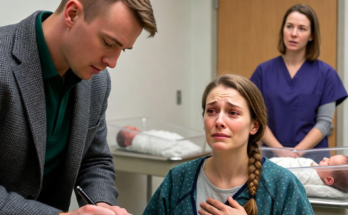
“Officer Jennings,” the woman said, her voice breaking. “I’m Maria Rodriguez. Emma’s mother. I… I needed to see if you were okay. Emma hasn’t slept right since that day. She keeps having nightmares that you died and she couldn’t save you.”
I looked at Emma. She was staring at the floor, her small shoulders hunched.
“Emma,” I said softly. My voice was still rough from the breathing tube they’d removed the day before. “Can you look at me?”
She raised her eyes slowly, and I saw the fear there. The trauma of watching a grown man nearly die in front of her. The weight of responsibility she’d carried for six days, wondering if she’d done enough.
“You saved my life,” I told her. “Not just because you called for help, but because you stayed. You kept me warm. You kept me fighting. You are the bravest person I’ve ever met.”
A tear rolled down her cheek. “I was really scared.”
“I know. Being brave doesn’t mean you’re not scared. It means you do the right thing even when you’re terrified.”
Her mother was crying now too. “The police chief came to our house yesterday. He wants to give Emma a civilian commendation. But I wanted to ask you… is it okay? I don’t want to upset you or make this about publicity. We just… we just needed to know you were alive.”
I was released from the hospital two weeks later with medications, a pacemaker, and strict orders to take three months of medical leave. Rex came home with me, and for the first time in years, I actually felt grateful to be alive.
But I couldn’t stop thinking about Emma. About all the other Emmas in our city who were growing up afraid of cops. About how I’d spent fourteen years behind a badge without really connecting to the people I was supposed to serve.
About how my father’s legacy was still poisoning the relationship between police and community.
I made a decision that made my captain think I’d lost my mind.
I started a program called “Community K-9 Kids.” Every Saturday, Rex and I visit schools, libraries, and community centers in high-crime neighborhoods. We teach kids about police work, about kindness, about how to help people in emergencies. We answer their questions—even the hard ones about police violence, about fear, about why some cops are bad and some are good.
Emma is our assistant teacher. Her mother brings her every Saturday, and she helps demonstrate CPR, shows kids how to call 911, and tells her story to anyone who’ll listen.
The program grew faster than I expected. Other officers with K-9 partners joined. We expanded to monthly community cookouts where kids could meet officers without fear, without the context of crime or punishment. Just humans connecting with humans.
Six months after my heart attack, Emma’s father—the firefighter—told me something that made me break down crying in a McDonald’s parking lot.
“My daughter used to hide when she saw police cars,” he said. “After what happened to her uncle a few years back, she thought all cops were scary. But now? Now she tells everyone at school that police officers are heroes. That they need help sometimes just like regular people. That kindness is the most important thing.”
He paused, his voice thick. “You gave me my daughter back, man. You showed her that the world isn’t all bad.”
It’s been eighteen months since that day in the snow. My heart is stable. Rex is still my partner, though we’re on modified duty now—more community outreach, less high-stress calls. Emma just turned eight and wants to be a paramedic “because they save police officers.”
I think about my father sometimes. About how he could’ve used his badge to build bridges instead of walls. About all the kids he scared instead of helping. About the legacy of fear and mistrust he left behind.
I can’t change what he did. But I can spend the rest of my career undoing it, one Emma at a time.
Last week, I got a letter from a mother in one of the neighborhoods we visit. Her twelve-year-old son had seen our presentation about calling 911. Three days later, he found his grandmother unconscious from a stroke. He called for help, stayed calm, and followed the dispatcher’s instructions until the ambulance arrived.
She survived because a kid remembered what we taught him. Because he believed that helping people—even scary things like medical emergencies—was something he could do.
The letter ended with: “Thank you for teaching my son that kindness isn’t weakness. That courage is choosing to help even when you’re afraid. That being a hero doesn’t require a badge—just a willing heart.”
I keep that letter in my wallet, right next to a photo of Emma in her red coat, kneeling in the snow beside Rex and me. It reminds me why I survived that day. Not just because of medical intervention or luck or timing, but because a six-year-old girl decided that kindness mattered more than fear.
She saved my life twice. Once in the snow, and once when she reminded me what it means to be human.
To anyone reading this: You don’t need a badge to be a hero. You don’t need training or equipment or permission. You just need to be willing to stop when someone needs help. To stay when everyone else walks away. To choose kindness even when it’s hard.
Emma taught me that. And now I spend every day teaching it to others.
Because kindness isn’t just something that matters. It’s the only thing that matters.