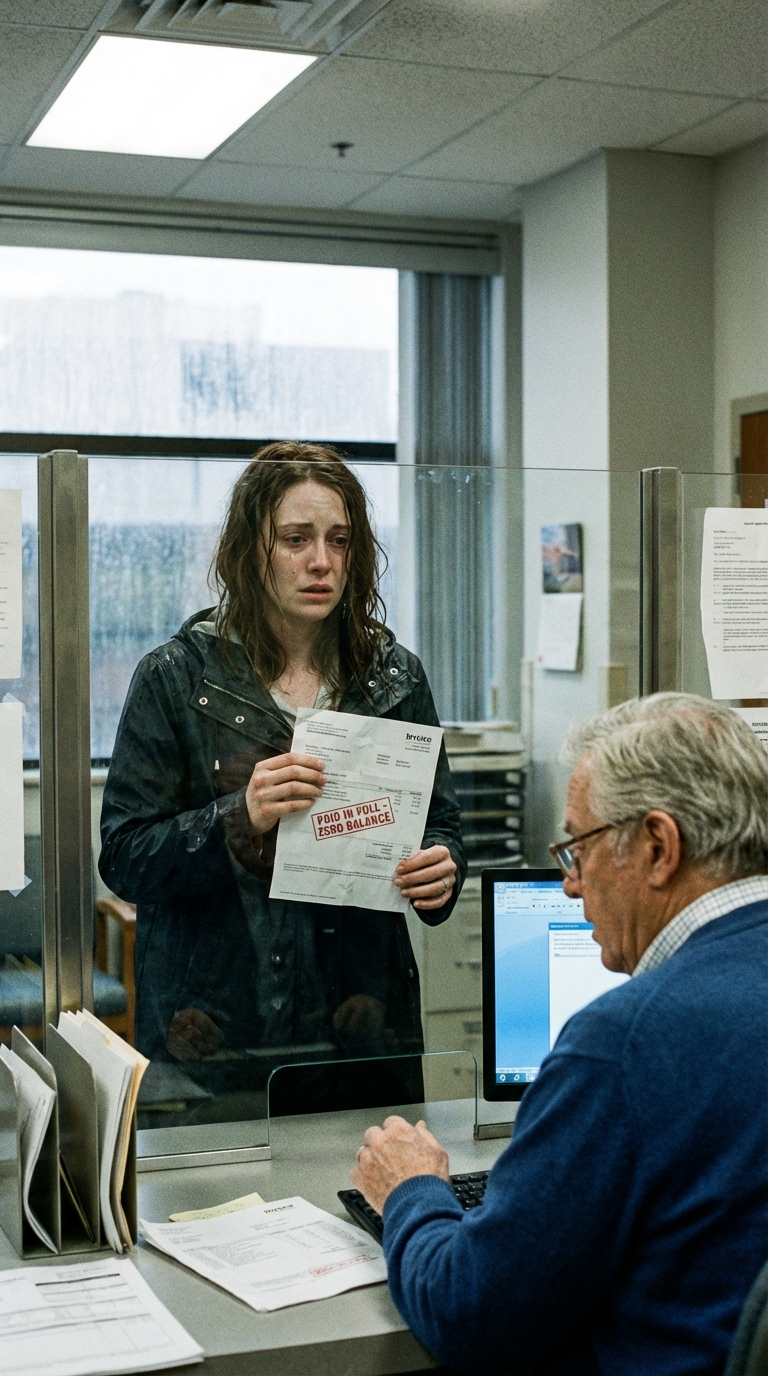
“I don’t understand,” I whispered, my voice cracking under the oppressive fluorescent hum of the hospital billing department. The smell of antiseptic and stale coffee, usually a background nuisance, felt thick enough to choke on today. I pushed the invoice back toward the administrator, my fingers leaving sweaty smudges on the thick glass partition that separated the insured from the desperate.
“This has to be a mistake, Brenda. Please check again. My insurance capped out two months ago. I owe this hospital sixty-four thousand dollars for this round of infusions. I don’t have sixty-four dollars, let alone thousands.”
Brenda, a tired woman with kind eyes who had watched me cry over payment plans and denied claims for three years, adjusted her reading glasses. She tapped her keyboard, her brow furrowed in genuine confusion. The clacking of the keys sounded like gunfire in the silent waiting room.
“Clara, I’m looking right at it,” she said, turning the monitor slightly so I could see the impossible zeros. “The account is clear. Zero balance. Paid in full as of 9:00 AM this morning.”
The room started to spin. The chronic pain in my joints—the insidious autoimmune fire that was slowly stealing my mobility and my youth at twenty-eight—flared up in sync with my rising panic. This wasn’t relief. This was terrifying. In modern America, nobody gives you six figures for free without expecting something terrifying in return.
“Who?” I demanded, gripping the counter for support. “Who is paying this?”
Brenda lowered her voice. “It’s set up as an anonymous recurring wire. It comes from a shell LLC. ‘Aethelred Holdings.’”
The world stopped. The noise of the hospital faded into a high-pitched ringing in my ears.
Aethelred.
Nobody knew that name. It wasn’t a common corporate moniker. It wasn’t a bank. It was the name of an obscure, historical Anglo-Saxon king known for his disastrous reign. And the only person I had ever heard mention it was Elias Thorne.
He had used it in a rare keynote speech three years ago, a speech about “ruthless efficiency and the cost of hesitation.” It was a throwaway historical reference that only a history nerd like me would remember.
Elias Thorne. The CEO of Thorne Capital. My boss’s boss’s boss.
The coldest man in Manhattan. A man who existed forty floors above my gray cubicle in a glass fortress of high finance. A man who had ridden in the elevator with me perhaps twenty times in five years and had never once acknowledged my existence other than a stiff nod directed at the floor numbers.
Elias Thorne was secretly, anonymously, paying for the incredibly expensive, specialized autoimmune treatments that were the only thing keeping me out of a wheelchair.
Why?
He wasn’t benevolent. He didn’t do charity unless there was a gala and a tax write-off involved. He was a shark in a five-thousand-dollar bespoke suit, renowned for gutting companies and putting thousands out of work without blinking.
A sick feeling, heavier than my disease, settled in my gut. This wasn’t kindness. This was leverage.
I didn’t go back to my tiny, overpriced apartment in Queens. I walked out of the hospital, the zero-balance receipt burning a hole in my purse, and hailed a cab straight to the Thorne Tower in Financial District.
It was 8:00 PM on a rainy Tuesday. The massive obsidian tower was mostly dark, a monolith against the stormy sky. But way up at the top, a single light glowed in the penthouse suite.
My security badge still worked in the executive elevator. The ride up was agonizingly fast, the pressure building in my ears matching the fury building in my chest.
The doors slid open directly onto his private floor. The office was cavernous, minimalist, and intimidating—all steel, glass, and expensive modern art that looked angry.
He was there. Elias Thorne was standing by the floor-to-ceiling window, looking out over the sprawling, rain-slicked city he practically owned. He was holding a glass of amber liquid, his shoulders tight beneath his suit jacket.
He didn’t turn around when I burst in, breathing hard, rain dripping from my cheap trench coat onto his imported Italian marble floor. I clutched the crumpled receipt in my shaking hand like a weapon.
“Why, Elias?” I demanded. My voice echoed in the massive, silent space, sounding smaller than I intended. “Why are you paying for my life? I know it’s you. Aethelred.”
He paused for a long, agonizing moment before slowly turning.
I expected his usual look of icy indifference, or perhaps arrogant amusement at being caught. I expected the shark.
What I saw stopped me cold.
His face, usually an impassive mask of corporate power, looked devastated. It looked old. The lines around his eyes were deep valleys of exhaustion. He looked at me not as an underling, but as someone he feared.
“Because, Clara,” he said, his voice hollow, lacking its usual resonant boom. “It’s the taxes I owe.”
“Taxes? What are you talking about? I’m not one of your shell companies.”
“No,” he murmured, taking a sip of the whiskey. “You’re the collateral damage of a sin I committed ten years ago. And paying your medical bills is the only way I can sleep at night.”
He walked to his expansive, empty desk. It was completely bare except for one thing: a faded manila envelope. He picked it up, his manicured hand trembling slightly, and held it out to me across the vast expanse of the room.
“You need to read this to understand,” he said.
I approached slowly, my heart hammering against my ribs. I took the envelope. It felt heavy.
I opened it. Inside wasn’t money, or legal threats. It was a collection of old photographs and police reports.
The first photo was a grainy picture of two teenage boys. One was clearly a young Elias—already serious, intense. The other boy was laughing, wild-eyed, charismatic.
I recognized the second boy instantly, and a scream trapped itself in my throat.
It was Marcus.
My ex-husband. The man I had spent four years hiding from. The man whose name I had legally changed my own to escape. The man whose relentless emotional and psychological abuse had sent my body into the prolonged state of high-alert stress that doctors believed triggered my autoimmune disease in the first place.
“You know him,” I whispered, horrified.
“Marcus was my younger brother,” Elias said. The confession hung in the air like toxic smoke.
I stared at him. The resemblance was there, hidden under years of divergence. Marcus, the fiery, destructive addict. Elias, the cold, controlled titan.
“I don’t understand,” I said, my mind reeling, trying to connect the dots. “If he was your brother, why… I was married to him for three years. I never met you. He said his family was dead.”
“We were dead to him,” Elias said bitterly. “We cut him off years before you met him. He was destructive. Violent. He refused help. So we excised him like a tumor to protect the family name. I was the one who made the final call. I threw him out.”
He walked closer, his eyes pleading. “When you applied for the job here five years ago, under your maiden name, I didn’t recognize you. You were just another analyst. But then… then the background check for your security clearance came through a year later. It flagged your previous name. Marcus’s name.”
Elias looked away, out the window again. “I dug into it. I hired investigators. I found out what he did to you. The police reports you filed that went nowhere. The restraining orders he violated. The way he isolated you, broke you down, made you sick.”
Tears were streaming down my face now, hot and fast. I remembered those years. The constant fear. The way my body started attacking itself because it was always in fight-or-flight mode.
“And then I found out about the illness,” Elias continued softly. “The direct result of the trauma he inflicted on you. You were working sixty hours a week in my data department, drowning in medical debt, slowly dying, because of what my brother did to you.”
He turned back to me, his eyes shining with unshed tears. “And I did nothing to stop him back then. I knew what he was. I knew he was hurting people. But I just wanted him away from me, away from the company. I bought my peace of mind by unleashing him on the world. On you.”
The realization hit me with the force of a physical blow.
Elias Thorne wasn’t paying my bills out of benevolence. He wasn’t even paying them out of simple guilt. He was paying hush money to his own conscience.
Every month, that wire transfer was him buying another month of not having to face the reality that his ruthless efficiency—his decision to cut his brother loose rather than deal with him—had destroyed my life.
I looked down at the zero-balance receipt in one hand and the photo of my abuser in the other. I looked up at the billionaire CEO who looked small and broken in his tower.
“You think money fixes this?” I asked, my voice shaking with a rage that had been buried for years. “You think paying the hospital makes up for the fact that your brother made me sick? That you let him?”
“No,” Elias whispered. “I know it doesn’t fix it. But it’s all I have to offer. I have all the money in the world, Clara, and it can’t buy back the years you lost.”
He slumped down into his expensive leather chair, defeated. “I’m sorry,” he said. It was the first time I had ever heard him say those words.
I stood there in the silence of the penthouse. I was holding the evidence of my past trauma and the evidence of my present survival, both supplied by the same family.
I thought about the pain. I thought about the nights I laid awake wondering if I’d be able to walk in the morning. I thought about the humiliation of dodging calls from debt collectors.
And I looked at Elias Thorne, the great titan of industry, reduced to a man begging for absolution from his lowest-paid analyst.
A strange clarity washed over me. The fear was gone. The intimidation was gone.
I walked over to his desk. I placed the photo of Marcus face down. Then, I placed the hospital receipt on top of it.
“You’re right, Elias. The money doesn’t fix it,” I said, my voice steady now, stronger than it had been in years. “And I don’t forgive you. Not yet. Maybe not ever. You sacrificed others to keep your world clean.”
He winced, but he nodded, accepting the judgment.
“But,” I continued, locking eyes with him. “I’m going to keep taking the money. Every single cent needed to keep me healthy. Because you owe me that. You owe me a functional body.”
I leaned over his desk, invading his space for the first time.
“But the terms change today. No more anonymous shell companies. No more hiding in your tower paying penance in secret. You’re going to set up a foundation, Elias. A real one. Publicly attached to the Thorne name. For victims of domestic abuse suffering from long-term health consequences. You’re going to fund research. You’re going to help thousands of women who didn’t have a billionaire CEO feeling guilty about them.”
His eyes widened slightly. He looked surprised, then… relieved.
“And,” I added, “I’m running it. With a salary commensurate with a Thorne Capital executive.”
Elias stared at me. A slow, strange look crossed his face. It was respect.
“Ruthless,” he murmured, a ghost of a smile touching his lips. “Very well, Clara. Done. Have the proposal on my desk by Monday.”
I turned and walked toward the elevator. My joints still ached, the rain was still falling outside, but for the first time in a decade, I wasn’t just surviving the storm. I was directing it.
I pressed the lobby button and watched the doors close on Elias Thorne, leaving him alone in his glass tower with his guilt, and my demands. The transaction was no longer anonymous. And I was finally collecting what I was owed.