The smell of wet ash is something you never get out of your nose. It tastes like metal and sorrow; it smells like the end of the world.
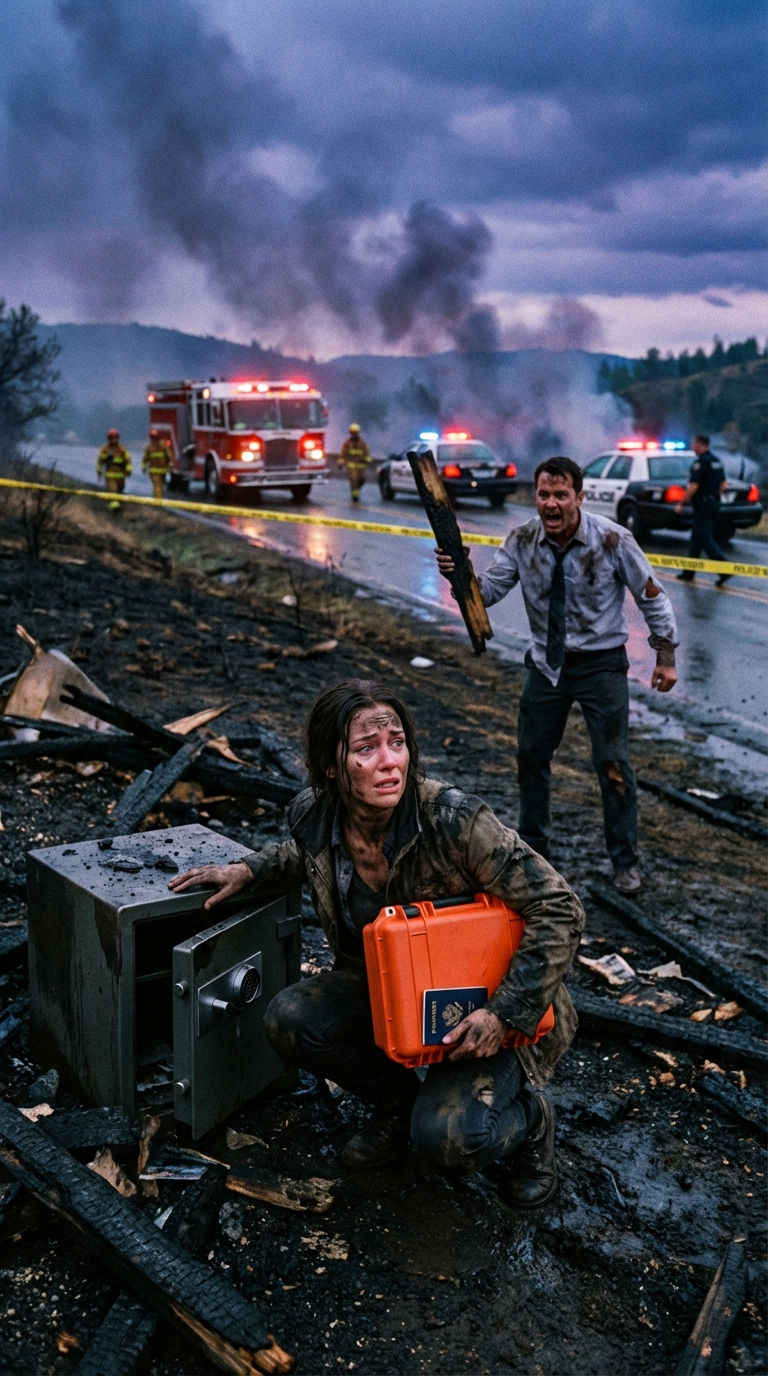
“Don’t go back there, Sarah!” David screamed, grabbing my arm, his fingernails digging into my skin through my jacket. “It’s not safe! The structural integrity is gone! The firefighters said stay back!”
I yanked my arm away, staring at the man I’d been married to for seven years. We were standing at the yellow police tape, staring up the blackened hillside where our “forever home” had stood just forty-eight hours ago. His face was soot-stained, his eyes wide and frantic. But as I looked closer, cutting through the haze of my own shock, I realized something.
It wasn’t grief I saw in his eyes. It was panic. Pure, unadulterated terror.
“I need to find the cat, David,” I lied. My voice sounded jagged, like broken glass. I knew the cat was safe at my sister’s house three towns over. I had shoved him into the carrier myself. “And I need to check the floor safe.”
“The safe is melted!” he shouted, stepping in front of me, blocking my path to the skeletal remains of what used to be our master bedroom. “Everything is gone, Sarah! The jewelry, the savings bonds, it’s all ash! We just need to call the insurance company and start over! Why are you making this harder?”
He was sweating. It was forty degrees out, raining a cold, miserable drizzle, and he was sweating bullets.
I pushed past him. “I’m going, David.”
I climbed over the charred remains of the staircase, my boots crunching on the debris of my life.
The Six Minutes That Changed Everything
To understand why I was climbing through a pile of toxic rubble, you have to understand the six minutes that preceded the ruin.
The fire had come out of nowhere. One minute, I was chopping vegetables for a salad, watching the wind whip the eucalyptus trees outside. The next, the sky turned a sickly, apocalyptic orange. The sirens didn’t wail; they screamed.
“Evacuate now! This is not a drill!”
David had been in his home office. He was an investment banker—high stress, high reward. He always kept the door locked during trading hours. When the alert came, I banged on his door.
“David! We have to go! Now!”
He didn’t open it for thirty seconds. When he finally did, he looked disheveled. He wasn’t grabbing our wedding album. He wasn’t grabbing the go-bag we had prepared for earthquakes. He was clutching his laptop bag to his chest like a shield.
“Get the car,” he had snapped, pushing past me. “I have to… I have to secure the server.”
“Secure the server? The house is going to burn down!” I screamed.
Those six minutes were a blur of adrenaline. Buckling the kids. Finding the cat. Reversing out of the driveway as embers the size of softballs rained down on the hood of the SUV.
I looked in the rearview mirror. David was in his car behind me. But he had stopped at the bottom of the driveway. He sat there for a full ten seconds, just watching the house.
At the time, I thought he was saying goodbye.
Now, climbing through the wet, black wreckage, I realized he hadn’t been mourning. He had been waiting.
The Discovery
I made it to where the master closet used to be. The roof was gone. The sky was a bruised purple above me, the clouds heavy with pollutants. And there, amidst the blackened beams and melted insulation, was the floor safe.
David had installed it three years ago. “For the legacy items,” he had said. “Grandma’s diamonds. The deeds. The hard drives with the kids’ photos.”
He never gave me the combination. He said he was “protecting me” from the burden of security.
The safe wasn’t melted. It was titanium-reinforced, rated for two hours of direct fire. And, miraculously, the floor around it had collapsed in such a way that the locking mechanism had torqued. It was slightly ajar.
David scrambled up the debris behind me, slipping on wet ash, panting. “Sarah, stop! Don’t look in there! It’s dangerous!”
My heart hammered against my ribs. I kicked a piece of drywall away and crouched down. My hands were trembling, black with soot. I pulled the heavy steel door open.
There was no jewelry inside. No hard drives of baby photos. No deeds.
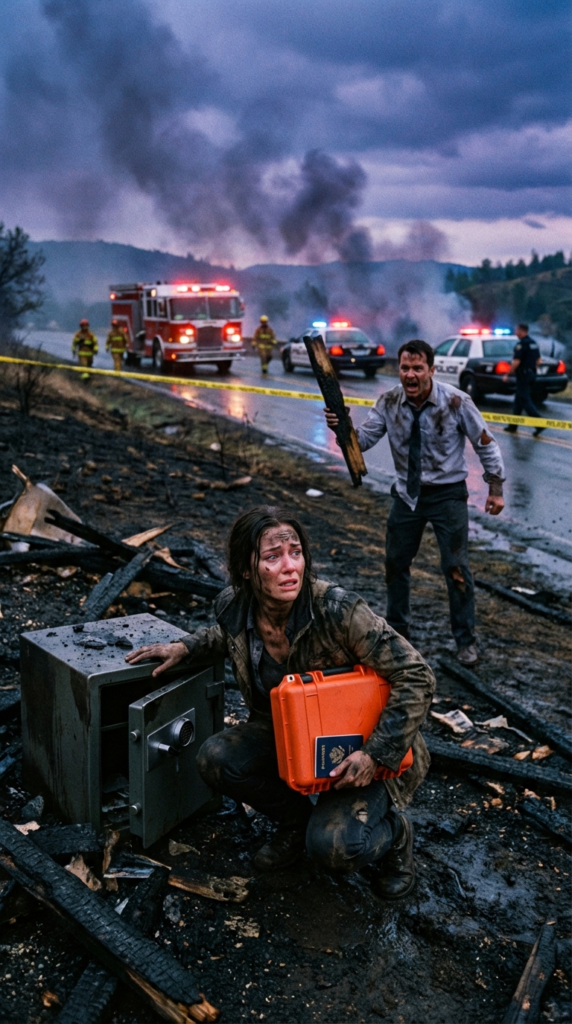
Instead, there sat a single, waterproof, fireproof Pelican case. Bright orange. Unscathed.
I popped the latches. Snap. Snap.
I looked inside, and my blood turned to ice.
Neatly stacked inside were:
- Three passports. One for David. One for a woman I didn’t recognize. And one for a boy who looked like David.
- A stack of bearer bonds.
- A thick ledger.
- A burner phone.
I picked up David’s passport. The photo was him, but the name read Julian Vane. The issue date was three weeks ago.
I looked up at David. He was standing over me, silhouetted against the gray sky. He wasn’t panicking anymore. His face had gone blank, cold. He was holding a heavy, charred piece of timber like a baseball bat.
“I told you not to look,” he said quietly.
The Escape
Adrenaline is a funny thing. In the fire, it made me fast. Now, it made me sharp.
“You weren’t checking the server,” I whispered, clutching the case to my chest. “You were waiting to make sure the fire took the house. You wanted it to burn.”
“Give me the case, Sarah.” He stepped closer. The timber raised an inch.
“Who is she?” I asked, backing up. My heel caught on a twisted pipe. “Who is Julian Vane?”
“It doesn’t matter,” he spat. “The house is gone. The insurance pays out four million. I’m leaving. You can have the debt. You can have the ashes. Give me the case.”
He swung.
I didn’t think. I threw myself to the left, rolling down the slope of debris. The timber smashed into the safe with a sickening clang.
I scrambled down the ruins of the staircase, sliding on the slick, wet ash, clutching the orange case like my life depended on it. Because it did.
“Sarah!” he roared, chasing me.
I hit the bottom of the hill and sprinted toward the police line. There were two officers standing by the cruiser, watching the hillside for mudslides.
“Help!” I screamed. “He’s trying to kill me!”
David skidded to a halt halfway down the driveway when he saw the cops turn. He dropped the wood. He put his hands up, instantly shifting his demeanor.
“She’s in shock!” he yelled to the officers, putting on his best concerned-husband face. “She’s hysterical! She lost everything!”
I reached the officers, gasping for air. I didn’t say a word to David. I just handed the orange case to the older officer.
“Open it,” I wheezed. “Check the passports.”
The Unraveling
The next forty-eight hours were a whirlwind, more destructive than the fire itself.
While David was trying to explain to the police why he had a fake passport and why he was chasing his wife with a weapon, I was at the station with the FBI.
It turned out, the fire was an act of God. But David’s timing was an act of malice.
The ledger in the box detailed accounts in the Cayman Islands. Millions of dollars. Money he had been siphoning off his clients’ accounts for five years. He had been running a massive Ponzi scheme. The walls were closing in, and he needed an exit.
The wildfire was his miracle.
He planned to let the house burn, destroying all his “records” (which were actually on the flash drives in the box). He would claim the insurance money, fake his death—or simply vanish—and start life as Julian Vane in Costa Rica with his mistress, the woman in the passport.
The burner phone was full of texts. “Did it burn? Are we clear?” “Waiting for the roof to collapse. Then I’m gone. Don’t worry, baby. She won’t suspect a thing. She’s too busy crying over the curtains.”
That text broke me.
I sat in the interrogation room, reading those words over and over. She’s too busy crying over the curtains.
I wasn’t crying anymore.
The Resolution
David—or Julian, or whatever he wanted to be called—was denied bail. The flight risk was obvious, given the passport in his pocket.
The insurance company was very interested in the contents of the Pelican case. Because David had filed the claim under his name alone, attempting to cut me out, and because the fraud was so extensive, the policy on the house was complicated.
But here was the kicker: The house wasn’t in David’s name. It was in mine. My parents had bought the land twenty years ago.
David had increased the insurance premiums secretly, planning to forge my signature on the payout check. But he never got that far.
Because I cooperated fully with the FBI and the insurance investigators, handing over the ledger that recovered millions for his defrauded clients, the insurance company honored the policy for me. They viewed me as another victim of his fraud, not a co-conspirator.
Six months later.
I stood on the empty lot. The debris was cleared. The ash was gone. Green shoots of grass were poking through the scorched earth. Nature was healing.
I wasn’t rebuilding the house. I had sold the land.
I took the insurance money—the four million dollars David had killed for—and I put half of it into a trust for our children. The other half?
I donated a significant portion to wildfire relief and legal aid for victims of financial abuse.
And with the rest, I bought a small house. Not in Malibu. But in a quiet town in Vermont, far away from the fires, far away from the pretension.
I still have nightmares about the smell of smoke. I still wake up checking the exits.
But yesterday, I received a letter from the prison. It was from David. He wanted to apologize. He wanted to see the kids. He said he had “changed.”
I walked over to my fireplace. I struck a match. I watched the flame dance on the tip of the wood.
I held the letter over the fire and watched it curl, brown, and turn to ash.
Six minutes. That’s how fast the wildfire took the life I thought I loved. But it gave me back the life I actually deserved.
I watched the last of his words turn to dust, and for the first time in years, I breathed easy.