The Tuesday Regular
“Get him out of here, Sarah. He smells like wet dog and he’s scaring the brunch crowd.”
My manager, Rick, didn’t even whisper. He stood right in the middle of the diner floor, pointing a thick finger at Table 4.
At Table 4 sat Mr. Henderson. To everyone else in “The Rusty Spoon,” he was just a nuisance. An eyesore. He came in every Tuesday at 10:00 AM sharp. He wore a coat that was three sizes too big, stained with mud and oil, and held together with silver duct tape. He wore a beanie even in the summer.
He always ordered the same thing: black coffee and dry wheat toast. Total cost: $4.50. He counted out his payment in nickels and dimes, his hands shaking with tremors, stacking the coins in neat little piles.
I looked at Mr. Henderson. He had his head down, staring into his black coffee like it was a scrying pool. He was pretending he hadn’t heard Rick’s cruelty, but I saw his ears turn bright red. I saw the way his shoulders hunched in, trying to make himself smaller, trying to disappear.
I felt the eviction notice burning a hole in my apron pocket. It was folded three times, sharp edges pressing against my hip. I was three months behind on rent. My daughter, Lily, needed braces. My car needed a new transmission. I needed this job. I needed the tips from the brunch rush that Rick was currently threatening to kick me out of.
But I looked at Rick’s smug face—a man who drove a BMW and stole tips from the jar when he thought we weren’t looking—and then at the old man’s trembling hands.
“No,” I said. My voice was quiet, shaking, but it was there.
“Excuse me?” Rick stepped closer, invading my personal space. I could smell his expensive cologne mixed with the grease of the fryer.
“He’s a paying customer, Rick. He stays. If you want him out, you drag him out yourself. But if you touch him, I quit.”
The diner went silent. It was that heavy, suffocating silence where you can hear the hum of the refrigerator. Forks stopped clinking. The couple in the corner booth stopped arguing. Everyone was watching.
Rick turned a shade of purple I’d never seen before. “Fine. You want to be a martyr? You’re fired. Get your stuff and get out. And take the bum with you.”
I felt the tears sting my eyes. I had just lost my livelihood over a cup of coffee and a stranger. My heart hammered against my ribs. How am I going to tell Lily? How are we going to eat next week?
I took a deep breath, untying my apron. I wasn’t going to let Rick see me cry. I walked over to Table 4 to tell Mr. Henderson that it wasn’t his fault, that the coffee was on me.
But the booth was empty.
He was gone. He must have slipped out the back while Rick was screaming at me.
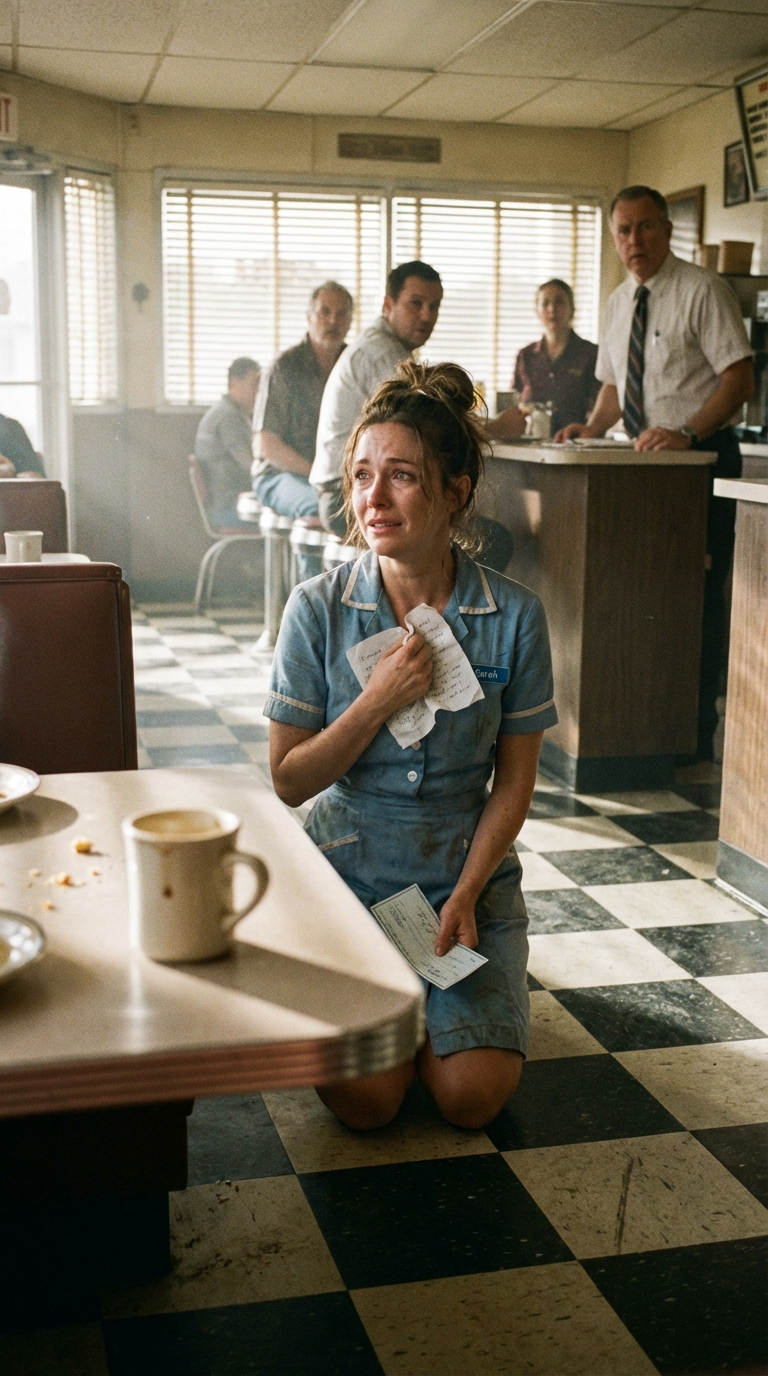
All that was left on the chipped Formica table was his empty cup, a folded paper napkin, and a personal check facedown.
I picked up the check, expecting to see a dollar or two. Maybe five if he was feeling generous. I flipped it over.
The room started to spin. The noise of the diner—the clatter of plates, the sizzling grill—rushed back in all at once, deafening me.
I read the number. $50,000.00.
Signed: Arthur J. Henderson.
And underneath the check was the napkin. In shaky, blue ballpoint pen, he had written:
“You were the only one who didn’t look through me. You saw a man, not a mess. Thank you for giving me my dignity back.”
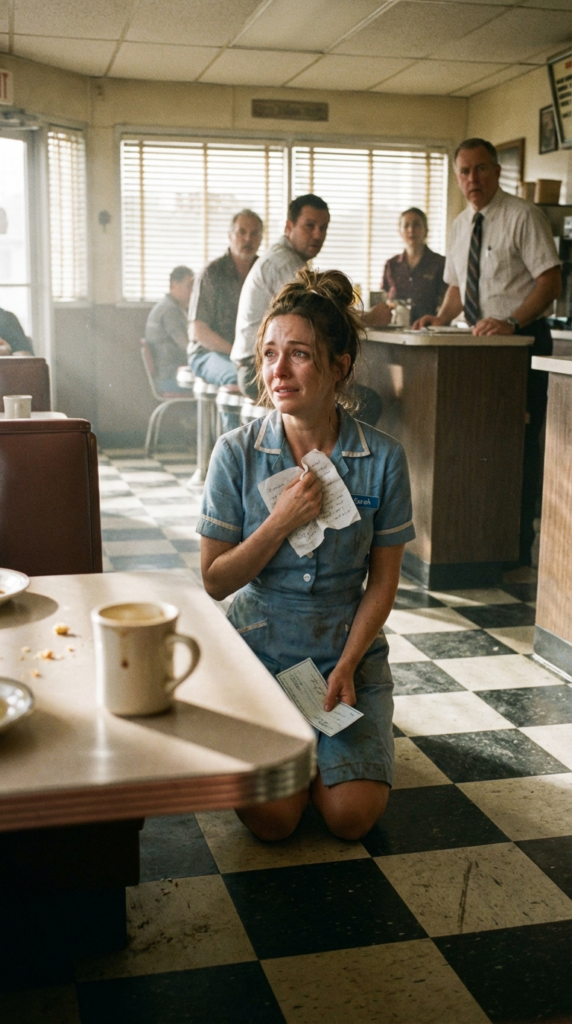
My knees gave out. I collapsed right there on the checkered floor, clutching that napkin to my chest, sobbing so hard I couldn’t breathe.
The Invisible War
To understand why that moment broke me, you have to understand the year I’d had.
I wasn’t always a waitress at a roadside diner. Two years ago, I was a graphic designer with a mortgage and a husband. Then came the cancer diagnosis—my husband, Mark. Pancreatic. Fast. Brutal.
We lost the insurance. We lost the savings. Then I lost him.
I was left with a mountain of medical debt and a seven-year-old girl who asked every night when Daddy was coming home. I took the job at The Rusty Spoon because it was the only place that would give me flexible hours to pick Lily up from school.
I was invisible. Customers looked right through me. They snapped their fingers for refills. They complained the eggs were cold. They didn’t see the grieving widow; they saw a uniform.
That’s why I liked Mr. Henderson.
The first time he came in, six months ago, other waitresses ignored him. They “didn’t see” him sitting there. I walked right up.
“Good morning, sir. Coffee?” I’d asked.
He looked up, startled. His eyes were a piercing, cloudy blue. “Please,” he’d whispered.
Over the months, we developed a silent routine. I knew he liked his toast cut diagonally. I knew he didn’t like the radio too loud. Occasionally, he’d ask about Lily—I had shown him a picture once.
“She has your eyes,” he had said. “Kind eyes.”
I didn’t know anything about him. I assumed he was homeless, living in the tent city under the overpass. I’d slip him an extra muffin when Rick wasn’t looking. I didn’t do it for a reward. I did it because, in a way, looking at him… I was scared that could be me one day. Alone. Broke. Forgotten.
I defended him against Rick not because I was a hero, but because I knew what it felt like to be treated like furniture.
The Truth About Arthur
I was still on the floor, crying, when Rick came storming over.
“What is this? A seizure? Get up, Sarah, you’re making a scene!” He snatched the check from my hand before I could stop him.
He looked at it. He froze. His jaw literally dropped.
“Is this… is this fake?” he stammered.
“It’s not fake,” a voice boomed from the doorway.
We all looked up. Standing there wasn’t the hunched-over “bum” Mr. Henderson. It was a man in a sharp black suit. Well, not Mr. Henderson—but a chauffeur.
“Mr. Henderson would like a word with Sarah. Outside,” the driver said.
I stood up, wiping my face with my sleeve. I grabbed the check back from Rick’s stunned fingers. “I quit,” I whispered, and I walked out the door.
In the parking lot sat a vintage Rolls Royce. The back window rolled down.
There was Mr. Henderson. He wasn’t wearing the dirty coat. He was wearing a clean flannel shirt. He still looked old, and his hands still shook, but he looked… powerful.
“Get in, Sarah,” he said gently.
I sat in the plush leather seat. “Mr. Henderson… Arthur… I don’t understand.”
“My name is Arthur Henderson. I founded Henderson Logistics forty years ago,” he said, staring out the window at the diner. “I sold the company last year for more money than I could spend in ten lifetimes.”
“But… the coat? The pennies?”
He sighed, a long, rattling sound. “My wife, Betty, died two years ago. We used to come to this diner when we were young and broke. We’d share a coffee and dream about the future.”
He turned to look at me, his eyes wet.
“After she died, I felt invisible. My kids only call when they want money. My ‘friends’ only want me for my connections. I wanted to see if anyone would treat me like a human being if I had nothing to offer them. I wanted to see if kindness still existed without a price tag.”
He pointed a shaking finger at the check in my hand.
“For six months, people stepped over me. They mocked me. That manager treated me like a disease. But you… you asked about my day. You warmed up my cup without me asking. You smiled.”
He reached out and took my hand. His skin was like dry paper.
“I have a lot of money, Sarah. But I am very poor in friends. You stood up for me today. You put your livelihood on the line for an ‘old bum.’ That check… that’s not a tip. That’s an investment.”
“An investment?” I choked out.
“In you. In your daughter. In kindness.”
The New Beginning
I wish I could say I coolly accepted it. I didn’t. I cried all over the leather interior of his Rolls Royce. I told him about Mark. About the debt. About the eviction.
Arthur listened. He didn’t offer pity. He offered a handkerchief.
The next day, I went to the bank. The teller looked at me, looked at the check, and called the manager. They thought it was fraud. They called Arthur.
When Arthur confirmed it, the manager apologized to me three times.
I paid off the medical debt. I paid the rent for a year. I got Lily her braces.
But the story doesn’t end with the money.
Two weeks later, I bought The Rusty Spoon.
Arthur helped me with the legal side, but I used the rest of the money for the down payment. Rick was… let’s just say Rick doesn’t work there anymore.
We renamed it “Betty’s Diner,” after Arthur’s wife.
Arthur still comes in every Tuesday. He doesn’t wear the dirty coat anymore, but he still orders coffee and wheat toast. He sits at Table 4, which now has a little brass plaque on it that reads: Reserved for the V.I.P. (Very Important Person).
Sometimes, people come in and see us sitting together—the young owner and the old billionaire—laughing over dry toast. They probably wonder what we have in common.
They don’t know that we saved each other. He saved me from poverty, and I saved him from invisibility.
Yesterday, a homeless man walked in. He looked tired, worn out, smelling of rain. The new manager looked at me, raising an eyebrow, asking silently if he should kick him out.
I smiled, walked over to the man, and poured him a fresh cup of coffee.
“On the house,” I said. “And take your time.”
Because you never know who you’re serving. And sometimes, a cup of coffee is the only thing keeping a person from falling apart.