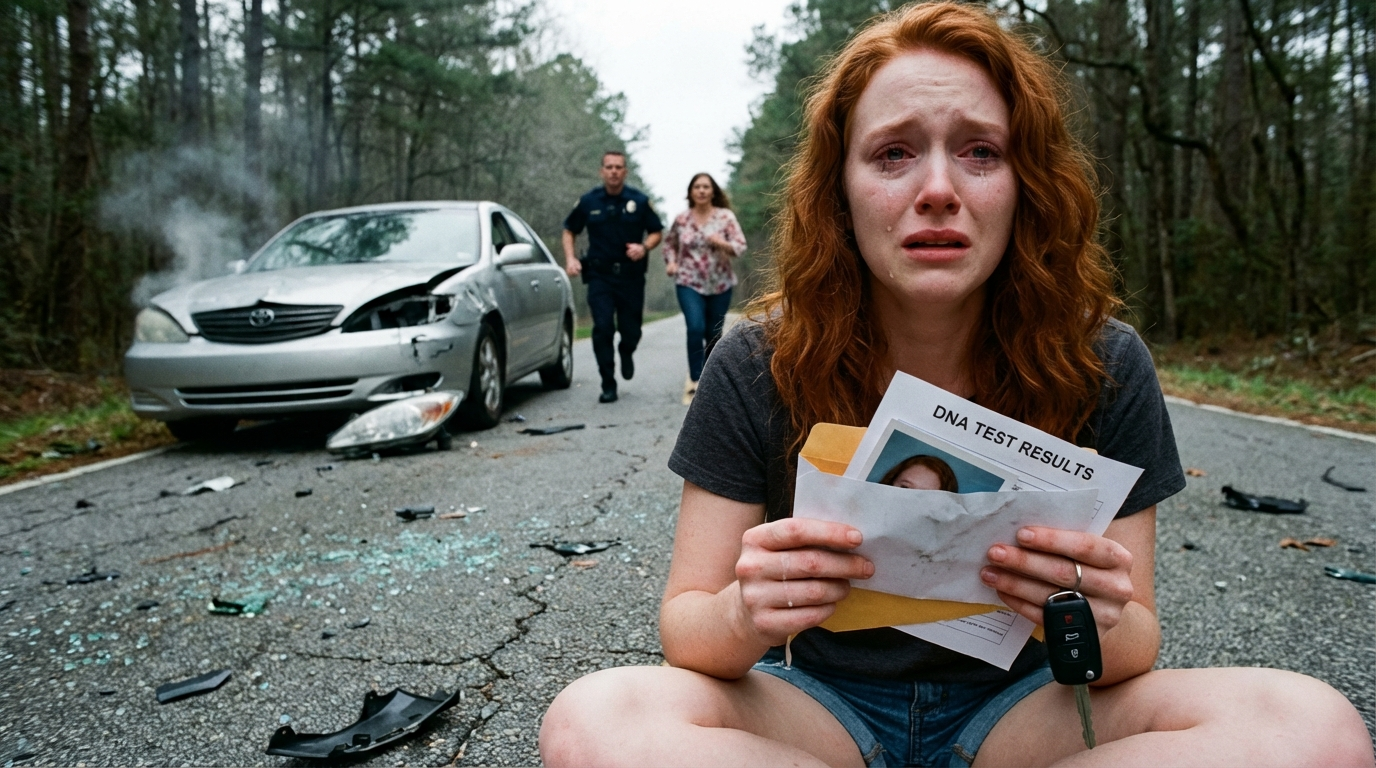
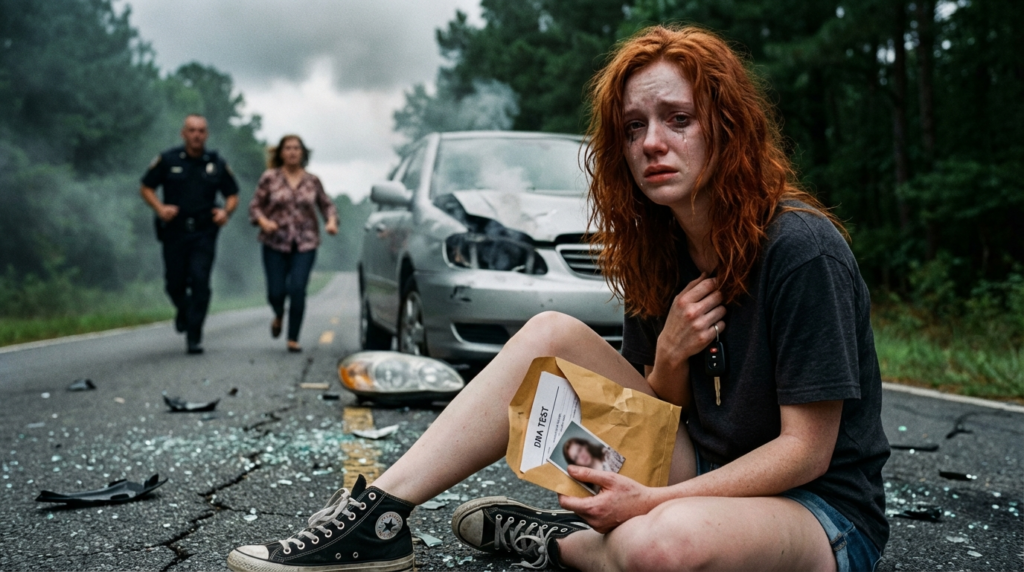
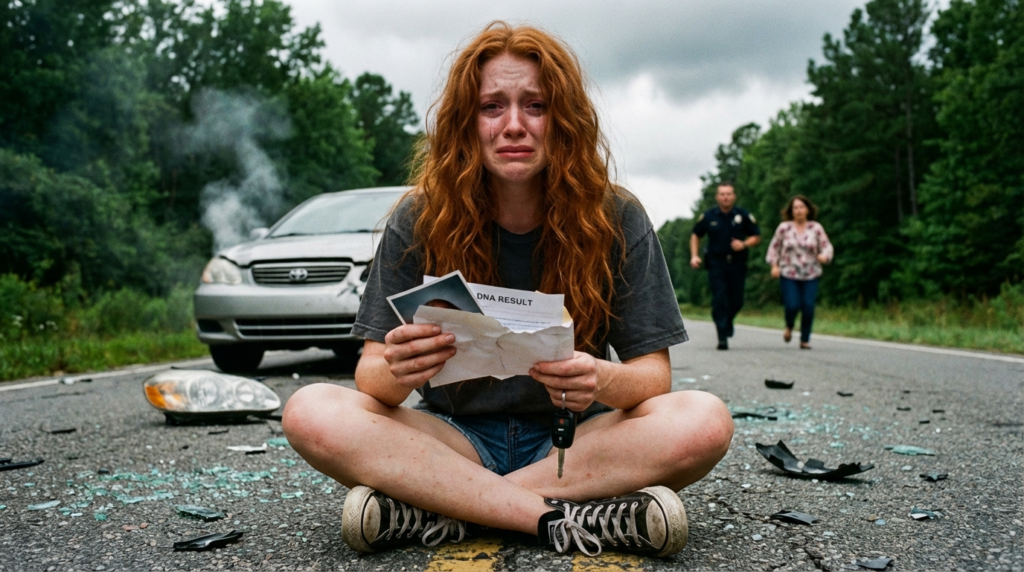
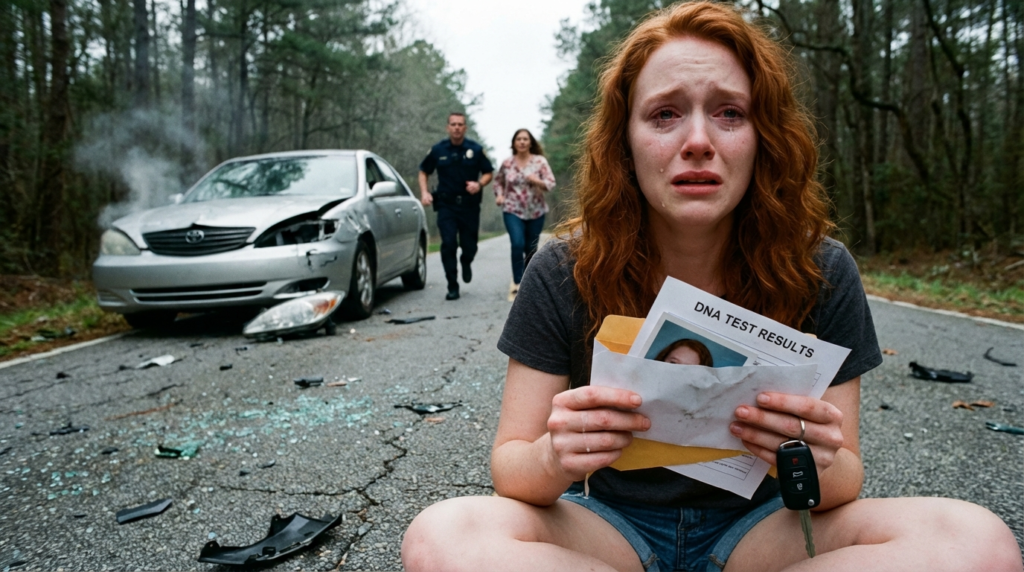
The asphalt bit into my legs as I sat cross-legged in the middle of that empty rural road, shards of glass glittering like cruel stars around me. Smoke billled from the crumpled front left of Mom’s silver sedan, the headlight dangling like a broken eye, staring back at me accusingly. My hands shook, clutching her car keys so tight the fob dug into my palm. Tears blurred everything—my long red hair stuck to my wet cheeks, my charcoal tee soaked with sweat and snot. I was 19, and I’d just wrecked everything.
It started as a stupid fight. “You’re just like your deadbeat dad!” Mom screamed, hurling those words like knives. I’d grabbed the keys and peeled out, rage-fueled, tires screeching on the wooded lane. One sharp turn too fast—bam. The crash spun the world sideways. Now, sirens wailed in the distance, but worse: a crumpled envelope had flown from the glovebox during the wreck, landing right by my black Converse. It was addressed to her in Dad’s handwriting—postmarked years ago, never opened.
I tore it open with trembling fingers, my heart pounding like the hood was still steaming. Inside? A letter… and a photo. My breath caught. The man in the picture wasn’t Dad. It was someone else—holding a baby that looked just like me. “Your mother lied to you your whole life,” the note began. “I’m not the monster she made me out to be. And you’re not her daughter.”
Footsteps pounded closer—a cop and some older woman running toward me, faces etched with worry. But I couldn’t move. The words swam: DNA test results clipped to the page. Mom’s biggest lie, spilled out on this godforsaken road.
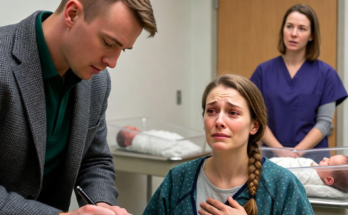
To understand why that envelope hit like a second crash, you have to go back to the beginning. My name’s Riley, and I grew up in a crumbling split-level in suburban Ohio, the kind of place where the American Dream went to die. Mom—Linda—was a force of nature, a 45-year-old nurse with a sharp tongue and sharper grudges. Dad bailed when I was 5, or so she said. “He was a drunk, a cheater, a loser who didn’t deserve you,” she’d spit, every birthday, every report card, every time I messed up. She made sure I believed it, drilling it into me like gospel.
But life with Mom was its own hell. She worked doubles, came home exhausted, and unloaded on me. “Useless, just like him!” she’d yell if dinner burned or my room wasn’t spotless. High school was my escape—good grades, track team star with my wild red hair flying—but she’d sabotage it. Forgot to sign field trip forms. “Accidentally” threw out my prom dress. Once, she even called my boyfriend’s mom to say I was “troubled.” I internalized it all, becoming the quiet good girl who never fought back.
The fights escalated after I turned 18. I’d saved for community college, dreaming of nursing school like her, but she mocked it. “You’ll drop out like your father.” That night, two weeks ago, it boiled over. I’d found an old photo album, confronted her about Dad. “Why no pictures of him holding me?” She snapped: “Because he never cared! You’re his spitting image—lazy, worthless!” I exploded, grabbed her keys, and floored it down Route 42, the winding backroad lined with thick Ohio woods.
The crash wasn’t just bad luck. My phone buzzed mid-turn—a text from her: “Don’t come back, traitor.” Distracted, I swerved into a ditch. Airbags deployed, glass shattered, and there I was, stranded at dusk, overcast sky pressing down like judgment.
The cop—Officer Hale, mid-30s with a kind face under his dark blue uniform—reached me first. “Miss, are you okay? Stay still.” The woman beside him, mid-50s with shoulder-length brown hair, floral blouse hugging her pencil skirt, knelt gently. “Honey, it’s alright. I’m Ellen, the dispatcher who heard your call go out. We’ve got you.” Her warmth pierced my shock. But my eyes were glued to the envelope.
Ellen helped me to my feet while Hale radioed for a tow. “That your mom’s car?” he asked. I nodded, numb, stuffing the envelope in my pocket. They drove me to the station in Ellen’s cruiser—her heeled shoes clicking reassuringly. Over bad coffee, I spilled fragments: the fight, the crash, Mom’s venom. Ellen listened, her eyes wise and steady. “Sounds like more than a bad night, sweetie. Sometimes crashes reveal what’s been broken longest.”
At home, Mom was waiting, furious. “You idiot! That car’s my lifeline!” I faced her, envelope burning a hole in my jeans. “What’s this?” I slapped it on the kitchen table. She paled, snatching it. “None of your business!”
But it was. That night, alone in my room, I read it all under flashlight. Dad—real Dad, Tom—wasn’t the villain. The letter detailed their 1990s college romance: Mom pregnant with me, but not by him. She’d cheated with her boss, a married guy, then lied to Tom, claiming the baby was his. He stayed, married her out of duty. But when he discovered the affair via a paternity test (the very results attached), she gaslit him, accused him of abuse, got a restraining order. He fled to California, sending that envelope yearly, begging her to tell me the truth.
Photos showed a devoted dad: baby Riley in his arms, family vacations. He’d built a life—tech entrepreneur now, remarried with kids. My half-siblings. And me? The “spitting image” wasn’t his failure—it was her guilt projected.
Texts to his number (from the letter) confirmed: “Riley? I’ve waited 19 years.” Mom had blocked him, poisoned me against him.
Next morning, I drove Mom’s rented sedan to the station—Ellen had pulled strings. “Need backup?” she’d offered, that old-and-kind vibe radiating strength. I nodded. We confronted Mom at work, hospital parking lot buzzing with staff.
“You lied about everything!” I thrust the DNA results—99.9% no match. Nurses gawked. Mom crumbled, then raged: “He abandoned us! I protected you!” Lies crumbled under Ellen’s calm questions. “Protected? Or controlled?” Ellen said softly. “I’ve seen your type—bullies hiding shame.”
Mom admitted it: the affair, the frame-job on Tom. “I was scared. Young. He would’ve left anyway.” But the bullying? “You reminded me of my mistakes.” It poured out—years of resentment masking her own regrets.
Security escorted her out; ethics board got tipped. She begged: “Don’t leave me like he did.” I walked away, Ellen’s arm around me.
Tom flew in days later. Not a billionaire, but solid—hugging me at the airport like the photos promised. “I never stopped fighting for you.” We met my half-sibs; awkward, then warm. He covered college, no strings.
Mom? Apologies came via letter—real remorse this time. Ellen mediated a coffee meet: “Kindness isn’t weakness,” she said. We forgave, not forgetting—boundaries set. She’s in therapy; I’m thriving at school, red hair proud now.
That crash? My turning point. Ellen’s run to me that day, her quiet wisdom, reminded me: kindness from strangers can heal generational wounds. Mom’s lie nearly destroyed us, but truth—and mercy—rebuilt something better. Kindness matters. It saved me.