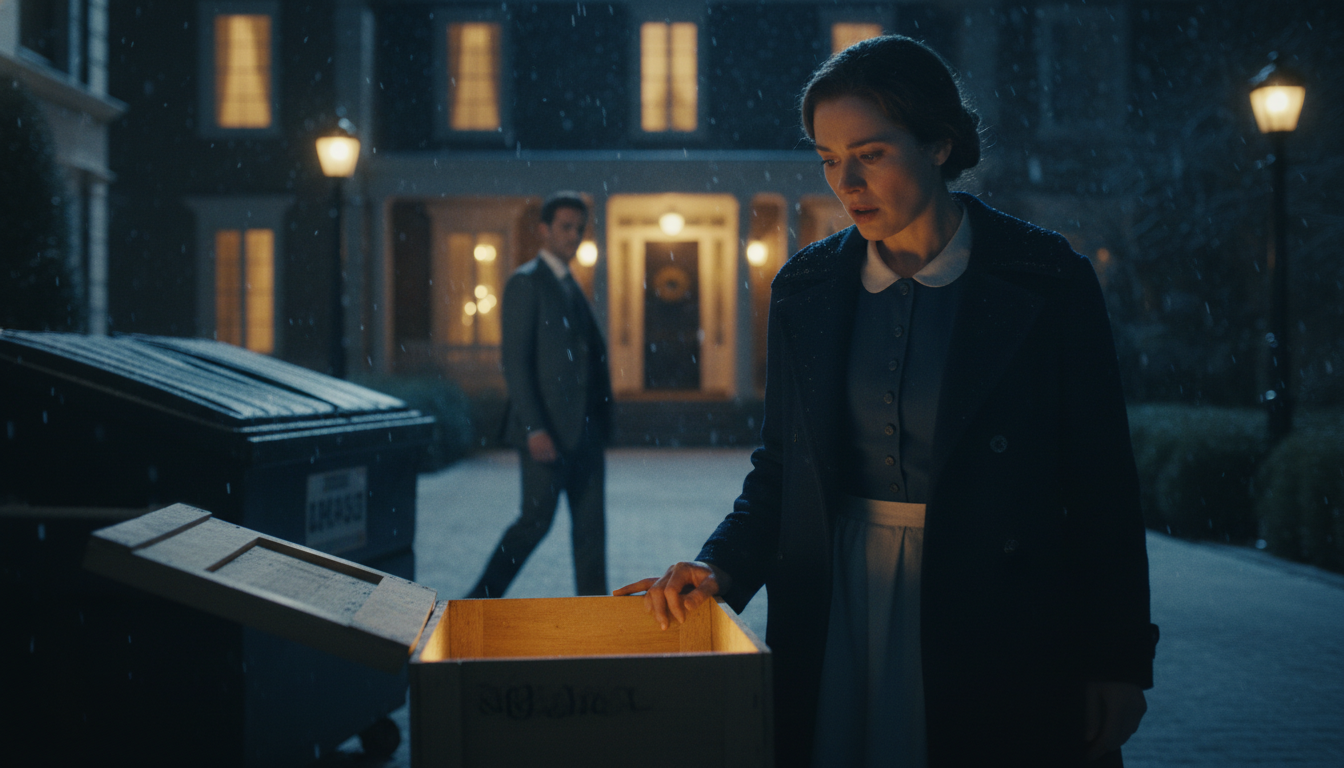
The sleet felt like needles against my skin. I stood in the shadow of our $4 million Connecticut estate, wearing a dark blue maid’s uniform that felt like a shroud. To the neighbors, I was the help. To the man standing on the porch in the grey designer suit, I was a mistake he was currently erasing.
“Take it to the bin, Elena,” Julian had commanded. His voice, once the one I turned to for comfort, was now a jagged blade. “Don’t ask questions. Just get it out of my sight.”
I remember the weight of the crate. It wasn’t heavy, but it felt like lead. As I reached the edge of the black commercial dumpster, the world seemed to go silent. Then, a sound. A tiny, fragile cry that shattered the silence of the alleyway.
I tore the tape back with a desperation I didn’t know I possessed. My breath hitched. Inside, among the shadows of the trash, was a baby. A newborn, dressed in a pale blue sleeper, his skin chilled by the winter air. I looked back at the house. Julian was there, backlit by the warm glow of a home I no longer belonged to. He was holding his head, pacing like a caged animal. He wasn’t mourning; he was panicked.

He thought I had finished the task. He thought he was free. He had no idea that he had just handed me the weapon that would destroy him.
To understand how I ended up in a maid’s uniform in my own backyard, you have to understand Julian Sterling. When we married seven years ago, he was a rising star in tech-driven real estate. He was charming, attentive, and seemingly devoted.
But as the billions rolled in, the man I loved drifted away. He replaced his heart with a spreadsheet. Two years ago, the “gaslighting” began. He started telling me I was “unstable” in front of our friends. He took control of our joint accounts “for my own protection.” By last year, he had moved his mistress into a condo downtown and told me that if I wanted to see a dime in a divorce, I had to prove I was “useful.”
He fired the cleaning staff and told me that if I wanted to stay in the house while the lawyers bickered, I would work for it. I stayed. Not because I wanted the money, but because I knew he was hiding something. I just didn’t know the “something” had a heartbeat.

I didn’t throw the baby away. I didn’t even scream. I tucked the infant inside my oversized uniform coat, feeling his tiny warmth against my ribs. I walked past the dumpster, past the gate, and straight to my old, beat-up sedan parked three blocks away.
I drove to a motel, my heart hammering against my teeth. As I warmed the baby with my own body heat, I began to piece it together. Two days ago, I’d overheard a hushed, vitriolic phone call between Julian and a woman named Sarah—a former intern who had disappeared from the company a year ago.
Julian had promised to “handle it.” This was his version of handling it. He had convinced Sarah to hand over the child, promising a life of luxury and a private adoption. Instead, he had handed the baby to the wife he despised, assuming I was too broken and too obedient to look inside the box. He wanted the “problem” to vanish into a landfill.
Three days later was the Sterling Foundation Gala. It was the biggest night of Julian’s year—a room full of investors, press, and his billionaire grandfather, Silas Sterling, the man who actually held the purse strings of the family empire.
Julian was on stage, looking radiant in a tuxedo, speaking about “Investing in the Future” and “Protecting the Vulnerable.”
I didn’t show up in my maid’s uniform. I showed up in the silk Vera Wang gown I’d hidden in a storage unit months ago. And in my arms, I carried a bundle wrapped in the finest cashmere.
The room went silent as I walked toward the stage. Julian’s face went from smug to ghostly pale. He gripped the podium so hard his knuckles turned white. He thought I was gone. He thought the “trash” had been collected.
“Julian,” I said, my voice amplified by the stunned silence of the ballroom. “You forgot something in the alleyway.”
I didn’t go to the police first. I went to Silas. I had spent the last 48 hours getting a private DNA test—expedited with the last of my jewelry money—and a recorded confession from Sarah, who was terrified for her son’s life.
I walked up to the podium and handed the baby to Silas Sterling.
“This is your great-grandson, Silas,” I said, my voice steady as a rock. “Julian tried to have him ‘disposed of’ three nights ago. He told his ‘maid’ to take out the trash.”

The fallout was nuclear.
The press captured the moment Julian tried to lung at me, only to be restrained by his own security. Silas Sterling, a man of old-school honor, looked at his grandson with a disgust that was more painful than any prison sentence.
Within twenty-four hours, Julian was stripped of his CEO title. Within a week, the “morality clause” in his contract was triggered, freezing his assets. But the real victory wasn’t the money.
Today, I live in a quiet house by the coast. I’m no longer a wife to a monster, and I’m certainly no one’s maid. I have full custody of the little boy Julian tried to throw away. His name is Leo.
Every morning, when I look at Leo’s smile, I’m reminded of that cold night in the alleyway. Julian thought he was breaking me by making me a servant. Instead, he gave me the one thing he could never understand: a purpose.
He threw away his legacy. I just made sure I was there to catch it.