THE SCREAMING WIND
The wind on the George Washington Bridge isn’t just air; it’s a physical assault. It screams past your ears, trying to deafen the thoughts you’re already trying to kill. It carries the exhaust fumes of a thousand trucks and the stinging salt of the river below, a sensory overload designed to numb you.
I was already numb. At 42, I was a hollowed-out shell of a man, standing on the pedestrian walkway of a structure built to connect landmasses, while I felt entirely disconnected from the human race. The ink on the divorce papers, signed that morning in a sterile lawyer’s office, was barely dry. My corporate access badge—my identity for fifteen years—lay cut in half on the granite island of an apartment that was no longer mine. The silence in my life had become louder than the traffic roaring fifty feet behind me.
I gripped the freezing cold steel railing. My knuckles were white, the only part of me still holding on to anything solid.
I didn’t look down at the Hudson River; I looked through it. I pictured the dark, swirling cold not as water, but as an eraser. I wanted the black abyss to swallow the failure that was Arthur Penhaligon. I wanted it to wash away the performance reviews, the silent dinners, the mounting debt of keeping up appearances, the look of quiet disappointment in Sarah’s eyes that had eventually turned into indifference.
I lifted one foot onto the lower metal rung of the railing. The vibration of an eighteen-wheeler passing in the westbound lane rattled up my spine, shaking my teeth. This was it. The exhale before the end. The final executive decision of a failed career.
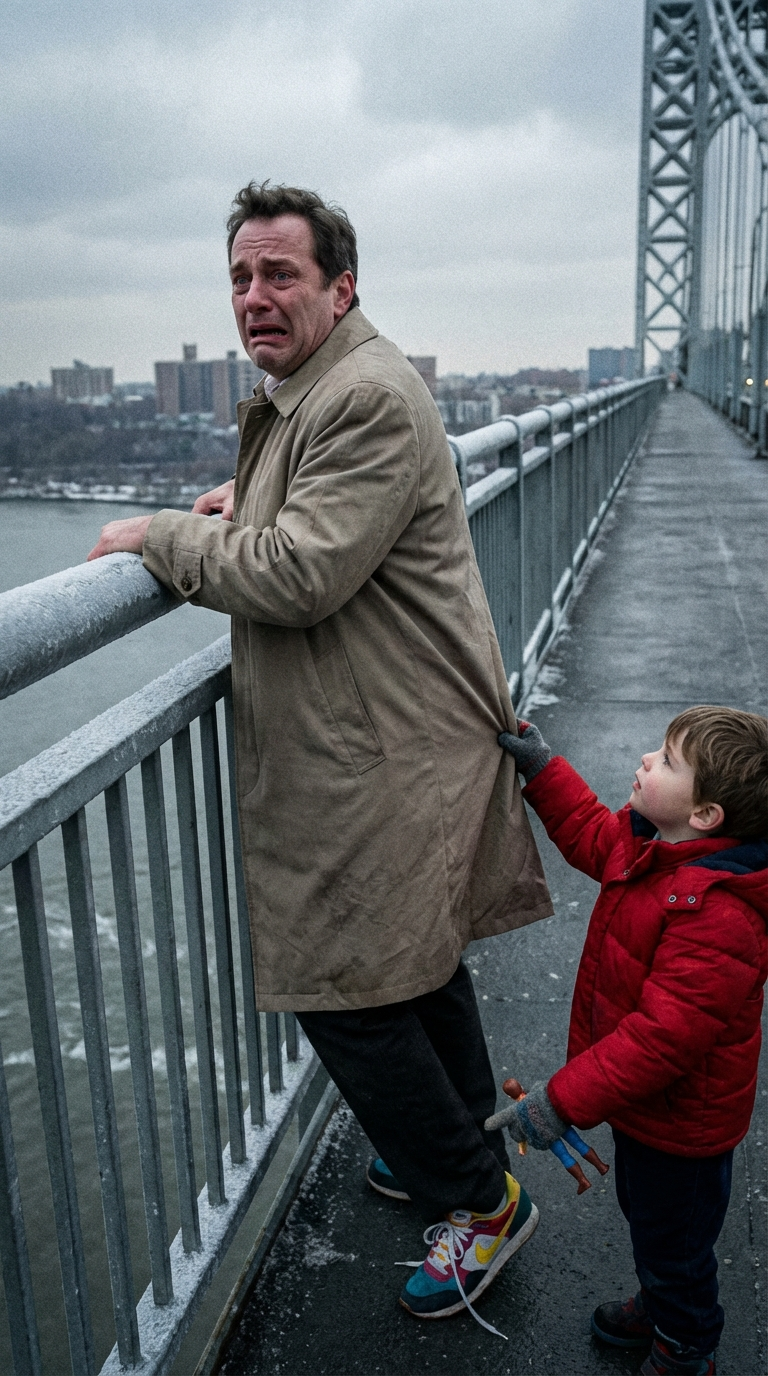
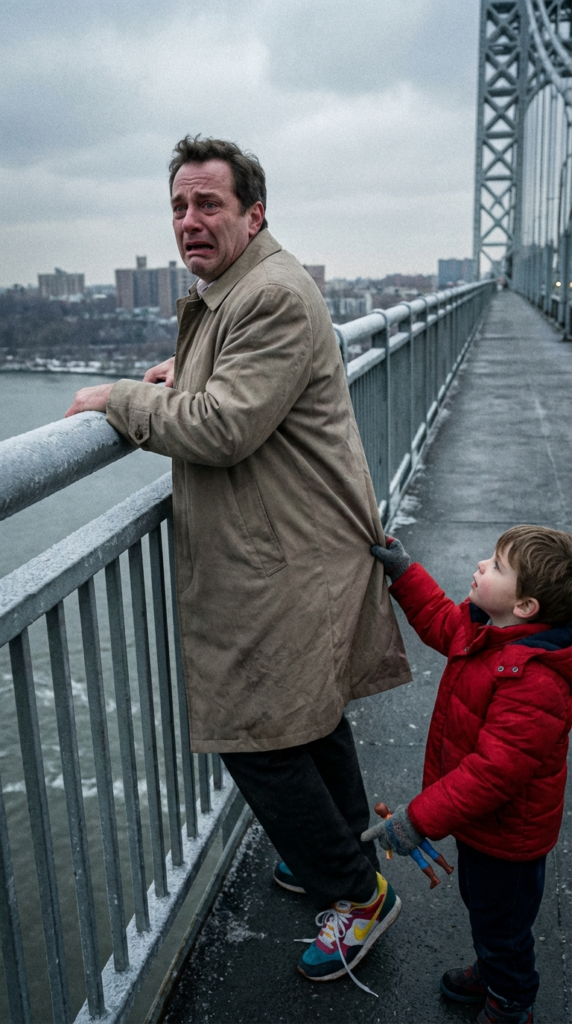
Then, I felt a tug on the back of my trench coat.
It wasn’t the wind. It was distinct. Insistent. A downward pull, like an anchor trying to find purchase in the seabed.
I froze. I was balanced precariously, one leg perched over the abyss, my heart hammering against my ribs like a trapped bird desperate to escape its cage. I turned my head slowly, my vision blurred by final tears and the biting, late-November cold. I expected a cop, hand on holster, shouting orders. I expected a hallucination, a final firing of dying synapses.
Instead, I was looking down at a mop of messy blonde hair and a ridiculously bright red puffy jacket that seemed almost radioactive against the gray steel of the bridge. A little boy, no older than five, was standing there. He was holding a scuffed plastic Iron Man figure in one mittened hand and pointing emphatically at his left foot with the other.
His sneaker was a tiny high-top, bright yellow and blue, and the shoelace was a chaotic mess of nylon trailing on the dirty, oil-stained concrete walkway.
He tilted his head back to look up at me with huge, disarming brown eyes. He was totally, beautifully oblivious to the fact that he was interrupting a suicide. He didn’t see a man at the end of his rope, teetering on the edge of oblivion. He just saw a grown-up. A utility.
“Excuse me,” he chirped, his voice high and tiny against the mechanical roar of the bridge traffic. “My mom says I’m gonna trip and break my face. Can you do the bunny ears? I can’t make them stay.”
I stared at him. Time seemed to warp. The roar of the traffic faded into a background drone. The absurdity of the moment paralyzed me. I was seconds away from ending my existence—from canceling the entire project of my life—and this kid wanted a double knot.
THE ARCHITECTURE OF A FALL
To understand why I was on that bridge, you have to understand that nobody simply wakes up one Tuesday and decides to jump. It’s a slow erosion. It’s a structure that weakens over years until a final, small stress fracture brings the whole thing down.
For me, the erosion started with the illusion of success. I was a mid-level VP at a data analytics firm in Midtown. It was the kind of job that sounds impressive at dinner parties but felt like soul-sucking gray sludge on a daily basis. I managed people who hated me to hit metrics that didn’t matter to enrich shareholders I’d never meet.
I bought the house in the Westchester suburbs because that’s what you do. I leased the German sedan because that’s what you drive. I married Sarah because she was beautiful and smart and we looked right together on Christmas cards.
But the modern Western dream is expensive, and the currency isn’t just money; it’s your humanity.
The debt mounted silently. Not credit card debt, but emotional debt. Sarah and I stopped talking years ago. We just coordinated logistics—who was picking up the dry cleaning, when the landscapers were coming. We shared a king-sized bed separated by a canyon of unspoken resentments. She wanted connection; I wanted to just survive the work week. I drowned my anxiety in expensive scotch and late nights at the office, pretending I was “providing.”
Then came the merger. Six months ago. The new leadership brought in their own people. I was fifty grand in debt on home renovations we didn’t need, and suddenly, I was “redundant.”
When I told Sarah I lost the job, the canyon between us didn’t just widen; the bridge across it collapsed. She didn’t scream. She just looked exhausted. “I can’t do this anymore, Art,” she said quietly. “I’m alone in this house even when you’re here.”
The divorce was swift. She took the house; I took the debt and a shitty studio apartment in Jersey City that smelled like someone else’s curry.
The morning of the bridge incident, I had gone back to the house one last time to sign the final papers. It was empty. The staging furniture was gone. It looked small and cheap without the decorations. I saw a ghost of myself in the hallway mirror—gray skin, dead eyes, a man wearing a suit that no longer fit him right.
I left the keys on the counter. I didn’t take an Uber back to Jersey City. I just started walking. I walked for four hours until I saw the towers of the G.W. Bridge looming like iron gateways. They seemed to be calling me. They promised a final, definitive solution to the agonizing complexity of being Arthur Penhaligon.
THE KNOT
Back on the bridge, the wind whipped the little boy’s scarf around his face. He shivered, waiting patiently for an answer to his request.
“Bunny ears,” he repeated, slightly louder, waving the Iron Man doll for emphasis.
My brain was misfiring. The adrenaline that had prepared me for death was now coursing through a body that had no idea what to do with it. My hands, still gripping the railing behind me, were vibrating.
I slowly took my leg off the rung. My foot touched the concrete. The sensation was jarring. I was back on solid ground, even though my mind was still falling.
I looked around frantically. Where was the mother? The walkway stretched out in both directions, a narrowing perspective of steel beams. About fifty yards back, I saw a woman in a beige coat, her back to us, frantically digging through a large tote bag, probably looking for a snack or a phone, momentarily unaware her son had wandered ahead.
“Please?” the boy said.
I looked down at him. He was shivering. He needed help. It was such a simple, binary transaction. A problem with an immediate, solvable solution. Unlike my life.
I let go of the railing. My hands felt alien as I brought them in front of me. I crouched down slowly. The movement felt mechanical, like I was operating a rusted construction crane. I was eye-level with him now. The smell of dryer sheets and strawberry bubblegum hit me, cutting through the diesel fumes.
“Okay,” I croaked. My voice sounded like it was coming from the bottom of a well. “Let’s see.”
My hands were shaking so violently I could barely grasp the yellow nylon laces. They were wet from dragging on the ground. I fumbled with them, my fine motor skills shot to hell by trauma.
The boy watched me with intense scrutiny. “You’re shaking,” he observed matter-of-factly. “Are you cold? My daddy shakes when he drinks too much coffee.”
The innocent comparison hit me like a physical blow to the chest. A strangled sound escaped my throat—half sob, half laugh.
“Yeah,” I whispered, focusing all my remaining mental energy on the yellow strings. “Something like that.”
I made the first loop. The “bunny ear.” I wrapped the other lace around it. My giant, trembling adult fingers felt clumsy against his tiny shoe. I pulled the second loop through.
“Double knot?” I asked, my voice barely audible.
“Yup. Mom says double or nothing.”
I tied the second knot. It was tight. Secure. A small, perfect piece of order in a chaotic universe.
I sat back on my heels, breathing heavily. The simple act of crouching and concentrating had broken the trance. The immediacy of the urge to jump had receded, replaced by a crushing, overwhelming exhaustion.
“There,” I said.
The boy inspected his foot critically. He wiggled it. The knot held. He looked up at me and beamed, a smile missing one front tooth. It was blinding.
“Thanks, mister! You’re good at that.”
Before I could respond, I heard running footsteps. “Leo! Leo, oh my god!”
The woman in the beige coat rushed up, breathless, her face pale with panic. She grabbed the boy by the shoulders. “I told you not to run ahead! You scared me half to death.”
She looked up at me, ready to apologize for her son bothering a stranger. Then she really saw me.
She saw a man in a wrinkled trench coat, kneeling on a dirty bridge walkway, tears streaming down a face that looked shattered, his hands trembling in his lap. She looked past me to the railing, then back to me.
The realization hit her eyes. Her breath hitched. The panic about her son shifted instantly to a different kind of horror. She recognized the look.
“Oh,” she whispered, her hands tightening on her son’s shoulders.
We stared at each other for five seconds that felt like five years. A silent dialogue passed between us—two strangers on a cold bridge, understanding the fragile boundary between being here and being gone.
“He… his shoe was untied,” I managed to say, gestures toward the bright yellow knot.
She looked down at the shoe, then back at me. Her eyes welled up. “Thank you,” she said, and the weight she put on those two words could have crushed steel. “Thank you so much for helping him.”
She wasn’t thanking me for tying a shoe. We both knew that.
“Come on, Leo,” she said, her voice shaking. She grabbed his hand tightly, pulling him close to her side, away from the edge. “Say goodbye to the nice man.”
“Bye!” Leo yelled, waving the Iron Man. “See ya later!”
They turned and started walking toward the Manhattan side. The mother looked back over her shoulder once, making sure I was still standing.
I watched them go until the red jacket was just a dot. I was alone again with the wind and the roar of the trucks. I looked at the railing. The spot where my hands had gripped it was still slightly warmer than the surrounding steel.
I was still broke. I was still divorced. I still had no job and a curry-scented apartment waiting for me. Nothing had changed.
Except I had tied a knot. I had made something secure.
I turned away from the edge. My legs felt like jelly as I started the long walk back toward Jersey. I wasn’t “fixed.” I wasn’t happy. But for the first time in years, I was curious about what would happen tomorrow. And for today, that was enough to keep walking.