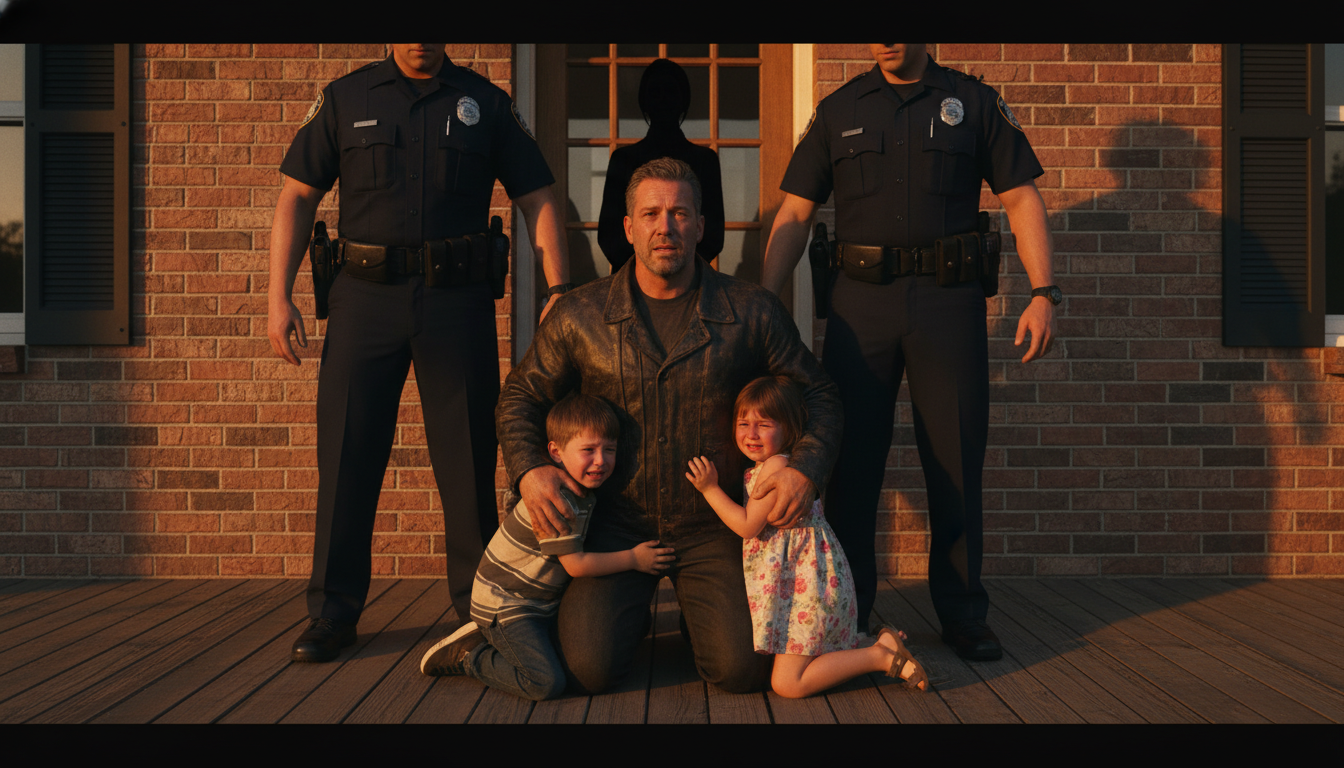
The sunset was beautiful, but it felt like a funeral. The golden light of the “magic hour” crawled across the wooden planks of my porch, illuminating the dust motes and the utter wreckage of my life.
The handcuffs were cold, clicking shut with a sound that I know will haunt my dreams until the day I die. “Please,” I gasped, the word catching in my throat as the gravel dug into my knees. “Not in front of the kids. Please.”
But the officers didn’t move. They had a job to do.
On my left, my six-year-old son, Leo, was sobbing so hard he couldn’t breathe, his little hands white-knuckled as he gripped my jeans. On my right, my daughter, Maya, was screaming for me to stay. Their terror was a physical weight, heavier than the two grown men pinning my arms behind my back.
I looked up at the brick house I’d spent ten years trying to turn into a home. Through the glass of the front door, I saw Sarah. She was a shadow behind the glass, her long blonde hair glowing in the hall light, her face unreadable. Her hand was still resting on the phone she’d used to call the precinct. After everything I’d sacrificed to keep us afloat, after the double shifts at the warehouse and the crushing debt I’d taken on to cover her “failed” boutique business, this was the reward.
She told them I was dangerous. She told them I had stolen the money from her business account. She told them I was a threat to the children.
“Sir, stay still,” the older officer, a man with gray hair and eyes that looked like they’d seen a thousand domestic disputes, muttered. His grip was firm but, strangely, not cruel.
I looked at the green canvas duffel bag sitting on the porch. It contained my life: a few shirts, my father’s watch, and a legal pad filled with bank statements Sarah didn’t know I had recovered—the ones showing where the money actually went. But in that moment, with the sirens spinning and my children’s screams piercing the air, I felt the light going out. I was a father being taken from his children on a lie.
Then, the black SUV roared up.
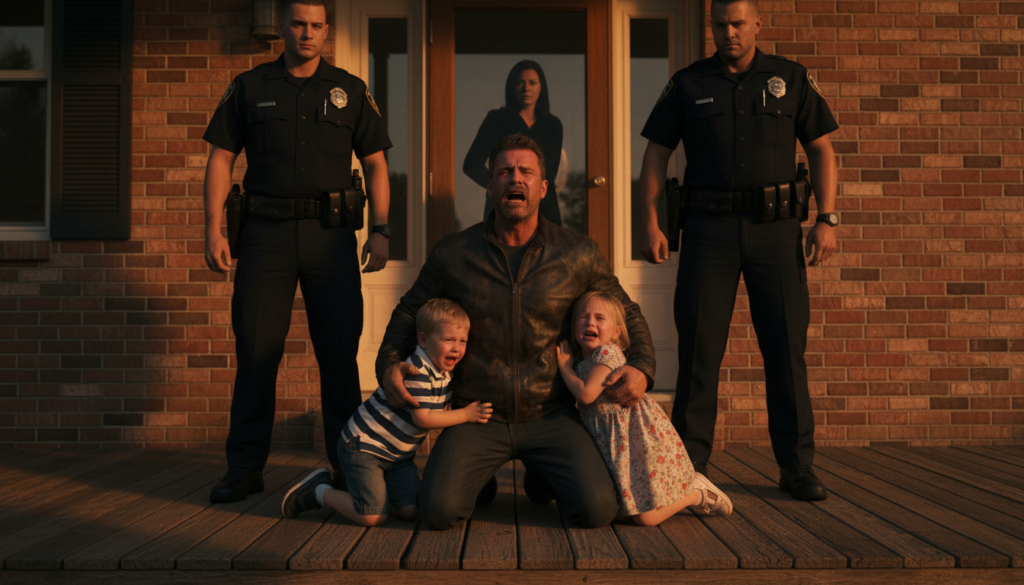
To understand how I ended up on my knees in my own driveway, you have to understand the last three years. I loved Sarah with a blindness that borders on the criminal. When she wanted to open “The Velvet Rose,” a high-end boutique, I refinanced the house. When the boutique failed to turn a profit for thirty-six consecutive months, I took a night job.
I thought we were a team. I thought we were fighting the world together.
But six months ago, I found a second phone in her gym bag. I didn’t find “cheating” texts—I found something worse. I found messages between Sarah and her brother, a man who had been in and out of white-collar legal trouble for a decade. They weren’t just losing money; they were moving it. They were using my name, my signatures, and my credit to facilitate a shell company.
When I confronted her, she didn’t cry. She didn’t apologize. She looked at me with a coldness that froze my blood and said, “Who do you think the judge is going to believe? A hardworking mother or a man with ‘unexplained’ debt and a temper?”
I didn’t have a temper. But I was starting to have a paper trail.
For months, I lived as a ghost in my own home, secretly gathering the evidence to prove that I was being framed for the embezzlement she and her brother were committing. I was planning to leave that night. The green duffel bag was packed. I was going to take the kids to my mother’s and call the authorities.
She beat me to it. She called 911 and reported an “active domestic assault,” claiming I was trying to kidnap the children and that I had “confessed” to the financial crimes.
The officers were about to lift me up when the SUV stopped. The man who stepped out was in his 60s, wearing a simple flannel shirt and work boots. He didn’t look like a lawyer or a hero. He looked like a man who had spent his life working with his hands.
“Hold on a second, Officers,” the man said. His voice was calm, the kind of calm that demands an audience.
“Sir, stay back. This is an active scene,” the younger officer barked.
The man didn’t stop. He walked right up to the porch, his eyes landing on my children. He knelt down for a split second, looking Leo and Maya in the eye. “It’s okay, little ones,” he whispered. “Your dad is a good man. I’m here to help him.”
He turned to the older officer. “Officer Miller, right? We met at the benefit for the Precinct 4 youth league last year. My name is Arthur Vance.”
Officer Miller blinked, his grip on my arm loosening slightly. “Mr. Vance? The… the developer?”
“The guy who owns the building Sarah’s boutique was in,” Arthur corrected. He held up the yellow envelope. “I’ve been watching the security feeds from my property for months, Officer. I saw Sarah and her brother moving files out of that boutique at 3:00 AM. I saw them forging signatures on documents in the back office. And more importantly, I heard the conversation they had on the loading dock this morning through the Nest cam.”
He looked at the front door, where Sarah was now stepping out, her face pale.
“She wasn’t just calling the police to report a crime,” Arthur said loudly, making sure Sarah could hear. “She was calling them because she knew I was on my way here with the evidence of her fraud. She wanted him in a cell before he could talk to me.”
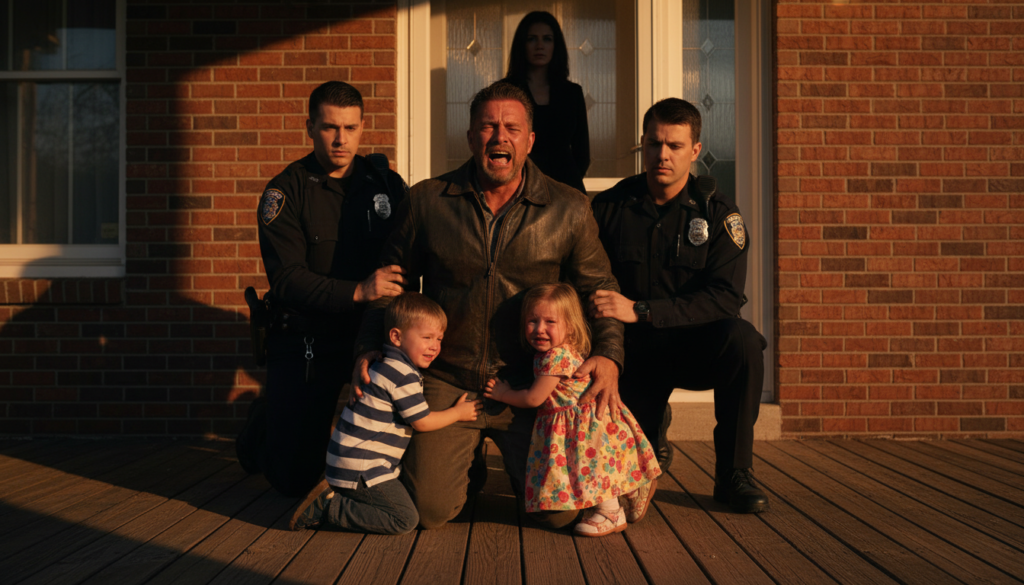
The silence that followed was deafening. Even the cicadas in the trees seemed to stop.
Arthur Vance was a man I had met only once, two years ago, when I helped him change a flat tire in the rain outside the boutique. I hadn’t even told him my name. I just saw an elderly man struggling and did what my father taught me to do. I didn’t know he was a billionaire developer. I didn’t know he owned half the block.
I just thought he was a person who needed a hand.
“I remember that tire, Elias,” Arthur said, looking at me. “And I remember the way you talked about your kids while we worked. A man who loves his children that much doesn’t do what she’s claiming you did.”
Officer Miller took the envelope. He opened it and began to scan the contents—photos, transcripts, and a USB drive. His expression shifted from professional detachment to grim realization.
He looked at the younger officer. “Uncuff him.”
“But sir—”
“I said uncuff him. Now.”
The clicks of the handcuffs releasing felt like the sound of my soul returning to my body. I collapsed forward, pulling Leo and Maya into my chest. We sat there on the wooden planks, three people huddled together, sobbing in the fading light.
The officers walked past me toward the door. Sarah tried to retreat inside, but Miller was faster. “Ma’am, we need to have a very long conversation about filing a false police report and the contents of this envelope.”
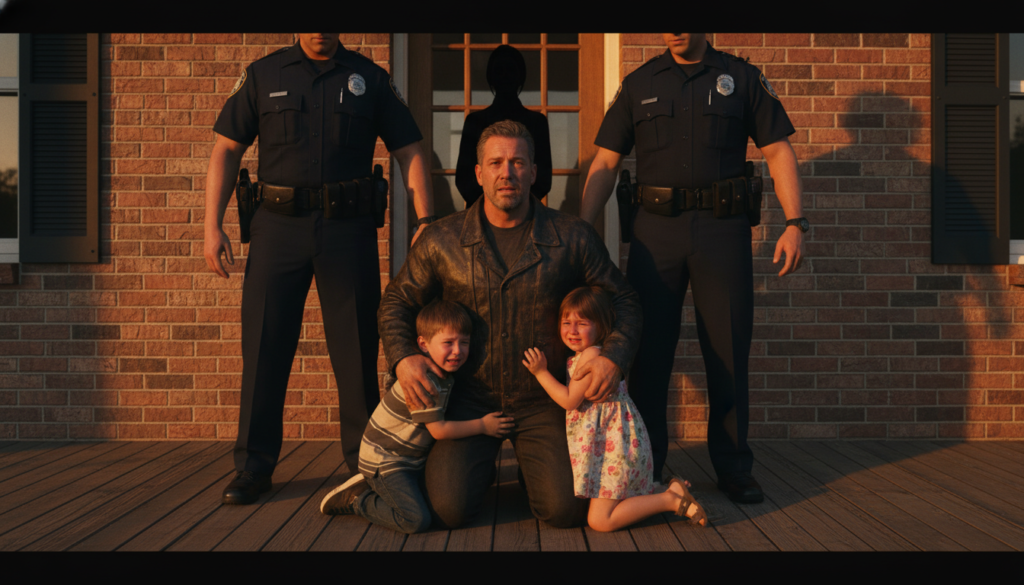
Arthur Vance stayed on my porch until the police cruisers left—this time with Sarah in the back of one. He didn’t ask for a thank you. He didn’t ask for the $20 I’d refused to take from him two years ago when I changed his tire.
“Why?” I asked, my voice raspy. “Why go to all this trouble for me?”
Arthur smiled, a tired but kind expression. “Because, Elias, we live in a world where people think being ‘smart’ means stepping on others to get ahead. They think kindness is a weakness. But I’ve lived a long time, and I’ve learned that the only thing that actually lasts is what we do for each other when no one is watching.”
He patted the green duffel bag. “You were going to leave to protect them. That makes you a hero. I just provided the shield.”
The “bad men” had come to my door that day, but they weren’t the ones in uniform. The real “bad” was the betrayal I had lived with for years. And the “good”? It wasn’t a miracle or a superhero. It was just a man who remembered a stranger who helped him in the rain.
Today, the brick house is gone. I sold it and moved to a smaller place closer to the woods, where Leo and Maya can run without fear. We have a garden now. And every time I see a sunset, I don’t think about the handcuffs or the sirens.
I think about the yellow envelope, the stranger’s smile, and the fact that no matter how dark it gets, kindness is the one light that never truly sets.