The wind on 5th Avenue that night felt less like weather and more like a physical assault. It cut through the layers of cheap fabric I was wearing, settling deep in my bones. But the cold outside was nothing compared to the icy pit in my stomach.
It was -5 degrees, and my seven-year-old son, Leo, was shivering so hard his teeth were chattering. We had been standing outside Le Jardin, one of the city’s most exclusive bistros, for three hours. We weren’t there to eat. We were there to beg.
My ex-husband, Mark, was inside. He had promised—sworn on his mother’s grave—that if I met him here tonight, he would finally sign the release forms for the joint savings account. It was the money I had inherited from my grandmother. It was the only lifeline Leo and I had left before the eviction notice on our tiny apartment turned into a padlock on the door.
Through the pristine, condensation-free glass, I saw him. He looked radiant, healthy, and wealthy. He was laughing, throwing his head back as he clinked champagne glasses with a woman in a red dress who looked barely old enough to rent a car.
He saw us, too. I know he did. For a split second, his eyes locked with mine. He saw his son jumping in place to keep warm. He saw my red, wind-burned nose. And then, with the casual cruelty that had defined our ten-year marriage, he just smirked and looked away.
“Mom, look,” Leo whispered, tugging my freezing hand.
I followed his gaze. In the darkened alleyway next to the restaurant, near the steam vents that weren’t working, a stray dog was curled up on a metal grate. It was a golden retriever mix, emaciated and shaking violently, its ribs showing through matted, wet fur.
My heart broke, but my survival instinct kicked in. “Leo, leave it. We have to wait for Dad.”
But Leo has never had my survival instinct. He has something better—something his father tried to beat out of him and failed. He has a heart that is too big for his chest.
Before I could stop him, Leo unzipped his puffer coat—the only winter coat he owned, which we had bought at a thrift store two years ago—and peeled it off.
“Leo, no! You’ll freeze!” I cried, lunging forward to pull him back. The wind hit his small chest, covered only by a thin, faded superhero t-shirt.
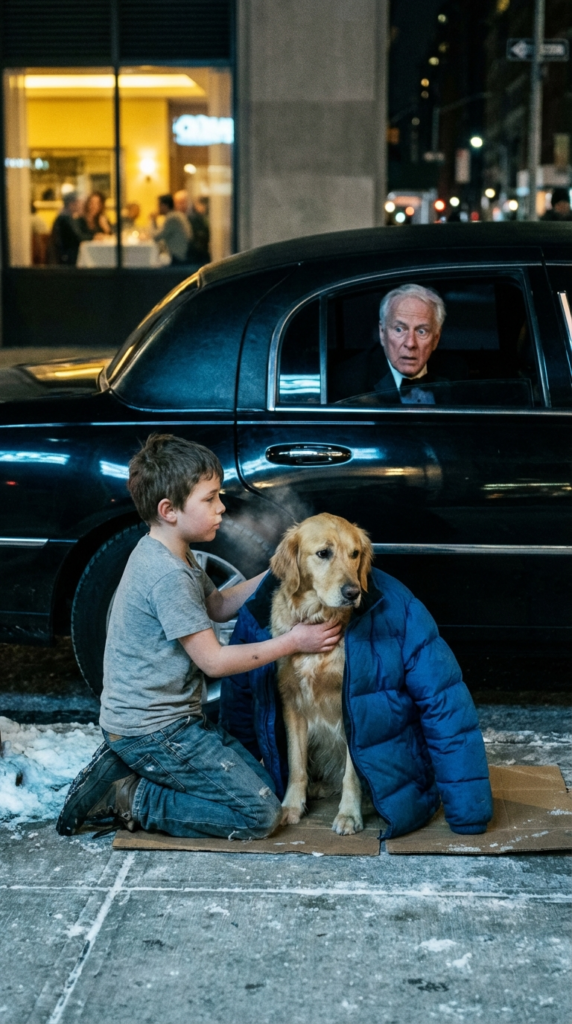
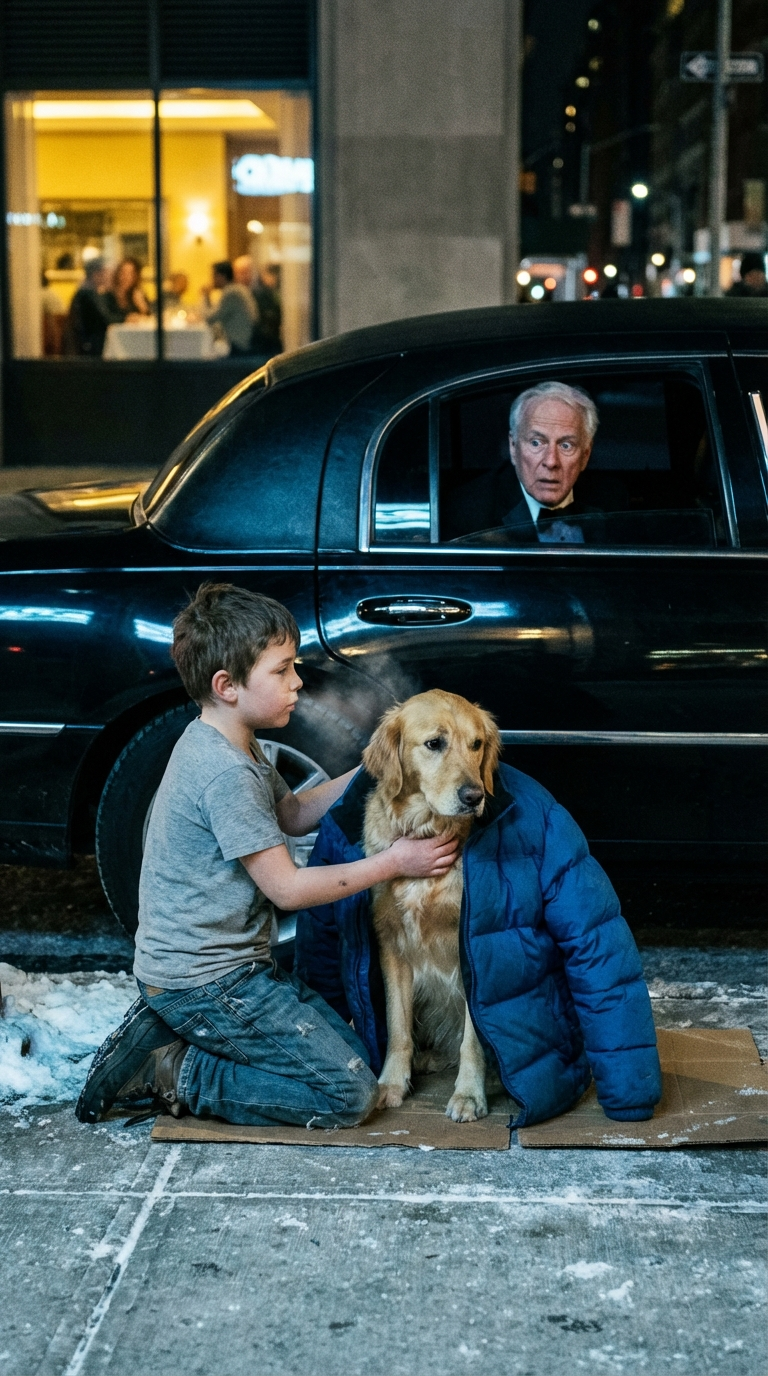
“He’s colder than me, Mom,” Leo said, his voice trembling but determined. He knelt in the slush and draped the coat over the animal. The dog stopped whimpering immediately, nuzzling its nose into the warmth of the cheap polyester.
Leo sat down in the snow next to the dog, wrapping his small arms around the dirty animal to share his body heat.
I broke down. The tears felt hot on my frozen cheeks. I felt like the worst mother in the world. I couldn’t protect my son from the elements, and I couldn’t protect him from the heartbreak of watching his father ignore him from a warm, golden-lit restaurant.
That’s when the black limousine pulled up.
I hadn’t noticed it before, but it had been idling across the street for twenty minutes. It was a sleek, long Phantom, the kind of car that costs more than any house I’ve ever lived in. The back window rolled down with a low, expensive hum.
An older man with silver hair and eyes like steel was staring right at us. He wasn’t looking at the dog. He was looking at Leo.
The door opened. The man stepped out into the snow. He was immaculate, wearing a tuxedo and a long cashmere overcoat. He didn’t look like he belonged on the dirty sidewalk. He looked like he owned the city. In his hand, he held a thick, cream-colored envelope.
He didn’t say a word to me initially. He walked past us, straight up to the restaurant window where Mark was sitting. He tapped on the glass with a heavy platinum ring—clack, clack, clack.
Mark looked up. The color drained from his face instantly. He dropped his fork.
The stranger didn’t smile. He just pointed at Mark, then pointed at the door, and then walked back to us.
He knelt in the snow—ruining pants that probably cost $5,000—and looked Leo in the eye.
“That was a brave thing you did, young man,” he said, his voice gravelly and warm. He took off his own cashmere scarf and wrapped it around Leo’s neck. Then, he stood up and handed me the envelope.
“Get in the car,” he said softly. “It’s warm inside.”
“I… I can’t,” I stammered. “I don’t know you.”
“My name is Arthur Vance,” he said. “And I think you’re waiting for a signature from the man inside. Don’t worry. He’s coming out right now.”
Arthur Vance. The name hit me like a physical blow. Arthur Vance wasn’t just a millionaire. He was the CEO of Vance Global—the company Mark had just been promoted to Vice President of. Mark had been bragging for months about the ‘big gala’ tonight where he was going to be honored.
I was shaking. I didn’t know whether to scream or laugh. But what I did next shocked everyone. I picked up the dog, grabbed Leo’s hand, and climbed into the back of the Rolls Royce.
The Confrontation
The inside of the car smelled like leather and cedar. The heater was blasting. Leo instantly curled up into the soft seats, the dog resting its head on his lap.
Outside, the restaurant door burst open. Mark came running out, no coat, looking frantic. He spotted his boss standing by the open door of the limo.
“Mr. Vance!” Mark gasped, breathless. “I… I didn’t expect to see you until the gala. Is everything okay?”
Arthur Vance looked at Mark with a look of pure, unadulterated disgust.
“I was early, Mark,” Vance said, his voice carrying over the wind. “I decided to sit and watch the city for a moment before heading to the venue. And do you know what I saw?”
Mark looked confused. He glanced at the limo, and then he saw me. He saw Leo. His eyes went wide.
“Sarah?” he hissed. “What are you doing in Mr. Vance’s car? Get out immediately. You’re embarrassing me.”
“She stays,” Vance barked. The authority in his voice was terrifying. “I saw a seven-year-old boy give the clothes off his back to a dying animal. And I saw his father—my Vice President—sip Dom Pérignon ten feet away while his son froze.”
“It’s… it’s complicated, sir,” Mark stammered, sweating despite the cold. “She’s crazy. She keeps the boy from me. It’s a custody tactic.”
“Is it?” Vance asked. “Because I’ve been watching for twenty minutes. You saw them. You laughed.”
Vance reached into the car and took the envelope back from my hands. He pulled out a document. It wasn’t a check. It was a contract.
“This,” Vance said, holding it up, “is your partnership agreement, Mark. It was going to be the highlight of your night.”
Mark reached for it, a desperate smile forming on his lips. “Thank you, sir. I won’t let you do—”
RRRRIIIP.
Vance tore the thick paper in half. Then in quarters. He let the pieces fall into the slushy snow.
“You’re fired, Mark,” Vance said calmly. “Effective immediately. My company relies on character. You clearly have none.”
Mark stood frozen, his mouth agape. The woman in the red dress had come to the door, watching the scene unfold. When she heard “fired,” she turned around and went back inside.
“But… the gala,” Mark whispered.
“Oh, we’re still going to the gala,” Vance said, turning to me with a warm smile. “Sarah, is it? Do you and Leo have plans for dinner? I believe there is a table of honor that has just opened up. And I happen to know a very good veterinarian for your new friend.”
The Aftermath
That night, Leo didn’t eat ramen noodles in a cold apartment. He ate filet mignon in a ballroom, wearing a tuxedo jacket that Arthur Vance had borrowed from a waiter and pinned to fit him. The dog, whom Leo named ‘Lucky,’ was taken to a 24-hour vet by Vance’s personal driver and treated for hypothermia and malnutrition.
Mark didn’t make it to the gala. Security stopped him at the door.
But the story didn’t end there. The “shocking” part wasn’t just the firing.
Two days later, I received a call from Vance’s legal team. Arthur hadn’t just fired Mark; he had launched an internal audit into Mark’s expenses. It turned out Mark had been funneling company money to pay for his girlfriend’s apartment—hiding assets that should have been part of our divorce settlement.
Because of Arthur Vance’s testimony and the audit, the judge didn’t just grant me access to my savings. She granted me full custody, full alimony, and 70% of Mark’s hidden assets.
We bought a house with a big backyard six months later. It has a heated dog house.
Lucky loves it there. But sometimes, when it snows, I see Leo go outside and sit with the dog for a few minutes. He doesn’t need to give him his coat anymore, but he sits there anyway, just to remind himself that they are both safe, and they are both warm.
Mark sends emails sometimes, asking to see Leo. I let Leo decide. So far, Leo’s answer has always been the same.
“Tell him I’m busy,” Leo says, petting Lucky’s golden head. “I’m taking care of my family.”
And he is.