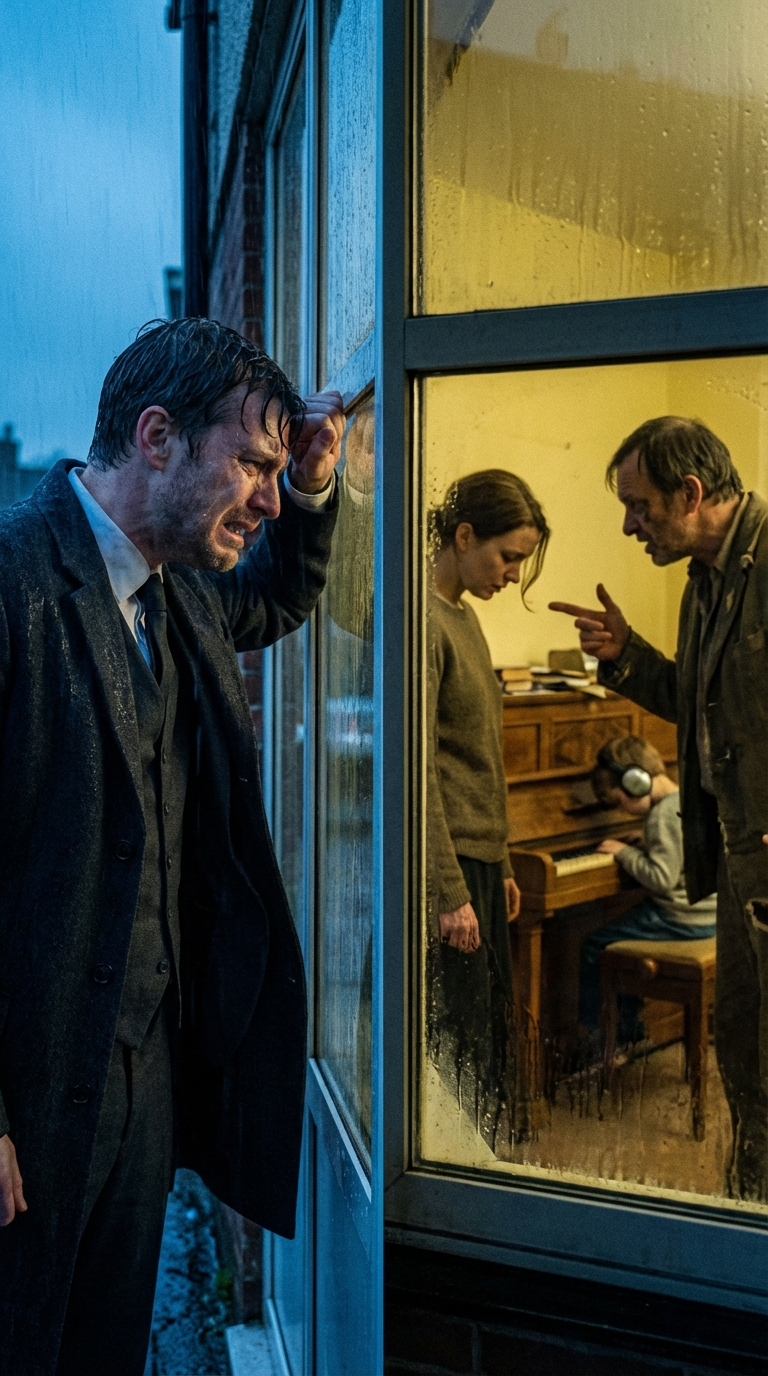
I dialed 9-1-1, my finger hovering over the call button. Then I hung up. The police take too long. I needed this to stop now.
My name is Julian Thorne. I made my fortune in high-frequency trading, an industry where milliseconds cost millions. I deal in silence, precision, and absolute isolation. My estate in the Hamptons is a fortress of solitude—steel gates, high hedges, and acoustic dampening technology that rivals a recording studio. Or it was, until three weeks ago when the new tenants moved into the rundown Victorian property that sits like a rotted tooth next to my perimeter wall.
Every evening at 6:00 PM, it started. The piano.
It wasn’t virtuoso. It was hesitant. Clumsy. Missed keys and broken rhythms that cut through my triple-paned windows like a dentist’s drill. For a man who has fired employees for chewing gum too loudly during board meetings, it was psychological torture.
Tonight, I snapped. I grabbed my cashmere coat and marched across the wet lawn, disregarding the property line, ready to threaten legal action, noise ordinances, or simply intimidate them into silence. I was ready to be the monster the tabloids say I am.
I pounded on their peeling front door. It swung open before I could knock again.
I didn’t find a party. I didn’t find a rebellious teenager blasting a stereo.
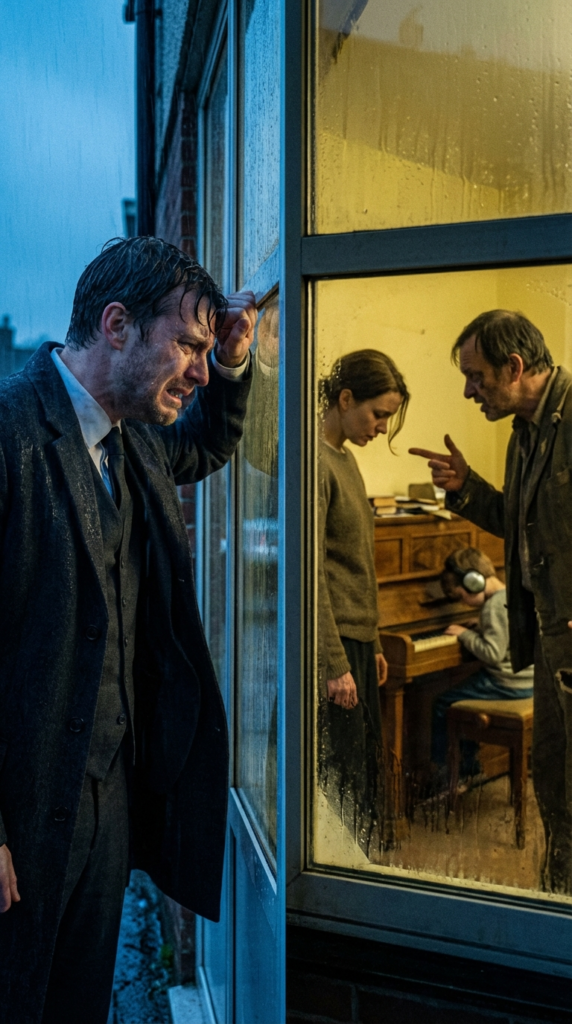
I found a woman, thin and pale, wearing a waitress uniform that looked two sizes too big. She was standing in a hallway filled with half-packed cardboard boxes. A heavy-set man in a cheap, shiny suit—the landlord—was towering over her, waving a crumpled eviction notice in her face.
“I don’t care about your sob stories, lady!” the landlord spat, his spit landing on the linoleum. “You’re three weeks late. I’m taking the deposit, and I’m selling that piece of junk piano to cover the rest. You have until midnight to get out.”
And there, in the corner of the dim living room, sat a boy. He couldn’t have been more than seven years old. He was wearing oversized headphones that clearly weren’t plugged into anything. He was hunched over an upright piano that had seen better decades.
He was playing. He wasn’t playing to make noise. He was playing to drown out the shouting. He was playing to hide.
And then I heard the song. Clair de Lune.
My heart stopped. My breath hitched in my throat, choking off the angry tirade I had prepared. It was the song. The specific arrangement. The hesitancy on the high C.
It was the song my daughter, Maya, was playing the week she died.
The Fortress of Grief
To understand why I stood frozen in that doorway, you have to understand the silence.
Five years ago, I wasn’t this man. I was a father. I was a husband. My house was loud—filled with the chaotic, beautiful noise of a ten-year-old girl and a wife who loved to entertain. Maya loved the piano. She wasn’t a prodigy, but she had passion. We practiced Clair de Lune every night after dinner.
Then came the accident. A drunk driver. A rainy intersection. The silence didn’t happen gradually; it slammed into my life like a guillotine.
After the funeral, my wife, Elena, couldn’t handle the quiet. She wanted to talk, to cry, to fill the house with memories. I couldn’t. I wanted the world to stop. I wanted the noise to cease. We divorced two years later. She moved to Italy to find the sun; I moved into this bunker to embrace the cold.
I soundproofed the walls not to keep the world out, but to keep the memories from echoing. I became the “Billionaire Hermit.” I hated noise because noise is life, and I had decided I was done with living.
The Confrontation
Back in the hallway, the landlord, whose name I would later learn was Mr. Henderson, noticed me.
“Who the hell are you?” Henderson barked, turning his aggression toward me. “You with her? You the deadbeat dad?”
The mother looked at me, terrified. “Please, sir, we don’t want any trouble. We’re leaving. I just need time to get a truck for the piano.”
“The piano stays!” Henderson yelled. He turned and grabbed the boy’s shoulder to yank him off the bench. “Did you hear me, kid? Get up! That’s my property now!”
The boy let out a yelp. The music stopped.
That sound—the abrupt silence where the music used to be—triggered something primal in me. It was the same silence that had haunted me for five years.
“Take your hand off him,” I said. My voice wasn’t loud. It was the voice I used when I was about to hostilely takeover a competitor. It was the voice of absolute, crushing authority.
Henderson froze. He looked at me, really looked at me. He took in the tailored coat, the Patek Philippe watch, the way I stood. He realized I wasn’t a neighbor coming to borrow sugar.
“Look, buddy, this is a private matter,” Henderson stammered, stepping back from the boy. “They haven’t paid rent.”
“How much?” I asked.
“What?”
“The rent. How much do they owe you?”
“Twelve hundred,” Henderson sneered. “Plus late fees. Call it fifteen hundred.”
I reached into my coat pocket. I didn’t carry cash, usually. But I had my checkbook. I pulled it out, uncapped my fountain pen, and scribbled.
I ripped the check out and held it up.
“Here is a check for five thousand dollars,” I said. “That covers the back rent, the next two months, and the inconvenience.”
The mother gasped. “Sir, I can’t…”
Henderson’s greedy eyes widened. He reached for the check.
I pulled it back. “But there is a condition.”
“Yeah? What?” Henderson asked, eyeing the paper.
“You are going to sell me the property. Right now.”
Henderson laughed. “You’re joking. This is a prime lot. I’ve got developers sniffing around…”
“I’m Julian Thorne,” I said simply.
The name landed like a bomb. Even a slumlord like Henderson read the papers. He knew that name meant endless resources and ruthless lawyers.
“I will buy this house for 20% over market value,” I continued, stepping closer, invading his personal space. “Cash. Closing in 48 hours. Or, I can have my legal team scrutinize every building code violation, every zoning infraction, and every tax filing you’ve made in the last twenty years. I will tie this property up in litigation until your grandchildren are gray.”
I held the check out again. “Take the rent. Get out of my sight. We will discuss the sale tomorrow.”
Henderson snatched the check. He looked at the mother, then at me, realizing he was out of his depth. “Fine. Whatever. I just want my money.”
He stormed out, slamming the door behind him.
The Arrangement
The silence in the room was heavy. The boy, Leo, was still sitting at the piano, trembling. The mother, whose name was Sarah, looked at me with a mixture of awe and fear.
“Mr. Thorne,” she whispered. “I… I don’t know how to thank you. But I can’t pay you back. I work double shifts at the diner, but…”
“I don’t want your money,” I said. I looked at Leo. “I want him to keep playing.”
Sarah looked confused. “You… you like the noise? The neighbors usually complain.”
“It’s not noise,” I said, my voice cracking for the first time in years. “It’s practice.”
I walked over to the piano. I sat down on the bench next to Leo. He smelled like soap and fear. I reached out and touched the keys.
“You’re rushing the arpeggio,” I told him softly. “My daughter… she used to rush it too. You have to let the notes breathe.”
Leo looked up at me. “I’m scared,” he admitted.
“I know,” I said. “So am I. But the music helps.”
The Resolution
I bought the house three days later.
I didn’t evict Sarah and Leo. In fact, I lowered their rent to $1 a month. I drew up a contract that stated they could stay as long as they wanted, provided the “maintenance of the musical instrument” continued.
I hired a private tutor for Leo—the best in the state.
But I didn’t stop there. I realized that my silence wasn’t peace; it was a grave. I started leaving my windows open.
Every evening at 6:00 PM, I sit in my armchair with a glass of scotch. I don’t turn on the TV. I don’t check the stock market. I just listen.
Leo is getting better. He doesn’t rush the arpeggio anymore.
Last week, I saw a moving truck in my own driveway. Not moving out, but moving things in. I called Elena in Italy. We talked for three hours. She’s coming to visit next month.
People think I bought the house next door to control the noise. They’re wrong. I bought the house next door because that little boy’s piano playing was the first thing in five years that made me feel like I was still alive.
I am a billionaire who hates noise. But I would pay every cent I have to ensure that the music next door never stops.