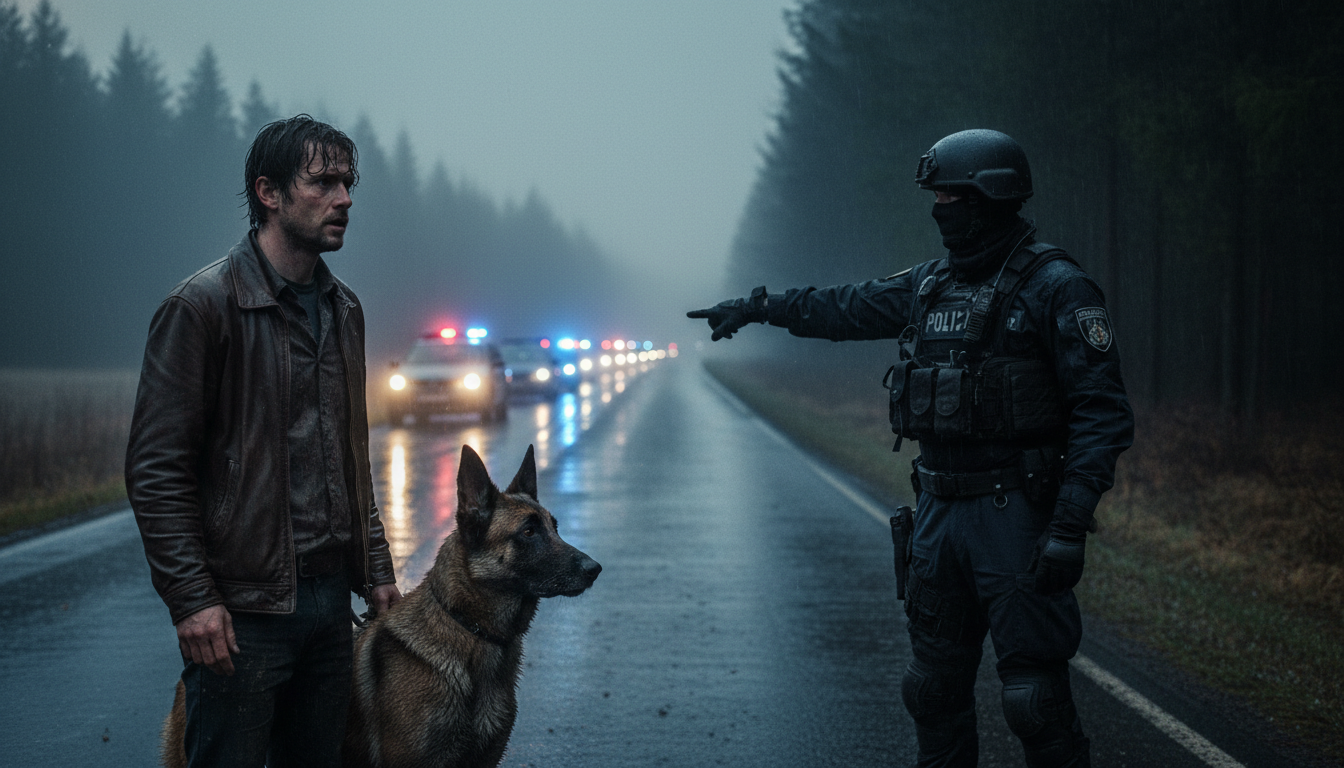
I have three commas in my bank account. I own the tallest building in the city. I have a team of lawyers who can make problems disappear with a single phone call. But standing in the middle of that highway, soaked to the bone with my dog growling at my side, I had never felt more powerless.
The rain was coming down in sheets, turning the asphalt into a black mirror. My Italian leather boots were ruined, caked in mud. My $5,000 jacket was heavy with water. I hadn’t shaved in two days, and I looked like a madman marching down the center line of a rural two-lane road.
Behind me, the world was exploding in red and blue.
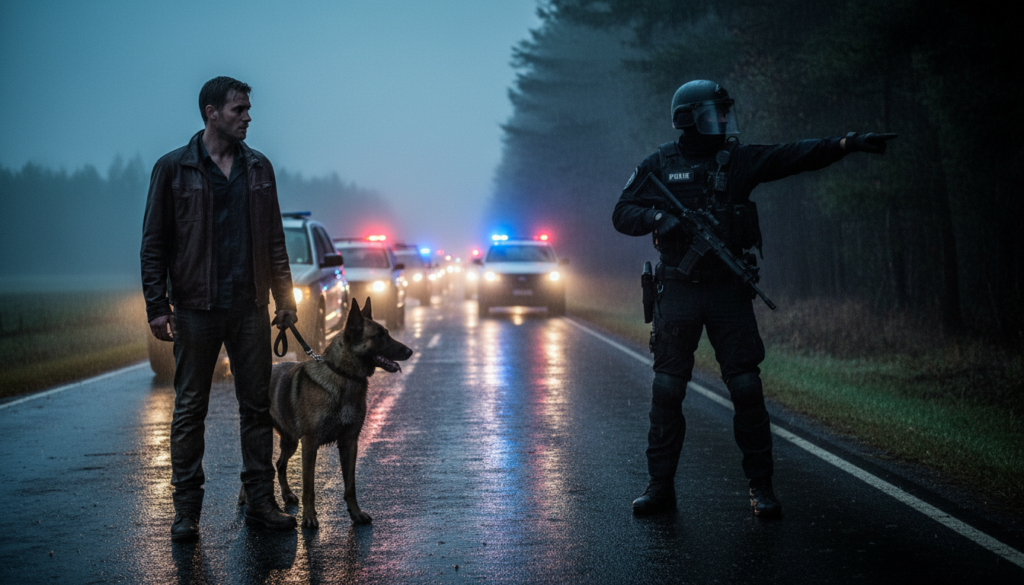
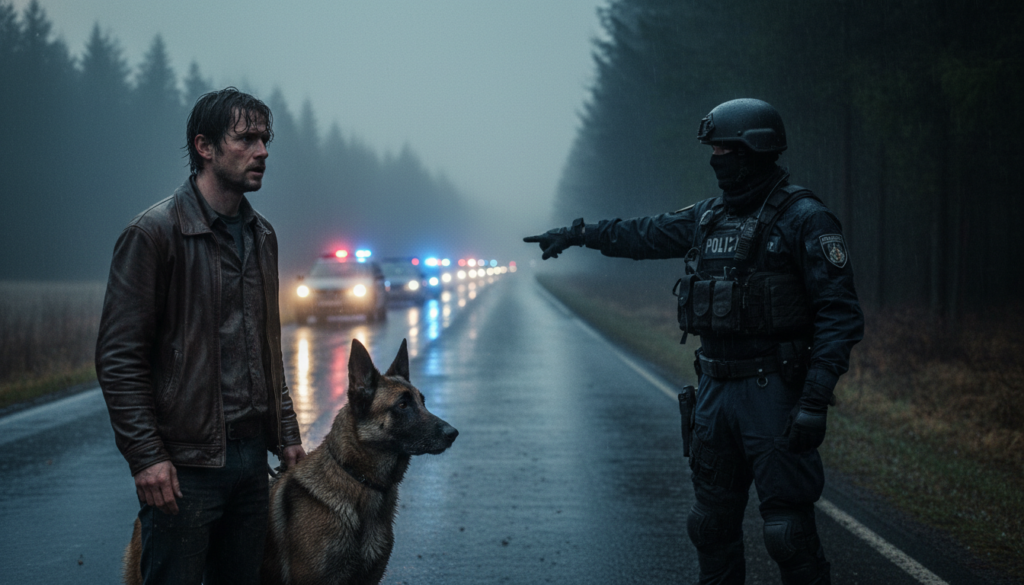
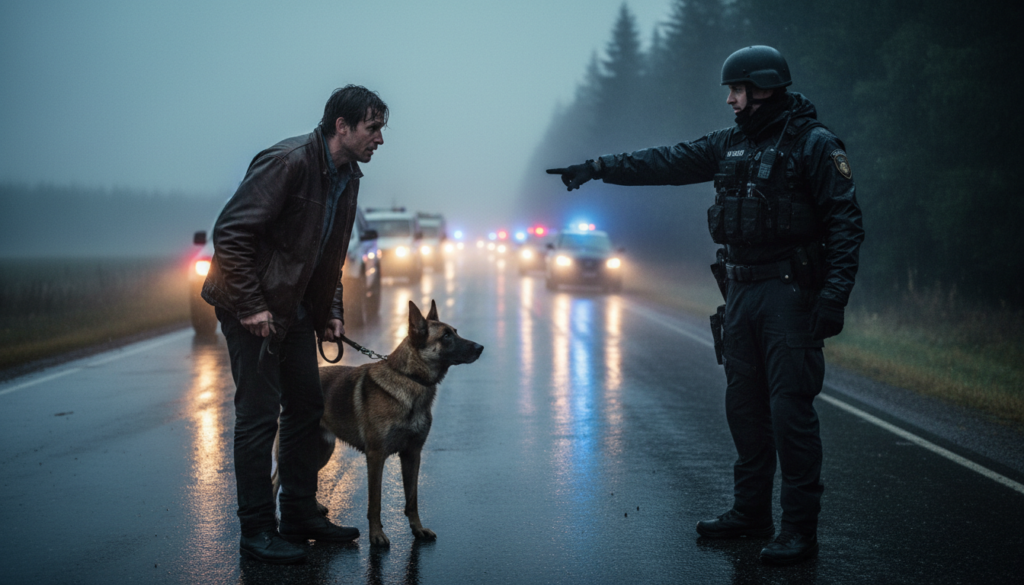
First, it was one siren. Then two. Now, a convoy of six police cruisers was trailing me, their lights cutting through the thick fog. They weren’t passing me. They were following me.
My heart hammered against my ribs like a trapped bird. I tightened my grip on Titan’s leash. He was a Belgian Malinois, trained for protection, and he could feel my panic. He pressed his wet fur against my leg, his ears pinned back.
Ahead of me, a tactical unit pulled diagonally across the road, blocking my path.
I stopped. The only sound was the drumming of rain and the idling engines of the police cars.
An officer stepped out. He was wearing a green tactical vest and a serious expression. He didn’t look like he wanted to talk. He looked like he wanted to take me down. I knew what this looked like. A deranged man walking a dangerous dog in the middle of a storm, refusing to stop. They didn’t know I was a CEO. They didn’t know why I was out here. They just saw a threat.
But to understand why I was standing in front of a police blockade on a Tuesday night, you have to understand the silence in my house that morning.
My name is Elias. If you read the business journals, you know me as a ruthless innovator, a man who built a tech empire from a garage in Seattle. But if you asked my sixteen-year-old daughter, Maya, she’d use a different word: Absent.
For the last five years, since my wife passed away, I buried myself in work. It was easier to look at spreadsheets than to look at Maya, who had her mother’s eyes. I bought her things. Horses, cars, vacations. I thought provision was the same thing as love.
That morning, the tension finally snapped.
I missed her debate championship. Again. I had a merger meeting that ran late. When I got home, she was waiting in the foyer, her bags packed.
“I’m going to Grandma’s,” she said. Her voice wasn’t angry; it was hollow. That hurt worse.
“Maya, don’t be dramatic. I’ll make it up to you. We’ll go to Paris next week,” I said, checking my watch.
She laughed, a bitter, sharp sound. “You think you can buy your way out of being a dad, Elias. You’re not a father. You’re just an ATM.”
She walked out the door. I let her go. I thought she’d cool off.
Two hours later, I got a notification on my phone. The tracking app I installed on her car—for safety, I told myself, though she called it control—showed her vehicle had stopped.
Not at her grandmother’s house. But thirty miles away, on a rural stretch of Highway 9, deep in the heavy forest belt.
The dot on the map wasn’t moving.
I called her. Straight to voicemail. I called again. Voicemail.
A cold dread, colder than any business loss I’d ever experienced, settled in my stomach. I grabbed Titan, my dog, and jumped into my Porsche. I didn’t wait for my driver. I didn’t wait for security.
The storm hit ten miles out of the city. It wasn’t just rain; it was a deluge. The visibility dropped to zero. I was driving too fast, panic seizing my muscles.
The GPS showed I was five miles from her location when the hydroplaning started. The Porsche spun. I corrected, but the road was slick with oil and water. We slid off the shoulder and slammed into a muddy embankment.
The airbags deployed. Dust and smoke filled the cabin.
I coughed, checking myself. Bruised, but okay. I looked at the passenger seat. Titan was shaken, whining, but unhurt.
I tried to restart the car. The engine sputtered and died. I checked my phone. No Service.
I kicked the door open. The rain hit me instantly, soaking my clothes within seconds. I looked at the dark stretch of road ahead. Dense forest on both sides. No streetlights. Just the fog and the rain.
“Come on, boy,” I said to Titan.
We started walking.
A mile in, the adrenaline wore off, replaced by the stinging cold. My expensive loafers were slipping on the wet asphalt. I kicked them off and put on a pair of old work boots I kept in the trunk, though they were a size too small.
Every car that passed sprayed us with dirty water. None stopped. Why would they? A bearded man in a leather jacket with a wolf-like dog? I looked like a nightmare.
My mind raced. Was she hurt? Was she kidnapped? Why had the car stopped?
I bargained with the universe. Take the company. Take the stock options. Just let her be okay.
Three miles in, my legs were burning. Titan kept nudging my hand with his nose, keeping me moving.
Five miles in, the police lights appeared.
At first, I felt relief. I waved my arms. But the cruiser didn’t stop to pick me up. It slowed down, trailed me for a hundred yards, and then backed off. Then another joined.
Paranoia set in. I wasn’t carrying ID. My wallet was in the glove box of the wrecked Porsche. I looked like a vagrant.
They’re going to arrest me, I thought. I’m going to spend the night in a cell while my daughter is out here alone.
I didn’t stop. I couldn’t stop.
Which brings us back to the moment the tactical officer stepped out of his vehicle, blocking the road.
The convoy behind me had stopped. The silence was deafening.
The officer, a man with graying temples and a badge that read SGT. MILLER, kept his arm raised. He pointed his finger sharply to the right.
I flinched. I prepared to drop to my knees.
“Sir!” he shouted over the wind. “The woods! To the right!”
I blinked, confused. “What?”
Miller walked closer, ignoring Titan’s low growl. He didn’t reach for handcuffs. He reached out and put a steady hand on my shoulder.
“We found the car, Mr. Vance,” he said.
He knew my name.
“Is she…” My voice broke. I couldn’t finish the sentence.
“She’s alive,” Miller said firmly. “She skidded off the road, same as you. The car is down a ravine about two hundred yards that way. My guys are down there now getting her out. We blocked the road to stop traffic so you could cross safely.”
I looked at him, stunned. “You… you were escorting me?”
“We ran the plates on your Porsche back at the ditch,” Miller said, a small, kind smile breaking his serious face. “We saw the child seat in the back wasn’t used, but the tracking data on your phone… we figured you were coming for her. When we saw you walking, we knew we couldn’t stop a father on a mission. We just made sure no one hit you.”
The convoy behind me wasn’t a chase. It was a shield.
I fell to my knees. Not in surrender, but in relief. Titan licked the rain off my face.
“Go to her,” Miller said, pulling me up.
I scrambled down the muddy embankment, slipping and sliding, tearing my jacket on thorns.
At the bottom of the ravine, illuminated by floodlights, was her car. It was battered, resting against a large oak tree.
Paramedics were pulling a stretcher up.
“Maya!” I screamed.
She sat up on the stretcher. She had a bandage on her forehead and she was shivering, wrapped in a foil blanket.
“Dad?” she whispered. She looked at me—mud in my beard, soaking wet, bleeding from a scratch on my cheek, panting heavily.
I ran to her and collapsed by the stretcher, burying my face in her blanket. I sobbed. I didn’t care about the paramedics watching. I didn’t care about dignity.
“I walked,” I choked out. “I wrecked the car. I walked the rest of the way.”
She reached out a trembling hand and touched my wet hair. “You walked? In this?”
“I’d walk across the ocean,” I said.
We didn’t go to Paris the next week. We didn’t go anywhere.
I spent the next week at home, making grilled cheese sandwiches and sitting on the floor of her room while she recovered. I turned my phone off. I missed three board meetings. I lost a contract worth four million dollars.
And I didn’t care.
Officer Miller came by the house a few days later to check on us. I tried to offer him a check—a donation to the police benevolent fund, something huge.
He refused it.
“Just take care of your girl, Mr. Vance,” he said, patting Titan on the head. “That’s the only payment that matters. We all get lost in the fog sometimes. We just need someone to point the way.”
I kept the muddy boots. I put them in the corner of my office, right next to the floor-to-ceiling window overlooking the city.
Visitors ask me why I keep a pair of dirty, cheap work boots in a billion-dollar office.
I tell them they are my most valuable possession. They remind me that the most important steps you take in life aren’t the ones that climb the corporate ladder.
They are the ones you take in the rain, when you have nothing left to offer but your presence, walking toward the people you love.
Kindness isn’t always a soft word. Sometimes, kindness is a police officer blocking a highway so a father can find his child. And success isn’t the number in your bank account. It’s showing up, even when you have to walk through the storm to do it.