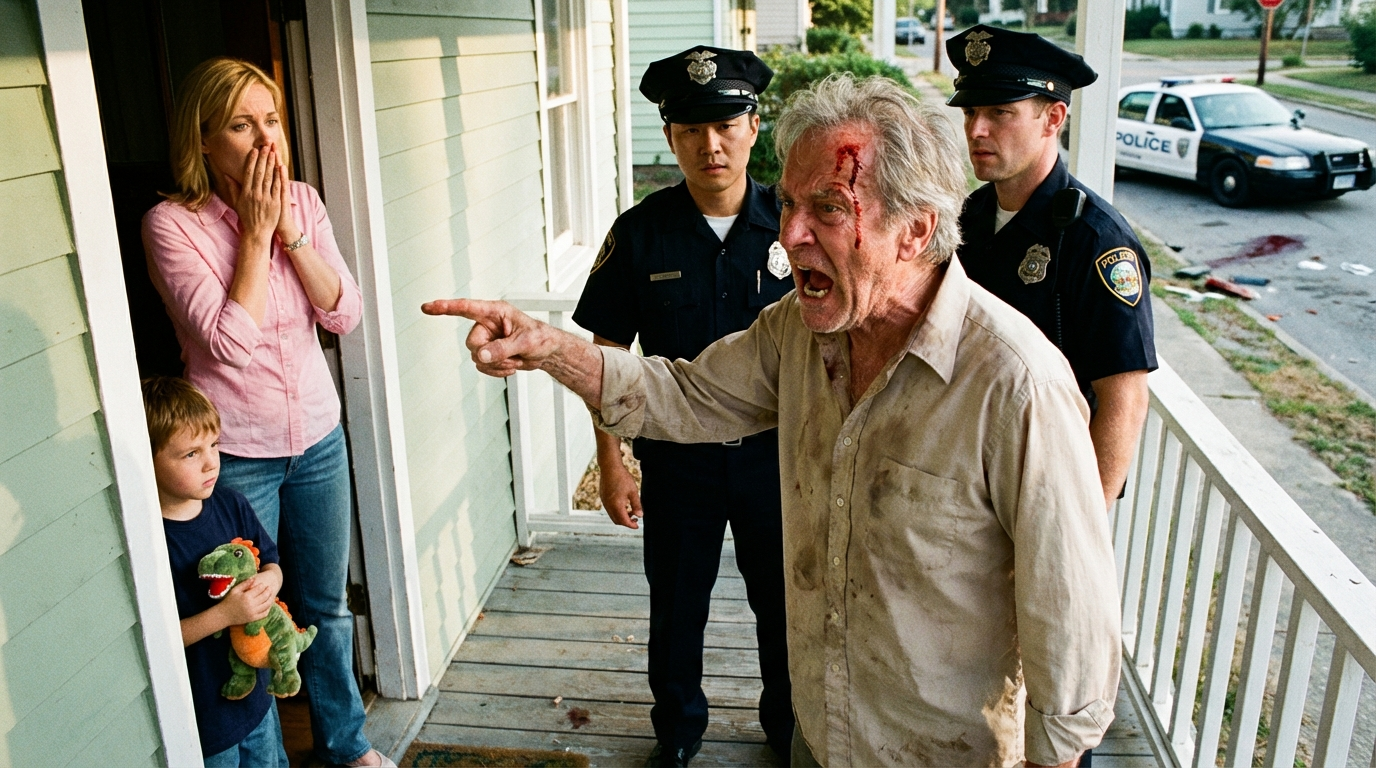
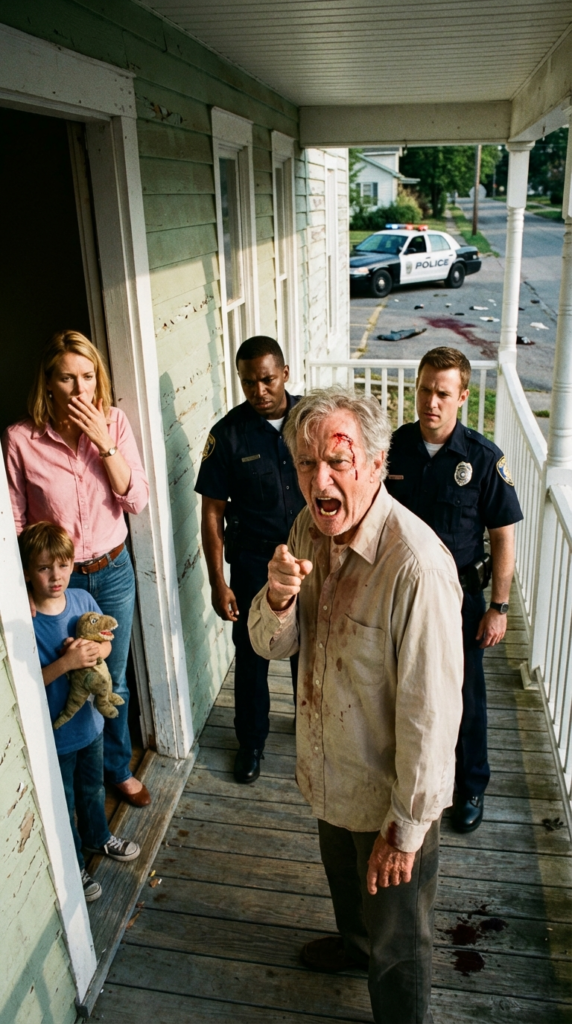
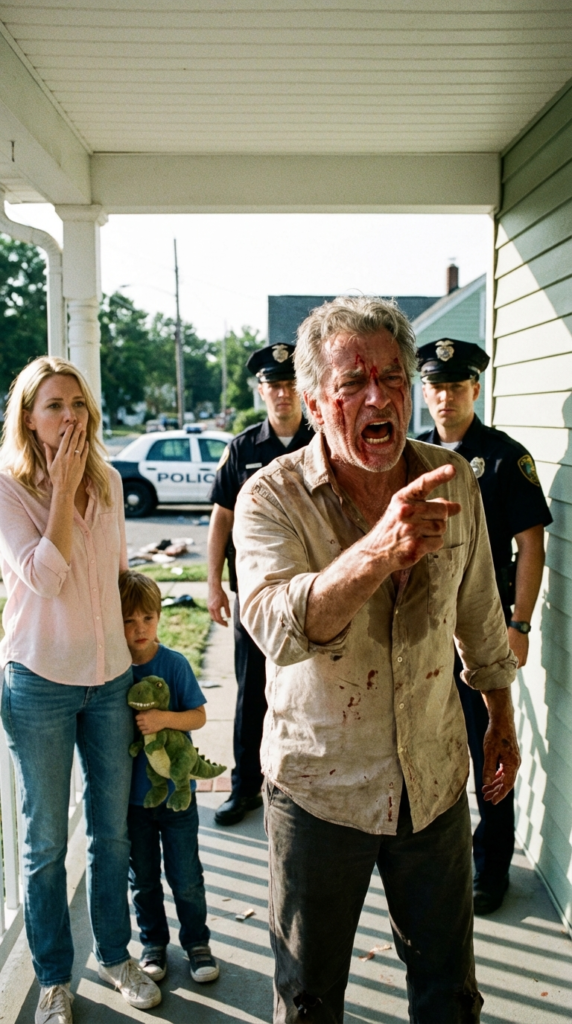
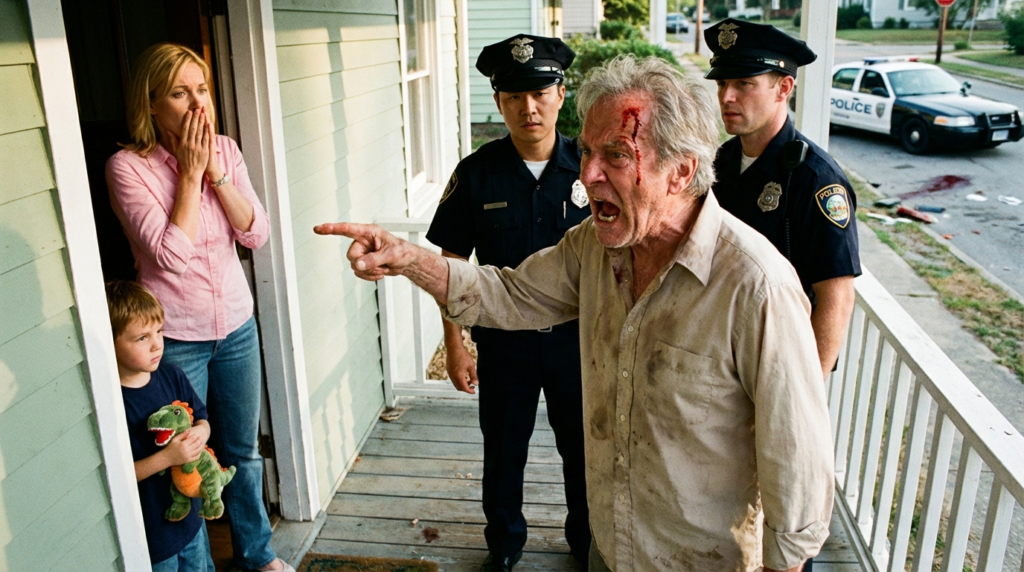
Blood was pouring from the gash on his forehead, mixing with the tears streaming down his weathered face. The 68-year-old man standing on my porch was screaming so loud the neighbors had already called 911.
“YOU KILLED HER!” he roared, pointing a shaking finger at me. “MY DAUGHTER IS DEAD BECAUSE OF YOU!”
Two police officers flanked him, trying to calm him down, but he wouldn’t stop. Behind me, I could feel my six-year-old son Tommy clutching his stuffed dinosaur, his small body trembling against my leg.
“Sir, you need to calm down,” one officer said firmly. “Ma’am, do you know this man?”
I stared at the stranger bleeding on my doorstep, my mind racing. I’d never seen him before in my life. But the rage in his eyes—the absolute certainty that I’d destroyed his world—made my stomach drop.
“I don’t know what you’re talking about,” I managed to say, my voice shaking. “I don’t know your daughter. I don’t know you.”
“LIAR!” He lunged forward, and the officers had to physically restrain him. That’s when I saw it—the crumpled photo he was gripping so tightly his knuckles were white. A young woman, maybe early thirties, with long dark hair and a bright smile.
My breath caught. She looked familiar. Very familiar.
“That’s the lady from the park, Mommy,” Tommy whispered, his voice barely audible. “The one who—”
“Be quiet, Tommy,” I said quickly, my heart hammering. Because if Tommy was right, if that was who I thought it was, then this man had every right to be angry. Every right to be on my porch demanding answers.
“She was coming to see you,” the old man said, his voice breaking. “Three days ago. She said she needed to talk to you. She said you’d help her. And now she’s dead, and the police say it’s an accident, but I know—I KNOW you had something to do with it!”
The officers exchanged glances. One of them looked at me. “Ma’am, do you have any idea what he’s talking about?”
I made a decision in that moment that would change everything.
“Come inside,” I said quietly. “All of you. I’ll explain.”
The old man looked ready to explode again, but I held up my hand. “Please. Let me show you something. Then if you still want to press charges, call for backup, whatever—I understand. But you deserve to know the truth.”
The officers looked uncertain, but something in my voice must have convinced them. We moved into the living room—me, Tommy, the two officers, and the bleeding, grief-stricken man whose daughter was dead.
“Tommy, go get the box from Mommy’s closet,” I said gently. “The blue one.”
He ran upstairs, his dinosaur tucked under one arm. The old man sank onto my couch, suddenly looking every one of his 68 years. Up close, I could see the exhaustion etched into his face, the kind that comes from weeks of not sleeping, of crying until there’s nothing left.
“What’s your name?” I asked softly.
“Robert. Robert Chen.” His voice was hoarse from screaming. “My daughter was Jennifer. She was—” His voice broke. “She was everything.”
Tommy returned with the box. I took it from him and set it on the coffee table. Inside were letters. Dozens of them. All addressed to me, all in the same handwriting.
“Your daughter has been writing to me for six months,” I said. “We’ve never met in person. But she was planning to come here three days ago. She never showed up, and I’ve been worried sick.”
Robert stared at the letters like they were evidence from a crime scene. “Why? Why would Jennifer write to you?”
I pulled out the most recent letter, dated a week ago. My hands were shaking as I handed it to him.
Dear Amanda,
I’ve decided I’m ready. Ready to tell my father the truth. Ready to face what I’ve done. You’ve shown me that redemption is possible, that people can change, that forgiveness exists even for the worst mistakes.
I’m coming to see you on Tuesday. I want to thank you in person for saving my life. And then I’m going to go home and tell Dad everything. About the accident. About the little boy. About why I ran.
Wish me luck.
Jennifer
Robert read the letter three times. Then he looked at me with confusion replacing the anger. “What accident? What boy?”
I glanced at Tommy, who was watching with wide eyes. This wasn’t something I wanted him to hear, but he’d already been through so much. He deserved honesty.
“Five years ago,” I began, “I was driving home from work. It was raining. I was texting—just one message, I told myself. Just one quick reply to my ex-husband about picking up Tommy. I looked down for three seconds. When I looked up—”
My voice broke. Even after five years, the memory could still shatter me.
“There was a little boy in the crosswalk. He was four years old. His name was Michael Chen. I hit him going thirty-five miles an hour.”
Robert made a sound like all the air had been punched from his lungs.
“He died two days later in the hospital,” I continued, tears streaming down my face now. “I was charged with vehicular manslaughter. I served eighteen months in prison. I lost my job, my marriage, my savings. But worst of all, I lost the right to call myself a good person.”
“Jennifer’s son,” Robert whispered. “You killed my grandson.”
“Yes.” I couldn’t look at him. “And your daughter killed something in me too. Not physically. But every day, I see Michael’s face. Every day, I remember what I took from the world. From your family.”
One of the officers cleared his throat. “Ma’am, if you’ve already served your sentence—”
“This isn’t about the law,” Robert said hollowly. “This is about my family being destroyed. First Michael. Now Jennifer. And you—” He looked at me with such pain that I wanted to disappear. “You’re the connection. You’re the reason my daughter is dead.”
“I don’t understand how—”
“She never forgave herself,” Robert said. “For not holding Michael’s hand that day. For letting him run ahead into the crosswalk while she was looking at her phone. She blamed herself as much as she blamed you.”
The irony hit me like a physical blow. We’d both been distracted by our phones. We’d both made a choice that cost a child his life.
“How did you start writing to her?” one officer asked.
“Prison rehabilitation program,” I explained. “They encouraged us to write to the victims’ families. To try to make amends, to explain, to apologize. Most families never respond. But Jennifer—”
I pulled out another letter, this one from two years ago.
Amanda,
I got your letter. I’ve read it seventeen times. I don’t know what I’m supposed to feel. You killed my son. You destroyed my life. But you’re also a mother. You have a son Tommy’s age. And you wrote about him with such love that I can’t help but think—you understand. You understand what I lost.
I don’t forgive you. I don’t know if I ever can. But I’m writing back because I need someone to talk to. Someone who knows what that day cost. Someone who carries the same guilt I do.
Jennifer
“She blamed herself?” Robert asked, his anger draining away into confusion.
“Every letter,” I said. “She talked about how she should have held his hand. How she should have been paying attention. How she failed as a mother. We—” I had to force the words out. “We became each other’s confessional. The only two people who truly understood the weight of that day.”
I pulled out more letters. Letters where Jennifer talked about her depression, her failed marriage, her father who tried so hard to help but couldn’t understand. Letters where she talked about wanting to end her life but couldn’t because her father had already lost so much.
And my letters to her. Letters where I talked about the nightmares, the guilt, the way I couldn’t look at Tommy sometimes without seeing Michael’s face. Letters where I shared the therapy techniques I’d learned, the grief counseling resources, the small steps toward forgiveness—of ourselves, if not each other.
“We saved each other,” I said simply. “For two years, we were the only ones who understood.”
“What happened three days ago?” I asked quietly. “You said it was an accident?”
Robert’s face crumbled. “Car crash. She was driving to your house—I found your address in her GPS history. A truck ran a red light and hit her driver’s side. She died instantly.”
The room fell silent except for Tommy’s quiet sniffling. He’d loved the letters from Jennifer—I’d read him the ones where she talked about Michael as a little boy, about the things they used to do together. In a strange way, Tommy had gotten to know the big brother he’d never meet.
“I went crazy,” Robert continued. “When I found out she was coming here—coming to see the woman who killed my grandson—I thought maybe you’d planned it. Maybe you’d manipulated her. Maybe you’d—” He shook his head. “I wasn’t thinking clearly. I crashed my car two blocks from here trying to get to your house. That’s why I’m bleeding. That’s why the police were already on their way.”
He looked at the letters spread across my coffee table. Two years of correspondence. Two broken women trying to carry impossible guilt.
“She was coming to tell you something,” I said, remembering the last letter. “She said she wanted to thank me for saving her life.”
“How did you save her life?” Robert asked. “You took my grandson from us.”
“Three months ago,” I said, “Jennifer sent me a letter that scared me. She talked about not wanting to be here anymore. About how the guilt was too much. She didn’t say the word ‘suicide’ but I knew. I knew because I’d been there myself.”
I pulled out that letter, and the one I’d written in response.
“I told her about the day Tommy found me in the garage with pills in my hand. He was three years old—the same age Michael was when he died. And he looked at me with those innocent eyes and said, ‘Mommy, why are you crying?’ And I realized that if I left, I’d be doing to him what I’d done to Jennifer. I’d be taking a mother away from a child.”
My voice was shaking now. “I told Jennifer that living with guilt is hard. But dying with it is cowardly. That we owed it to Michael to become better people. To make his death mean something.”
“And she listened?” Robert whispered.
“She started therapy. She joined a support group for parents who’d lost children. She volunteered at a children’s hospital. She was—” I had to stop to wipe my eyes. “She was healing. Finally healing. And she wanted to tell me in person that I’d helped her find a reason to keep living.”
Tommy suddenly spoke up, his small voice cutting through the heavy silence. “Mr. Robert, do you want to see Michael’s box?”
Everyone turned to look at him. Robert’s eyes widened. “What?”
Tommy ran upstairs and came back with a small wooden box decorated with dinosaur stickers. Inside were drawings, small toys, a baseball card.
“Mommy told me about Michael,” Tommy said seriously. “She said he loved dinosaurs like me. So I made this box for him. Every time I learn something new about dinosaurs, I write it down and put it in the box. Mommy says that way Michael can keep learning even though he’s in heaven.”
Robert stared at the box like it was the most precious thing he’d ever seen. His hands trembled as he picked up one of Tommy’s drawings—a T-Rex with “For Michael” written in crayon.
“You told your son about the boy you killed?” one of the officers asked, incredulous.
“I told my son about the boy I took from the world,” I corrected. “I told him about my mistake and its consequences. I told him because I never want him to think that actions don’t matter. That choices don’t have weight. That we can just move on and forget.”
“How old were you when your mom told you?” Robert asked Tommy gently.
“Four,” Tommy said. “The same age Michael was. Mommy said when I was old enough to cross the street alone, I was old enough to know why we always look both ways. Always put the phone down. Always pay attention.”
Robert broke down then. Really broke down. Decades of grief—for his grandson, for his daughter, for the family that tragedy had shattered—poured out of him in wrenching sobs.
I knelt in front of him. “I’m sorry. I will be sorry every day for the rest of my life. But Jennifer—she didn’t die because of me. She died because sometimes terrible, random things happen. The same way Michael died because I made a terrible, split-second mistake. The same way you crashed your car because grief makes us do things we wouldn’t normally do.”
“I wanted someone to blame,” Robert said between sobs. “When the police said it was just an accident, just bad timing, I couldn’t accept it. I needed it to be someone’s fault.”
“I know,” I said softly. “I spent months in prison needing it to be someone else’s fault. Michael’s for running ahead. Jennifer’s for not holding his hand. The city’s for the crosswalk placement. Anyone but me. But the truth is—sometimes we’re the villain in someone else’s story. And we have to live with that.”
We sat there for a long time—a strange collection of people bound by tragedy. The police officers eventually called for an EMT to check Robert’s head wound. While they bandaged him up, he read through more of the letters.
“She never told me she was writing to you,” he said. “She never told me she was struggling this badly.”
“She didn’t want you to worry more than you already were,” I said. “She wrote about you in every letter. About how hard you tried to help. About how much she loved you but couldn’t burden you with her pain.”
“I could have helped.”
“You did help. You were there. You didn’t give up on her. Sometimes that’s all we can do—just keep showing up, even when we don’t have answers.”
Robert looked at Tommy, who was showing the officers his dinosaur collection. “How do you do it? How do you live with yourself?”
“By making different choices now,” I said. “I volunteer at the prison where I served, talking to people about distracted driving. I speak at high schools about the consequences of not paying attention. I’m writing a book about guilt and redemption and the long road to forgiving yourself.”
I paused. “And I try to be the kind of mother who teaches her son that mistakes don’t define us—how we respond to them does. Jennifer taught me that too. In her letters, she talked about how she was trying to be better. Trying to help other parents. Trying to make Michael’s short life mean something by preventing other deaths.”
“She volunteered at a child safety nonprofit,” Robert said, wiping his eyes. “She never told me why. I thought she was just trying to stay busy.”
“She was trying to honor him. The same way I honor him every time I tell my story to a room full of teenagers who think they’re invincible.”
Robert stayed for three hours. We ordered pizza—the officers left after the first hour, satisfied that no crime had been committed. We looked through more letters. We talked about Michael—the real Michael, not the symbol or the guilt, but the actual little boy who loved dinosaurs and hated broccoli and wanted to be a paleontologist when he grew up.
Tommy listened, rapt, adding his own dinosaur facts when appropriate. In the innocent way of children, he treated this like a normal conversation, not the bizarre grief-counseling session it actually was.
“Jennifer was going to bring you photos,” Robert said, pulling out his phone. “She texted me the morning of the accident. Said she wanted to show you what Michael looked like in person, not just in the one photo she’d sent.”
He scrolled through his gallery, and there he was—Michael Chen at age two, covered in birthday cake. Michael at three, dressed as a dinosaur for Halloween. Michael at four, the last photo taken three weeks before the accident, grinning with his two front teeth missing.
I cried looking at those photos. Cried for the boy I’d killed, for the life I’d stolen, for the future I’d erased. But Robert didn’t pull the phone away. He let me look. Let me grieve. Let me see Michael as a real person, not just a mistake.
“Thank you,” I whispered.
“Jennifer would have wanted you to see them,” he said. “In her last letter to me—the one I found after she died—she said she was going to ask you to come to Michael’s grave with her. She said you’d both earned the right to say goodbye properly.”
“Can I still come?” I asked. “Even though she’s not here?”
Robert was quiet for a long moment. Then he said, “Jennifer’s buried next to Michael. We can visit them both together.”
That was six months ago. Robert and I visit the graves together once a month now. We bring Tommy, who leaves dinosaur facts written on construction paper weighted down with rocks. We bring flowers. We tell stories.
Robert has become an unlikely friend—maybe the only person who truly understands the complexity of this grief. He’s not my victim’s father anymore, and I’m not his grandson’s killer. We’re just two people trying to find peace with the unpayable debts we carry.
He helped me finish my book. It came out last month: “The Weight of Three Seconds: A Story About Distracted Driving, Grief, and Forgiveness.” Jennifer’s story is in it, with Robert’s permission. Michael’s story is in it, with Robert’s blessing. It’s already being used in driver’s education programs across the state.
Robert speaks with me sometimes at schools. He tells them about the grandfather who lost everything. The daughter who couldn’t forgive herself. The grandson who never got to grow up. He tells them that forgiveness isn’t about forgetting or excusing—it’s about choosing not to let tragedy multiply.
“Amanda didn’t kill Jennifer,” he told a room full of teenagers last week. “Jennifer’s death was a terrible accident. But the guilt—the guilt that Amanda accidentally planted and that Jennifer watered with her self-blame—that nearly killed her long before the car crash. And I almost let the same guilt kill me when I blamed Amanda for Jennifer’s death.”
He looked at me across the room. “Forgiveness isn’t weak. Forgiveness is choosing to stop the cycle of pain. It’s saying, ‘Enough people have been hurt. No more.'”
Tommy is eleven now. He still keeps Michael’s box, though it’s overflowing with dinosaur facts and drawings and letters. He’s started writing his own letters to Jennifer, telling her about school and friends and the things he’s learning.
“Do you think they get them in heaven?” he asked me last week.
“I don’t know, buddy. But I think the act of writing them—the act of remembering and honoring them—that’s what matters.”
Robert heard this conversation. He pulled out a letter from his pocket—weathered, folded, read a thousand times.
“This is the last letter Jennifer wrote to me,” he said. “The one I found after she died. Can I read part of it to you?”
We nodded.
Dad,
I know you don’t understand why I’ve been so much happier lately. Why I’ve been volunteering and going to therapy and actually smiling again. I want to tell you, but I’m scared you’ll be angry.
I’ve been writing to Amanda—the woman who hit Michael. I know that sounds crazy. But she’s the only person who understands this guilt. The only person who knows what it’s like to replay three seconds over and over and wonder if you could have changed everything.
She’s helped me see that Michael wouldn’t want me to destroy myself with blame. That being a good mother isn’t about being perfect—it’s about loving fiercely and forgiving deeply, including forgiving yourself.
I’m going to see her this week. I’m going to thank her for giving me my life back. And then I’m coming home to tell you everything. To show you that it’s possible to be happy again without betraying Michael’s memory.
I love you, Dad. Thank you for never giving up on me, even when I gave up on myself.
Jennifer
Robert folded the letter carefully. “She was happy when she died. For the first time in five years, she was actually happy. And you gave her that.”
“We gave each other that,” I corrected. “She saved me too. Every letter she sent reminded me that I wasn’t alone in this impossible guilt. That someone else understood.”
“I used to think forgiveness was about letting people off the hook,” Robert said. “But it’s not. It’s about cutting the rope that ties you to the boat that’s sinking. Amanda will carry her guilt about Michael forever. I’ll carry my grief forever. But we don’t have to drown in it.”
He looked at Tommy. “Your mom made a terrible mistake. But she’s spent every day since trying to make it right. That’s what we all should do—not run from our mistakes, but run toward being better because of them.”
I still speak at schools. I still write. I still volunteer. But now Robert comes with me sometimes, and we tell the whole story—the accident, the grief, the letters, the forgiveness.
We started a foundation last year: The Michael and Jennifer Chen Foundation for Distracted Driving Prevention. It funds educational programs, provides resources for families affected by traffic accidents, and offers grief counseling for parents who’ve lost children.
The irony isn’t lost on us—that tragedy became purpose, that guilt became mission, that the worst day of our lives became the foundation for helping others avoid the same pain.
“Do you think Michael and Jennifer are proud of us?” Tommy asked last week at their graves.
Robert put his hand on Tommy’s shoulder. “I think they’re grateful that their deaths weren’t meaningless. That we took the worst thing imaginable and built something good from it.”
We stood there in silence—three generations connected by tragedy but sustained by choice. The choice to forgive. The choice to heal. The choice to honor the dead by living better lives.
The 68-year-old man who showed up bleeding on my porch taught me that forgiveness isn’t about forgetting what happened. It’s about refusing to let the past destroy the future. It’s about seeing the humanity in the person who hurt you and recognizing the same brokenness in yourself.
Robert lost his grandson to my mistake and his daughter to fate. I lost my freedom, my marriage, and my innocence to one distracted moment. But together, we found something neither of us expected:
Peace.
Not because the pain went away—it never fully does. But because we chose to transform it into something meaningful. Something that honors the people we lost by preventing others from experiencing the same devastation.
Every life saved by our foundation is Michael’s legacy. Every parent who puts their phone down while driving is Jennifer’s gift to the world. Every person who hears our story and chooses forgiveness over bitterness is proof that even the worst tragedies can plant seeds of hope.
The man I thought was coming to destroy me actually came to save me—from bitterness, from isolation, from the prison of unforgiveness that’s worse than any cell I served in.
And in saving me, I saved him too.
Because that’s what forgiveness does—it sets both people free.