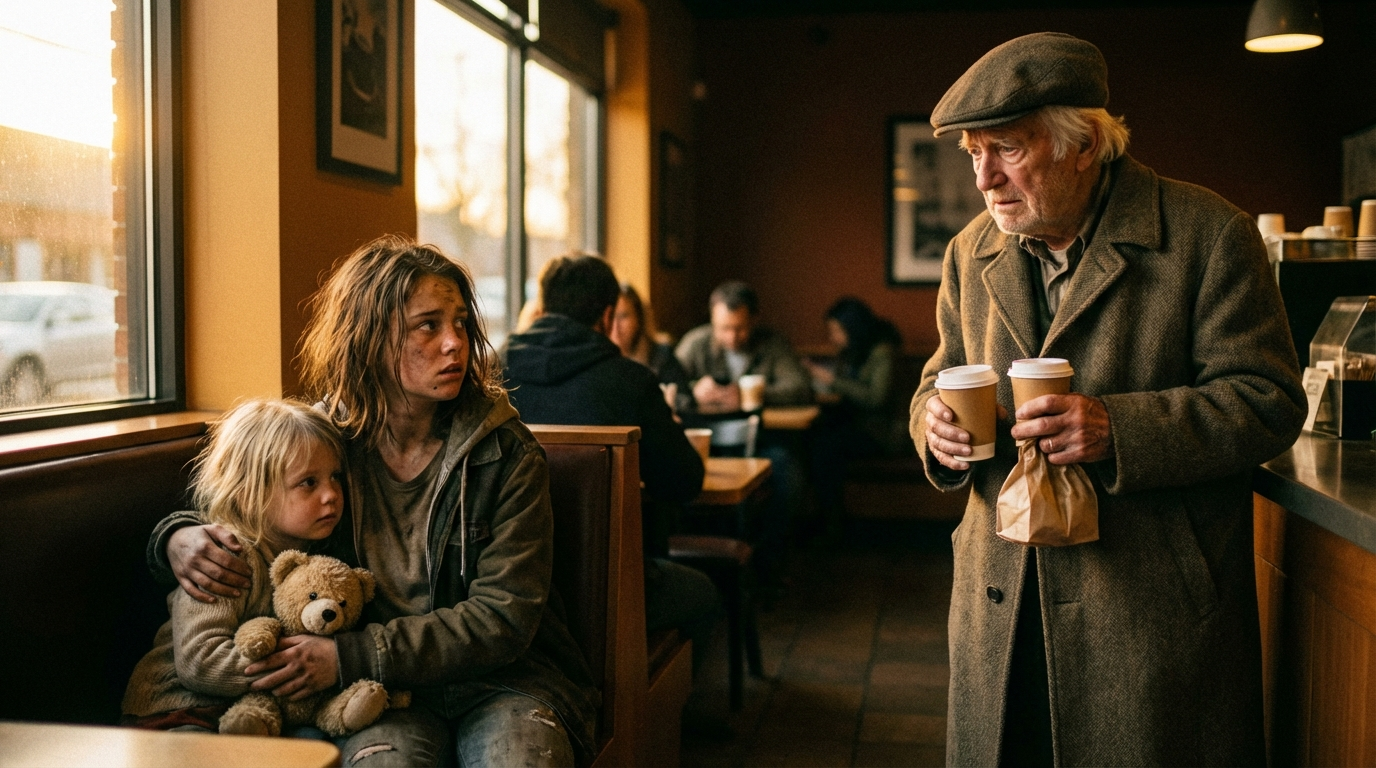
The old man had been following me for three days.
I first noticed him at the library on Monday—sitting in the corner with a newspaper, but his eyes were on me and Lily, not the page. Tuesday, he was outside the grocery store where I returned bottles for the five-cent deposit. Wednesday, he was on the same bus, two rows back, watching.
Now it was Thursday, and he was standing across the street from the abandoned building where Lily and I had been sleeping. Just standing there. Staring. A tall, thin man in his seventies with white hair and a long coat, holding a worn leather briefcase like he was waiting for something.
My hands shook as I held Lily closer. She was only five—too young to understand why we were hiding, why we couldn’t go home, why Mommy wasn’t coming back. But she trusted me. And I couldn’t let this creep hurt her.
I’d dealt with predators before. Men who saw homeless teenage girls as easy targets. Men who offered help that came with conditions I wouldn’t accept. I knew what to look for. And this man had all the signs.
So when he started crossing the street toward us, I ran.
“Lizzy, wait!” His voice was raspy, desperate. “Please, I’m not going to hurt you!”
But that’s what they all say.
I pulled Lily through the alley, her little legs struggling to keep up. My backpack—everything we owned—bounced against my spine. Behind us, I could hear his footsteps, slower than mine but persistent.
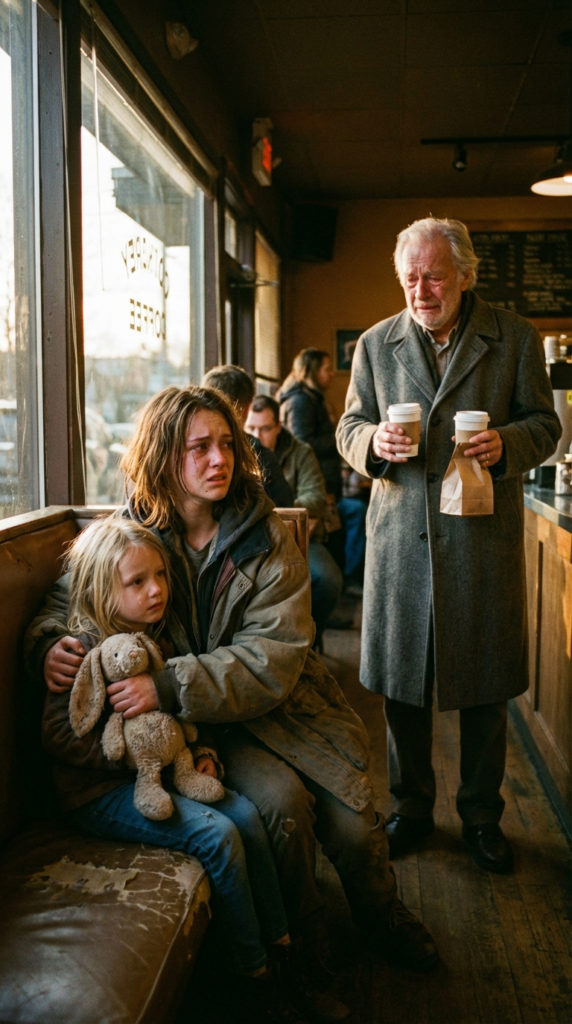
We burst out onto Main Street. People everywhere. Safety in crowds. I ducked into a coffee shop, praying they wouldn’t kick us out for not buying anything.
The old man walked in thirty seconds later.
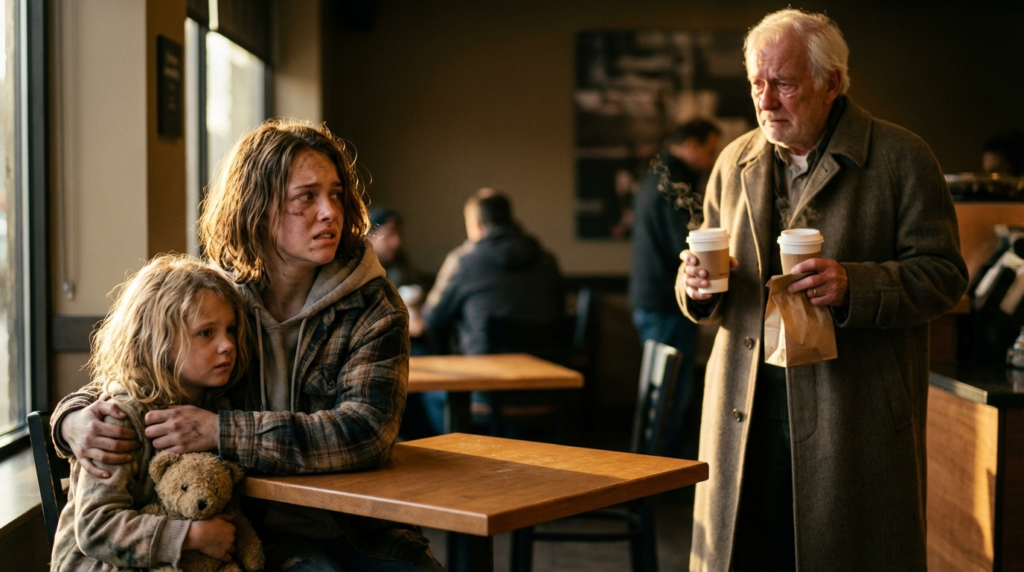
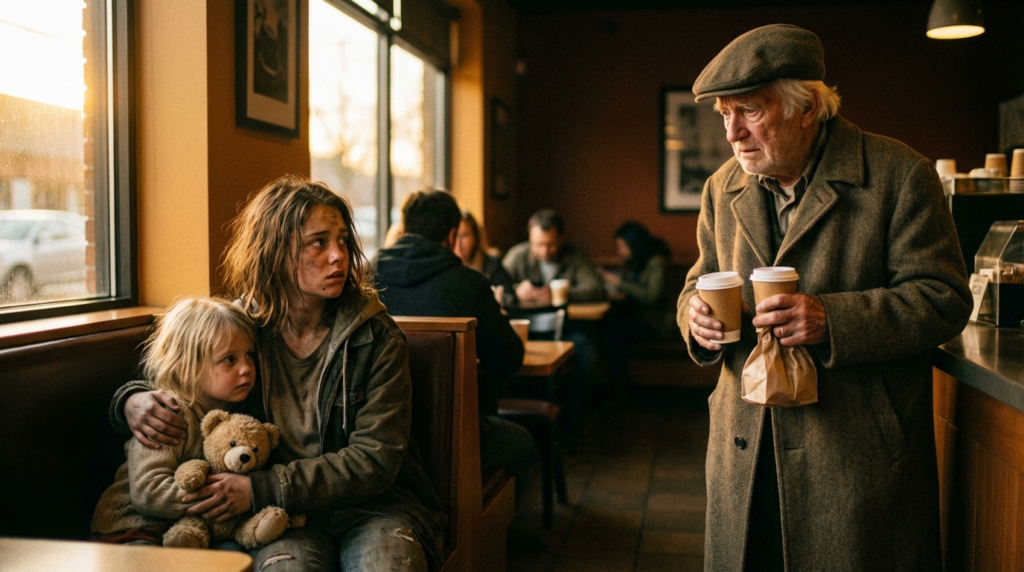
He didn’t approach us. He just went to the counter, ordered two hot chocolates and a bag of cookies, then turned to me with the saddest expression I’d ever seen.
“I knew your mother,” he said quietly, his voice breaking. “And I know what happened to her. But what I don’t know is why her daughter has been living on the streets for six months when she has a trust fund with $2.3 million dollars waiting for her.”
The world stopped spinning.
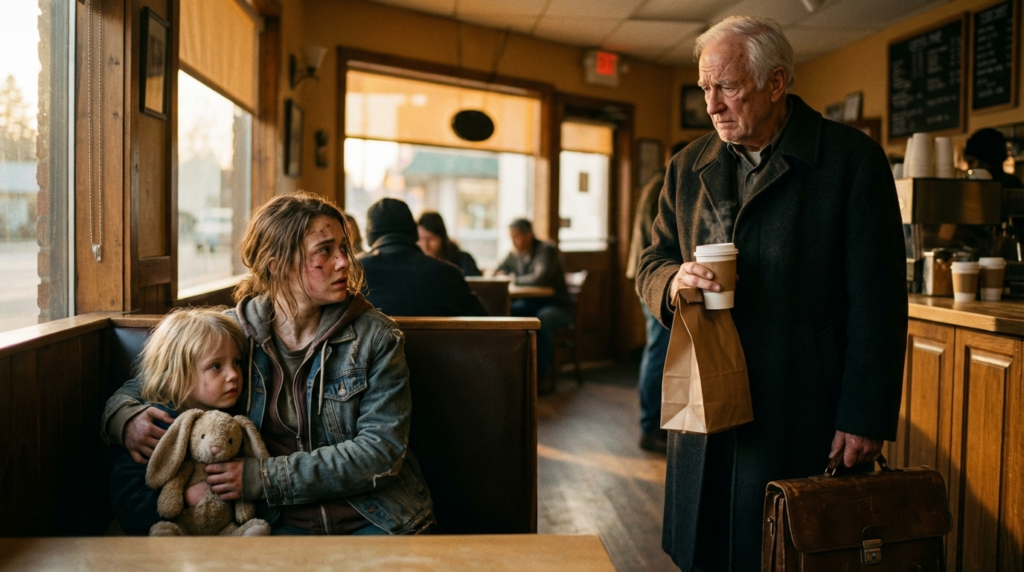
“You’re lying,” I said, pulling Lily behind me. But my voice wavered. Because he’d called me Lizzy—a name only family used. My legal name was Elizabeth, but Mom always called me Lizzy.
“I’m not lying, Elizabeth Marie Carson,” he said gently, staying where he was. “Your mother was Sarah Carson. She died six months ago in the fire at the Riverside Apartments. You and your sister disappeared the next day, and I’ve been looking for you ever since.”
My throat closed up. The fire. The smoke alarm that didn’t work. The locked door that wouldn’t open. Mom screaming at us to jump from the second-story window while she went back for our photo albums.
We jumped. She didn’t make it out.
“How do you know that?” I whispered.
“Because I was your mother’s estate attorney,” he said, pulling a business card from his pocket and sliding it across the table. “My name is Harold Whitman. And for the last six months, I’ve been trying to find you to tell you that your mother left you everything.”
I stared at the card. Whitman & Associates. Estate Planning and Probate Law.
“Mom didn’t have anything,” I said. “We lived in a one-bedroom apartment. She worked two jobs just to pay rent. There’s no money.”
Harold’s expression was pained. “Your mother worked very hard to make sure you believed that. But it wasn’t true. Your father—before he died when you were a baby—left her a substantial life insurance policy. Your mother invested it carefully. She lived modestly so you wouldn’t grow up spoiled, planning to give it all to you when you turned eighteen.”
“That’s impossible. We were broke. We—”
“You ate generic cereal and wore thrift store clothes because your mother was teaching you the value of money,” Harold interrupted gently. “But she paid for your sister’s medical bills when she was born premature—$47,000 out of pocket. She set up college funds for both of you. She bought a small rental property that generates income. Elizabeth, your mother was worth over $2.5 million when she died.”
Lily tugged on my sleeve. “Lizzy, is the man telling the truth?”
I didn’t know. I couldn’t process this. It was too big, too impossible.
“If this is real,” I said slowly, “why didn’t someone tell me? Why didn’t Child Services—”
“Because you disappeared before anyone could find you,” Harold said. “The fire department reported that you and Lily survived. But when social workers went to place you in temporary custody, you were gone. I’ve had private investigators searching. I’ve checked every shelter, every youth center. I was about to give up when I saw you at the library on Monday.”
“Why were you following me instead of just talking to me?”
Harold looked down at his hands. “Because I’m a seventy-three-year-old man who wanted to approach a teenage girl about money. I know how that looks. I was trying to figure out the right way to tell you without scaring you. I was waiting for the right moment. But when I saw you sleeping in that abandoned building last night, I couldn’t wait anymore.”
“Why did you run?” Harold asked gently. “After the fire, why didn’t you go to the authorities?”
I looked at Lily, who was coloring on a napkin with a crayon the barista had given her. Innocent. Trusting. Everything I needed to protect.
“Because of Mark,” I said finally.
Mark was Mom’s boyfriend. He’d moved in six months before the fire. Mom thought he was great—charming, helpful, always offering to watch us while she worked. But I knew better.
I’d seen the way he looked at me when Mom wasn’t around. The way he’d “accidentally” brush against me. The way he’d make comments about how I was “growing up” that made my skin crawl.
Two weeks before the fire, he’d cornered me in my room. Told me that soon I’d be old enough to “appreciate his attention.” I’d kicked him and run, and Mom had found us arguing in the hallway. I’d tried to tell her what he’d said, but Mark claimed I was lying because I didn’t want her to have a boyfriend.
Mom believed him.
“After the fire, Mark was at the hospital,” I explained. “He told me that since Mom was gone, he was my legal guardian because they were engaged. He said he’d take care of us. But the way he looked at me when he said it—”
I couldn’t finish. Harold’s face had gone pale.
“You ran to protect yourself and Lily from him.”
I nodded. “I grabbed what I could and we left. I figured foster care would be better than—” I gestured vaguely. “But then I thought they’d split us up. Lily’s so young, and she’d just lost Mom, and I couldn’t let them take her away from me too. So I just… kept running.”
Harold was quiet for a long moment. Then he said, “Mark Davis is in prison.”
“What?”
“Three months ago. He was arrested for fraud, identity theft, and attempted assault of a minor in another state. He’s serving four to six years. Elizabeth, he can’t hurt you anymore.”
The relief was so overwhelming that I started crying. Really crying. The kind of crying I’d been holding back for six months because I had to be strong for Lily.
Harold slid the hot chocolates across the table. “Drink this. And then let’s talk about getting you home.”
Home turned out to be a three-bedroom house in a quiet suburban neighborhood. A house Mom had bought two years ago but never told me about.
“She was planning to surprise you on your sixteenth birthday,” Harold explained as we stood on the front porch. “She’d been fixing it up little by little. New paint, new appliances, a garden she was planting. She wanted to give you stability after years of apartment living.”
He handed me a key.
The door opened into a living room with furniture still wrapped in plastic. Family photos on the walls—me as a baby, Lily’s first birthday, Mom smiling in ways I’d forgotten she could smile.
“She’d been moving money into this place for two years,” Harold said. “Every extra dollar went into making it perfect for you girls. She was going to tell you after you graduated eighth grade this year. It was going to be a fresh start.”
Lily ran through the rooms, her laughter echoing off the walls. “Lizzy! There’s a room with two beds! And a bathroom with a big tub! And—”
“Her room,” I finished, walking into what was clearly meant to be Lily’s bedroom. Pink walls. Shelves for toys. A reading nook by the window.
My room was next door. Blue and white, with a desk for homework and a bulletin board already hung on the wall.
“She knew you,” I whispered. “She knew exactly what we’d love.”
Harold nodded. “She spent hours planning every detail. This house was her love letter to you.
The first few weeks were hard. I kept waiting for someone to take it all away. Kept my backpack packed and hidden under the bed, ready to run. Kept checking the locks on the doors and windows.
Harold was patient. He helped me enroll in school. Helped me navigate the legal process of becoming Lily’s guardian—temporary at first, then permanent when I turned sixteen. Helped me understand the trust fund and how it worked.
“Your mother set it up so you’d receive a monthly allowance for living expenses,” he explained. “The bulk of the money is held in trust until you’re twenty-five, to make sure you have security for your future. But there’s enough for you to live comfortably, finish school, go to college.”
“Why are you doing this?” I asked one day. “You could have just sent a letter. Why did you spend months looking for me?”
Harold was quiet for a moment. Then he said, “I had a daughter once. Annie. She died in a car accident when she was seventeen. If she’d lived, she’d be about your mother’s age now. And I keep thinking—if Annie had left children behind, I’d want someone to make sure they were okay. I’d want someone to care.”
“I’m sorry about your daughter.”
“And I’m sorry about your mother,” he said. “But Sarah made sure you’d be taken care of. My job is just to make sure her wishes come true. The rest—checking in on you, making sure you’re adjusting—that’s just an old man who wishes he could have helped his own daughter but is grateful he can help someone else’s.”
That was five years ago. I’m twenty now. Lily is ten. We still live in Mom’s house—our house—and it finally feels like home.
I graduated high school with honors. I’m in college now, studying social work, because I remember what it’s like to be a scared kid with nowhere to go. I want to help others the way Harold helped me.
Lily is thriving. She’s on the honor roll, takes dance classes, has friends who come over for sleepovers. She barely remembers the six months we spent on the streets, which is exactly how I wanted it.
Harold still comes by every Sunday for dinner. He’s become the grandfather we never had. He teaches Lily chess, helps me with legal questions about the trust, tells terrible jokes that make us groan.
Last year, I started a nonprofit with part of the trust fund money—Sarah’s House, named after Mom. It’s an emergency shelter specifically for siblings trying to stay together in the foster system. We’ve helped forty families so far.
Harold serves on the board. He also connected me with other estate attorneys who work pro bono to help families navigate the legal system after losing parents.
“Your mother would be so proud,” he told me at our last board meeting.
“I think she’d be proud of you too,” I said. “For not giving up on us.”
I think about that day in the coffee shop a lot. About how close I came to running away from the one person who could help us. About how fear and trauma made me see threats where there was only kindness.
I teach a class now at Sarah’s House about safety versus suspicion. About the difference between healthy caution and letting fear control your life. About how sometimes the people who look scary are just scared themselves—scared of doing the wrong thing, scared of being misunderstood, scared of failing.
Harold was terrified that day. He told me later that he’d almost given up a dozen times. Almost convinced himself that I’d be better off without an old stranger trying to help. But he kept showing up because he’d made a promise to Mom to look after us.
“I was creepy,” he admitted once, laughing. “Following a teenage girl around town. If someone had reported me, I would have deserved it.”
“You were persistent,” I corrected. “There’s a difference.”
“Is there?” he asked.
“Yes,” I said. “Creepy is motivated by selfishness. Persistence is motivated by love. You loved Mom enough to keep her promise to us. That’s not creepy. That’s heroic.”
Yesterday, a fifteen-year-old boy came to Sarah’s House with his two younger brothers. Their mother had died, and their father’s parental rights had been terminated. They were scared, defensive, convinced that everyone was trying to separate them.
I saw myself in that boy’s eyes.
“I know you don’t trust me,” I told him. “I know you think this is too good to be true. But I promise you—we’re here to keep you together. That’s what this place is about.”
“Why should I believe you?” he asked.
I pulled out my phone and showed him a photo—me and Lily at ten and five, dirty and scared, standing in front of the abandoned building. Then I swiped to the next photo—us last week, laughing on the porch of our house.
“Because I was you,” I said. “And someone showed up when I needed them most. Someone I thought was creepy turned out to be my only hope. Now I’m paying that forward.”
Harold was at the shelter that day, helping sort donations. He heard me talking to the boy and smiled.
Later, as we locked up for the night, he said, “You know what the best part about all this is?”
“What?”
“Your mother’s kindness didn’t die with her. It multiplied. Every kid you help, every family you keep together—that’s Sarah’s legacy. That’s her love continuing to change the world.”
He was right. Mom had worked two jobs and lived modestly so she could give us a better future. Now that future includes helping others have the same chance.
The trust fund she left wasn’t just money. It was a foundation for generosity. A blueprint for compassion. A reminder that the greatest wealth you can leave behind isn’t measured in dollars but in lives changed.
Harold is eighty-three now. He moves slower, forgets names sometimes, needs reading glasses for paperwork. But every Sunday, he still shows up for dinner. Every board meeting, he still offers wisdom. Every crisis, he still makes time.
“Why do you keep doing this?” I asked him last month. “You could retire. Enjoy your life. You don’t owe us anything.”
He looked at me with those kind, tired eyes. “Elizabeth, when Annie died, I thought my purpose died with her. I spent years going through the motions—work, home, sleep, repeat. Then your mother hired me to set up her will, and she told me about you girls. About her dreams for your future. And I remembered what it felt like to care about something.”
He paused. “Finding you—helping you—gave me my life back. So no, I don’t owe you anything. You saved me just as much as I saved you.”
That’s the thing about kindness. It’s never one-directional. The helper needs the helped just as much as the helped needs the helper. We save each other.
Harold taught me that. Mom taught me that. And now I teach it to every scared kid who walks through Sarah’s House doors.
The old man I thought was creepy turned out to be my guardian angel. The stranger I ran from became family. The person I feared most became the person I trust most.
And that’s the lesson I want everyone to know: Sometimes your salvation comes in unexpected packages. Sometimes your miracle looks like a threat at first. Sometimes the hand reaching out to help you seems scary because you’ve been hurt before.
But if you can find the courage to take that hand—if you can see past your fear to the kindness underneath—you might just find that the person you were running from was actually running toward you with exactly what you needed.
Harold gave me more than money. He gave me back my childhood, my future, and my faith in humanity.
And now, every day, I work to do the same for someone else.
Because that’s what Mom would have wanted. That’s what Harold showed me was possible.
That’s the legacy of love that never dies.