The smell of fresh sawdust and linseed oil usually means a new beginning. For architects like me, it’s the scent of possibility. But standing in that foyer, for me, it smelled like an autopsy.
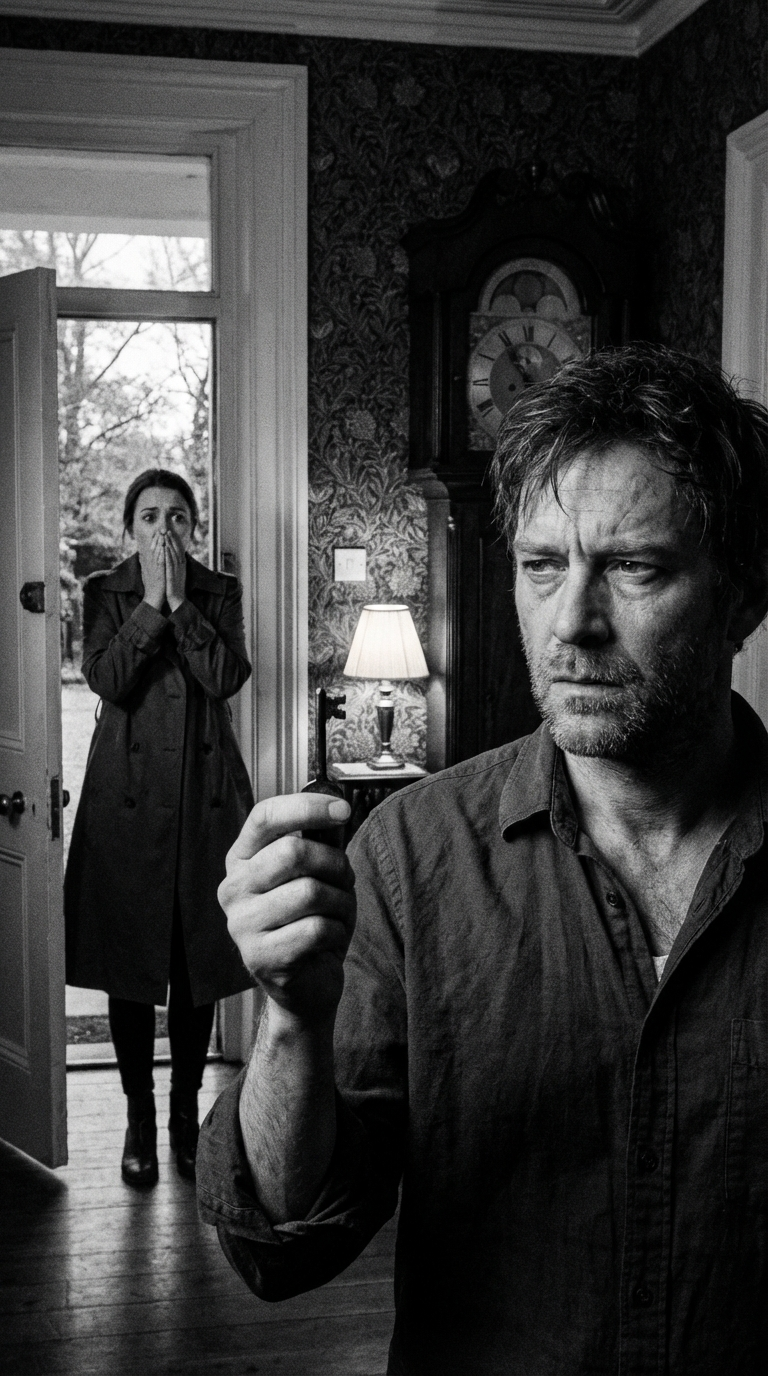
I stood waiting, the grandfather clock ticking a slow, heavy rhythm against the oppressive silence. It had taken me six months to find that exact clock face, with its specific lunar phase complication, in a dusty antique shop in Munich. I adjusted the collar of my shirt, smoothing fabric that felt too tight. My hands were steady, which surprised me. They hadn’t been steady in five years. Not since the night the sky over Connecticut turned orange and my life burned to ash.
Every detail surrounding me was a clone. The William Morris ‘Pimpernel’ wallpaper in the hallway—the exact busy, green print my wife, Sarah, had insisted on in 2018. The long Persian runner rug, painstakingly sourced to match the original, right down to the coffee stain near the fringe that I had replicated a week ago with espresso and a syringe.
I hadn’t built a home. I had constructed a flawless, three-dimensional memory. A multimillion-dollar trap designed for one specific animal.
The sound of gravel crunching under tires outside broke the silence. A car door slammed, sharp as a gunshot. My heart hammered against my ribs like a trapped bird.
The front door handle turned. It was the bronze lion head, the left ear slightly chipped. I’d chipped the original moving a sofa years ago; I had chipped this one myself with a chisel yesterday. I held my breath.
The door opened, and the past walked in.
Sarah stopped dead on the threshold. She looked exactly the same, yet totally different. The soft curves of the woman I loved had been replaced by angles. She looked harder. Sharper. Her eyes went wide, taking in the wallpaper, the clock, the rug. The color drained from her face faster than water from a cracked basin.
She wasn’t looking at a house. She was looking at a ghost she thought she had exorcised with fire five years ago. She took a staggering step backward, a strangled gasp escaping her throat, her hand flying to her mouth.
I hadn’t seen my wife or my children in 1,826 days. They were supposed to have vanished, victims of the trauma I had allegedly caused. But here she was, lured by a fake inquiry from a wealthy overseas buyer, walking into a mausoleum built entirely of my apparent obsessive grief.
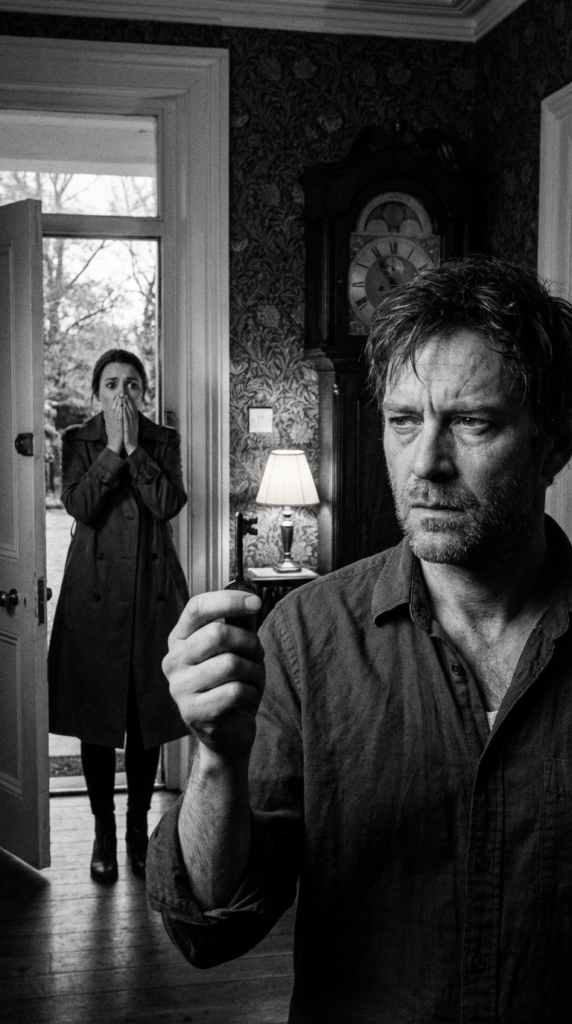
I stepped out of the shadows of the living room archway, holding up a single, blackened, fire-warped brass key.
“Welcome home, Sarah,” I said, my voice terrifyingly calm. “We need to check the wall safe in the library. The one you told the police didn’t exist.”
The Inferno and the Lie
Five years ago, I was Elias Vance, award-winning residential architect, husband to the beautiful Sarah, and father to twins, Leo and Mia. We lived in a sprawling 1920s revival outside of Westport, a house I had spent years restoring. On the outside, we were the picture of American success.
Inside, we were rotting.
Sarah was a chameleon. She could be the charming hostess one moment and a vicious, calculating manipulator the next. The arguments were quiet but lethal, filled with gaslighting that made me question my own sanity. By the time I realized she was funneling money out of our joint accounts, it was too late.
I confronted her on a Tuesday. She cried, promised counseling, begged me not to break up the family. That Friday, I went to an architectural symposium in Boston.
I woke up at 3 a.m. to my phone vibrating itself off the hotel nightstand. It was our neighbor. The house was gone.
By the time I drove back, speeds topping 110 mph, there was nothing but a smoldering foundation and news helicopters circling like vultures. Sarah and the kids were “miraculously” safe at her sister’s house.
The narrative was set before I even parked the car. Sarah, wrapped in a blanket on live TV, tearfully told a reporter that I had been threatening them. That I said if I couldn’t have the house, no one would. She claimed I had disabled the smoke detectors before I left for Boston.
It was a masterclass in victimhood. The police found traces of accelerant in my basement workshop. The timing devices I used for garden irrigation were framed as detonators. I was arrested at the scene.
Although the charges were eventually dropped due to a lack of concrete evidence linking me directly to the ignition, the court of public opinion had already executed me. My firm collapsed. My friends stopped calling. Sarah took the kids, got full emergency custody, changed their names, and vanished into the ether.
I was left with nothing but insurance money I couldn’t touch without looking guilty, and a blackened plot of land filled with ghosts.
The Obsessive Blueprint
For the first two years, I drank. I lived in a cheap apartment, replaying the last ten years of my life, looking for the moment I missed the signs. I knew I didn’t set that fire. Which meant she did. But she was too smart. She had destroyed the evidence in the very fire she set.
Or so she thought.
The turning point came when the insurance company finally released the settlement for the structure. It was a massive sum. Everyone expected me to sell the land and move to Bali.
Instead, I hired a contractor.
“I want it back,” I told him, unfurling the original blueprints I had saved on a cloud server. “Exactly as it was.”
It became an obsession. A sickness, some said. I spent my days pouring over old family photos, magnifying the background details to see the specific weave of the curtains or the type of brass molding on the fireplace. I hunted down discontinued tiles. I had a carpenter rebuild the kitchen island three times until the distressing on the oak matched the wear patterns of my children’s homework sessions.
My contractor thought it was profound grief therapy. The media caught wind of it and ran stories about the “Sad Architect Building a Shrine to His Lost Family.”
Let them think that. It served my purpose. I needed Sarah to believe I was broken. I needed her to believe I was a pathetic man trying to live in the past.
Because the house wasn’t a shrine. It was forensic evidence.
I was rebuilding the scene of the crime.
The Trap
The rebuild took three years. As it neared completion, I set the trap. I created a shell company in Singapore and approached the high-end real estate agency Sarah was covertly working for under her new identity—a fact I learned after spending fifty thousand dollars on a private investigator.
My shell company expressed interest in buying the “infamous replica house” for an absurd amount of money, but only if the original owner’s wife, who knew the property best, could facilitate the final walkthrough. It was a long shot, appealing to her greed and her arrogance. She assumed I was a broken recluse who wouldn’t even be there.
She took the bait.
And now, here we were.
Sarah stood frozen in the foyer, her chest heaving. The shock on her face was slowly morphing into something else: terror.
“Elias,” she whispered, her voice cracking. “This is… sick. You’re sick.”
“Am I?” I walked slowly towards her. “I just wanted everything back the way it was. Isn’t it beautiful, Sarah? It’s just like before the fire.”
She looked around wildly, as if expecting the walls to burst into flames again. “I’m leaving. I’m calling the police.”
“I already did,” I said calmly.
Her head snapped back to me. “What?”
“And the press. Channel 4 is pulling into the driveway right now. The same reporter you cried to five years ago. They think they’re here for the reveal of the grieving husband’s masterpiece. But I promised them a bigger story.”
I dangled the blackened key again. “The library, Sarah.”
She went pale. “There was no safe in the library. The police report said—”
“The police report said they couldn’t find one in the rubble. Because I built it too well. Reinforced concrete, encased in the chimney stack. It was designed to survive an inferno. You thought it melted.”
I turned and walked toward the library, knowing she would follow. She had to know.
The new library was a perfect replica, smelling of rich mahogany and leather. I walked to the fireplace, pressed a hidden panel in the molding, and a section of the stone surround popped open, revealing a pristine, brand-new digital safe.
Sarah let out a shaky laugh. “You’re insane. You built a new safe to put… what? Fake evidence inside?”
I shook my head. “No, Sarah. This is the new safe for the new house.”
I reached into my pocket and pulled out the blackened brass key again. I walked past the new safe, toward a cardboard box sitting in the corner of the room.
“When the forensic team finally let me excavate the site myself last year, I knew exactly where to dig. It took me three days with a jackhammer to get through the slag and concrete surrounding the original chimney base.”
I opened the cardboard box. Inside was a rectangular, incredibly heavy metal box, scarred by intense heat, warped and ugly.
The original safe.
Sarah made a sound like a dying animal.
I jammed the warped key into the lock. It took all my strength to turn it against the heat-fused tumblers, but with a sickening crunch, it gave way. I heaved the heavy lid open.
The contents were charred around the edges, but intact.
I pulled out a thick stack of papers, preserved in a fireproof pouch I’d insisted on years ago. “Your insurance policies, Sarah. The ones you tripled a week before the fire without telling me. The ones that only paid out in the event of ‘accidental total loss.’”
I pulled out a small, half-melted plastic bag containing a burner phone. “And this. The phone you used to call your sister to set up the alibi, and the phone you used to Google ‘how to make an arson look like an electrical fault.’ The police have already pulled the data off the SIM card that survived.”
She looked at the items in my hands, then at the replica room around her. The realization hit her with the force of a physical blow. The entire house—the wallpaper, the rugs, the obsessive details—it was all theater. It was all just to get her into this room, at this moment, when the lights would turn on.
Blue and red lights began to strobe through the front windows. The cavalry had arrived.
“You destroyed my life to get rich,” I said, my voice devoid of any emotion now. “You took my children. You let the world believe I was a monster. I just used the blueprints you left behind to prove who the real monster was.”
The front door burst open. Police swarmed the hallway, their boots loud on the replica hardwood floors. The reporter from Channel 4 was right behind them, cameraman in tow, the lens pointed directly at Sarah’s face as she crumbled to the floor of the beautiful, terrible house I had built just for her.
I didn’t feel happy. I didn’t feel triumphant. I just felt finished. I dropped the blackened key onto the Persian rug. I didn’t need it anymore. I didn’t need the house anymore. The ghosts were finally gone.